

A dangerous local privilege escalation vulnerability in the core Linux operating system has escaped into the wild ahead of official upstream security patches. Over the past 48 hours, security researchers confirmed the public release of functional exploit code targeting ZDI-CAN-33367, an unpatched flaw in the kernel’s networking subsystem that researchers have dubbed the Dirty Frag v2.0 root exploit.
The flaw carries a CVSS v3.1 base score of 7.8 (High). Any unprivileged local user, or any compromised low-privilege service account, can corrupt the Linux page cache and overwrite read-only system files in memory. The result is immediate and total root takeover.
The risk to enterprise servers, cloud infrastructure, and multi-tenant hosting environments is immediate. Security teams at TuxCare, CloudLinux, and Sysdig independently verified that the public proof-of-concept reliably spawns an interactive root shell on major enterprise distributions: AlmaLinux (8 through 10), CloudLinux (9 and 10), Debian (12 and 13), and Ubuntu (24.04 and 26.04).
Stable upstream kernel maintainers have not yet merged a finalized patch into released kernel trees. Until they do, infrastructure teams need temporary hardening that shuts down the exploit’s prerequisites while they test kernel backports.
Quick Answer
ZDI-CAN-33367 is an unpatched Linux kernel zero-day local privilege escalation flaw (CVSS v3.1 7.8, CWE-823 / CWE-787) in the skb_zerocopy networking function. An unprivileged local attacker uses user namespaces to corrupt page-cache pages that back read-only files, such as /etc/passwd or SUID binaries, and gains root access.
Official stable patches have not reached upstream distribution repositories, so system administrators should immediately disable unprivileged user namespaces with sysctl -w user.max_user_namespaces=0 or deploy live-patching hotfixes from enterprise vendors.
What Happened & Incident Timeline
This vulnerability is a direct sequel to an architectural weakness first reported earlier this year as “Dirty Frag” (CVE-2026-43284). When Linux kernel developers patched that original bug, they added validation logic meant to stop network packet fragments from zero-copy socket operations from overwriting shared page-cache memory. Independent vulnerability researcher p1r0x then found that the check missed a secondary code path in the network buffer copying logic.
The flaw was submitted to Trend Micro’s Zero Day Initiative under advisory tracker ZDI-CAN-33367, as part of a coordinated disclosure bundle containing multiple kernel reports.
That is where the process broke down. Technical analysis and working exploit code leaked to public developer forums on October 22, 2026, days before maintainers could finish and validate backports for stable enterprise branches. Within hours, independent testing teams confirmed that the exploit needed no special compiler flags or rare kernel modules. It worked out of the box on default multi-tenant distributions where user namespaces are enabled.
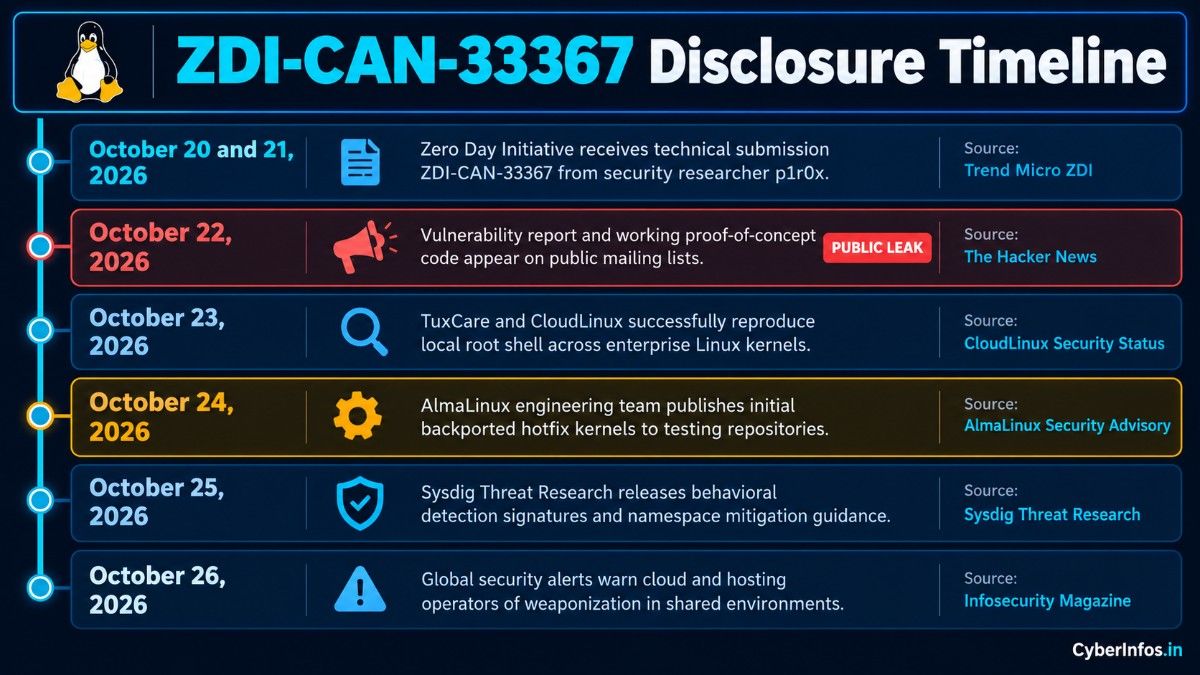
| Date / UTC Time | Milestone & Threat Intelligence Development | Source / Attribution |
|---|---|---|
| October 20 and 21, 2026 | Zero Day Initiative receives technical submission ZDI-CAN-33367 from security researcher p1r0x. | Trend Micro ZDI |
| October 22, 2026 | Vulnerability report and working proof-of-concept code appear on public mailing lists. | The Hacker News |
| October 23, 2026 | TuxCare and CloudLinux successfully reproduce local root shell across enterprise Linux kernels. | CloudLinux Security Status |
| October 24, 2026 | AlmaLinux engineering team publishes initial backported hotfix kernels to testing repositories. | AlmaLinux Security Advisory |
| October 25, 2026 | Sysdig Threat Research releases behavioral detection signatures and namespace mitigation guidance. | Sysdig Threat Research |
| October 26, 2026 | Global security alerts warn cloud and hosting operators of weaponization in shared environments. | Infosecurity Magazine |
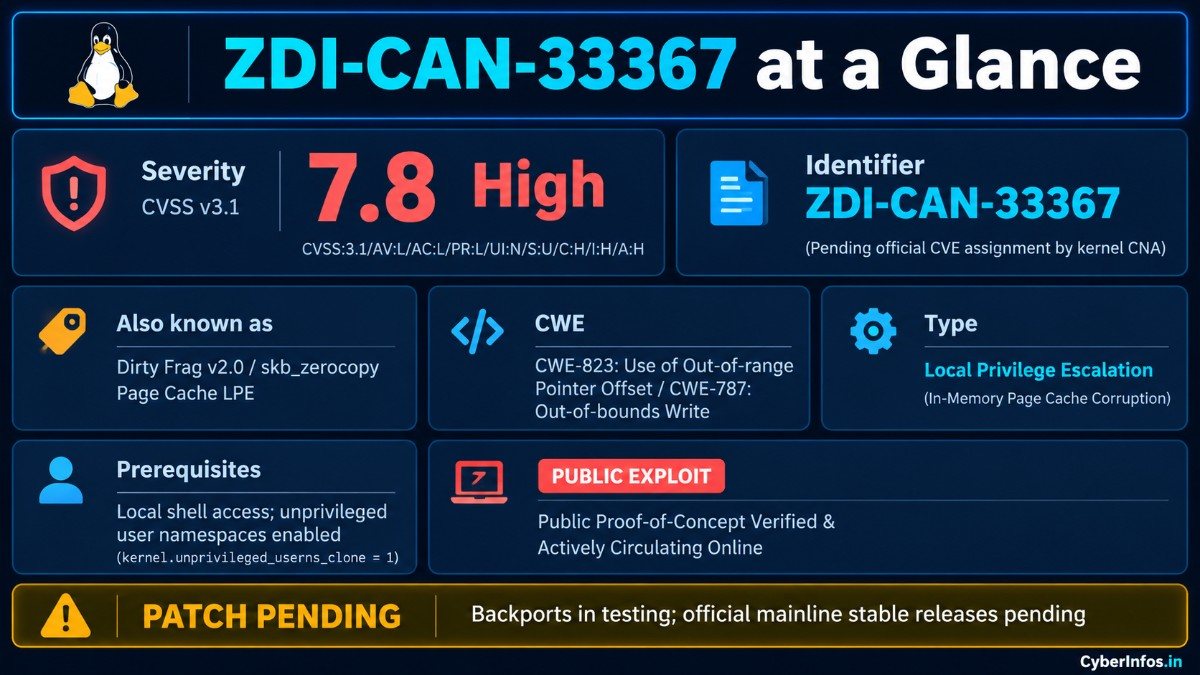
Threat Facts at a Glance
The table below compiles verified technical specifications from ZDI, CloudLinux, AlmaLinux, and independent threat researchers:
| Security Dimension | Verified Technical Specification |
|---|---|
| Vulnerability Identifier | ZDI-CAN-33367 (Pending official CVE assignment by kernel CNA) |
| Common Vulnerability Names | Dirty Frag v2.0 / skb_zerocopy Page Cache LPE |
| Severity & CVSS Score | CVSS v3.1 7.8 High (CVSS:3.1/AV:L/AC:L/PR:L/UI:N/S:U/C:H/I:H/A:H) |
| Common Weakness Enumeration | CWE-823: Use of Out-of-range Pointer Offset / CWE-787: Out-of-bounds Write |
| Vulnerability Type | Local Privilege Escalation (In-Memory Page Cache Corruption) |
| Exploitation Prerequisites | Local shell access; unprivileged user namespaces enabled (kernel.unprivileged_userns_clone = 1) |
| Exploit Availability | Public Proof-of-Concept Verified & Actively Circulating Online |
| Target Architecture | Enterprise Linux distributions running kernel 4.18 through 6.12+ (x86_64, aarch64) |
| Upstream Patch Status | Backports in testing; official mainline stable releases pending |
Affected and Fixed Versions
The vulnerability lives in core socket buffer memory management (net/core/skbuff.c), so it reaches an exceptionally broad range of Linux kernel releases across enterprise LTS branches.
| Linux Distribution / Kernel Branch | Affected Version Range | Fixed / Remediated Release | Remediation Status |
|---|---|---|---|
| AlmaLinux OS 10 | kernel-6.12.0 prior to 211.68.2.el10_2 | kernel-6.12.0-211.68.2.el10_2 | Available in Testing Repository |
| AlmaLinux OS 9 | kernel-5.14.0 prior to 687.59.2.el9_8 | kernel-5.14.0-687.59.2.el9_8 | Available in Testing Repository |
| AlmaLinux OS 8 | kernel-4.18.0 prior to 553.177.2.el8_10 | kernel-4.18.0-553.177.2.el8_10 | Available in Testing Repository |
| CloudLinux 8 / 7h | All unpatched kernel builds | kernel-4.18.0-553.177.1.lve.1 | Released to Beta/Rollout Channels |
| Ubuntu Linux (24.04 / 26.04) | Default generic and cloud kernels | Pending official Ubuntu security notice | Apply sysctl namespace mitigation |
| Debian GNU/Linux (12 / 13) | Standard stable kernel releases | Pending upstream package rebuild | Apply sysctl namespace mitigation |
| Red Hat Enterprise Linux (8 / 9 / 10) | Under investigation by Red Hat | Upstream backport in progress | Apply sysctl namespace mitigation |
Technical Attack Chain
1. Exploiting Zero-Copy Socket Buffers
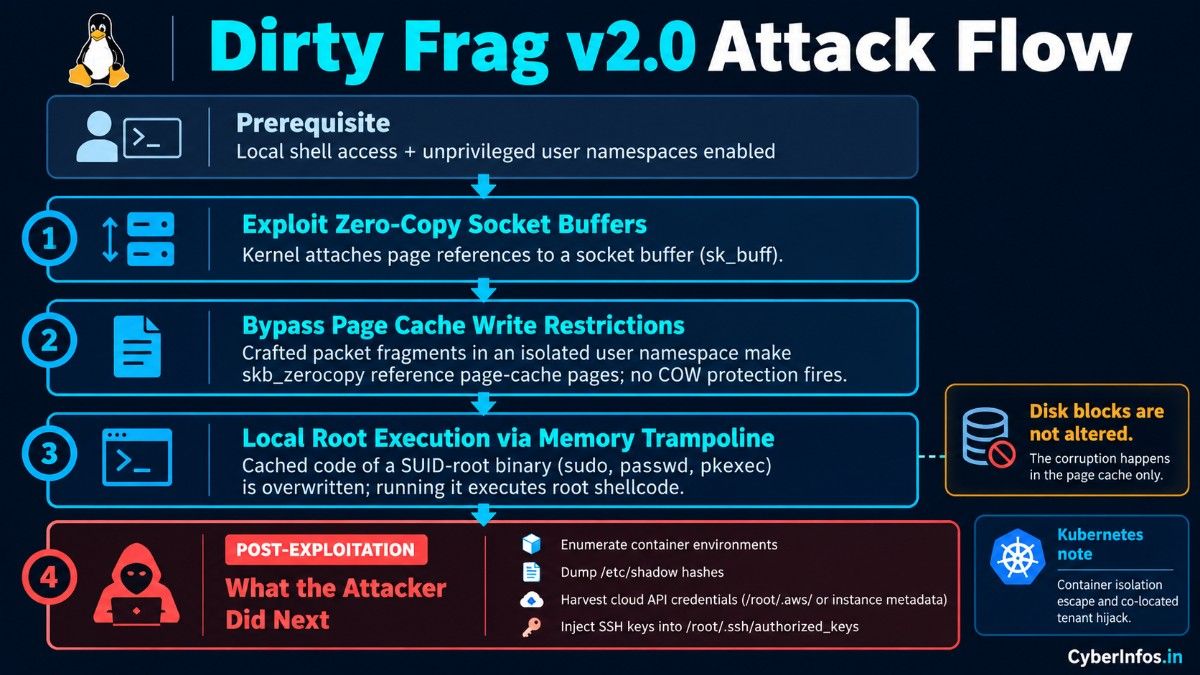
The root of this skb_zerocopy privilege escalation sits in zero-copy networking. In high-throughput network programming, the Linux kernel offers zero-copy socket features that let network drivers transmit data straight from user-space memory buffers, skipping the CPU cost of intermediate kernel-space copies. When a program passes an open file descriptor to a zero-copy socket, the kernel attaches references to the underlying physical memory pages directly to a socket buffer (sk_buff).
2. Bypassing Page Cache Write Restrictions
Normally, Linux enforces strict copy-on-write (COW) semantics. If an unprivileged process tries to write to a read-only file, it triggers a memory fault, and the kernel allocates a private, modified copy of the page.
The attacker sidesteps this. By setting up an unprivileged network loopback transmission inside an isolated user namespace, they deliver crafted packet fragments in which skb_zerocopy wrongly references memory pages that belong to the global system page cache. The kernel’s networking code then modifies that page-cache memory directly, and no COW protection fires.
# Example Conceptual Flow of Dirty Frag v2.0 Exploitation
# 1. Unprivileged user opens a read-only system binary (e.g., /usr/bin/su or /etc/passwd)
# 2. Creates unprivileged user namespace and network namespace
# 3. Invokes skb_zerocopy via loopback socket referencing page cache
# 4. Injects shellcode into cached memory page
# 5. Executes target binary from memory; injected payload runs as root
3. Local Root Execution via Memory Trampoline
The corruption happens in the page cache, the kernel’s in-memory mirror of filesystem blocks. Any later process that reads or executes the modified file receives the attacker’s tampered bytecode, and the attacker never has to alter the physical disk blocks.
By overwriting the cached executable code of a SUID-root binary such as sudo, passwd, or pkexec, the attacker simply runs the command. The injected root shellcode executes immediately.
4. What the Attacker Did Next
In lab reproductions and telemetry analyzed by Sysdig, attackers who reached interactive root moved straight to host reconnaissance. They enumerated running container environments, dumped shadow password hashes (/etc/shadow), harvested cloud API credentials from /root/.aws/ or instance metadata, and established persistent backdoors by injecting SSH public keys into /root/.ssh/authorized_keys.
Kubernetes environments face an added danger. Compromising a container node’s underlying kernel lets the adversary escape container isolation completely and hijack every co-located tenant workload.
Why Patching Alone May Not Be Enough
Waiting on vendor package managers carries real operational risk during a zero-day window.
- Upstream release lag: The Linux kernel security team assigns CVE identifiers and issues official advisories only after patches have been merged across all active stable branches. Until then, standard vulnerability scanners such as Nessus, Qualys, or OpenVAS have no CVE signatures to flag vulnerable servers.
- Reboot bottlenecks in production: A new kernel package only takes effect after a full system reboot. In critical enterprise production environments, scheduling that window often takes weeks or months, and live servers stay exposed to local privilege escalation in the meantime.
- Container host exposure: Containers share the host operating system’s kernel, so patching container base images such as Alpine or Ubuntu does nothing here. The physical or virtual host running the container runtime is what needs hardening.
Indicators of Compromise (IOCs) & Hunting Telemetry
Security operations centers should watch host audit logs, EDR process trees, and system call events for abnormal namespace and memory activity.
| Telemetry Source | Hunting Pattern / Indicator | Investigative Context |
|---|---|---|
| Auditd / Syscall Logs | High frequency of unshare(CLONE_NEWUSER) or clone(CLONE_NEWUSER) | Unprivileged processes creating user namespaces to initiate the exploit |
| Auditd / Syscall Logs | Anomalous calls to sendfile() or splice() targeting SUID binaries | Suspicious attempts to bind read-only system files to network sockets |
| EDR Process Tree | SUID binaries (/usr/bin/passwd, /usr/bin/su) spawning /bin/sh or /bin/bash | Signature of successful memory trampoline hijacking |
| Kernel Ring Buffer | Memory allocation warnings in dmesg referencing skb_zerocopy or skbuff.c | Evidence of failed or imperfect exploit attempts |
{
  "event": "edr_privilege_escalation_alert",
  "rule_id": "SEC-LINUX-DIRTYFRAG-001",
  "parent_process": "/usr/bin/passwd",
  "child_process": "/bin/sh",
  "user_context": "root",
  "initiating_user": "unprivileged_user",
  "action": "flag_and_terminate"
}
SOC & IT Emergency Response Checklist
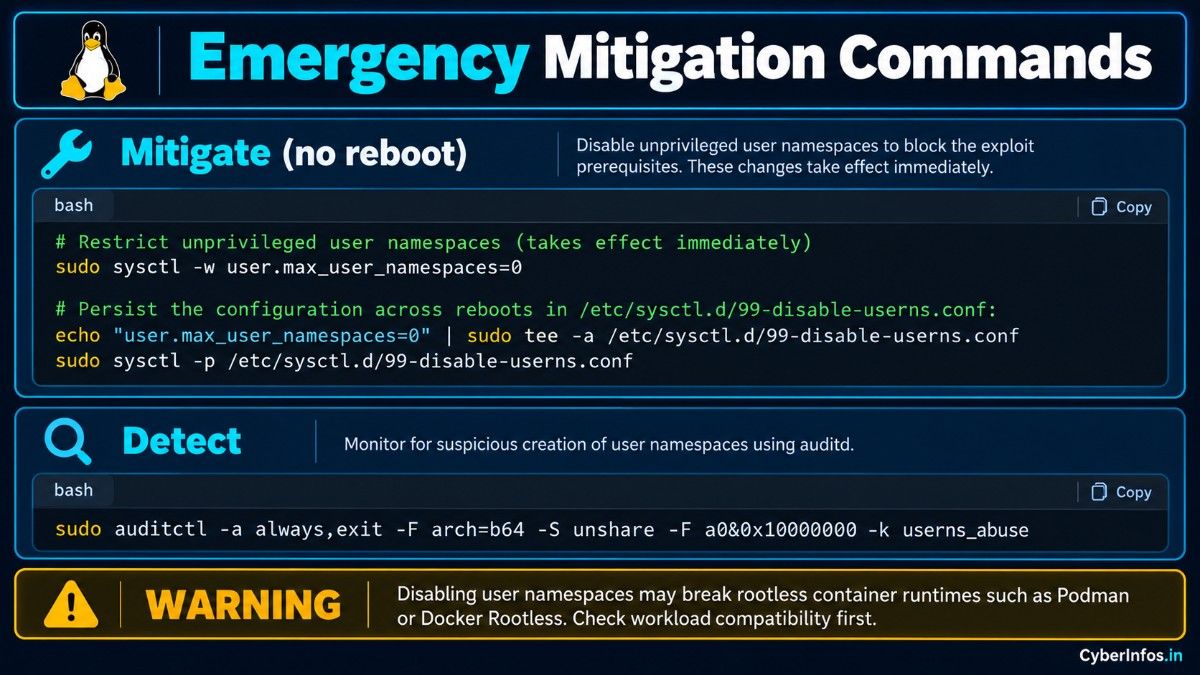
- Deploy Immediate Sysctl Mitigation: The public exploit depends on unprivileged user namespaces to set up zero-copy network routing, so administrators can cut off the attack vector right away, with no reboot:
# Restrict unprivileged user namespaces (takes effect immediately)
sudo sysctl -w user.max_user_namespaces=0
# For Red Hat, CentOS, and AlmaLinux kernels supporting this flag:
sudo sysctl -w kernel.unprivileged_userns_clone=0

# Persist the configuration across reboots in /etc/sysctl.d/99-disable-userns.conf:
echo "user.max_user_namespaces=0" | sudo tee -a /etc/sysctl.d/99-disable-userns.conf
sudo sysctl -p /etc/sysctl.d/99-disable-userns.conf
Note: disabling user namespaces may break rootless container runtimes such as Podman or Docker Rootless, so check workload compatibility first.
- Audit Host System Calls: Configure Linux audit framework rules (auditd) to alert on unprivileged namespace creation:
sudo auditctl -a always,exit -F arch=b64 -S unshare -F a0&0x10000000 -k userns_abuse- Test Distribution Hotfixes: If you run AlmaLinux or CloudLinux, test the updated kernel packages currently in testing repositories (kernel-5.14.0-687.59.2 for EL9).
- Deploy Live-Patching Hotfixes: Organizations with enterprise live-patching infrastructure (such as TuxCare KernelCare Enterprise or Kpatch) should roll out rebootless hotfixes as vendor live-patch streams publish them.
- Inspect SUID Binary Execution: Search SIEM and EDR telemetry for unusual interactive shell processes spawned by SUID-root binaries over the past 7 days.
Global Regulatory & Compliance Implications
Local privilege escalation gives an attacker total administrative control over the operating system and any co-located virtual tenant files. Confirmed exploitation therefore triggers mandatory statutory disclosure obligations:
- United States (CISA, SEC, & CIRCIA): Under CISA Binding Operational Directive (BOD 26-04), federal agencies must prioritize vulnerabilities on exposed assets that grant total control. Public companies must evaluate operational materiality under SEC Form 8-K guidelines within four business days if unauthorized root access compromised cloud customer databases.
- United Kingdom (NCSC & ICO): Under UK GDPR, organizations that discover unauthorized local root escalation on systems hosting personal data must notify the Information Commissioner’s Office within 72 hours of becoming aware of the breach.
- Australia (ASD & SOCI Act): Operators of critical infrastructure assets governed by the Security of Critical Infrastructure Act must report critical cybersecurity incidents affecting service availability to the Australian Signals Directorate within 12 hours.
- European Union (NIS2 Directive & GDPR): Covered entities in the European Union must send an early warning notification within 24 hours of identifying a significant incident, followed by a comprehensive incident report within 72 hours under NIS2.
- India (CERT-In Mandates): Under Section 70B(6) of the Information Technology Act, 2000 (April 2022 Directions), all Indian corporate entities, intermediaries, and data centers must report unauthorized system access and privilege escalation incidents to CERT-In within 6 hours of discovery.
CyberInfos Analyst Insight
From an investigative and operating system architecture perspective, three takeaways stand out from this disclosure.
Kernel memory race conditions are enduring architectural weaknesses.
Like Dirty COW (CVE-2016-5195) and Dirty Pipe (CVE-2022-0847) before it, the Dirty Frag vulnerability class exploits a basic trade-off between I/O performance and memory isolation. Zero-copy networking reaches extreme throughput by skipping standard memory copies, but every performance shortcut can introduce subtle race conditions that let page-cache protections be circumvented.
Unprivileged user namespaces remain an enterprise attack surface.
They were designed to enable secure unprivileged containers, yet they keep serving as the main stepping stone for kernel exploitation. By giving unprivileged users access to restricted network configuration interfaces, namespaces expose deep kernel driver code to untrusted local callers. Unless rootless containers are strictly required, production servers should restrict user namespace creation by default.
The gap between public exploits and CVE assignment is growing.
Vulnerability discovery is accelerating through automated fuzzing and AI-assisted source auditing, and functional exploit code often hits public forums days or weeks before CVE numbers and distribution errata appear. Teams that rely only on automated CVE scanners stay blind during that exposure window.
Frequently Asked Questions (FAQ)
What is ZDI-CAN-33367?
It is an unpatched local privilege escalation zero-day flaw in the Linux kernel’s networking subsystem (skb_zerocopy). It lets unprivileged local users corrupt the page cache and overwrite read-only files in memory to gain root access.
Why is it referred to as Dirty Frag v2.0?
The Dirty Frag v2.0 root exploit is a sequel to earlier “Dirty Frag” vulnerabilities (CVE-2026-43284). The original patch added checks to stop zero-copy socket buffers from modifying page-cache pages, but ZDI-CAN-33367 bypasses that logic through an alternate network buffer path.
Which Linux distributions have confirmed vulnerability?
Security researchers at TuxCare and CloudLinux confirmed successful root shell execution with the public exploit on AlmaLinux 8 through 10, CloudLinux 9 and 10, Debian 12 and 13, and Ubuntu 24.04 and 26.04.
Can this vulnerability be exploited remotely over the network?
No. Exploitation requires local shell access on the target machine. That said, it can be chained with web application flaws (such as PHP webshells or container escapes) to achieve full system takeover.
How can administrators immediately protect Linux servers without rebooting?
Administrators can temporarily disable unprivileged user namespaces by running sudo sysctl -w user.max_user_namespaces=0 or sudo sysctl -w kernel.unprivileged_userns_clone=0. Either command blocks the unprivileged namespace creation needed to trigger the zero-copy socket race condition.
Final Thoughts
The public release of weaponized exploit code for ZDI-CAN-33367 is an urgent risk to enterprise Linux servers. Upstream patches are still working their way through testing trees, and waiting for routine distribution update cycles leaves your systems open to trivial root escalation.
Apply the sysctl namespace mitigation today, test the patched kernels in testing repositories where available, and monitor host execution telemetry so unauthorized users cannot compromise your Linux infrastructure.
