

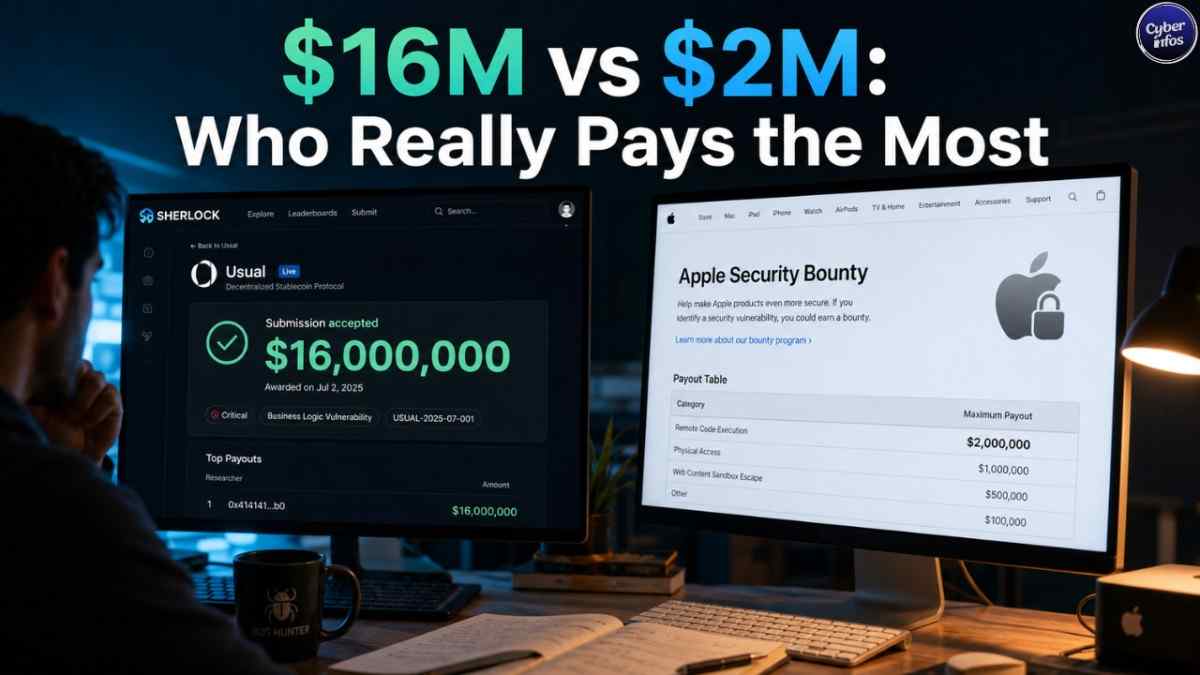
Bug bounty payouts stopped looking like a niche hacker perk a while ago. Five years back, a five-figure reward for a critical web vulnerability made headlines on its own. Not anymore. In 2026, that kind of number barely cracks the top of this list. The real ceiling has moved into eight figures – and it isn’t coming from where most people would guess.
Most “best bug bounty programs 2026” roundups still frame HackerOne and Bugcrowd as the top of the mountain. They’re not wrong that those platforms host the most programs. But they’re missing where the actual money is. In 2026, the highest paying bug bounty in tech history was a $16 million payout on Sherlock for a protocol called Usual, and it wasn’t a fluke.
Several Web3 programs now offer seven-figure ceilings that dwarf what mainstream tech giants pay, while Apple, Google, Samsung, Microsoft, and Meta have all raised their own top rewards this cycle in response.
This bug bounty list 2026 ranks the ten programs actually setting that ceiling, and explains why the highest paying bug bounty platform for a given researcher depends entirely on which skill set they bring to it.
Who is this for? Two groups, really: security researchers weighing where to spend their next few months, and CISOs or security leaders trying to benchmark what a genuinely competitive program looks like this year. We ranked all ten by realistic maximum payout, weighted against reputation, transparency, and track record – not popularity, and not marketing copy.
What follows covers the exploit-acquisition and Web3 programs now defining the top of the market, alongside the corporate giants that still set the standard for accessibility and documentation.
Quick Comparison Table
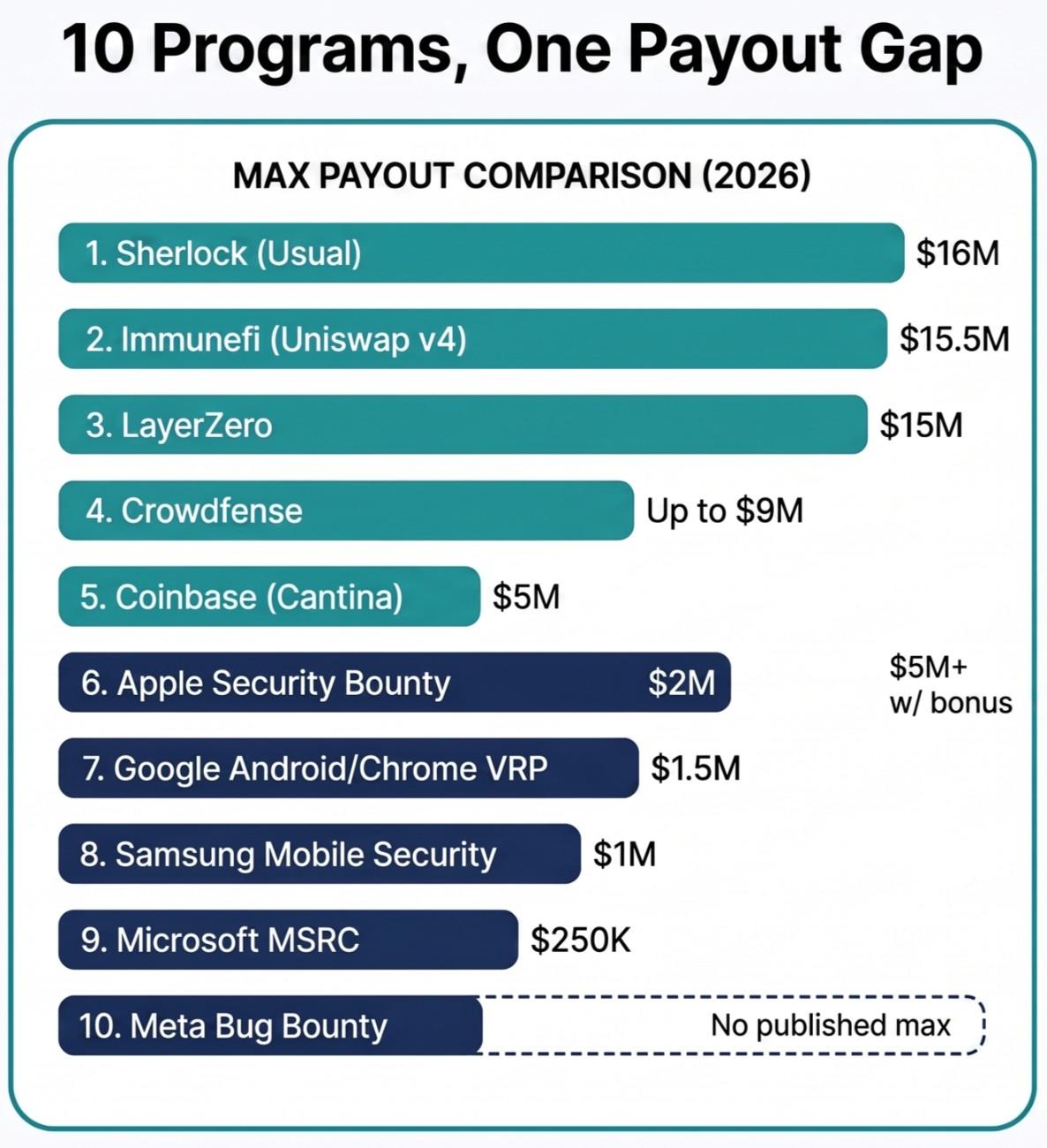
| Rank | Program | Best For | Max Payout | Rating | Key Feature |
|---|---|---|---|---|---|
| 1 | Crowdfense | Elite exploit developers | Up to $9M/exploit | 4.6/5 | $30M total acquisition pool |
| 2 | Sherlock (Usual) | Web3 audit specialists | $16M | 4.5/5 | Highest single bounty in tech history |
| 3 | Immunefi (Uniswap v4) | DeFi/smart contract hunters | $15.5M | 4.5/5 | Largest Web3 bounty marketplace |
| 4 | LayerZero | Cross-chain protocol researchers | $15M | 4.3/5 | Hosted across Sherlock/Immunefi |
| 5 | Apple Security Bounty | Mobile/OS specialists | $2M ($5M+ w/ bonus) | 4.8/5 | Most mature mainstream program |
| 6 | Coinbase (on Cantina) | Web3 beginners | $5M | 4.3/5 | Exchange-backed credibility |
| 7 | Google Android/Chrome VRP | Beginner-friendly entry | $1.5M | 4.7/5 | $17.1M paid in 2025 alone |
| 8 | Samsung Mobile Security | Mobile hardware/firmware | $1M | 4.2/5 | Covers Bixby, Wallet, chipset |
| 9 | Microsoft MSRC | Enterprise/cloud researchers | $250K | 4.4/5 | Most diverse program set |
| 10 | Meta Bug Bounty | New researchers | No published single max* | 4.1/5 | $25M paid lifetime, 13,000+ annual reports |
*Meta doesn’t publish one flat ceiling; payouts are assessed case by case against its severity guidelines.
Our Methodology
Evaluation Criteria: Maximum Payout Ceiling (30%), Program Reputation & Track Record (25%), Transparency & Documentation (20%), Researcher Accessibility (15%), Payout Consistency (10%).
Research Process: This ranking draws on official program pages, published payout-guideline documents, verified security-industry reporting – SecurityWeek, BleepingComputer, SecurityAffairs, TechRadar, Forbes – and platform-disclosed payout data. We didn’t submit anything to any of these programs ourselves. Every figure here comes from a public, verifiable source. And where the public record itself is murky – Zerodium’s current activity status, for instance – we’ve said so rather than guessing.
Disclaimer: One caveat worth repeating: payouts vary enormously by severity, exploitability, and plain program discretion. What’s listed below is the ceiling for the most critical, best-documented submissions. It is not what a typical researcher walks away with.
#1 Crowdfense – Best Overall (Highest Realistic Payout Ceiling)
Rating: ⭐⭐⭐⭐⭐ (4.6/5)
Quick Take: Most researchers have never heard of it. It pays more than any name on this list.
Overview: Crowdfense is a Dubai-based exploit acquisition platform, and that distinction matters it isn’t a traditional bug bounty program. Rather than paying for vulnerability reports, it buys fully functional, previously unreported zero-day exploits outright. Its 2026 acquisition program covers Android, iOS, Chrome, Safari, WhatsApp, iMessage, and a growing list of enterprise software targets.
Key Features:
- $30 million total acquisition pool
- Up to $9M for zero-click full-chain exploits delivered via SMS/MMS
- $7M ceiling for iOS full-chain exploits, $5M for Android
- $3M–$5M for WhatsApp and iMessage zero-days
- Vulnerability Research Hub platform for private, high-priority bounties
Pros:
- Genuinely the highest per-exploit payouts publicly documented
- Transparent published price ranges by capability
- Rapidly expanding scope (enterprise software, WiFi/baseband, messengers)
Cons:
- Requires fully weaponized exploits, not just vulnerability reports – a much higher bar than traditional VRPs
- Not a fit for beginners; effectively closed to casual researchers
Reward Structure: Payouts range from $10,000 to $9 million per submission depending on target and capability; partial chains are priced proportionally.
Best For: Experienced exploit developers with working full-chain capabilities, not researchers reporting individual bugs.
Our Verdict: Crowdfense sits outside the usual bug bounty conversation, and it would be tempting to leave it off a “highest paying” list for exactly that reason. Don’t. It’s the clearest evidence that the real ceiling in vulnerability research has moved well past anything corporate VRPs offer – at the cost of demanding far more sophisticated submissions.
Bottom Line: ⭐⭐⭐⭐⭐ The single highest-paying, publicly documented program in this list – for researchers who can meet its bar.
#2 Sherlock (Usual Protocol Bounty) – Highest Single Bounty in Tech History
Rating: ⭐⭐⭐⭐⭐ (4.5/5)
Quick Take: The single largest bug bounty ever recorded lives here: $16 million, for one protocol.
Overview: Sherlock is a Web3 audit and bug bounty platform that blends competitive audit contests with ongoing bounty programs. As of March 2026, its Usual protocol bounty is the largest active bug bounty in tech history – and the platform also hosts LayerZero’s $15 million program, which we cover next.
Key Features:
- $16M Usual protocol bounty – the current industry record
- Post-exploit coverage up to $500K on select programs
- Combines audit-competition and continuous-bounty models
- Hosts multiple eight-figure DeFi protocol programs
Pros:
- Genuinely record-setting payout ceiling
- Strong protocol-side vetting reduces scam-program risk
- Active, well-documented program pages
Cons:
- Requires deep smart-contract and Solidity expertise – not accessible to generalist researchers
- Payout realistically depends on finding a critical, exploitable bug in a single protocol; most researchers will never see anywhere near the ceiling
Reward Structure: Individual protocol bounties vary; Usual’s $16M and LayerZero’s $15M represent the platform’s current top tier.
Best For: Smart-contract security specialists with existing Web3 audit experience.
Our Verdict: That headline number is real and verifiable, not marketing inflation. But it reflects total protocol exposure at risk, not a typical or even likely single payout. Still, for researchers with the right skill set, it’s the clearest sign yet that Web3 security work now outpays almost everything in traditional tech.
Bottom Line: ⭐⭐⭐⭐⭐ The record-holder – but only realistically reachable by specialists.
#3 Immunefi (Uniswap v4 Bounty) – Best for DeFi/Smart Contract Hunters
Rating: ⭐⭐⭐⭐⭐ (4.5/5)
Quick Take: The largest Web3 bug bounty marketplace by volume – and the one with the deepest receipts.
Overview: Immunefi dominates DeFi and blockchain bug bounties, hosting over 650 active programs and protecting more than $190 billion in total value locked. Its Uniswap v4 program currently carries a $15.5 million ceiling. And the platform holds the largest confirmed single crypto bug bounty payout in history: $10 million, paid to researcher satya0x for a critical Wormhole vulnerability back in 2022.
Key Features:
- 650+ active programs, 45,000+ registered researchers
- $110M+ paid out to date, $162M+ currently available across programs
- On-chain Vaults let projects publicly commit bounty funds before researchers invest time
- Open submission model, no staking requirement
Pros:
- Largest track record of major confirmed payouts in Web3 ($10M Wormhole, $6M Aurora, $2.2M Polygon)
- Broadest program selection of any Web3 platform
- Structured dispute resolution via formal arbitration
Cons:
- Median confirmed payout is around $2,000 – the headline numbers are exceptional, not typical
- Program quality varies significantly across 650+ listed protocols
Reward Structure: Ranges from a few hundred dollars for low-severity bugs to $15.5M for Uniswap v4’s critical tier; average confirmed payout is roughly $52,800, skewed heavily by rare large payouts.
Best For: Researchers who want the widest selection of active Web3 programs and the deepest historical evidence that large payouts actually happen.
Our Verdict: Why does that matter to a researcher deciding where to spend a month of work? Because Immunefi’s history of large, real payouts is the most independently documented of any platform on this list. That’s what makes it the safest entry point into high-paying Web3 bug hunting, not just the biggest.
Bottom Line: ⭐⭐⭐⭐⭐ The most proven high-payout track record in Web3 security.
#4 LayerZero – Best for Cross-Chain Protocol Researchers
Rating: ⭐⭐⭐⭐ (4.3/5)
Quick Take: A $15 million bounty guarding one of the most widely integrated cross-chain messaging protocols in Web3.
Overview: LayerZero’s bounty program – hosted across both Sherlock and Immunefi listings – ranks among the top three highest-value Web3 bounties tracked in 2026. That size isn’t arbitrary. It reflects the outsized risk cross-chain infrastructure represents if it’s ever compromised.
Key Features:
- $15M maximum bounty tier
- Covers core cross-chain messaging infrastructure used by dozens of downstream protocols
- Listed alongside Immunefi and Sherlock’s other top-tier programs
Pros:
- High payout ceiling reflecting genuine systemic risk
- Cross-chain expertise is in high demand and comparatively less crowded than general smart-contract auditing
Cons:
- Requires specialized cross-chain and messaging-protocol knowledge
- Less independently documented payout history than Immunefi’s marquee cases
Reward Structure: Up to $15M for critical vulnerabilities in core protocol infrastructure.
Best For: This bug bounty program suits researchers specializing in cross-chain bridges and messaging protocols.
Our Verdict: A genuinely high-ceiling program. The catch is that its publicly documented payout history is thinner than Immunefi’s flagship cases – worth watching as the sourcing catches up to the headline number.
Bottom Line: ⭐⭐⭐⭐ A top-tier ceiling for a specialized, high-demand skill set.
#5 Apple Security Bounty – Best for Mobile/OS Specialists
Rating: ⭐⭐⭐⭐⭐ (4.8/5)
Quick Take: The most mature, best-documented mainstream program on this list – and now the highest-paying one outside exploit brokers and Web3.
Overview: In October 2025, Apple doubled its top award to $2 million for zero-click exploit chains comparable to sophisticated mercenary spyware attacks. A bonus system layered on top covering Lockdown Mode bypasses and beta-software vulnerabilities pushes the effective maximum above $5 million. Since the public program launched in 2020, Apple has paid out more than $35 million to over 800 researchers.
Key Features:
- $2M base for zero-click, no-interaction exploit chains
- Bonuses can push total payout beyond $5M
- $1M for one-click exploit chains (up from $250K previously)
- $1M for broad unauthorized iCloud access
- Target Flags system for faster, programmatically verified payouts
Pros:
- Longest, most consistent track record of any mainstream corporate program
- Clear, published category-by-category reward structure
- Backed by a stated $10M cybersecurity grant program for related civil-society protection work
Cons:
- Top-dollar payouts are genuinely rare – multiple $500K awards, but few researchers reach the $2M+ tier
- Requires deep iOS/macOS internals expertise for top-tier categories
Reward Structure: $100K (Gatekeeper bypass) up to $2M base (zero-click RCE), with bonuses extending beyond $5M for the most severe categories.
Best For: Researchers specializing in iOS, macOS, or Apple ecosystem internals who want the most established, transparent mainstream program.
Our Verdict: Apple’s program is still the gold standard for how a corporate program should be run: clear categories, a verifiable payout history, and rewards that have kept pace with – and in some categories now exceed the threat landscape it’s defending against.
Bottom Line: ⭐⭐⭐⭐⭐ The most trustworthy top-tier mainstream program on this list.
#6 Coinbase (on Cantina) – Best for Web3 Beginners
Rating: ⭐⭐⭐⭐ (4.3/5)
Quick Take: A $5 million bounty with something rarer than a big number attached to it: institutional credibility.
Overview: Coinbase launched its $5 million bug bounty program on the Cantina platform in July 2025, focused exclusively on its onchain products and Base layer-2 smart contracts. It’s one of the largest bounties ever backed by a centralized exchange.
Key Features:
- $5M reward pool covering all Coinbase onchain products and Base
- Backed by an established, publicly traded exchange rather than an anonymous protocol team
- Hosted on Cantina, which combines AI-assisted triage with expert-led review
Pros:
- Strong institutional credibility reduces scam/non-payment risk common to smaller protocols
- Broad scope across multiple onchain products increases the chance of finding an in-scope bug
Cons:
- Still requires solid smart-contract security fundamentals – not a true beginner program
- Payouts follow reproducibility and technical-impact tiers rather than a flat top number for most findings
Reward Structure: Up to $5M (paid in USDC), tiered by severity and reproducibility.
Best For: This bug bounty program is a fit for researchers who want Web3-level payouts backed by a household-name, regulated company rather than an anonymous DeFi protocol.
Our Verdict: Coinbase’s program works as a useful bridge for researchers moving from traditional bug bounty work into Web3. The underlying skills required are Web3-native, but the institutional backing feels closer to a mainstream corporate VRP.
Bottom Line: ⭐⭐⭐⭐ The most institutionally credible high-value Web3 program.
#7 Google Android/Chrome VRP – Most Beginner-Accessible Entry Point
Rating: ⭐⭐⭐⭐⭐ (4.7/5)
Quick Take: Google paid a record $17.1 million to researchers in 2025 and just restructured its rewards to pay even more for the hardest-to-find bugs.
Overview: In May 2026, Google raised its maximum Android reward to $1.5 million for a zero-click, persistent Pixel Titan M2 exploit up from $1 million – while reducing some Chrome payouts as part of a deliberate shift toward rewarding vulnerabilities that AI-assisted tools can’t easily find. The restructuring followed a record-breaking 2025, in which Google paid $17.1 million to 747 researchers, a 40% increase year-over-year.
Key Features:
- $1.5M ceiling for top-tier Android exploits
- Chrome full-chain exploits pay up to $250K, plus a $250,128 MiraclePtr bypass bonus
- Separate AI-specific bug bounty track with its own reward tier
- $81.6M paid out cumulatively since the program launched in 2010
Pros:
- Longest continuously operating major VRP, with the deepest public payout history
- Explicitly restructured to keep pace with how AI is changing vulnerability discovery
- Extremely well documented rules pages, updated regularly
Cons:
- Some individual Chrome payouts were reduced in the 2026 restructure, even as aggregate rewards are expected to rise
- Reaching the $1.5M Pixel tier requires finding an extremely rare class of vulnerability
Reward Structure: Chrome full-chain up to $250K (plus bonuses); Android zero-click Titan M2 with persistence up to $1.5M; without persistence, up to $750K.
Best For: Researchers new to high-value bug bounty hunting who want the most transparent, well-documented rules and the largest annual payout pool of any mainstream bug bounty program.
Our Verdict: Google’s willingness to publicly explain why it’s restructuring rewards, rather than quietly cutting them, is itself a trust signal. It remains the most accessible on-ramp into serious bug bounty income for researchers without existing Web3 expertise.
Bottom Line: ⭐⭐⭐⭐⭐ The best combination of accessibility, documentation, and real payout volume.
#8 Samsung Mobile Security Rewards Program – Best for Mobile Hardware/Firmware
Rating: ⭐⭐⭐⭐ (4.2/5)
Quick Take: A $1 million ceiling for the most severe Samsung device compromises, with an expanding scope into Galaxy services like Bixby and Samsung Wallet.
Overview: Samsung raised its Mobile Security Rewards Program maximum to $1 million through its Important Scenario Vulnerability Program, targeting the most severe attack classes: persistent, zero-click arbitrary code execution on highly privileged targets. The program has paid over $4 million total since launching in 2017, including more than $800,000 to 113 researchers in 2023 alone.
Key Features:
- $1M ceiling for persistent, zero-click critical vulnerabilities
- Covers device unlock/data extraction, arbitrary app installation, and protection bypasses
- Extended scope now includes Bixby, Samsung Account, and Samsung Wallet
- Published Annual Rewards Program Report for transparency
Pros:
- Clear five-tier severity classification system
- Growing scope keeps pace with Samsung’s expanding software ecosystem
Cons:
- $1M ceiling requires an unusually demanding combination of persistence and zero-click delivery
- Total annual payout volume is smaller than Google’s or Microsoft’s programs
Reward Structure: Up to $1M for the top severity tier; $100K for remote arbitrary app installation from an unofficial source, scaling down by severity.
Best For: This bug bounty program suits researchers focused specifically on Android OEM firmware, chipset-level vulnerabilities, or Samsung’s proprietary software layer.
Our Verdict: A solid, well-structured program that benefits from Samsung’s hardware-specific attack surface – a good complement to, rather than a substitute for, Google’s broader Android VRP.
Bottom Line: ⭐⭐⭐⭐ Strong for OEM-specific research, less broad than the platform-level programs above it.
#9 Microsoft MSRC Bounty Programs – Best for Enterprise/Cloud Researchers
Rating: ⭐⭐⭐⭐ (4.4/5)
Quick Take: Not the highest single payout on this list, but the most diverse set of programs and the broadest total payout pool of any traditional VRP.
Overview: Microsoft’s bounty programs span Windows, Azure, Microsoft 365, Identity, Copilot, and more, each with its own scope and reward tier. In its most recent program year, Microsoft distributed $17 million to 344 researchers across 59 countries the highest total in the program’s history – and continues expanding coverage to include third-party and open-source code that affects its online services.
Key Features:
- Endpoint & On-Prem programs pay up to $250K
- Windows Insider Preview program pays up to $100K
- Cloud programs pay up to $100K
- Now covers third-party/open-source code impacting Microsoft’s online services
- Annual Zero Day Quest live-hacking event with bounty multipliers
Pros:
- Widest range of distinct programs of any company on this list more entry points for different skill sets
- Actively expanding scope rather than narrowing it
- Strong documentation across every individual program page
Cons:
- No single program approaches the $1M+ tier that Apple, Google, or Samsung now offer
- Reward structure is fragmented across many separate program pages, which can be confusing for newcomers
Reward Structure: $500–$250,000 depending on the specific program (Applications/On-Prem, Cloud, Identity, Windows Insider, Copilot, Xbox, and others each have separate ceilings).
Best For: This bug bounty program suits researchers targeting enterprise software, cloud infrastructure, or identity systems who want the widest possible range of in-scope targets.
Our Verdict: Microsoft trades a lower individual payout ceiling for genuinely the broadest scope and most consistent total payout volume of any traditional corporate program. That makes it a strong pick for researchers who want steady opportunities rather than a single jackpot.
Bottom Line: ⭐⭐⭐⭐ Breadth over ceiling – the most consistent volume play on this list.
#10 Meta Bug Bounty – Best for New Researchers
Rating: ⭐⭐⭐⭐ (4.1/5)
Quick Take: No headline seven-figure payout, but the highest report volume and most beginner-friendly minimum threshold on this list.
Overview: Meta paid $4 million through its bug bounty program in 2025 alone, bringing its cumulative total since launch to more than $25 million. The program received roughly 13,000 vulnerability reports that year, with 800 rewarded – reflecting one of the highest report volumes of any program covered here.
Key Features:
- Covers Facebook, Instagram, WhatsApp, and Quest/GenAI products
- $500 minimum bounty threshold, among the most accessible entry points on this list
- Detailed, publicly published payout guidelines by category
- Dedicated GenAI-specific program with its own payout guidelines
Pros:
- High acceptance volume (800 of ~13,000 reports rewarded in 2025) gives newer researchers realistic odds
- Clear category-by-category payout guidelines reduce ambiguity for first-time submitters
Cons:
- No published flat maximum payout – top-end figures aren’t as clearly stated as Apple’s or Google’s
- GenAI-specific category caps at $30,000, notably lower than its peers’ AI bounty tiers
Reward Structure: Minimum $500; GenAI-specific issues capped at $30,000; other categories assessed case-by-case against published severity guidelines.
Best For: Researchers new to bug bounty hunting who want a high-volume, well-documented bug bounty program with realistic odds of a first payout.
Our Verdict: Meta’s bug bounty program doesn’t compete on ceiling. What it offers instead is documentation quality paired with acceptance volume, which makes it one of the more approachable places to start – and its GenAI-specific track is a useful signal of where the whole industry is heading.
Bottom Line: ⭐⭐⭐⭐ The most approachable program for researchers building a track record.
What to Look for When Choosing a Bug Bounty Program
Not every bug bounty program is built the same way, and the right bug bounty program for you depends on your skill set as much as the headline payout. Here’s what actually matters when comparing options.
Payout Ceiling vs. Realistic Earnings
Why it matters: Headline numbers like Sherlock’s $16M or Crowdfense’s $9M reflect the absolute top tier, not what a typical researcher earns. What to prioritize: Look at median/average confirmed payouts (Immunefi’s average is roughly $52,800, heavily skewed by rare large awards) rather than the maximum alone. Red flag: A program that advertises a huge ceiling but has little to no documented history of actually paying it out.
Documentation & Transparency
Why it matters: Clear, published severity guidelines (like Apple’s and Meta’s) reduce disputes and wasted research time. What to look for: Category-by-category payout tables, published rules-of-engagement, and regularly updated program pages.
Scope and Skill Fit
Why it matters: A $9M Crowdfense ceiling is meaningless if you don’t have full-chain exploit development skills; a $16M Sherlock bounty is out of reach without Solidity expertise. What to prioritize: Match the program’s required skill set to your actual specialization – mobile OS, cloud, web app, or smart contracts.
Program Reputation and Payment Reliability
Why it matters: Smaller or newer programs, especially in Web3, carry more risk of scope disputes or non-payment than established corporate VRPs. What to look for: Formal dispute-resolution processes (Immunefi’s arbitration model is a good example) and a public track record of past payouts.
Accessibility for New Researchers
Why it matters: A beginner-friendly bug bounty program with low minimum thresholds and high acceptance rates, like Meta’s or Google’s, is far better for building a track record than jackpot-focused exploit-acquisition platforms. What to look for: Published minimum bounty amounts and realistic acceptance-rate data where available.
Payment Method and Practical Constraints
Why it matters: Web3 programs often pay in the project’s native token or stablecoins (USDC), which carries its own volatility and tax considerations compared to a corporate VRP’s fiat payout. What to look for: Confirm payout currency, KYC requirements, and any jurisdictional eligibility restrictions before investing research time.
Frequently Asked Questions
1. Which bug bounty program pays the most overall?
Crowdfense currently offers the highest publicly documented per-exploit ceiling, up to $9 million for a zero-click full-chain exploit delivered via SMS or MMS. Among traditional bug bounty programs (as opposed to exploit acquisition), Sherlock’s $16 million Usual protocol bounty is the highest single active bounty in tech history as of 2026.
2. Which program is best for beginners?
Meta and Google’s programs are the most beginner-accessible. Meta has a low $500 minimum threshold and rewarded 800 of roughly 13,000 submitted reports in 2025, while Google’s Android/Chrome VRP has the most extensively documented rules pages of any program on this list.
3. Which program is best for security teams evaluating models to adopt?
Apple’s program is widely regarded as the industry benchmark for structure and transparency – clear severity tiers, a verifiable payout history since 2020, and a bonus system that scales with genuine threat severity. CISOs building or benchmarking an internal VRP often reference its category structure.
4. Which offers the most accessible entry point for new researchers?
Meta’s $500 minimum and high report-acceptance volume make it one of the easier programs to earn a first payout from, without requiring the specialized exploit-development or smart-contract skills that top-tier programs demand.
5. Are lower-payout or public disclosure programs still worth pursuing?
Yes, for researchers building a track record. Programs with lower ceilings but higher acceptance volume, like Meta’s or Microsoft’s, provide more realistic opportunities to gain experience and reputation before targeting higher-ceiling but far more competitive programs.
6. How much should researchers realistically expect to earn?
On Immunefi, the median confirmed payout is around $2,000, with the average closer to $52,800 once rare large payouts are factored in. Corporate VRPs like Google’s paid an average of roughly $22,900 per researcher across 747 recipients in 2025 ($17.1M total) – useful context against the eight-figure headline numbers.
7. Which program has the best researcher documentation and support?
Apple and Google both maintain detailed, regularly updated public rules pages with category-by-category payout tables. Microsoft’s documentation is extensive but fragmented across many separate program pages, which can be harder to navigate for newcomers.
8. Which offers the strongest vetting and payment security for participants?
Immunefi’s formal two-stage dispute resolution (internal mediation, then binding arbitration via the London Chamber of Arbitration and Mediation) is among the most structured processes for resolving payout disputes in the Web3 space. Established corporate programs (Apple, Google, Microsoft, Meta) carry lower non-payment risk given their institutional track record.
9. What alternatives should researchers consider beyond this list?
HackerOne, Bugcrowd, Intigriti, and YesWeHack all host large numbers of individual company programs and are worth exploring for breadth, even though no single program on those platforms currently matches the top-tier ceilings covered here.
10. How do I choose between Crowdfense and Sherlock, the top two on this list?
Choose based on skill set, not payout size. Crowdfense requires fully functional, weaponized exploit chains a much higher technical bar suited to experienced exploit developers. Sherlock’s top bounties require deep smart-contract auditing and Solidity expertise. Most researchers will find one skill set a far better fit than the other.
Final Recommendations
Best Overall
Crowdfense – the highest realistic payout ceiling with a transparent, published pricing structure, for researchers who can meet its technical bar.
Best for Beginners
Meta Bug Bounty – the lowest barrier to a first payout, with the highest documented report-acceptance volume on this list.
Best for Web3/Crypto Specialists
Immunefi – the deepest, most independently verified history of major Web3 payouts of any platform covered here.
Best for Mobile/OS Researchers
Apple Security Bounty – the most mature, best-documented mainstream program, with the industry’s highest published payout outside exploit brokers and Web3.
Highest Single Payout on Record
Sherlock’s Usual protocol bounty – at $16 million, the largest bug bounty ever recorded in the industry as of 2026.
How We Rank
- Maximum Payout Ceiling – 30%
- Program Reputation & Track Record – 25%
- Transparency & Documentation – 20%
- Researcher Accessibility – 15%
- Payout Consistency – 10%
A Note on Zerodium
No 2026 ranking of high-paying exploit markets would be complete without mentioning Zerodium, whose historical top payout of roughly $2.5 million once set the industry benchmark before Crowdfense overtook it. However, Zerodium’s current operational status is genuinely unclear: some sources list the company as defunct as of 2025, while its website remains live with a restricted-access notice. We’ve excluded it from the ranked list above because we could not verify it is currently paying out but researchers should watch for updates on its status before assuming it’s an active option.
Final Thoughts
The story of the highest paying bug bounty programs in 2026 isn’t really about which single number is biggest. It’s about how far the market has split in two. On one side, Crowdfense and the Web3 platforms – Sherlock, Immunefi, LayerZero, Coinbase – are paying out sums that would have sounded like a typo five years ago, but only to researchers with genuinely specialized, hard-to-build skills. On the other, Apple, Google, Samsung, Microsoft, and Meta keep raising their own ceilings while staying the most accessible, best-documented, and most consistently reliable places to actually get paid.
That’s why there’s no single answer to which is the best bug bounty programs 2026 has to offer – the honest answer depends entirely on what a researcher already brings to the table. This bug bounty list 2026 exists to make that decision easier: match your skill set to the right tier before chasing the headline number.
For most researchers, that means starting with an accessible, well-documented program like Google’s or Meta’s to build a track record, then moving toward the specialized, higher-ceiling platforms once the underlying expertise – exploit development, smart-contract auditing, cross-chain protocol knowledge – is genuinely there. The highest paying bug bounty platform for any given researcher is the one where their existing skills already clear the bar, not the one with the biggest number on the homepage.
