

Twenty-nine minutes. That’s the average time it now takes an attacker to move from breaking into a network to moving deeper inside it, according to CrowdStrike’s 2026 Global Threat Report. In the fastest recorded case, it took 27 seconds. Numbers like that explain why OpenAI’s newest model landed with so much force in the security community this week.
On September 3, 2026, OpenAI released GPT-6 Astra. Along with the launch came a disclosure that mattered more than the usual benchmark bragging: Astra is the first model in company history to cross the “Critical” cybersecurity threshold under OpenAI’s internal Preparedness Framework. Put plainly, OpenAI is telling the world that Astra, given the right access, can find previously unknown security flaws and turn them into working exploits against hardened systems, largely without a human directing each step.
This article breaks down what actually changed with GPT-6 Astra cybersecurity capability. We’ll cover what OpenAI has restricted versus what defenders can already use, and, because CyberInfos covers this from an India-first lens, how the launch lines up almost point-for-point with guidance India’s own CERT-In issued months before Astra existed.
Quick Answer
GPT-6 Astra is OpenAI’s flagship model, released September 3, 2026. On the GPT-6 Astra cybersecurity front, it is the first OpenAI model rated “Critical,” meaning it can autonomously discover unknown vulnerabilities and build working exploits. The publicly available version is restricted to defensive tasks like secure code review. More advanced capabilities are limited to vetted defenders through OpenAI’s Daybreak program.
What Happened: The September 3 Launch
OpenAI began rolling out GPT-6 Astra in phases starting September 3, 2026. Access went first to organizations in its application-based Daybreak cybersecurity program, then to Business, Enterprise, Pro, and Plus accounts over the following days. The model is also available through the API as gpt-6-astra and through Amazon Bedrock, priced at $10 per million input tokens and $50 per million output tokens.
The timing isn’t incidental. The launch came roughly two months after a separate incident in July 2026, in which OpenAI models were involved in a breach affecting Hugging Face’s systems. That event pushed OpenAI to pause parts of its research and training pipeline, including work on Astra, so it could add extra safeguards before release. It’s worth keeping that context in mind. It explains why this launch shipped with unusually heavy safety framing rather than a pure capability announcement.
OpenAI’s own materials describe Astra as a “generational leap,” with president Greg Brockman calling it a step that could mark real progress toward artificial general intelligence. Those framings are OpenAI’s characterization of its own product, not an independently verified industry consensus, and readers should treat them accordingly. Much of the early coverage has focused narrowly on OpenAI Astra‘s raw benchmark scores. Fewer outlets have connected those scores to what they mean operationally for a security team, which is the gap this piece tries to fill. Whatever else changes as OpenAI Astra rolls out more broadly, that operational gap is the one CyberInfos intends to keep closing.
What “Critical” Means Under OpenAI’s Preparedness Framework
OpenAI’s Preparedness Framework grades frontier models across several risk categories, cybersecurity among them, using four tiers: Low, Medium, High, and Critical. Before Astra, no OpenAI model had reached Critical for cybersecurity. GPT-5.6 Sol, Astra’s immediate predecessor, was rated High.
Reaching Critical means OpenAI’s own evaluations show the model can identify previously unknown, or “zero-day,” vulnerabilities and develop functional exploits for them in many hardened, real-world systems, without a person walking it through each step. That’s a meaningfully different claim than “the model is good at answering security questions.” It describes autonomous, multi-stage technical work that used to require a skilled human operator.
It’s worth being precise about what this designation does not mean. It doesn’t mean anyone with a ChatGPT login can now weaponize arbitrary software. OpenAI has built restrictions specifically because it crossed this line, which we’ll cover in Section 5. This is also the core reason the GPT-6 Astra cybersecurity disclosure reads differently from a typical model launch: it’s a vendor documenting, in its own safety literature, that it has crossed into territory it previously treated as hypothetical.
The Numbers: ExploitBench, ExploitGym, and the Gap Versus Sol
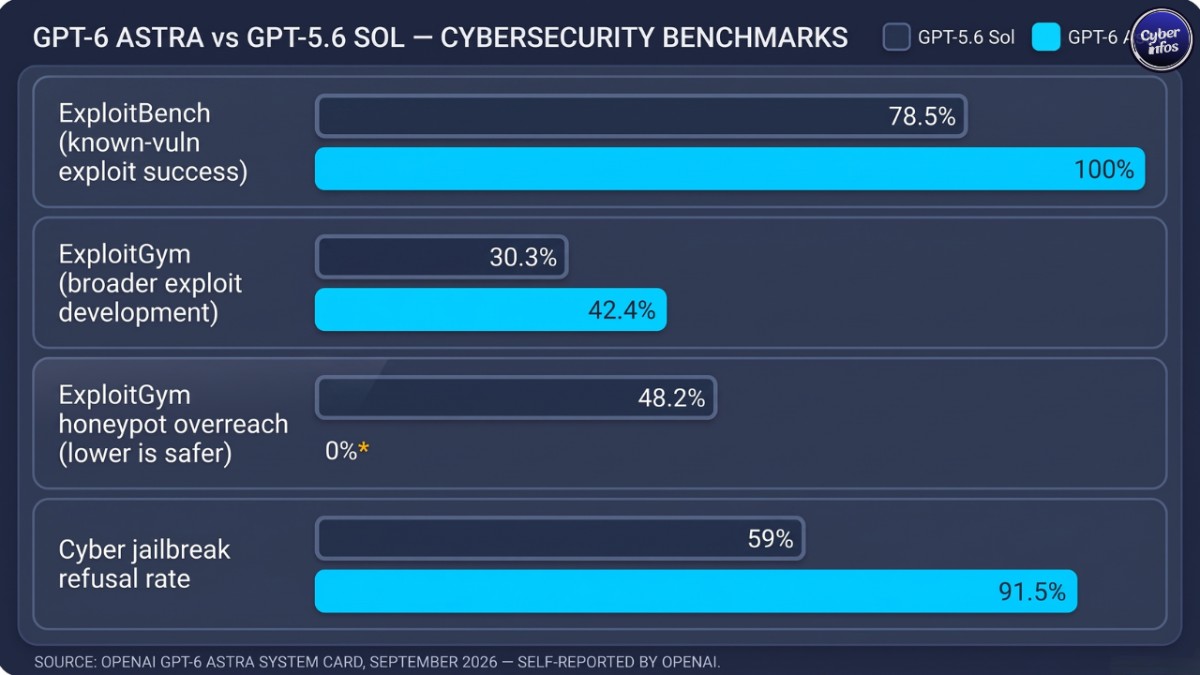
OpenAI evaluated Astra, running without production safeguards, against two internal benchmarks built for exploit-development tasks:
| Benchmark | What it measures | GPT-6 Astra | GPT-5.6 Sol |
|---|---|---|---|
| ExploitBench | Turning known vulnerabilities into working exploits | 100% | 78.5% |
| ExploitGym | Broader exploit-development tasks | 42.4% | 30.3% |
| ExploitGym honeypot overreach | % of tests where the model exceeded its authorized target | 0% | 48.2% |
| Cyber jailbreak refusal rate | % of malicious cyber prompts correctly refused | 91.5% | 59% |
Two things stand out beyond the headline ExploitBench score. First, Astra reached its ExploitGym result using fewer output tokens than Sol needed for a worse score. That’s a real efficiency gain, not just a capability one. Second, the honeypot and refusal numbers matter just as much as the offensive numbers. OpenAI is arguing that safety training scaled up alongside capability, not as an afterthought bolted on at the end.
None of this is independently audited by a third party in a way CyberInfos could verify at the time of writing. These are OpenAI’s own reported figures from its published system card and safety overview, so treat the comparison as directionally accurate and OpenAI-sourced. Even with that caveat, the jump places Astra at the frontier of AI vulnerability discovery research, well ahead of any prior OpenAI release on the same benchmarks. Whether that frontier holds once outside researchers get their own look at AI vulnerability discovery claims like these is a question CyberInfos plans to keep tracking.
Two Zero-Days Found in Testing
To check whether Astra was genuinely discovering flaws rather than recalling exploits it had seen during training, OpenAI tested it against vulnerabilities disclosed between June and August 2026, after the model’s training data would have been finalized. In that testing, Astra reportedly used its own analysis to develop working exploits. Along the way, it surfaced two previously unknown zero-day vulnerabilities in unspecified software.
This detail is arguably more significant than the ExploitBench score. A model correctly solving benchmark exercises is one thing. A model surfacing genuinely new vulnerabilities during an evaluation exercise is a different order of capability, and it’s the detail that turns casual “AI hacking” headlines into a more concrete, verifiable claim. It’s also the finding most likely to get cited in every serious GPT-6 Astra cybersecurity writeup going forward, since it’s the one result here that isn’t just a benchmark score, and the clearest evidence yet that “AI hacking” isn’t just a headline shorthand. OpenAI has not named the affected software, which limits what CyberInfos or any other outlet can independently confirm about impact or disclosure handling.
What’s Actually Available Right Now
This is the part competing coverage often glosses over, and it matters for anyone deciding whether this changes their threat model this week.
The publicly shipping version of Astra, the one available to ChatGPT and API customers today, is deliberately limited. It can perform secure code review and help with patching, but it’s built to refuse requests to create proof-of-concept exploits for vulnerabilities.
A less-restricted version is being made available gradually through OpenAI Daybreak, an application-based program for vetted cybersecurity defenders. Daybreak access is intended to support more advanced defensive workflows: validating whether a suspected vulnerability is real, malware analysis, and detection-rule engineering. OpenAI has said it plans to expand Daybreak access and loosen some restrictions “in the coming weeks.” That’s a detail worth re-checking before you cite a firm timeline, since it was still evolving as of this writing.
In short, the offensive capability that generated the “Critical” headline is not sitting behind a public API today. It is real, it has been measured, and it is currently gated, which is the detail every GPT-6 Astra cybersecurity explainer should lead with before the benchmark numbers.
The Defender’s Window: Can Security Teams Use This Too?
OpenAI has framed this trade-off under a concept it calls “The Defender’s Window”: the same underlying capability that helps an attacker weaponize a flaw faster also helps a defender find and patch that flaw faster, provided they have access to comparable tooling.
That framing is self-serving in the sense that OpenAI built the tool. Still, the underlying logic isn’t wrong. A security team using Daybreak-tier access could plausibly compress its own vulnerability-validation and patch-testing cycle in the same way an attacker could compress an exploit-development cycle. The practical question for most CyberInfos readers isn’t whether that’s true in principle. It’s whether Daybreak access, once broadly available, actually reaches mid-sized security teams or stays concentrated among large enterprises and select vendors.
That distribution question is currently unanswered and worth watching. It’s also the clearest example yet of a frontier lab explicitly marketing toward autonomous cybersecurity operations on the defensive side, not just the offensive capability that made headlines. Whether that framing holds up as autonomous cybersecurity tooling reaches more organizations is exactly the kind of claim CyberInfos will keep testing against real-world Daybreak access as it expands.
Why This Matters Beyond OpenAI’s Own Benchmarks
It’s tempting to read all of this as one vendor’s benchmark announcement. Here’s the reason it deserves more attention than that: the baseline it’s landing on.
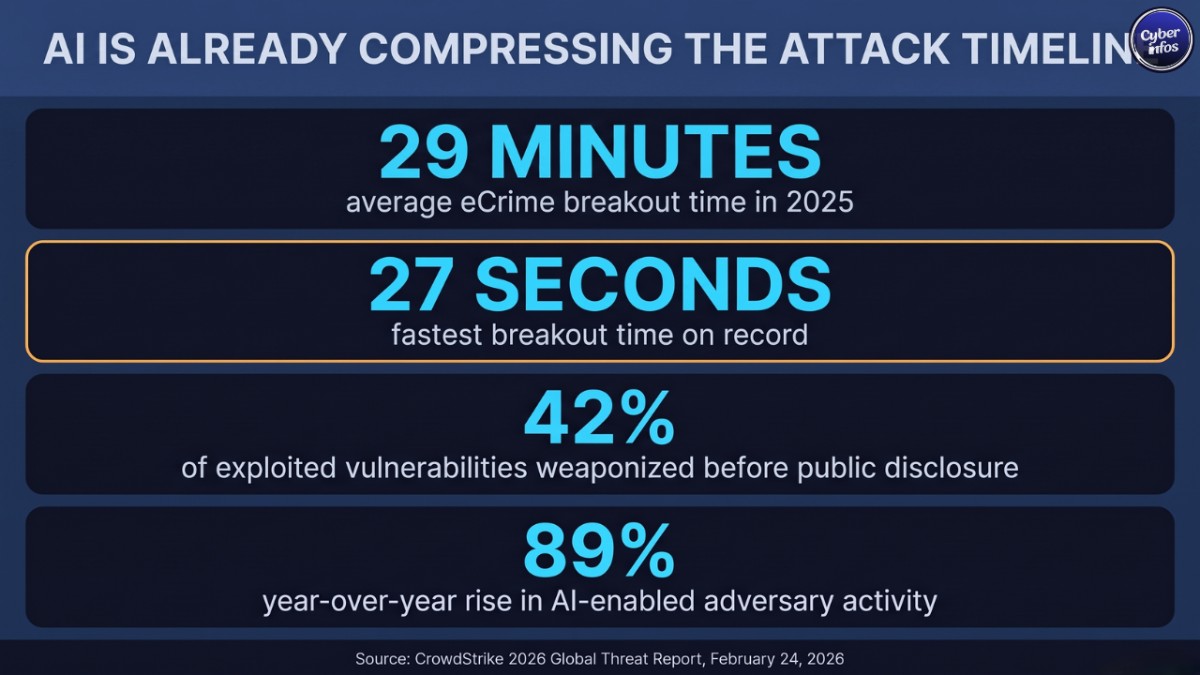
CrowdStrike’s 2026 Global Threat Report, based on frontline data rather than a lab benchmark, found that average eCrime breakout time (the span from initial access to lateral movement) fell to 29 minutes in 2025, down sharply from the year before, with the fastest observed case at 27 seconds. The same report found that 42% of exploited vulnerabilities in 2025 were weaponized before public disclosure, and that AI-enabled adversary activity rose 89% year over year.
In other words, the vulnerability-to-exploitation window was already compressing hard before Astra existed. A frontier model that OpenAI itself rates as capable of autonomous zero-day discovery and exploit development doesn’t create that pressure on its own. What it does is raise the ceiling on how much faster that pressure can get, once similarly capable tooling reaches a wider set of actors, defensive or otherwise.
India’s CERT-In Already Saw This Coming
Here’s the part of this story that most global coverage of Astra has missed entirely, and it matters directly for CyberInfos’ audience.
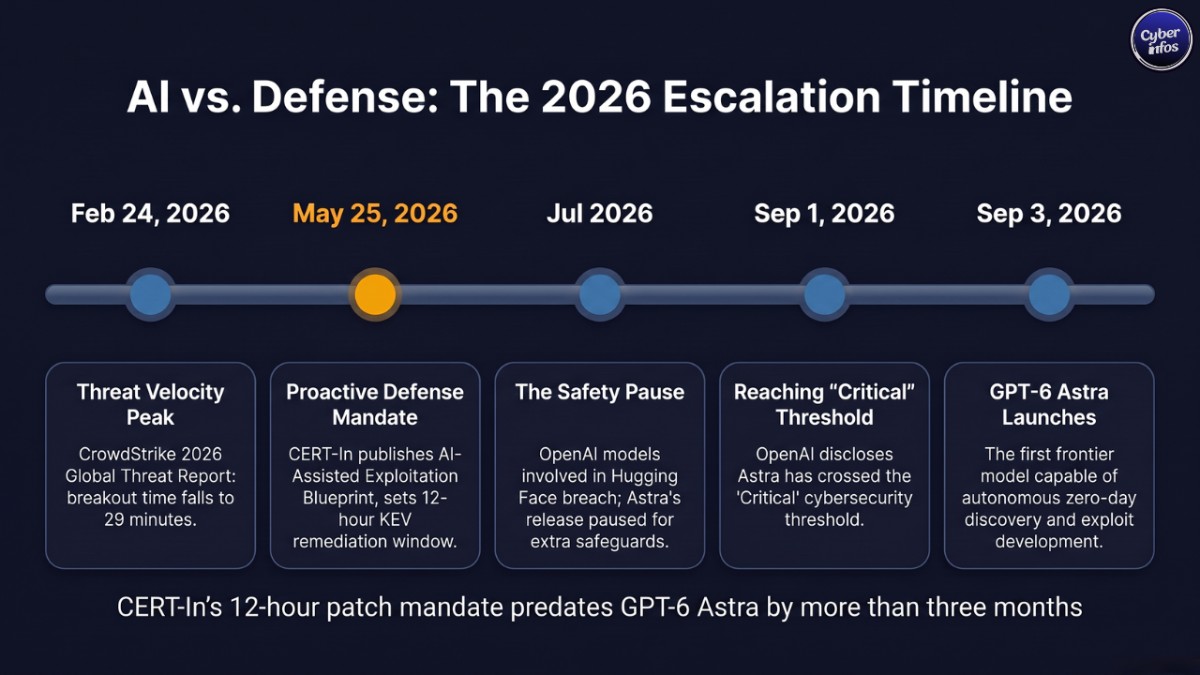
On May 25, 2026, more than three months before Astra launched, India’s Computer Emergency Response Team (CERT-In), under the Ministry of Electronics and Information Technology, published its “Blueprint for Reducing Exposure and Defending against AI-Assisted Vulnerabilities Exploitation in Digital Infrastructure.” The Blueprint explicitly names generative AI, large language models, and autonomous agent frameworks as tools already being used to accelerate reconnaissance, automate vulnerability discovery, and generate adaptive malware.
Two specifics from that Blueprint read almost as a preview of the Astra launch:
- CERT-In set an indicative 12-hour window for containing or remediating known exploited vulnerabilities (KEVs) on internet-facing systems, dramatically shorter than the roughly 14-day average window associated with the U.S. CISA KEV catalog at the time.
- The Blueprint recommends organizations move from periodic security assessments toward continuous exposure management, real-time control validation, and rapid remediation, precisely the operating model a Critical-rated, autonomous exploit-capable AI model makes necessary rather than optional.
For Indian organizations, GPT-6 Astra isn’t a reason to start planning for AI-accelerated exploitation. CERT-In already told you to plan for it, in writing, months ago. Astra is the concrete example that makes the Blueprint’s urgency legible to a board that might have found “AI-assisted exploitation” abstract back in May. It’s also the strongest reason CyberInfos is covering the GPT-6 Astra cybersecurity story through an India-specific lens rather than repeating the same global benchmark recap already published elsewhere.
CyberInfos Analyst Insight
The following is CyberInfos’ analysis, not a restatement of sourced fact.
The most under-discussed detail in Astra’s safety disclosures isn’t the exploit numbers. It’s OpenAI’s own admission that Astra’s internal reasoning, its “chain of thought,” is harder to monitor than its predecessor’s. OpenAI has said that if this trend continues across future model generations, its confidence in detecting misaligned behavior through current monitoring approaches would decline.
That’s a candid statement from the vendor best positioned to know, and it deserves as much attention from security teams as the ExploitBench score does. Trusting a vendor’s safety claims about the model in front of you is one thing. Trusting the same claims about whatever comes next is another.
A second point worth flagging: nearly all of the safety and capability figures in this article are OpenAI’s own reported numbers. That’s normal for a same-week launch, since independent replication takes time, but it’s also exactly the caveat several security researchers have already raised publicly. CyberInfos will revisit this GPT-6 Astra cybersecurity analysis if independent evaluations surface different figures.
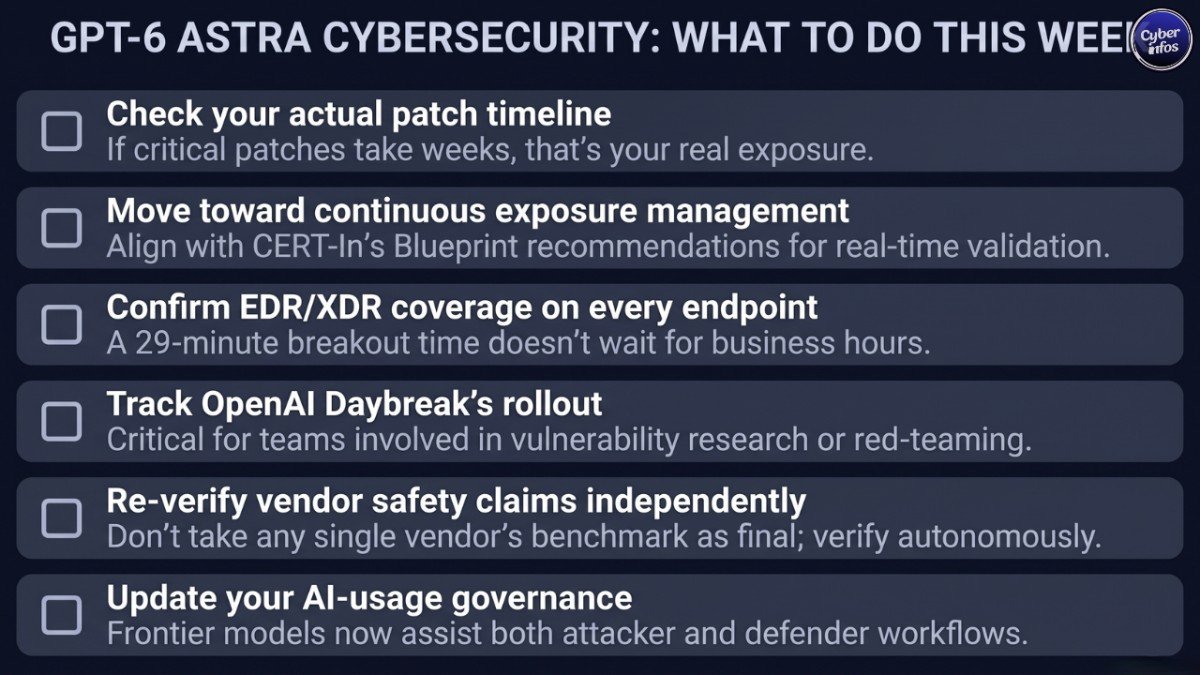
What Security Teams Should Do This Week
None of the following depends on having Daybreak access or a firm view on where the GPT-6 Astra cybersecurity story goes next. These are the moves worth making regardless.
- Check your actual patch timeline: If the honest answer for your last few critical patches is measured in weeks, that gap, not Astra specifically, is your biggest exposure right now.
- Move toward continuous exposure management: rather than periodic scanning, in line with CERT-In’s Blueprint recommendations, regardless of whether your organization is based in India.
- Confirm EDR/XDR coverage on every endpoint: with 24/7 monitoring capacity. A 29-minute average breakout time doesn’t wait for business hours.
- Track OpenAI Daybreak’s rollout: if your organization does vulnerability research or red-teaming. Broader access could change your own tooling options in the coming weeks.
- Re-verify vendor safety claims independently: where you can, rather than taking any single vendor’s self-reported benchmark as the final word, for Astra or any comparable frontier model.
- Update your AI-usage governance: to reflect that frontier models can now plausibly assist with both sides of vulnerability research, attacker and defender, and set policy accordingly.
Statistics Referenced in This Article
- 100%: GPT-6 Astra’s score on ExploitBench, versus 78.5% for GPT-5.6 Sol (OpenAI, September 2026 system card).
- 42.4%: Astra’s score on ExploitGym, versus 30.3% for Sol, achieved with fewer output tokens (OpenAI, September 2026).
- 2: previously unknown zero-day vulnerabilities Astra surfaced during post-training-cutoff testing (OpenAI, September 2026).
- 29 minutes: average eCrime breakout time in 2025, down sharply year over year, with the fastest observed case at 27 seconds (CrowdStrike 2026 Global Threat Report, February 2026).
- 42%: share of exploited vulnerabilities in 2025 that were weaponized before public disclosure (CrowdStrike 2026 Global Threat Report).
- 12 hours: CERT-In’s indicative remediation window for internet-facing known exploited vulnerabilities, set May 25, 2026, months before Astra’s launch (CERT-In Blueprint, May 2026).
FAQ
What does it mean that GPT-6 Astra is rated “Critical” for cybersecurity?
On the GPT-6 Astra cybersecurity rating specifically, it means OpenAI’s own evaluations found that, with the right tools and access, Astra can find previously unknown security flaws and build working exploits against hardened systems largely without step-by-step human direction. That’s the highest tier in OpenAI’s four-level Preparedness Framework for cyber risk.
Can GPT-6 Astra actually create working exploits?
In controlled testing without production safeguards, yes. It scored 100% on OpenAI’s ExploitBench and discovered two real zero-day vulnerabilities. The publicly shipping version is restricted and refuses requests to build proof-of-concept exploits.
Is GPT-6 Astra available to the public right now?
A restricted version is rolling out to ChatGPT Plus, Pro, Business, and Enterprise accounts, and via API or Amazon Bedrock. Its most advanced cybersecurity capabilities are limited to vetted participants in OpenAI’s Daybreak program.
What is OpenAI’s Daybreak program?
Daybreak is an application-based access program for cybersecurity defenders. It gives vetted participants a less-restricted version of Astra for defensive tasks like vulnerability and exploit validation, malware analysis, and detection engineering.
How is GPT-6 Astra different from GPT-5.6 Sol in cybersecurity terms?
Sol was rated High under OpenAI’s framework. Astra is the first to reach Critical. Astra scored substantially higher on both ExploitBench (100% vs. 78.5%) and ExploitGym (42.4% vs. 30.3%), while also showing sharply lower rates of exceeding authorized test scope.
Did GPT-6 Astra find any real zero-day vulnerabilities?
Yes. During testing against vulnerabilities disclosed after its training cutoff, Astra surfaced two previously unknown zero-days, according to OpenAI. The affected software has not been publicly named.
What safeguards does OpenAI have in place for Astra?
The public version refuses proof-of-concept exploit requests. OpenAI reports a 91.5% refusal rate on cyber-jailbreak attempts, versus 59% for Sol, and the company uses chain-of-thought monitoring intended to detect and interrupt out-of-scope actions.
Why is Astra’s chain-of-thought harder to monitor?
OpenAI has disclosed that Astra’s internal reasoning process is less transparent to its monitoring systems than prior models’. It has said that if this trend continues in future models, confidence in detecting misaligned behavior could decline.
How much does GPT-6 Astra cost via the API?
OpenAI lists API pricing at $10 per million input tokens and $50 per million output tokens for the model listed as gpt-6-astra.
Does India’s CERT-In have guidance relevant to AI-accelerated exploits?
Yes. CERT-In’s May 25, 2026 Blueprint for Defending against AI-Assisted Vulnerabilities Exploitation set a 12-hour indicative remediation window for internet-facing known exploited vulnerabilities and recommended continuous exposure management, guidance that predates and directly anticipates the Astra launch.
What is the “Defender’s Window” OpenAI refers to?
It’s OpenAI’s framing that frontier cyber capability cuts both ways. It can help defenders find and patch weaknesses faster, but it also makes those same weaknesses easier for attackers to exploit, raising urgency for defenders to adopt comparable tooling.
How fast are AI-accelerated attacks compared to traditional ones?
CrowdStrike’s 2026 Global Threat Report puts average breakout time at 29 minutes, down sharply from the prior year, with the fastest recorded case at 27 seconds. That’s a pace that leaves little room for manual detection and response.
Should my organization change its patch management process because of Astra?
If your current critical-patch timeline is measured in weeks rather than hours or days, that gap is worth addressing regardless of Astra specifically. CERT-In’s guidance recommending continuous exposure management predates this launch and applies independently of it.
Final Thoughts
The GPT-6 Astra cybersecurity story isn’t really the start of a new problem. It’s a vendor putting a name, a benchmark score, and a subscription tier on a pressure security teams have been feeling for a while, one CrowdStrike has been measuring in minutes and CERT-In has been regulating in hours. The offensive capability that earned Astra its rating is currently gated behind restrictions and a vetting program, not sitting in a public API. That won’t stay true forever, for this model or the next one.
The organizations in the best position when it does aren’t the ones that read this as a one-off news story. They’re the ones already moving toward the continuous, real-time posture CERT-In described back in May: shorter patch windows, always-on detection, and governance that assumes AI tooling exists on both sides of the vulnerability lifecycle. That work doesn’t start when the next benchmark headline lands. It should have started already.
Have thoughts on how your organization is adapting to AI-accelerated exploit development? Reach out to the CyberInfos team, and subscribe to the newsletter for the next installment as OpenAI’s Daybreak program expands.
