


This week in cybersecurity, August 31 to September 6, 2026, was defined less by a single blockbuster breach than by how many different layers of the stack got hit at once. A sixth Chrome zero-day of the year, a fresh crop of CISA-tagged exploited flaws spanning AI infrastructure, and a Chinese espionage crew quietly turning routers into surveillance platforms all landed in the same seven-day window.
Underneath the headline items, a medtech giant limped back online after a week-long outage, an airport operator’s booking data went up for sale, and a ransomware crew reportedly let an AI agent run the whole intrusion end to end.
CyberInfos assessed the global threat posture at Level 3 (Elevated) this week: internet-facing infrastructure and AI-adjacent developer tooling carried the bulk of confirmed exploitation, while no single event reached mass-casualty scale. This weekly cybersecurity report walks through what happened, what to patch first, and what to watch heading into next week.
Major Incidents in This Week’s Cybersecurity Landscape
The major incidents section of this weekly cybersecurity report begins with a medtech giant still recovering from an outage, followed by two data-theft claims and one case of AI-assisted ransomware tradecraft.
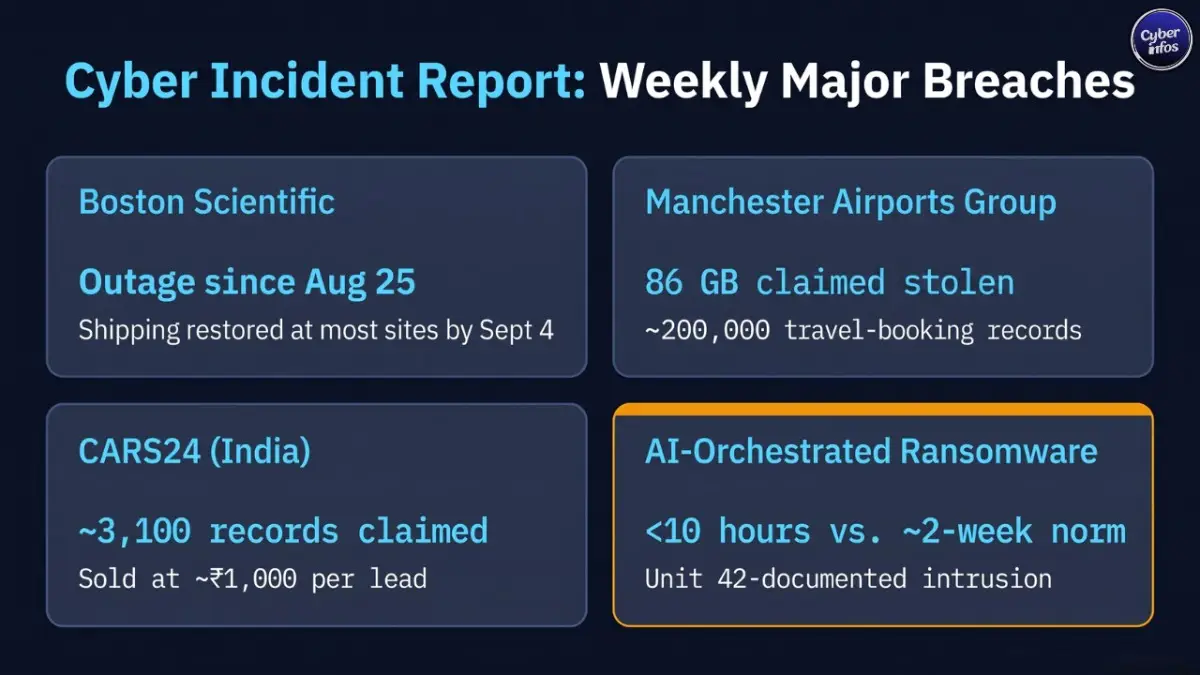
1. Boston Scientific – Medical Devices
The medtech giant spent this reporting week climbing out of a network outage first detected on August 25. By August 31, Boston Scientific was still working through the aftermath; by September 4, it confirmed it had begun restoring shipping at the majority of its major global distribution centers, working through an order backlog while other product lines and sites remained on the path back to full capacity.
The company has engaged CrowdStrike and other outside responders, said it found no evidence of unauthorized activity in its environment after August 25, and confirmed the intrusion was confined to on-premises systems rather than its cloud applications. Existing implantable cardiac devices were unaffected, though new remote activations for some cardiac monitors were disrupted. Boston Scientific has not disclosed an attacker, a method of entry, or whether data was taken. [Read more]
2. Manchester Airports Group – Aviation
The FulcrumSec extortion group claimed responsibility for a breach at Manchester Airports Group, which runs Manchester, London Stansted, and East Midlands airports, alleging theft of roughly 86 GB of data. The claimed haul includes around 200,000 records tied to upcoming travel bookings: FastTrack purchase history, scheduled arrival times, terminal assignments, and trip purposes. As of this week the claim rests on the extortion group’s own leak-site posting rather than a detailed disclosure from the airport operator. [Read more]
3. CARS24 – Automotive Marketplace (India)
Indian used-car marketplace CARS24 was the subject of a smaller but notable claim this week: a threat actor alleged theft of roughly 3,100 customer records, which were reportedly offered for sale at around ₹1,000 per lead. The relatively modest record count is itself the story. It illustrates how resale markets have matured to the point that even small, targeted data sets now carry a functioning price tag, rather than needing to be part of a mega-breach to be monetized. [Read more]
4. AI-Orchestrated Ransomware Intrusion – Enterprise Sector
Unit 42 responders disclosed a ransomware case in which a human operator relied on frontier AI models and agentic attack frameworks to carry out nearly every step of the intrusion, compressing what the firm said would normally be a roughly two-week operation for human attackers into under ten hours. Unit 42 said the AI agents monitored, evaluated, and re-planned the attack in real time, and the intruder reportedly left the victim an 80-page security assessment generated by the tooling used in the break-in. Researchers noted the case did not rely on a novel zero-day or elite tradecraft; the story is operational speed, not new capability. [Read more]
ANALYST INSIGHT: A theme worth carrying through the rest of this weekly cybersecurity report: none of this week’s major incidents relied on a headline-grabbing zero-day to get in the door. Boston Scientific’s outage, the Manchester Airports claim, and the CARS24 listing all point back to conventional intrusion paths and third-party exposure rather than novel exploitation. The AI-assisted ransomware case is the outlier worth watching: not for its access method, but because it shows attackers using agentic tooling to compress dwell time, which shortens the window defenders have to detect and respond before data leaves the network.
New Vulnerabilities and Patches
CISA added ten actively exploited vulnerabilities to its Known Exploited Vulnerabilities (KEV) catalog this week, and vulnerability trackers logged 2,316 new CVE disclosures across the same window, of which 271 were rated critical. This weekly cybersecurity report’s vulnerability section prioritizes confirmed exploitation over raw CVSS score.
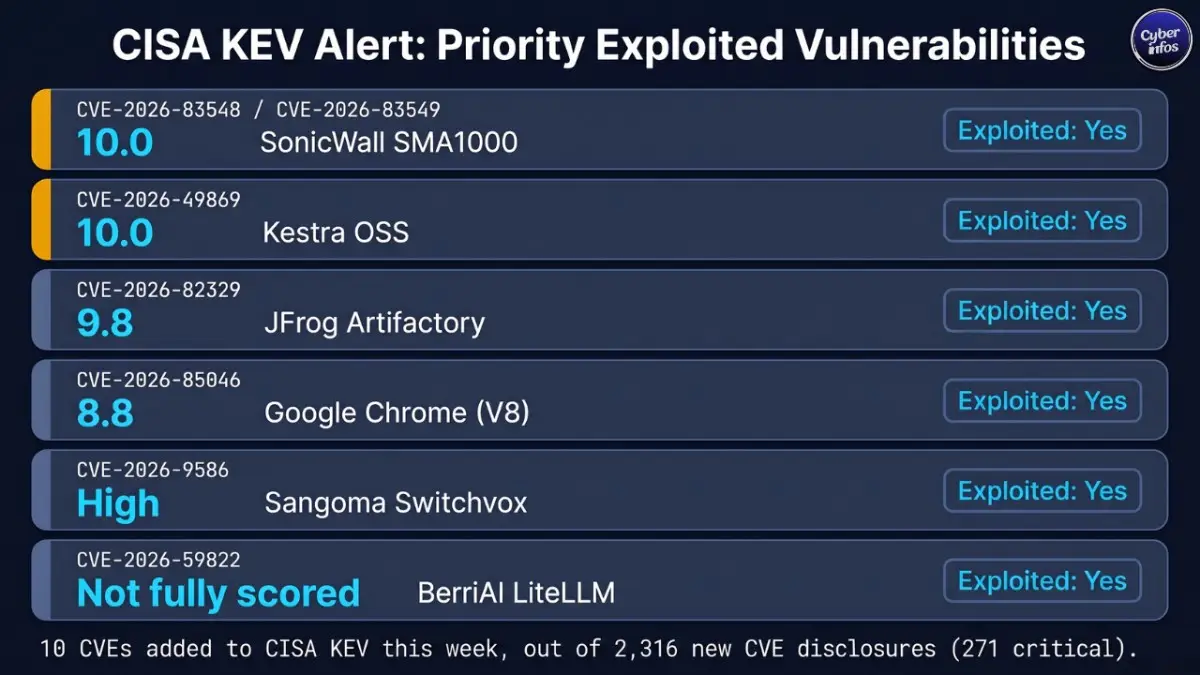
[CVE] CVE-2026-83548 / CVE-2026-83549 | SonicWall | SMA1000 Appliances | CVSS: 10.0 / high | Exploited: Yes
A pre-authentication SSRF (83548) can be chained with a post-authentication OS command injection (83549) to reach unauthenticated remote code execution on SMA1000 secure remote access gateways. SonicWall confirmed real-world attacks and both flaws were added to KEV, with reporting linking the activity to ransomware-affiliated actors. Because SMA1000 Work Place interfaces are commonly internet-facing by design, exposed appliances are a priority target.
[PATCH] Apply SonicWall’s SMA1000 security update immediately and review appliance logs for indicators tied to the vendor’s advisory.
[CVE] CVE-2026-82329 | JFrog | Artifactory | CVSS: 9.8 | Exploited: Yes
An improper-authentication flaw lets an unauthenticated attacker with network access mint administrator tokens under Artifactory’s default configuration. WatchTowr observed in-the-wild exploitation beginning September 1, four days after disclosure, with attackers minting admin tokens and enumerating users, groups, and credentials.
[PATCH] Update to a patched Artifactory release and rotate any tokens that may have been minted during the exposure window.
[CVE] CVE-2026-49869 | Kestra OSS | Workflow Orchestration | CVSS: 10.0 | Exploited: Yes
An authentication-bypass flaw in Kestra’s request-path handling lets an unauthenticated attacker create and execute arbitrary workflows without credentials, reaching code execution inside the worker container. CISA gave a three-day remediation window after adding it to KEV on September 2.
[PATCH] Upgrade to the fixed Kestra release without delay; this is one of the two flaws CyberInfos ranks for immediate patching this week.
[CVE] CVE-2026-59822 | BerriAI | LiteLLM | CVSS: Not fully scored at time of KEV addition | Exploited: Yes
An improper-authentication issue in LiteLLM, a widely used AI gateway and proxy for calling LLM APIs, was added to KEV alongside a companion flaw in the Starlette ASGI framework (CVE-2026-48710) that underlies LiteLLM, vLLM, and MCP server implementations. Together they mark the first KEV batch in which AI/ML infrastructure made up nearly half of the additions.
[PATCH] Patch LiteLLM and any Starlette-based services to their fixed versions, and re-verify authentication logic on any custom middleware built on Starlette’s URL-path handling.
[CVE] CVE-2026-9586 | Sangoma | Switchvox | CVSS: High | Exploited: Yes
An unauthenticated SQL injection flaw in the Switchvox PBX platform allows remote code execution. Horizon3.ai and watchTowr reported weaponization this week, with intruders deploying reverse shells against vulnerable systems.
[PATCH] Apply Sangoma’s fix and audit Switchvox systems for unfamiliar shell processes or outbound connections.
[CVE] CVE-2026-85046 | Google | Chrome (V8 engine) | CVSS: 8.8 | Exploited: Yes
A type-confusion bug in Chrome’s V8 JavaScript and WebAssembly engine allows arbitrary code execution inside the browser sandbox via a crafted HTML page. Google shipped Chrome 152.0.7977.82/.83 on September 3–4 to fix it along with eleven other flaws, and CISA added it to KEV the same week with an September 18 federal deadline.
It is the sixth actively exploited Chrome zero-day patched in 2026 and the third to hit V8 specifically. Chromium-based browsers, including Edge, Brave, Opera, and Vivaldi, inherit the same flaw and need the equivalent update.
[PATCH] Push Chrome 152.0.7977.82/.83 fleet-wide via managed update policy rather than relying on individual relaunches, and extend the same urgency to any other Chromium-based browser in use.
CISA also added CVE-2023-49105 (ownCloud, improper authentication), CVE-2026-53362 (Linux kernel IPv6 subsystem), and CVE-2026-66384 (JFrog Artifactory path traversal) to KEV this week, rounding out a ten-CVE KEV week that spans network appliances, AI gateways, workflow orchestration, and legacy file-sharing software.
PRIORITY ACTION: Patch the SonicWall SMA1000 chain and the Kestra authentication bypass first: both carry maximum CVSS scores, both are confirmed exploited, and both sit on internet-facing surfaces that are trivial for scanners to find. Chrome’s V8 fix is the next priority given its footprint across nearly seven in ten of the world’s browsers.
Ransomware Activity
This weekly cybersecurity report’s ransomware section spans an established RaaS operation, a busy week for mid-tier extortion crews, and the broader trendline heading into September.
Krybit and Gentlemen – Healthcare and Manufacturing Pressure Continues
CYFIRMA’s weekly intelligence tracking flagged continued activity from the Krybit ransomware-as-a-service operation, which the firm assesses as a financially motivated, affiliate-driven group whose custom malware suite has repeatedly hit healthcare targets, alongside the Gentlemen ransomware group’s claimed hit on a Japanese manufacturing company. Krybit’s affiliate model (external operators incentivized through profit-sharing rather than a single core team doing the intrusions) is the operational detail CyberInfos flags as the more durable trend, since it means takedown of leadership doesn’t necessarily stop the affiliates.
Settra and Storm – A Volume Week for Mid-Tier Groups
Newer, lower-profile groups had an unusually active week. The Settra group claimed victims spanning a Canadian metals company, a cell-tower construction firm, a U.S. medical billing company, and a Dutch firm, all within days of each other, while the Storm group claimed a Canadian construction contractor and a U.S. aerospace-parts repair specialist. Separately, a Brazilian adhesives manufacturer was claimed by the Vexy group. None of these claims carry independent confirmation from the named victims as of this report, and ransom amounts and full data scope remain unverified per each group’s own leak-site posting.
Where Ransomware Stands Heading Into September 2026
Black Kite’s most recent full-year tracking recorded 7,551 publicly disclosed ransomware victims across the prior twelve-month period, a 24.9% year-over-year increase and the fourth consecutive year the figure has set a new high, with the active group count reaching 146 by June 2026. Growth was concentrated in the back half of that period, closing with the highest single month on record.
Two structural weaknesses show up repeatedly in that dataset: a majority of victims still carried at least one medium-or-higher unpatched vulnerability at the time of disclosure, and a majority also had misconfigured DMARC records: both are gaps that predate the ransomware event itself and remain visible on rescan even after an incident closes.
ANALYST INSIGHT: The volume of mid-tier group activity this week (four or more organizations claimed by Settra alone) is more informative than any single named victim. It points to a maturing affiliate ecosystem where a group doesn’t need brand recognition to run a functioning double-extortion operation; it needs unpatched edge infrastructure and a leak site. That’s consistent with the unauthenticated, internet-facing flaws dominating this week’s KEV additions.
Threat Intelligence
This weekly cybersecurity report’s threat-intelligence section centers on one confirmed espionage campaign against network infrastructure and one emerging pattern in AI-assisted attack tradecraft.
Fire Ant (overlaps UNC3886) – China – Routers and Authentication Infrastructure as Attack Platforms
Incident-response firm Sygnia disclosed on August 30 that the China-nexus espionage cluster it tracks as Fire Ant (assessed to strongly overlap with Mandiant’s UNC3886) has expanded a long-running campaign beyond VMware hypervisors into Cisco IOS XR routers, TACACS authentication servers, and Linux management hosts. The group used a persistence script disguised as a legitimate system process, suppressed syslog output containing specific tunnel-related strings, and modified router command-execution paths so that administrators running “show” commands would not see evidence of the compromise.
A second implant, a Linux backdoor Sygnia named BridgeAgent, masqueraded as a Zabbix monitoring agent and disguised its process as a GNOME shell component while polling attacker infrastructure over TLS. Fire Ant also captured packet traffic from compromised routers and exfiltrated it to external FTP infrastructure, and targeted TACACS servers to harvest the credentials that authenticate administrative access across a network.
- [TTP] Impair Defenses (ATT&CK ID: T1562) – suppression of syslog messages and modification of router CLI output to hide tunnel configuration from administrators
- [TTP] Masquerading (ATT&CK ID: T1036) – Linux backdoor disguised as a Zabbix agent and a GNOME shell process
[IOC] Persistence path | /etc/rc.d/init.d/grub-rommon | Script used to relaunch the router implant
AI-Orchestrated Ransomware Tradecraft
Beyond the incident detailed above, Unit 42’s disclosure this week is itself a threat-intelligence data point: it documents agentic AI systems being used to run reconnaissance, exploitation, and negotiation-support tasks with minimal human intervention during an active intrusion, rather than as a coding aid used beforehand. Defenders should treat unusually fast dwell-time-to-exfiltration timelines as a possible signal of automated attack tooling rather than assuming a slower, human-paced kill chain.
Industry News
This weekly cybersecurity report’s industry section tracks funding, a law-enforcement takedown, and a vendor risk disclosure that all landed this week.
HiddenLayer Raises $100 Million to Expand AI Runtime Security
AI security company HiddenLayer announced a $100 million Series B on September 2, led by Delta-v Capital with participation from Ten Eleven Ventures, Morgan Stanley, Microsoft’s M12, and Booz Allen Ventures, bringing its total funding past $155 million. The round funds expansion of the company’s Agentic Runtime Security capabilities and a new Agent Harness Security product aimed at protecting AI coding agents at runtime. The raise lands in the same week CISA’s KEV additions turned toward AI gateway and orchestration software, underscoring that investor and attacker attention are converging on the same layer of the stack simultaneously.
DOJ-Led Operation Disrupts the Sality Botnet
The U.S. Department of Justice announced a multinational operation on September 2, working with authorities in Bulgaria, Hungary, and Romania alongside private-sector partners CrowdStrike and the Shadowserver Foundation, to disrupt the long-running Sality botnet and malware family and take down its supporting infrastructure. The action was framed as part of the U.S. government’s broader strategy of degrading adversary tooling and infrastructure through public-private coordination rather than pursuing arrests alone.
Toshiba Publishes 2026 Cyber Security Report
Toshiba released the English edition of its Cyber Security Report 2026, covering its fiscal year 2025, on August 31. The report describes cyber threats increasingly reaching into control systems and industrial equipment, with ransomware, targeted attacks, and supply-chain threats disrupting corporate activity across the sectors Toshiba operates in. That’s a reminder that OT-adjacent risk reporting is becoming a standard disclosure item for large industrial vendors, not just a specialist niche.
Tool Updates
This weekly cybersecurity report’s tool-updates section covers framework changes and CVE-tracking volatility relevant to detection engineering.
MITRE ATT&CK Agile Release Continues to Roll Through Security Programs
MITRE’s first-ever Agile release of ATT&CK, published in early August, remains the framework update security teams are still working through this week. Unlike the twice-yearly full releases, the Agile format adds Groups, Software, and Campaign entries between scheduled cycles when significant new threat activity emerges: this round added entries tied to ShinyHunters, software linked to CI/CD and software-supply-chain attacks, and other groups tracked in current intrusions.
No new ATT&CK release landed during this specific reporting week, but teams that haven’t yet reconciled detection content against the April v19 Defense Evasion split, now separated into Stealth and Defense Impairment tactics, should treat that reconciliation as still-open work, since it affects how this week’s Fire Ant anti-forensics techniques get mapped.
CVE Trackers Log a Volatile Week
Daily CVE-monitoring services recorded sharp day-to-day swings in disclosure volume this week, with critical CVE counts moving from 26 to 44 to 28 to 20 across successive days, illustrating how much noise sits on top of the small number of flaws that actually matter. Teams relying on CVSS score alone to triage would have missed that the highest-priority items this week were mid-score entries with confirmed exploitation, not the handful of CVSS-10 disclosures with no attack activity behind them.
Looking Ahead
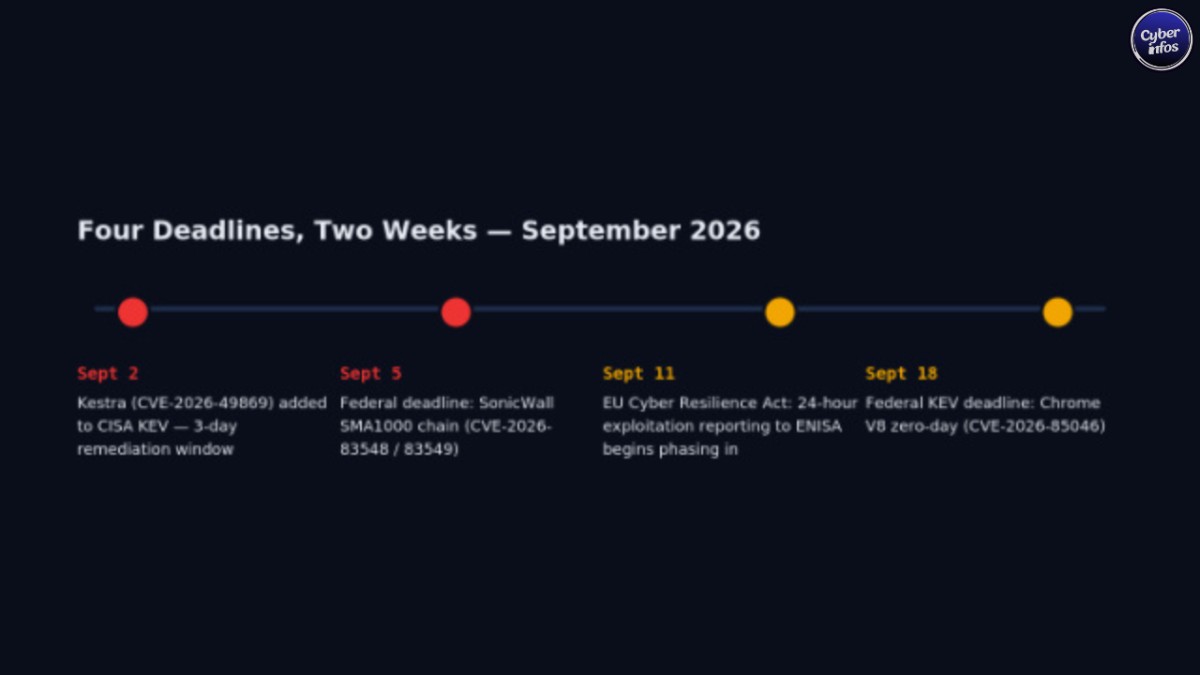
This weekly cybersecurity report closes with three developments worth tracking into next week. First, the SonicWall SMA1000 and Kestra remediation clocks are short. CISA set a September 5 federal deadline for the SonicWall chain and a three-day window for Kestra from its September 2 KEV addition, and organizations running either on internet-facing infrastructure should treat those same timelines as their own operational deadline, federal mandate or not.
Second, the Chrome 152 rollout needs fleet-wide verification rather than a one-time push. Staged rollouts mean a meaningful share of endpoints can remain on vulnerable builds well past the initial announcement, and the September 18 KEV deadline is a floor, not a target.
Third, expect continued reporting on the AI-orchestrated ransomware case as more incident responders compare notes; if the compressed intrusion timeline Unit 42 described turns out to be reproducible rather than a one-off, detection playbooks built around multi-day dwell times will need revisiting sooner rather than later.
UPCOMING EVENTS: The EU Cyber Resilience Act’s active-exploitation reporting obligations begin phasing in on September 11, requiring 24-hour disclosure to ENISA for in-scope products with European exposure; organizations with EU-facing software should confirm their reporting pipeline is ready before that date.
[WATCH] : The single item this weekly cybersecurity report wants on every defender’s radar next week: keep an eye on whether the Fire Ant/UNC3886 router and TACACS compromise spreads beyond the environments Sygnia has already named.
The group’s demonstrated ability to suppress the very logs defenders would use to detect it means an absence of alerts on Cisco IOS XR or TACACS infrastructure can no longer be read as evidence of a clean environment. Verification needs to come from an independent source outside the compromised device itself, and until that check has been done, treat administratively significant network gear as unproven rather than trusted by default.
