

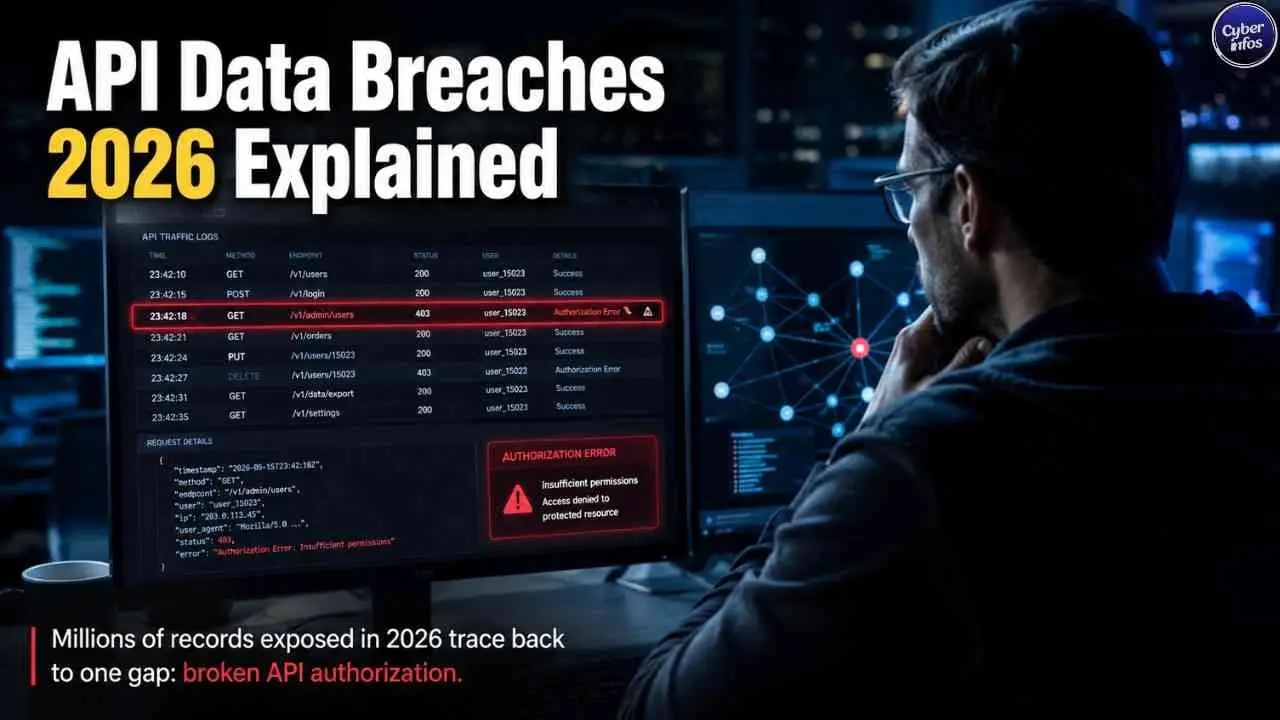
Most security teams still picture a breach as someone breaking down a door. That’s not what’s happening with API data breaches 2026 has produced so far. Attackers are walking through the front door, logged in, and simply asking for someone else’s data.
An exposed API doesn’t need a stolen password or a zero-day exploit to cause damage. It just needs one endpoint that trusts an ID it shouldn’t, and a request most firewalls will wave through without a second look. Security teams keep hardening the perimeter. Meanwhile, the real gap sits one layer deeper, inside the logic that decides who’s allowed to see what.
The stakes are already visible. Millions of records tied to healthcare platforms, hiring systems, and consumer apps have been pulled out through APIs this year alone. Regulators are watching closely, too, as broken API authentication breach cases pile up in disclosure filings.
Here’s what we’ll cover: what’s actually driving these incidents, three real cases from 2026, and a working checklist to find the same gaps in your own environment before someone else does.
Quick Answer
API data breaches 2026 has recorded so far share one root cause: authorization logic, not encryption or perimeter defense, is failing at the object level. Attackers don’t “hack” these APIs. They authenticate normally, change an ID in the request, and read data that was never meant for them.
What’s Actually Happening to APIs in 2026
Look closely at the API data breaches 2026 has generated, and a pattern emerges fast. APIs are the connective tissue of almost every modern application. Mobile banking, hiring platforms, healthcare portals, and AI-driven tools all lean on them to move data between services, and that growth has a cost.
Industry surveys now put the share of organizations reporting at least one API-related security issue in the past year at close to universal. The average API incident is exposing well over a million records noticeably higher than breaches that start elsewhere in the stack.
What’s changed isn’t that APIs suddenly got worse. It’s that they multiplied faster than the authorization logic protecting them.
Every new integration, every third-party connector, every internal microservice adds another endpoint that has to correctly answer one question: is this specific caller allowed to see this specific object? When that check is missing, inconsistent, or bolted on after the fact, the API works exactly as designed just for the wrong person.
A well-run zero trust API architecture is supposed to close this gap by verifying every request instead of assuming trust once a session exists, but most organizations are still retrofitting that model onto systems that were never built for it.
Why APIs Became the Easiest Way In
Traditional web applications enforce access control at the page level. APIs don’t work that way. A typical REST endpoint looks like /api/orders/456, exposing both a resource type and an identifier directly in the request. If the backend doesn’t independently verify that the logged-in user actually owns order 456, changing that number to 457 is all it takes to view someone else’s data.
That single design pattern explains most of the API exposure breach analysis coming out of 2026 incidents, and it’s the same pattern showing up across nearly every API data breaches 2026 report published so far. Three conditions make it worse:
- Cloud-native architecture spreads authorization logic across services: Misconfigured cloud APIs now account for a majority of exposure incidents, because ownership checks that used to live in one place now have to be enforced consistently across dozens of microservices, often sitting behind an API gateway that was configured for routing and rate limiting, not object-level authorization.
- Third-party and vendor APIs extend trust further than teams realize: A large share of recent leaks trace back to a partner integration, not the primary company’s own code which is exactly the third-party API risk that keeps showing up in post-incident reports.
- Nobody has a full inventory: Most security teams admit they can’t fully track where sensitive data flows across their own API surface. That gap is how shadow APIs and deprecated endpoints stay live long after anyone is watching them. It’s also the single biggest reason the API data breaches 2026 has recorded keep repeating the same story across unrelated companies.
The Three Failure Patterns Behind Every Major Incident
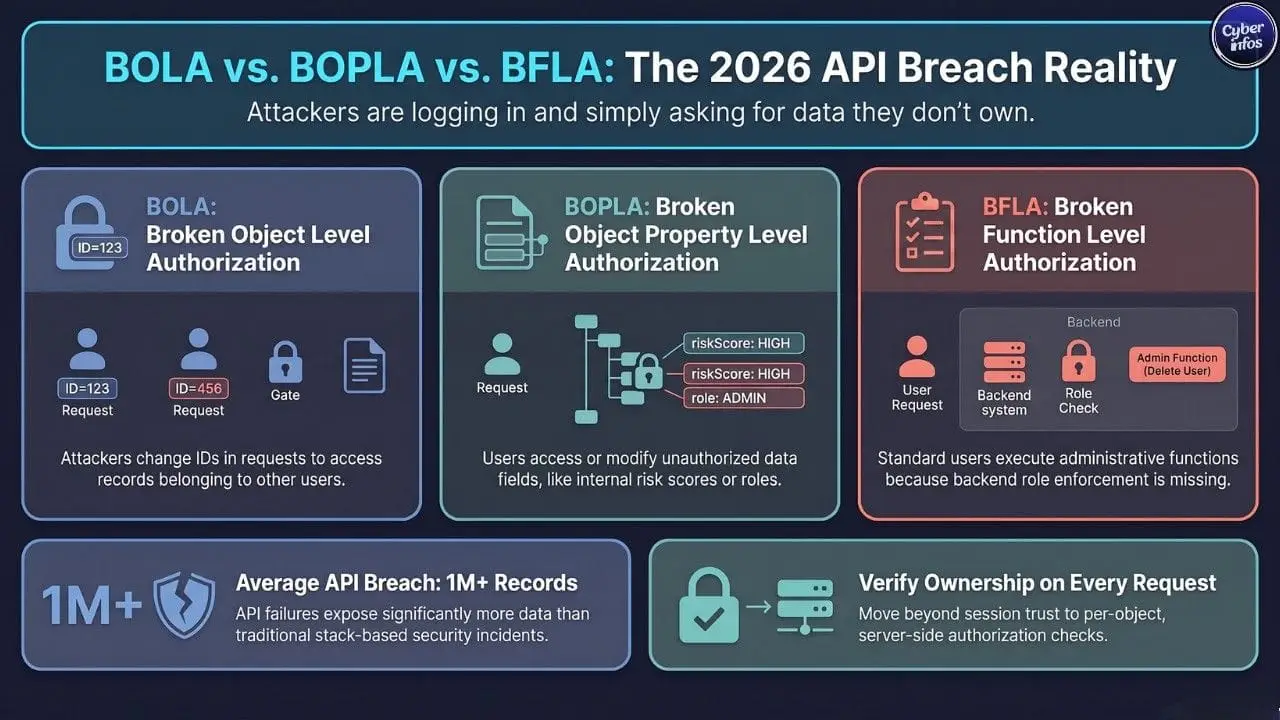
Not every API breach looks the same on the surface. Almost all of them, though, map back to one of three access-control failures on the OWASP API Security Top 10.
Broken Object Level Authorization (BOLA).
The classic pattern. An endpoint accepts an object ID and never confirms the caller owns it. Attackers exploit this through simple enumeration incrementing or guessing sequential IDs until they hit real records.
Broken Object Property Level Authorization (BOPLA).
A subtler variant. The endpoint checks ownership correctly but exposes or accepts fields it shouldn’t, letting a user read a property like an internal risk score, or write to a field like an account role that was never meant to be user-editable.
Broken Function Level Authorization (BFLA).
The API distinguishes between user roles in the interface, but the backend doesn’t actually enforce it. A standard user who discovers or guesses an admin endpoint URL can often call it directly, because the authorization check exists on the front end and nowhere else.
All three share the same root cause. Authentication confirms who someone is. Authorization confirming what that specific person can touch gets treated as an afterthought. Nearly every one of the API data breaches 2026 has produced maps back to one of these three patterns.
Real-World API Data Breaches 2026 Has Already Seen
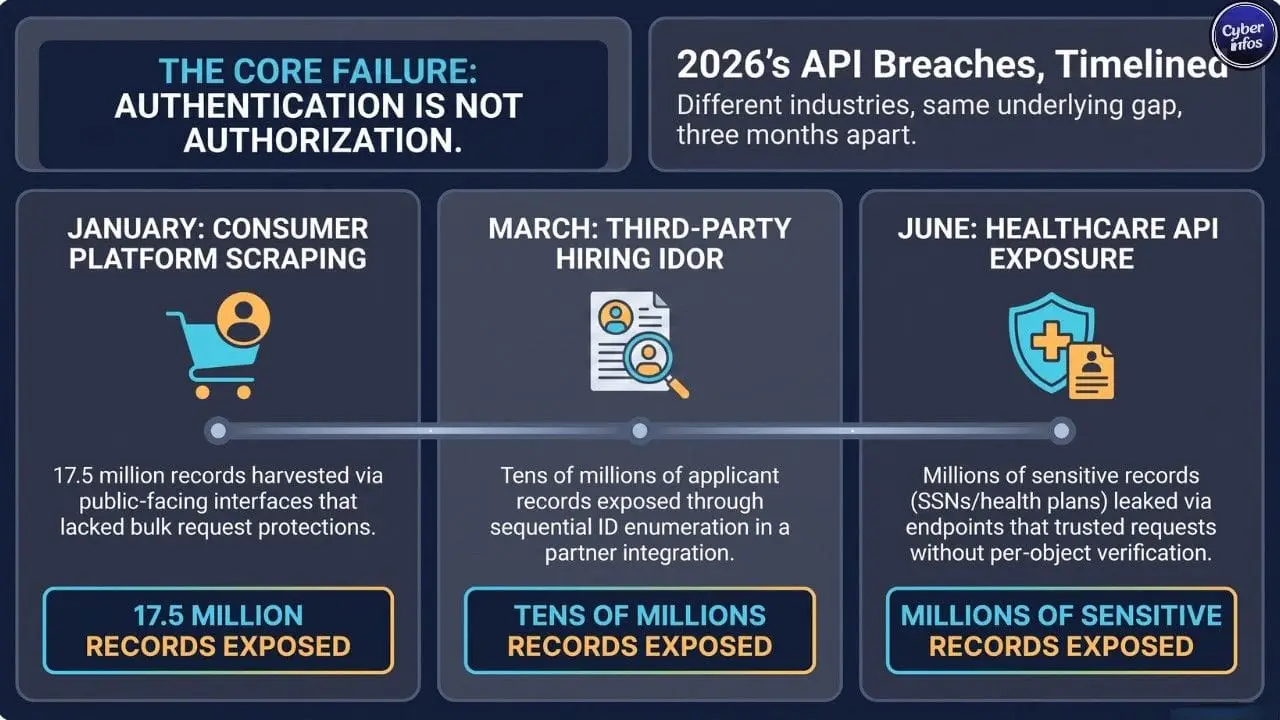
Instagram API scraping exposure – January 2026.
One of the earliest entries in the API data breaches 2026 has recorded. A dataset of roughly 17.5 million user records surfaced on a dark web marketplace, including names, email addresses, phone numbers, and partial location data. The platform maintained the data was technically “public,” but the scale and structure of the leak made it functionally identical to a breach for the people affected. It’s a reminder that API exposure doesn’t require a broken lock just an interface that hands out more than it should to anyone who asks in bulk.
Third-party hiring platform IDOR incident.
An AI-driven hiring tool integrated with a major restaurant chain’s applicant systems suffered a breach traced to weak admin credentials combined with an insecure direct object reference. Attackers enumerated applicant records simply by changing identifiers in requests, exposing tens of millions of records. The parent company’s own APIs were never directly compromised. The damage came entirely from trust extended into a connected third-party system.
Exposed healthcare API – late 2025 into early 2026.
Over a roughly three-week window, an exposed API tied to a healthcare organization let attackers pull names, Social Security numbers, dates of birth, phone numbers, and health plan information. Healthcare has led breach volume for much of 2026, and API exposure rather than ransomware or phishing has been a recurring entry point across several of the year’s largest disclosures.
Different industries. Different attackers. Different scale. Same underlying gap: an API answered a request it should have questioned first. These three cases alone account for a meaningful share of the API data breaches 2026 has recorded, and the pattern shows no sign of slowing.
How Attackers Actually Find These Endpoints
Exploiting BOLA and its variants doesn’t require sophisticated tooling. Attackers typically:
- Capture legitimate API traffic through a proxy while using the application normally
- Identify predictable or sequential identifiers in the requests
- Automate enumeration across a range of IDs, watching for successful responses
- Look for parallel or “hidden” endpoints referenced in JavaScript, mobile app binaries, or API documentation that never made it into the production access-control policy
None of this looks like credential stuffing or a brute-force login attempt, and that’s exactly the problem. Because the traffic mirrors normal authenticated usage, it rarely triggers the alerts that a network intrusion would. This class of vulnerability routinely evades automated scanners and checklist-driven audits for a simple reason: it’s a business logic failure, not a missing patch. It’s also why so many of the API data breaches 2026 has seen went undetected for weeks before anyone noticed.
What This Costs When It Goes Wrong
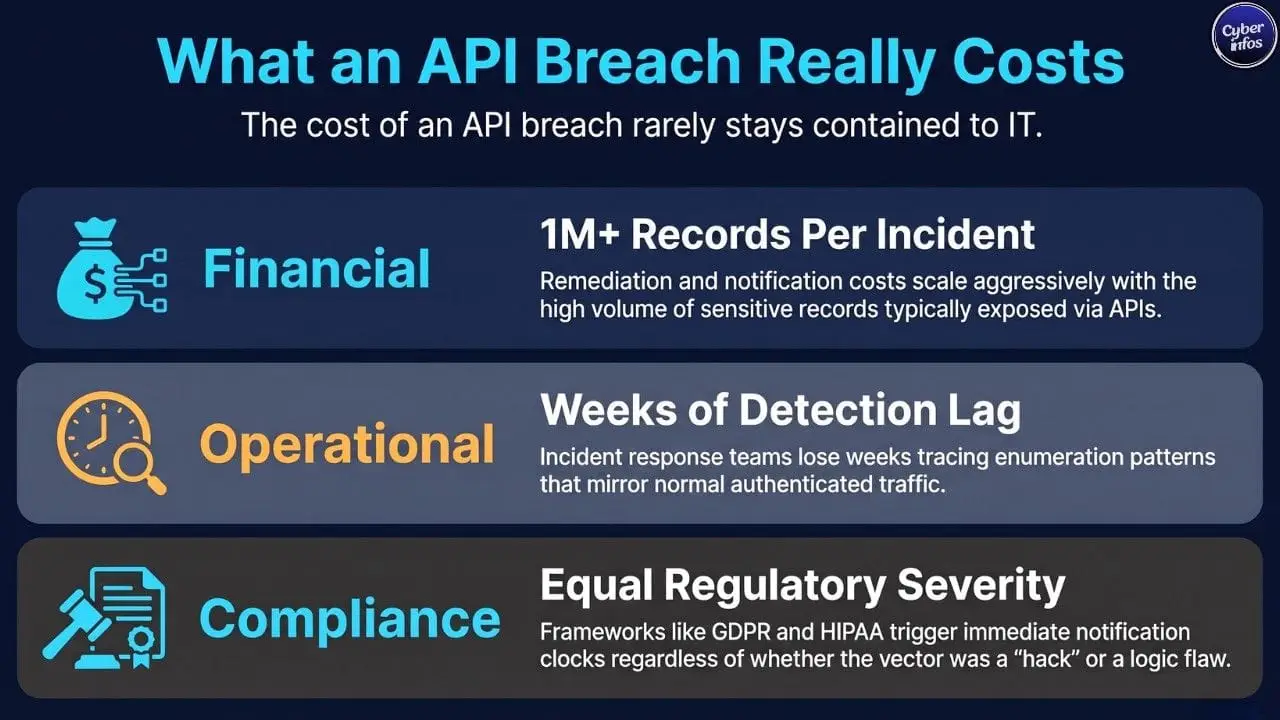
Every one of the API data breaches 2026 has produced carries a real price tag, and the direct costs are the ones most reports lead with. Regulatory notification obligations. Credit monitoring for affected individuals. In healthcare or financial cases, potential fines tied to frameworks like HIPAA, GDPR, or India’s DPDP Act. The IBM Cost of a Data Breach research has consistently shown that incidents involving improper access to sensitive records carry substantial financial and operational consequences, even without a ransomware payload attached.
Financially: notification costs and regulatory penalties scale with the volume of records exposed and the sensitivity of the data a breach involving Social Security numbers or medical records costs materially more to remediate than one limited to names and email addresses.
Operationally: incident response teams lose weeks tracing exactly which objects an attacker could reach, since API logs rarely distinguish “normal high-volume user” from “systematic enumeration” without dedicated tuning.
On the compliance side: an API-driven data exfiltration event triggers the same notification clock as any other breach the regulator doesn’t care whether the vector was a phishing email or a changed ID in a URL.
Then there’s the less obvious cost: trust. When a breach traces back to an API especially a third-party one customers and partners start asking questions about every other integration a company runs. That scrutiny slows down deal cycles, vendor onboarding, and in some cases entire product launches.
CyberInfos Analyst Insight
If there’s one throughline in the API data breaches 2026 has produced, it’s this: the pattern across nearly every incident referenced here is the same: authentication worked exactly as intended. The attacker had a valid account, a valid session, and a valid token. What failed was the second question every API should ask on every request not just “who are you,” but “should you be allowed to touch this specific object, right now, for this specific reason.”
Teams that treat authorization as a one-time architectural decision keep getting breached. Teams that treat it as a per-request, per-object, ownership-aware check tend to catch these gaps in code review instead of in a breach notification letter. That’s the difference between reading about the next API security data leak and writing the postmortem for it.
How to Stop Being the Next Case Study
None of the API data breaches 2026 has documented required a full infrastructure rebuild to prevent, and fixing this doesn’t require ripping out existing API infrastructure either. It requires closing the gap between authentication and authorization at the object level and it helps to sequence the work.
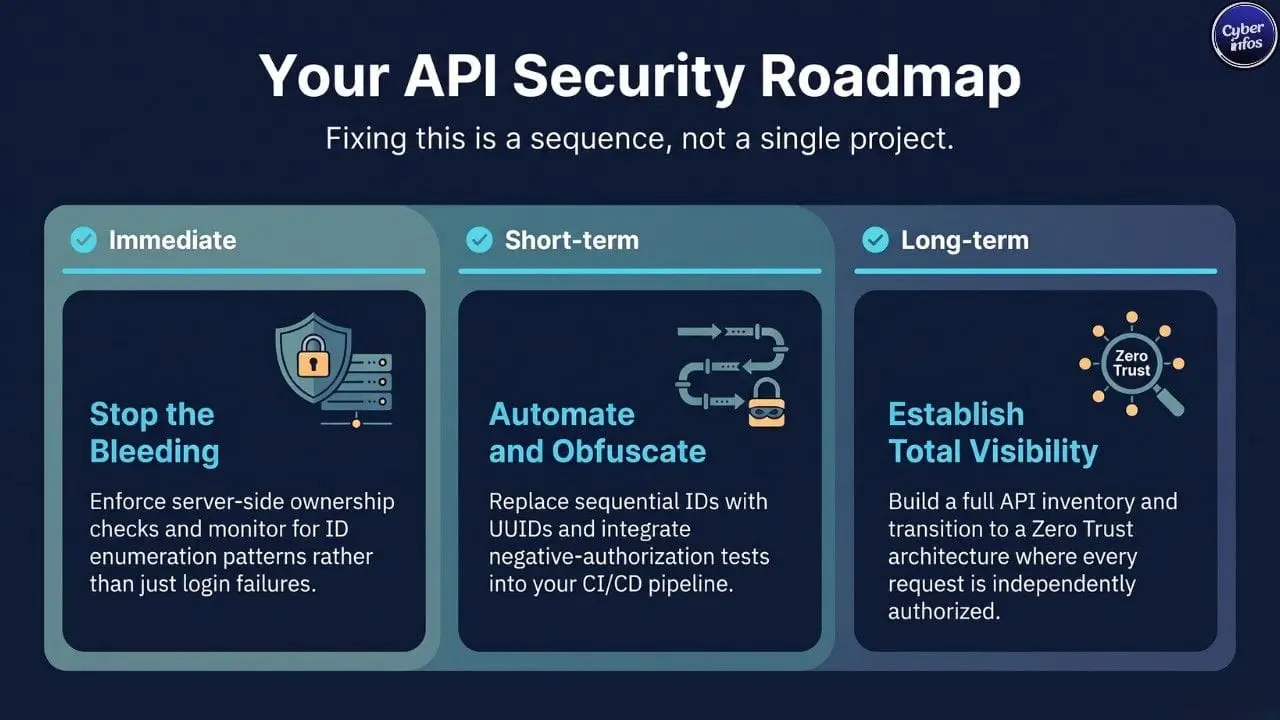
Immediate Actions
- Enforce ownership checks server-side, on every endpoint that accepts an identifier. Never assume the front end’s role-based restrictions are enforced anywhere else.
- Monitor for enumeration patterns, not just failed logins. A sequence of successful requests against incrementing IDs from one session is a signal worth alerting on, and it’s a much cheaper control than rebuilding authorization logic overnight.
Short-Term Actions
- Use unpredictable, non-sequential identifiers (UUIDs rather than incrementing integers) so enumeration stops being trivial, even as a defense-in-depth layer alongside real authorization checks.
- Add negative authorization tests to CI/CD, specifically testing that User A cannot retrieve User B’s records by changing an ID.
- Extend the same scrutiny to third-party and partner APIs. A vendor’s weak admin panel becomes your breach the moment it’s connected to your data.
Long-Term Actions
- Inventory every API, including the ones nobody remembers building. Deprecated and shadow endpoints are frequently still live, still authenticated, and no longer monitored.
- Fold API-specific coverage into your penetration testing program. Generic web app penetration testing often misses object-level authorization gaps entirely, so scope API penetration testing as its own line item rather than an afterthought.
- Move toward a genuine zero trust API architecture, where every request is authorized on its own merits instead of inheriting trust from a valid session token.
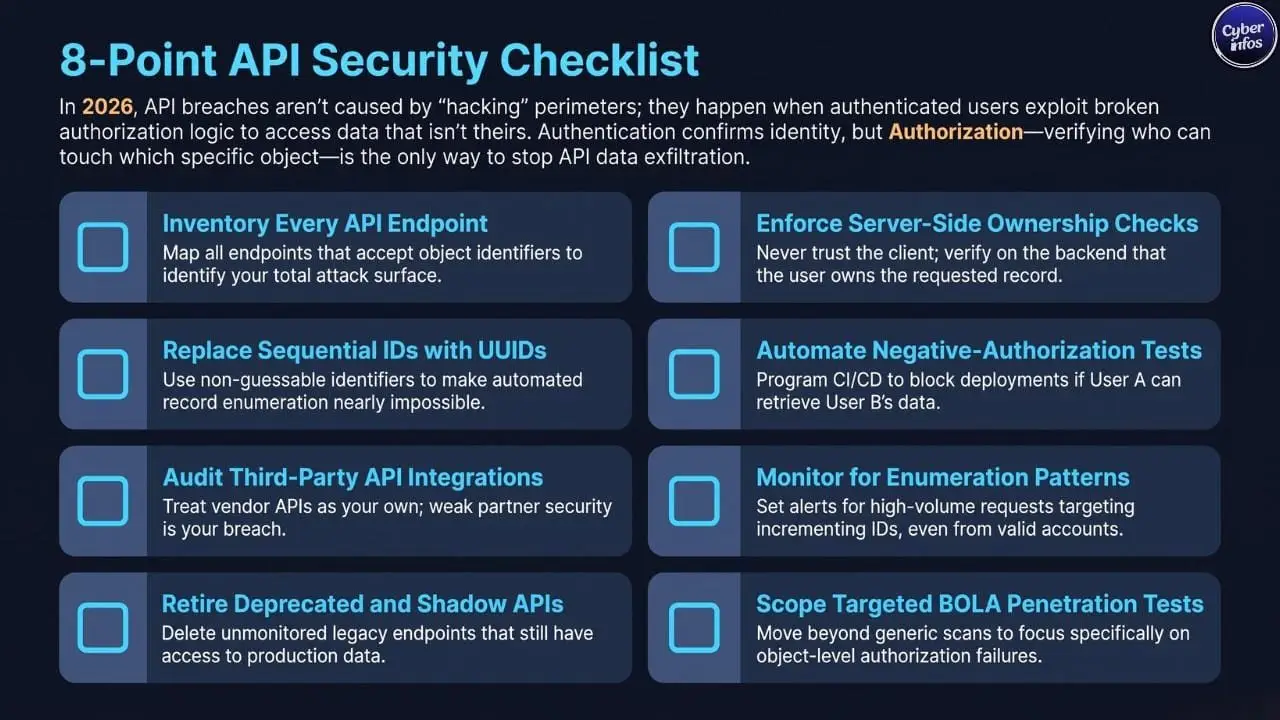
Actionable Checklist
Use this list as a working audit against the API data breaches 2026 has already produced. For deeper guidance, CISA’s API security guidance is a useful companion reference alongside your own inventory.
Inventory every API endpoint that accepts or references an object identifier the starting point for auditing against any of the API data breaches 2026 has produced
- Confirm server-side ownership checks exist on each one don’t rely on the client
- Replace sequential IDs with non-guessable identifiers where feasible
- Add automated negative-authorization tests to your deployment pipeline
- Review every third-party and partner API integration for the same gaps
- Configure monitoring for ID enumeration patterns, not just authentication failures
- Retire or re-secure deprecated endpoints still live in production
- Run a targeted BOLA/IDOR test as part of your next penetration test scope
Frequently Asked Questions
What caused most API data breaches 2026 has seen so far?
The majority trace back to broken authorization at the object level commonly called BOLA or IDOR where an API correctly confirms who a user is but fails to confirm whether that user should access the specific record being requested.
Is a broken API authentication breach the same thing as a BOLA vulnerability?
Not quite. Authentication confirms identity; BOLA is an authorization failure that happens after authentication succeeds. Most of the API data breaches 2026 has produced involved valid, authenticated sessions being used to reach data that was never authorized for that specific account.
How many records does a typical API breach expose?
Looking across the API data breaches 2026 has recorded, industry data puts the average well above a million records per incident, notably higher than breaches originating from other vectors, largely because API endpoints can be enumerated at scale once the authorization gap is found.
Can API scanners catch these vulnerabilities automatically?
Rarely on their own. BOLA and related flaws are business-logic issues, not signature-based vulnerabilities, so they often slip past automated scanners and require manual or dedicated API-focused testing.
Are third-party and vendor APIs a bigger risk than internal ones?
Several of the largest API data breaches 2026 has produced originated in a connected third-party system rather than the primary company’s own code, so yes vendor API risk deserves the same scrutiny as internal endpoints.
Does using HTTPS or API keys prevent this kind of breach?
No. Encryption in transit and API key authentication solve different problems. Neither one verifies that an authenticated caller is authorized to access a specific object, which is exactly where these breaches occur.
What industries are most affected by API exposure right now?
Among the API data breaches 2026 has recorded, healthcare, education, and consumer platforms have reported some of the largest API-related exposures, though the underlying vulnerability pattern shows up across virtually every sector running modern web or mobile applications.
What should a security team do first if they suspect a BOLA vulnerability exists?
Start with an inventory of endpoints accepting object identifiers, then manually test whether an authenticated low-privilege account can access another account’s data by changing that identifier.
Do regulations treat API breaches differently from other data breaches?
Generally no frameworks like GDPR, HIPAA, and India’s DPDP Act evaluate the data exposed and the harm caused, not the technical vector, so an API-driven breach carries the same notification and liability obligations as any other.
How long do these vulnerabilities typically go undetected?
It varies widely, but several of the API data breaches 2026 has produced describe exposure windows of multiple weeks to several months before detection, since enumeration traffic often resembles normal authenticated usage.
Final Thoughts
API data breaches 2026 has produced all trace back to the same gap: authentication working exactly as designed while authorization gets skipped, assumed, or bolted on too late. Instagram’s scraping exposure, the third-party hiring platform IDOR incident, and the healthcare API leak didn’t need a new attack technique. They needed one endpoint that trusted an ID it shouldn’t have.
The fix isn’t a bigger firewall or a smarter WAF rule. It’s treating every object-level request as its own authorization decision — who is asking, and should they be allowed to touch this specific record, right now. Teams that build that discipline into code review and CI/CD catch these gaps before launch. Teams that don’t end up writing the breach notification instead.
You don’t have to wait for a broken API authentication breach to force the conversation. Pull up your own API inventory this week, run the negative-authorization tests from the checklist above, and close the gap before it becomes your headline.
Ready to see where your APIs stand? Start with the actionable checklist in this guide, then bring your findings to your next security review and if you want a second set of eyes on your API exposure breach analysis, CyberInfos can help you scope one..
