

Perimeter network teams and firewall administrators finally have dedicated kernel-level PAN-OS updates to deploy. Reported on November 25, 2026 by SecurityWeek and BranDefense, Palo Alto Networks published PAN-SA-2026-0015 to fix PAN-OS Fragnesia CVE-2026-46300, a Linux kernel local privilege escalation flaw that attackers chained with PHP2Shell to gain root control over firewalls.
Palo Alto Networks blocked the initial PHP2Shell entry path back on October 30, 2026. Still, any appliance running older code with an internet-exposed PAN-OS management interface remains a prime target. With CVE-2026-46300 listed in CISA’s Known Exploited Vulnerabilities (KEV) catalog under BOD 26-04, teams should lock down management access, check for webshells, and schedule PAN-SA-2026-0015 patches across 10.2 through 12.2 release lines.
Quick Answer
PAN-OS Fragnesia CVE-2026-46300 is a
CVSS 7.8Linux kernel local privilege escalation flaw patched by Palo Alto Networks in PAN-SA-2026-0015 patches (10.2.7-h41through12.2.4-h3). Attackers chained it withPHP2Shellagainst internet-exposed PAN-OS management interfaces to root firewalls. Restrict management access to trusted internal IPs, verifyPHP2Shellfixes, and upgrade to a fixedPAN-OSrelease.
Facts at a Glance
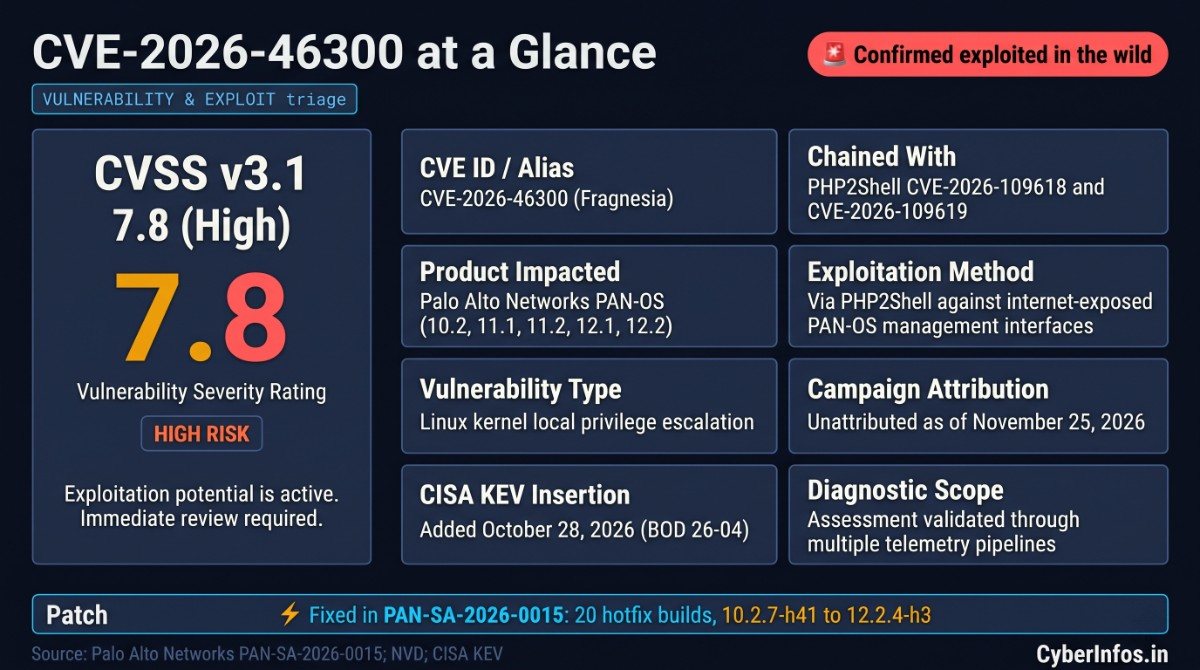
The table below summarizes the verified technical, severity, and remediation details for CVE-2026-46300 in PAN-OS as of November 25, 2026.
| Field | Verified Information |
|---|---|
| CVE ID | CVE-2026-46300 (chained with PHP2Shell CVE-2026-109618 and CVE-2026-109619) |
| Product and Vendor | Palo Alto Networks PAN-OS (10.2, 11.1, 11.2, 12.1, 12.2 release lines) |
| CVSS v3.1 Score | 7.8 High per NVD |
| Vulnerability Type | Linux kernel local privilege escalation (Fragnesia) |
| Exploit Status | Confirmed exploited in the wild targeting internet-exposed PAN-OS management interfaces via PHP2Shell |
| CISA KEV and National Alerts | CISA KEV CVE-2026-46300 added on October 28, 2026 under BOD 26-04 |
| Threat Actor Attribution | Unattributed as of November 25, 2026 |
| Patch Status | Fixed in PAN-SA-2026-0015 across 20 specific PAN-OS hotfix builds (10.2.7-h41 to 12.2.4-h3) |
What Happened and Incident Timeline
CVE-2026-46300, widely known as Fragnesia, is an open-source Linux kernel local privilege escalation bug, as PAN-SA-2026-0015 and SecurityWeek explain. On its own, CVE-2026-46300 cannot give an external attacker remote access. The reality is that threat actors paired it with the critical PHP2Shell flaws (CVE-2026-109618 and CVE-2026-109619) to compromise Palo Alto Networks firewalls whose management interfaces were left exposed online.
Confirmed Facts
-
Exploitation Restricted to Exposed Management Planes: Palo Alto Networks confirmed in PAN-SA-2026-0015 that every observed
CVE-2026-46300attack targetedPAN-OSdevices with internet-exposed management interfaces. The vendor also noted that the only known attack path starts withPHP2Shell. -
Dataplane Management Profiles Also Count as Exposure: Why this matters: teams often check the dedicated management port and stop there. BranDefense notes that
PAN-SA-2026-0015explicitly warns defenders to audit any internet-reachable dataplane interface carrying a management profile as well. -
Two-Layer Patching Protection: Firewalls already running a fixed
PAN-OSbuild from Palo Alto Networks’ October 30PHP2Shelladvisory (CVE-2026-109618) are protected against the known chain. Even so, the new PAN-SA-2026-0015 patches also eliminateCVE-2026-46300directly inside the Linux kernel -
Upstream Kernel & CISA KEV Context: The upstream
Fragnesiakernel fix shipped back in May 2026 (Dirty Frag), and CISA placedCVE-2026-46300on its KEV list on October 28, 2026 after chainedPHP2Shellroot attacks surfaced
Reported or Unconfirmed Claims
-
Total Compromised Firewalls & Alternate Chains: Palo Alto Networks has not shared how many customer firewalls were rooted before October 30, and states it knows of no
PAN-OSexploitation path other than chaining throughPHP2Shell
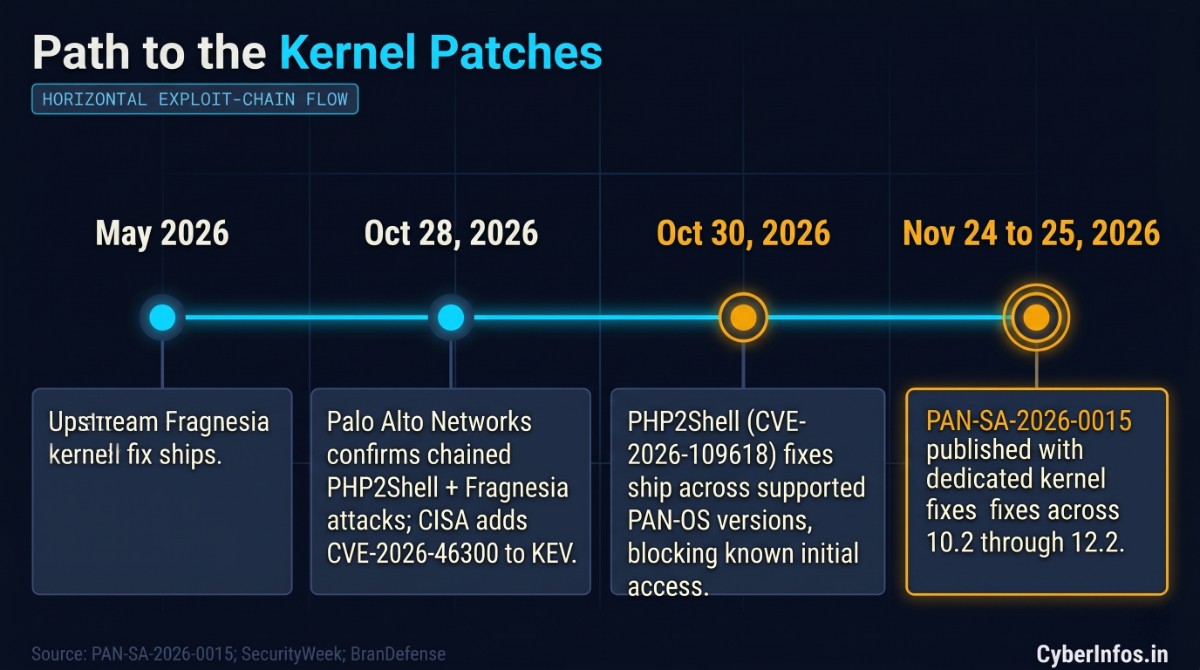
The table below tracks the verified sequence of events leading to PAN-SA-2026-0015.
| Date / UTC Time | Milestone / Event | Source |
|---|---|---|
| Oct 28, 2026 | Palo Alto Networks confirms chained PHP2Shell + Fragnesia attacks; CISA adds CVE-2026-46300 to KEV. |
BranDefense |
| Oct 30, 2026 | Palo Alto Networks ships PHP2Shell (CVE-2026-109618) fixes across supported PAN-OS versions, blocking known initial access. |
SecurityWeek |
| Nov 24 to 25, 2026 | Palo Alto Networks publishes PAN-SA-2026-0015 with dedicated CVE-2026-46300 kernel fixes across 10.2 through 12.2. |
PAN-SA-2026-0015 / SecurityWeek |
Affected and Fixed Versions
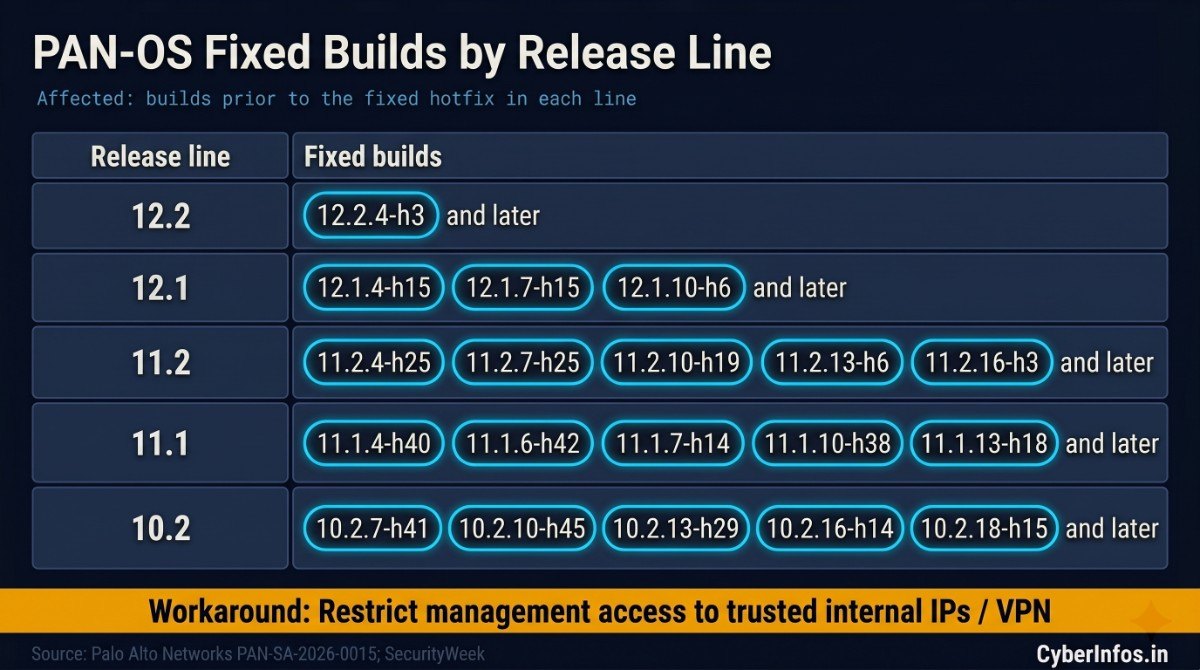
The table below lists all 20 fixed PAN-OS hotfix builds published in PAN-SA-2026-0015 and SecurityWeek.
| Software / Component | Affected Versions | Fixed Version | Official Workaround |
|---|---|---|---|
PAN-OS 12.2 |
12.2.x builds prior to fixed hotfix |
12.2.4-h3 and later |
Restrict management access to trusted internal IPs / VPN |
PAN-OS 12.1 |
12.1.x builds prior to fixed hotfixes |
12.1.4-h15, 12.1.7-h15, 12.1.10-h6 and later |
Restrict management access to trusted internal IPs / VPN |
PAN-OS 11.2 |
11.2.x builds prior to fixed hotfixes |
11.2.4-h25, 11.2.7-h25, 11.2.10-h19, 11.2.13-h6, 11.2.16-h3 and later |
Restrict management access to trusted internal IPs / VPN |
PAN-OS 11.1 |
11.1.x builds prior to fixed hotfixes |
11.1.4-h40, 11.1.6-h42, 11.1.7-h14, 11.1.10-h38, 11.1.13-h18, 11.1.16-h6 and later |
Restrict management access to trusted internal IPs / VPN |
PAN-OS 10.2 |
10.2.x builds prior to fixed hotfixes |
10.2.7-h41, 10.2.10-h45, 10.2.13-h29, 10.2.16-h14, 10.2.18-h15 and later |
Restrict management access to trusted internal IPs / VPN |
Technical Attack Chain
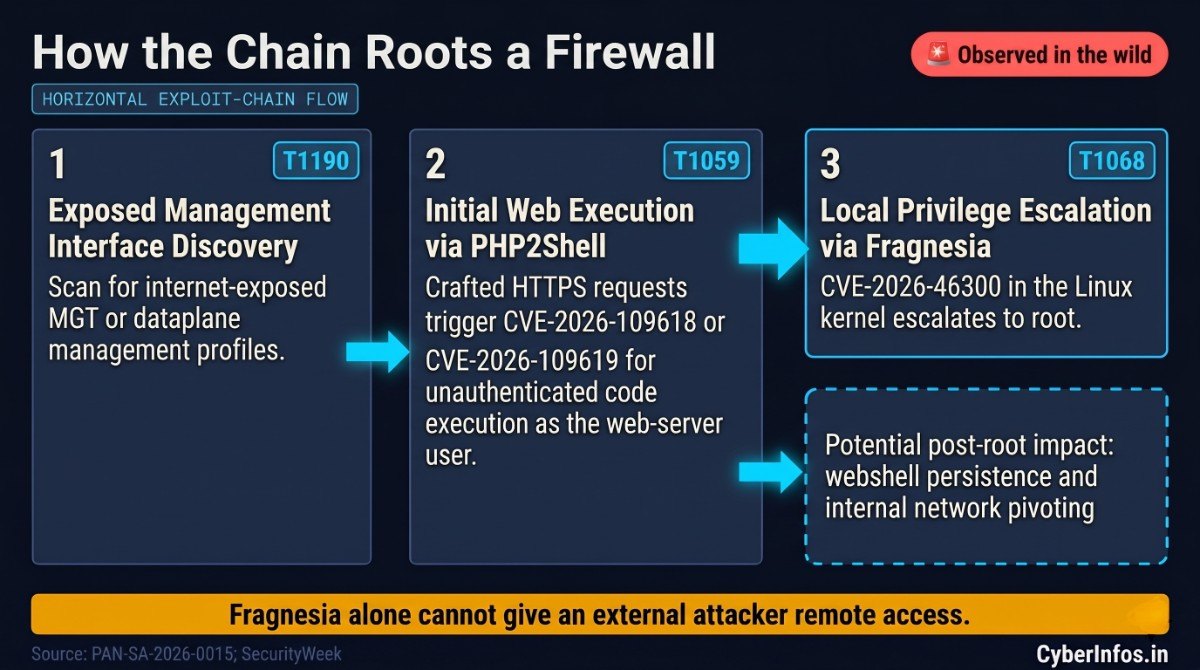
How Chained PHP2Shell and Fragnesia Exploits Root PAN-OS Firewalls
Based on PAN-SA-2026-0015 and SecurityWeek, the PHP2Shell firewall root exploit chain plays out in three stages:
-
Exposed Management Interface Discovery (
MITRE ATT&CK T1190): Attackers scan the internet forPAN-OSmanagement interfaces or dataplane interfaces with management profiles left open to public traffic. -
Initial Web Execution via
PHP2Shell(T1059): Crafted HTTPS requests sent to the web management interface triggerCVE-2026-109618orCVE-2026-109619, handing attackers unauthenticated code execution as the web-server user. -
Local Privilege Escalation via
Fragnesia(T1068): From that initial foothold, attackers exploitCVE-2026-46300in the underlying Linux kernel to escalate torooton the firewall appliance, opening the door to webshell persistence and internal network pivoting.
Why Patching Alone May Not Be Enough
If a PAN-OS firewall had an internet-exposed PAN-OS management interface before PHP2Shell or PAN-SA-2026-0015 updates were installed, patching today will not clear out webshells, rogue admin accounts, or altered firewall rules planted with root access. Upgrade the software, then check the logs and isolate the management plane.
CyberInfos Analyst Insight
-
CyberInfos Assesses That Management-Plane Exposure Turns Local Kernel Bugs Into Critical Risks: On paper,
CVE-2026-46300is a local privilege escalation bug. Yet leaving thePAN-OSweb management UI exposed online gave attackers aPHP2Shellladder straight into the kernel. -
From a Defensive Perspective, Dataplane Management Profiles Are Often Overlooked: Many teams lock down the dedicated
MGTport while forgetting dataplane interfaces carrying permissive management profiles; BranDefense rightly urges auditing both paths. -
Defense-in-Depth Still Requires Patching the Underlying Kernel: Even if your firewalls already carry the October 30
PHP2Shellfix, installing PAN-SA-2026-0015 patches removesFragnesiaitself so no future web-tier bug can chain with it.
Indicators of Compromise and Hunting Telemetry
PAN-SA-2026-0015 does not list static attacker IP addresses, focusing instead on exposure conditions (BranDefense). Defenders should audit firewall inventories for exposed management profiles and review PAN-OS system, web-server, and configuration logs since late October 2026 for unauthorized admin logins or unexpected changes.
| Indicator Type | Value / Pattern | Description and Context |
|---|---|---|
| Exposure Configuration | Internet-reachable MGT port or dataplane interface with management profile |
Primary precondition for observed PHP2Shell firewall root exploit attacks |
| Web Management Logs | Unfamiliar external IP connections to PAN-OS HTTPS management endpoints |
Signals scanning or exploitation attempts predating PHP2Shell patches |
| Configuration & Admin Audits | Unexpected PAN-OS config commits, new local admin accounts, or PHP errors |
Potential signs of post-root persistence on previously exposed firewalls |
Use the following SIEM queries (labeled Draft for testing, not production-validated) to hunt for external connections reaching PAN-OS management interfaces or unexpected administrative events:
Splunk SPL
/* Splunk SPL (Draft for testing, not production-validated):
   Detect external IPs reaching PAN-OS management interfaces or anomalous config commits */
(index=pan_logs OR index=paloalto OR index=syslog)
(sourcetype="pan:system" OR sourcetype="pan:config")
("authenticated" OR "commit" OR "management" OR "httpd")
| stats count values(action) as actions earliest(_time) as first_seen latest(_time) as last_seen by host, admin, client_ip
| sort - count
Code snippet
// Microsoft Sentinel KQL (Draft for testing, not production-validated):
// Hunt for external IP logins or configuration changes in Palo Alto Networks PAN-OS logs
CommonSecurityLog
| where TimeGenerated >= ago(30d)
| where DeviceVendor has "Palo Alto"
| where Activity has_any ("SYSTEM", "CONFIG", "auth", "commit")
| project TimeGenerated, DeviceName, SourceIP, DestinationIP, DestinationPort, Activity, Message
| order by TimeGenerated desc
Recommended Actions
Execute the following numbered steps across three operational phases based on PAN-SA-2026-0015, SecurityWeek, and BranDefense.
Immediate Actions (0 to 24 Hours)
-
Audit Every Firewall for Exposed Management Access: Check all dedicated
MGTinterfaces and dataplane interfaces with management profiles attached to confirm none are reachable from the public internet. -
Restrict Management Access to Trusted Internal IPs or VPN: Immediately cut off direct web access to
PAN-OSmanagement interfaces and allow connections only from dedicated management networks or over VPN -
Verify
PHP2ShellPatch Baseline & Triage Logs: Confirm every appliance already runs at least the October 30PHP2Shellfixed build, and review logs since late October if any device was internet-exposed.
Short-Term Actions (Within 7 Days)
-
Deploy
PAN-SA-2026-0015 patches: Match each firewall’s release branch (10.2,11.1,11.2,12.1, or12.2) to its exact fixed build (10.2.7-h41through12.2.4-h3) and upgrade at the next maintenance window -
Rotate Firewall Credentials if Previously Exposed: If an exposed firewall ran unpatched during the October exploitation window, rotate local admin passwords, API keys, and VPN secrets after verifying system integrity.
Long-Term Actions (Architecture)
-
Enforce Out-of-Band Management Policies via Panorama: Standardize Panorama templates to block management profiles on external dataplane zones and trigger automated alerts on configuration drift.
Global Regulatory and Compliance Implications (USA, UK, Australia, EU, Canada, India)
Regulatory notification duties apply only when an organization is in scope of a given framework and experiences a reportable security incident or personal data breach. The table below summarizes verified obligations as of November 25, 2026.
| Jurisdiction | Regulatory Framework | When It Applies and Verified Obligations |
|---|---|---|
| United States | CISA BOD 26-04, SEC Form 8-K, CIRCIA | When It Applies: CISA KEV CVE-2026-46300 (added Oct 28, 2026) falls under BOD 26-04 for federal civilian agencies; public issuers file SEC Form 8-K Item 1.05 within 4 business days if a rooted firewall causes a material incident (AOPL), while CIRCIA timelines depend on final rulemaking status. |
| United Kingdom | UK GDPR (ICO) & NCSC CAF | When It Applies: Controllers notify the ICO within 72 hours if a compromised firewall leads to personal data exposure; essential-service operators align perimeter isolation with NCSC Cyber Assessment Framework guidance. |
| Australia | SOCI Act (ASD) & OAIC NDB | When It Applies: Critical infrastructure entities report significant incidents to ASD within 12 hours (72 hours for other incidents) under the SOCI Act, while OAIC Notifiable Data Breaches apply if serious harm is likely. |
| European Union | NIS2 & EU GDPR | When It Applies: In-scope NIS2 entities submit an early warning within 24 hours, notification within 72 hours, and final report within 1 month, alongside EU GDPR 72-hour personal data breach notices (Global Compliance Map). |
| Canada | PIPEDA | When It Applies: Private-sector entities report breaches posing a real risk of significant harm as soon as feasible under PIPEDA. |
| India | CERT-In & DPDP Rules 2025 | When It Applies: Covered entities report firewall compromises to CERT-In within 6 hours and retain logs for 180 days; DPDP Rules 2025 Rule 4 started November 13, 2026 and main breach rules start May 13, 2027 (WONE Global). |
This summary supports operational readiness and is not legal advice.
Frequently Asked Questions (FAQ)
If our firewalls are already patched for PHP2Shell, do we still need PAN-SA-2026-0015?
Yes, Palo Alto Networks recommends upgrading to the new builds at your next maintenance interval. While PHP2Shell patches block the only known remote entry path for PAN-OS Fragnesia CVE-2026-46300, applying PAN-SA-2026-0015 patches removes the underlying Linux kernel privilege escalation flaw itself
Can attackers exploit CVE-2026-46300 remotely without PHP2Shell?
Not according to current vendor evidence. Palo Alto Networks states in PAN-SA-2026-0015 that CVE-2026-46300 is a local privilege escalation bug and that the only known exploitation path requires first exploiting PHP2Shell through an internet-exposed management interface.
What does internet-exposed PAN-OS management include beyond the MGT port?
In addition to the dedicated MGT interface, internet-exposed PAN-OS management includes any internet-reachable dataplane interface that has a management profile attached, per BranDefense. Both must be restricted to trusted internal IP addresses or VPN access.
Why is CISA KEV CVE-2026-46300 relevant if it is a local kernel bug?
CISA added CVE-2026-46300 to KEV on October 28, 2026 because attackers actively chained it in the wild with PHP2Shell to escalate to root on compromised firewalls, per BranDefense. Federal agencies must track remediation under BOD 26-04.
Are PAN-OS 10.2 firewalls still receiving fixes for Fragnesia?
Yes. Palo Alto Networks included five 10.2 fixed builds (10.2.7-h41, 10.2.10-h45, 10.2.13-h29, 10.2.16-h14, and 10.2.18-h15) alongside 11.1, 11.2, 12.1, and 12.2 releases in PAN-SA-2026-0015.
Final Thoughts
PAN-OS Fragnesia CVE-2026-46300 is a clear reminder that perimeter firewalls should never expose administrative interfaces to the open internet. Your immediate job is straightforward: confirm neither MGT ports nor dataplane management profiles are publicly reachable, verify PHP2Shell protections, and schedule PAN-SA-2026-0015 patches across your PAN-OS fleet.
Longer term, enforce Panorama templates that block public management profiles by default. Have you audited your PAN-OS dataplane interfaces and scheduled your PAN-SA-2026-0015 upgrades? Share your rollout status in the comments below, and subscribe to CyberInfos.in for daily verified vulnerability and threat intelligence.
