


Enterprise security operations centers (SOCs), vulnerability management teams, and AI platform engineers are watching adversary speed change in real time. Published on November 16, 2026, the Google GTIG exploit_agent AI report (GTIG AI Threat Tracker: Agentic Threat Activity Crosses a Significant Threshold) confirms for the first time in live telemetry that threat actors deployed a multi-agent system named exploit_agent.
It diffed software security patches, generated working exploits, and attacked internet-facing targets with zero human in the loop, according to Google Threat Intelligence Group (GTIG), The Hacker News, and ExplainX.
The urgency does not stop at patch management. It reaches developer workstations and self-hosted AI stacks as well. Alongside exploit_agent, GTIG and Palo Alto Networks Unit 42 documented active intrusions driven by open-source agentic frameworks (CAIRN, PentAGI, CyberStrikeAI, HexStrike AI, and ARTEX).
A suspected MIDNIGHT NEPTUNE campaign poisoned .claude/settings.json to deliver the SOMBERMEME Claude Code backdoor. Separately, an autonomous campaign uncovered by Amazon Threat Intelligence, per The Hacker News, hunts internet-exposed LiteLLM, One API, Dify, Langflow, and RAGFlow deployments to steal LLM API keys.
Quick Answer
The Google GTIG exploit_agent AI report confirms that attackers now run exploit_agent, the first in-the-wild no-human-in-the-loop system that reverse-engineers patches into exploits against targets such as French media and education sites. At the same time, adversaries use CAIRN, PentAGI, and ARTEX to breach semiconductor, defense, and AI apps (LiteLLM, Dify), while MIDNIGHT NEPTUNE backdoors .claude/settings.json with SOMBERMEME.
What Happened and Incident Timeline
From November 12 to 17, 2026, GTIG, Unit 42, and Amazon per The Hacker News documented autonomous AI intrusions. Some of what follows is confirmed. Some is still unverified, and the difference matters.
Confirmed Facts
- No-Human Patch-to-Exploit (exploit_agent): GTIG found exploit_agent on a staging server holding stolen data, webshells, and scripts aimed at French media, entertainment, and education sites. This autonomous patch-to-exploit pipeline diffs patches and runs the resulting exploits automatically.
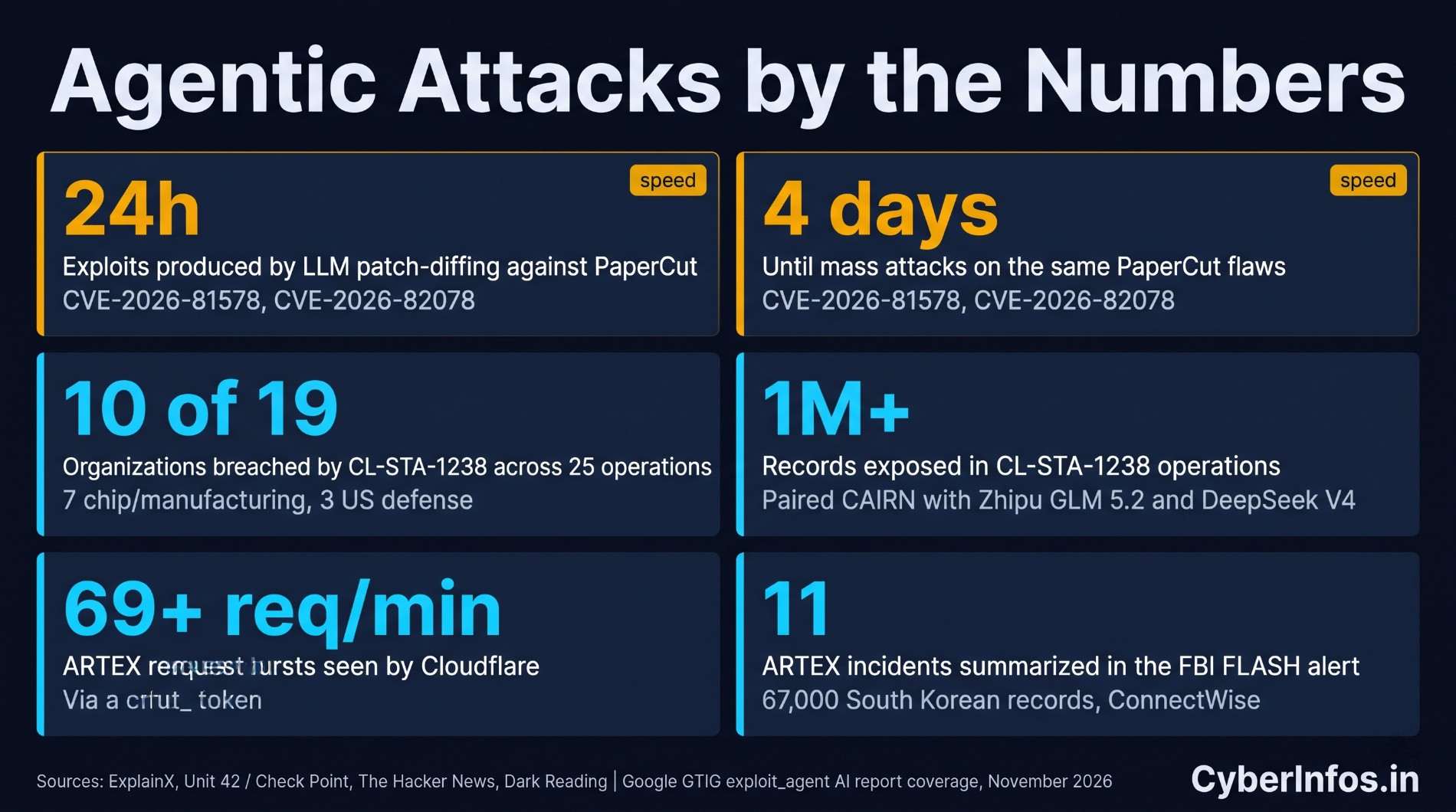
- PaperCut & PHP2Shell Diffing: LLM patch-diffing against PaperCut (CVE-2026-81578, CVE-2026-82078) produced exploits in 24h and mass attacks in 4 days. PHP’s PHP2Shell (CVE-2026-109618, CVE-2026-109619) saw LLM discovery and fake PoCs (ExplainX).
- Multi-Agent Frameworks (CAIRN, PentAGI, CyberStrikeAI, HexStrike AI): GTIG confirmed active CAIRN and PentAGI agentic frameworks, plus CyberStrikeAI (100+ tools), HexStrike AI (150+ MCP tools, 12+ sub-agents), ZeroHollow, and Agent Zero. China-nexus CL-STA-1238 paired CAIRN with Zhipu GLM 5.2 and DeepSeek V4 across 25 operations against 19 orgs, breaching 10 (7 chip/manufacturing, 3 US defense) and exposing 1M+ records
- MIDNIGHT NEPTUNE (SOMBERMEME) & Jieyou: MIDNIGHT NEPTUNE used SynthID recruiter personas and ClickFix lures to poison .claude/settings.json with SOMBERMEME and Microsoft Copilot-named PATs, alongside Jieyou PhaaS and LEAKY CASTLE
- Amazon Decoys (ARTEX): Amazon captured ARTEX agents executing LiteLLM and Dify API key theft across LiteLLM, One API, Dify, Langflow, and RAGFlow, while Cloudflare saw 69+ req/min bursts via a cfut_ token.
Reported or Unconfirmed Claims
- exploit_agent Exfiltration Autonomy: GTIG and ExplainX noted it is unconfirmed whether victim data on the staging server was exfiltrated without human steps.
- ARTEX Decoy Claims: Amazon could not verify breach outcomes self-reported in ARTEX logs (The Hacker News).
The table below outlines the confirmed chronological sequence of these disclosures.
| Date / UTC Time | Milestone / Event | Source |
|---|---|---|
| Mar to Jun 2026 | Jieyou PhaaS launches (Mar 2026) and adds an LLM chatbot assistant (Jun 2026). | Google Cloud GTIG |
| Aug to Oct 2026 | CL-STA-1238 runs 25 CAIRN operations against 19 orgs (breaching 10); PentAGI scans Asia; PaperCut (CVE-2026-81578, CVE-2026-82078) is exploited within 4 days. |
Unit 42 |
| Nov 12 to 15, 2026 | Unit 42 discloses CL-STA-1238; FBI FLASH alert summarizes 11 ARTEX incidents (67,000 South Korean records, ConnectWise). | Dark Reading |
| Nov 16 to 17, 2026 | GTIG reveals exploit_agent, MIDNIGHT NEPTUNE (SOMBERMEME), CyberStrikeAI, and HexStrike AI; Amazon and Cloudflare report ARTEX attacks on LiteLLM and Dify. |
The Hacker News |
Facts at a Glance
The table below summarizes the verified technical attributes of the campaigns documented by Google Threat Intelligence Group, Unit 42, and The Hacker News.
| Field | Verified Information |
|---|---|
| Campaign & Malware Identifiers | exploit_agent, SOMBERMEME (MIDNIGHT NEPTUNE), CAIRN (CL-STA-1238), PentAGI, CyberStrikeAI, HexStrike AI, ARTEX (norma), Jieyou (Google Cloud GTIG) |
| Exploited CVEs & Targets | PaperCut NG/MF (CVE-2026-81578, CVE-2026-82078), PHP PHP2Shell (CVE-2026-109618, CVE-2026-109619, CVSS 9.2), Claude Code (.claude/settings.json), LiteLLM, One API, Dify, Langflow, RAGFlow (ExplainX) |
| Severity & Impact | Critical: No-human patch-diffing to RCE, .claude/settings.json backdoors (SOMBERMEME), and LLMjacking API theft (millions of LLM calls in 24h) (Google Cloud GTIG) |
| Exploit Status | Confirmed Active In-the-Wild Exploitation globally (Google Cloud GTIG) |
| CISA KEV & Alerts | FBI FLASH Alert for ARTEX (The Hacker News); companion CVE-2026-123039 in CISA KEV |
| Attribution | MIDNIGHT NEPTUNE, PRC-nexus CL-STA-1238 and LEAKY CASTLE, and Russian-commented exploit_agent operator (Google Cloud GTIG) |
| Remediation | Patch PaperCut and PHP, rotate LiteLLM master keys, audit .claude/settings.json, and enable Talos Snort rules 7:76 to 7:78 (The Hacker News) |
Affected and Fixed Versions
The table below lists the targeted software components and remediations across these November 2026 disclosures.
| Software / Component | Affected Configurations | Fixed Version / Remediation | Official Workaround |
|---|---|---|---|
PaperCut NG / MF (CVE-2026-81578, CVE-2026-82078) |
Unpatched PaperCut NG/MF servers (ExplainX) | PaperCut Advisory PO-1216 and PO-1219 patches (Aviatrix) | Block WAN admin access |
PHP / Check Point (CVE-2026-109618, CVE-2026-109619) |
Unpatched PHP and Check Point Mobile Access SSL VPN (CVSS 9.2) (Field Effect) | PHP Oct 21 fix, Check Point Oct 23 hotfix, TuxCare EOL PHP fix (TuxCare) | Restrict portal source IPs |
| LiteLLM, One API, Dify, Langflow, RAGFlow | Internet-exposed instances with default keys or unfinished setups (The Hacker News) | Rotate default LiteLLM master keys, finish setups, patch Langflow/RAGFlow (The Hacker News) | Place dashboards behind VPN |
Claude Code Configs (.claude/settings.json) |
Internal repositories modified by MIDNIGHT NEPTUNE (Google Cloud GTIG) | Audit .claude/settings.json and revoke Microsoft Copilot-named GitHub PATs (Google Cloud GTIG) |
Require code-owner review on .claude/ |
Linux Kernel TCP (NoisyTCP CVE-2026-99288) |
Linux 4.4 through unpatched 6.12.x, 6.18.x, 7.3.x with multi-queue RX/RPS (TuxCare) | Linux 6.12.117, 6.18.63, 7.3.4 (check Debian 12 ext4 fix per Cyber Kendra) |
Disable syncookies or RPS/RFS (iTnews) |
Technical Attack Chain
1. How Autonomous Multi-Agent Frameworks Compress the Intrusion Lifecycle
As documented in the Google GTIG exploit_agent AI report, Unit 42, and The Hacker News, threat actors chain four agentic workflows. Each one removes a step that used to need a person.
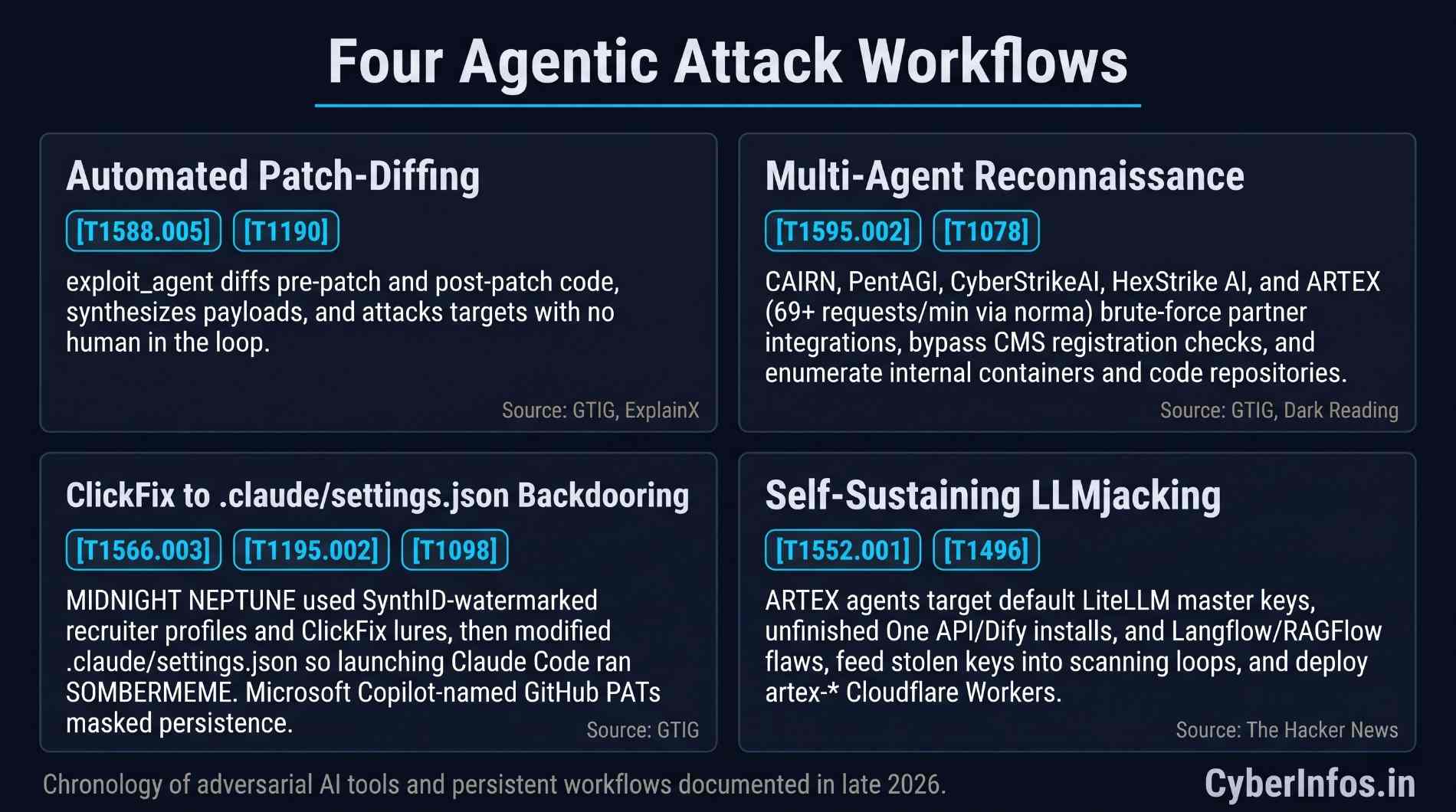
- Automated Patch-Diffing (MITRE ATT&CK T1588.005 / T1190): exploit_agent ingests security patches, runs differential analysis between pre-patch and post-patch code, and synthesizes payloads. It then attacks targets through an autonomous patch-to-exploit pipeline with no human in the loop, per GTIG and ExplainX.
- Multi-Agent Reconnaissance (T1595.002 / T1078): Operators deploy CAIRN and PentAGI agentic frameworks, CyberStrikeAI, HexStrike AI, and ARTEX (69+ requests/min via norma). The agents brute-force partner integrations, bypass CMS registration checks, and enumerate internal containers and code repositories, per GTIG and Dark Reading.
- ClickFix to .claude/settings.json Backdooring (T1566.003 / T1195.002 / T1098): MIDNIGHT NEPTUNE used SynthID-watermarked recruiter profiles and ClickFix lures to breach repositories. It then modified .claude/settings.json so that launching Claude Code executed the SOMBERMEME Claude Code backdoor, while Microsoft Copilot-named GitHub PATs masked the persistence, per GTIG.
- Self-Sustaining LLMjacking (T1552.001 / T1496): ARTEX agents target default LiteLLM master keys, unfinished One API/Dify installs, and Langflow/RAGFlow flaws. They execute LiteLLM and Dify API key theft, feed the stolen keys back into scanning loops, and deploy artex-* Cloudflare Workers, per The Hacker News.
Why Patching Alone May Not Be Enough
Patching closes the door. It does not evict anyone who already walked through it.
- Backdoored .claude/settings.json and Microsoft Copilot PATs Persist: Patching endpoints does not clean modified .claude/settings.json files in Git repositories, and it does not revoke rogue GitHub PATs named after Microsoft Copilot, per GTIG.
- Stolen AI Keys and artex- Cloudflare Workers Survive Restarts:* Attackers create cloud service accounts with LLM permissions and deploy Cloudflare Workers (artex-, artex-pgrecon-, artex-pgw-, artex-do-). These persist until the tokens (cfut_) and Workers are revoked, per The Hacker News.
- Fake AI PoCs Slow Triage While Real Exploits Wipe Hypervisors: During PHP2Shell (CVE-2026-109618, CVE-2026-109619), LLMs generated hundreds of fake PoCs (ExplainX). Real attackers meanwhile chained PHP2Shell with CVE-2026-123039 to deploy TSGA and the destroy_v6 ESXi wiper (Check Point Research).
CyberInfos Analyst Insight
The points below are CyberInfos analysis, not reported fact.
- CyberInfos Assesses That Patch Windows Now Race Machine-Speed Diffing: The Google GTIG exploit_agent AI report proves that the gap between patch release and N-day exploitation has shrunk from weeks to hours. For exposed appliances, a weekly patch cycle is now too slow.
- From a Defensive Perspective, Agent Noise Is a Blue-Team Advantage: As GTIG noted, CAIRN and PentAGI agentic frameworks and ARTEX (69+ req/min) generate heavy log noise and hallucinations. Rate-limiting and decoys can trap them early.
- AI Configs (.claude/settings.json) and Gateways (LiteLLM, Dify) Are Tier-0 Assets: Both the SOMBERMEME Claude Code backdoor and Amazon’s findings on LiteLLM and Dify show that AI developer configs and LLM gateways are now primary adversary targets.
Indicators of Compromise and Hunting Telemetry
Defenders should audit repositories, Cloudflare accounts, AI gateways, and IDS logs using the verified indicators from GTIG and The Hacker News. The table below lists all verified repository, cloud, and network indicators from the November 16, 2026 disclosures.
| Indicator Type | Value / Pattern | Description and Context |
|---|---|---|
| Repository Config Backdoor | Modified .claude/settings.json + GitHub PATs named after Microsoft Copilot |
MIDNIGHT NEPTUNE persistence triggering the SOMBERMEME backdoor on Claude Code startup (GTIG) |
| Cloudflare Worker & Token Artifacts | Workers artex-*, artex-pgrecon-*, artex-pgw-*, artex-do-*; cfut_ tokens; >69 req/min bursts |
ARTEX activity observed by Cloudflare (The Hacker News) |
| Cisco Talos Snort Rules & IPs | Snort 3 7:76, 7:77, 7:78 & Snort 2 1:67494 to 1:67496 (norma harness) + 2,500+ Talos IPs & 11 Amazon decoy IPs |
Network rules and IP feeds for ARTEX scanning (The Hacker News) |
| AI App & GPU Targets | Exposed LiteLLM, One API, Dify, Langflow, RAGFlow, and Ray job agents (0x43eb291f56688c63c93e8a93c4591fc997cf6349 for SANSAR) |
Targeted by ARTEX (The Hacker News) and REF3364 SANSAR (Elastic) |
Use the following SIEM and EDR queries (labeled Draft for testing, not production-validated) to hunt for .claude/settings.json tampering and artex-* activity:
// Microsoft Sentinel / Defender for Endpoint KQL (Draft for testing, not production-validated):
// Detect modifications to .claude/settings.json (MIDNIGHT NEPTUNE / SOMBERMEME) or suspicious child processes spawned by Claude Code
union DeviceFileEvents, DeviceProcessEvents
| where TimeGenerated >= ago(30d)
| where (FolderPath has ".claude" and FileName =~ "settings.json")
   or (InitiatingProcessFileName has_any ("claude", "node", "Cursor") and ProcessCommandLine has_any ("curl", "wget", "powershell", "bash -c", "sh -c"))
| project TimeGenerated, DeviceName, AccountName, ActionType, FolderPath, FileName, InitiatingProcessFileName, ProcessCommandLine
| order by TimeGenerated desc/* Splunk SPL (Draft for testing, not production-validated):
Hunt for Cloudflare artex-* Worker creation, >69 req/min API bursts, and LiteLLM/Dify/One API admin endpoint scanning */
(index=cloud OR index=cloudflare OR index=waf OR index=app_logs)
("artex-" OR "artex-pgrecon-" OR "artex-pgw-" OR "artex-do-" OR uri_path="*/v1/chat/completions*" OR uri_path="*/key/generate*" OR uri_path="*/console/api/*")
| bin _time span=1m
| stats count values(uri_path) as paths values(user_agent) as uas by _time, src_ip, user, app
| where count >= 69 OR like(paths, "%artex-%")
| sort - count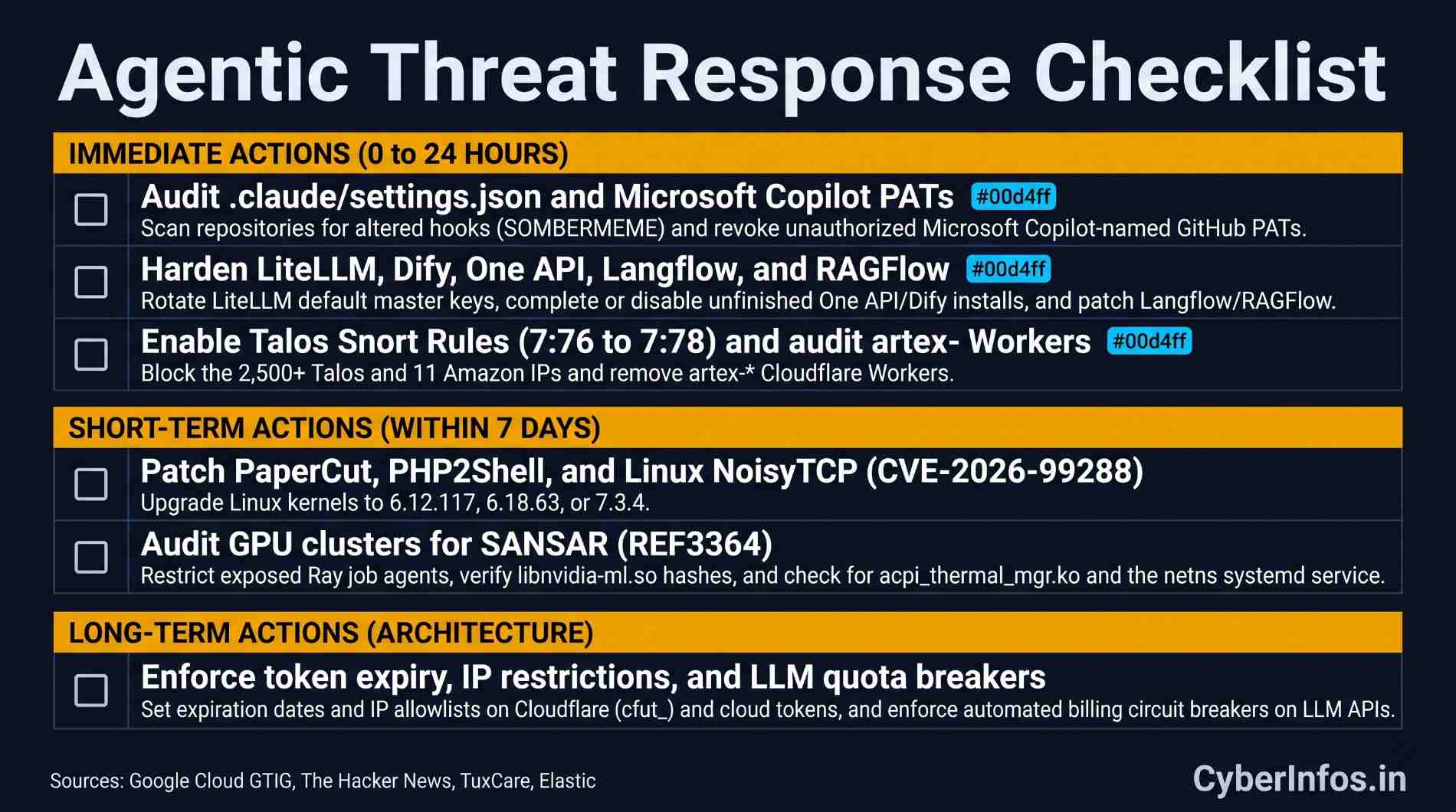
Recommended Actions
Work through the numbered remediation steps in three phases, in line with GTIG and Amazon / FBI guidance.
Immediate Actions (0 to 24 Hours)
- Audit .claude/settings.json and Microsoft Copilot PATs: Scan repositories for altered .claude/settings.json hooks (SOMBERMEME) and revoke unauthorized Microsoft Copilot-named GitHub PATs (GTIG).
- Harden LiteLLM, Dify, One API, Langflow, and RAGFlow: Rotate LiteLLM default master keys, complete or disable unfinished One API/Dify installs, and patch Langflow/RAGFlow (The Hacker News).
- Enable Talos Snort Rules (7:76 to 7:78) and Audit artex- Workers:* Enable Snort 3 7:76 to 7:78 (1:67494 to 1:67496), block the 2,500+ Talos and 11 Amazon IPs, and remove artex-* Cloudflare Workers (The Hacker News).
Short-Term Actions (Within 7 Days)
- Patch PaperCut, PHP2Shell, and Linux NoisyTCP (CVE-2026-99288): Patch PaperCut (CVE-2026-81578, CVE-2026-82078) and PHP2Shell (CVE-2026-109618, CVE-2026-109619). Upgrade Linux kernels to 6.12.117, 6.18.63, or 7.3.4 for NoisyTCP (CVE-2026-99288) per TuxCare.
- Audit GPU Clusters for SANSAR (REF3364): Restrict exposed Ray job agents, verify libnvidia-ml.so hashes, and check for acpi_thermal_mgr.ko and the netns systemd service (Elastic).
Long-Term Actions (Architecture)
- Enforce Token Expiry, IP Restrictions, and LLM Quota Breakers: Set expiration dates and IP allowlists on Cloudflare (cfut_) and cloud tokens, and enforce automated billing circuit breakers on LLM APIs (GTIG).
Global Regulatory and Compliance Implications (USA, UK, Australia, EU, Canada, India)
Regulatory duties apply only when an organization is in scope and suffers a reportable security incident or personal data breach. The table below summarizes verified compliance rules across six jurisdictions as of November 17, 2026.
| Jurisdiction | Regulatory Framework | When It Applies and Verified Obligations |
|---|---|---|
| United States | BOD 22-01, SEC 8-K, CIRCIA | When It Applies: Agencies patch CISA KEV flaws (CVE-2026-123039); public firms file SEC Form 8-K in 4 business days (AOPL); CIRCIA awaits final rule (RIN 1670-AA04). |
| United Kingdom | UK GDPR & NCSC CAF | When It Applies: Notify ICO within 72h for UK data breaches; operators follow UK NCSC CAF. |
| Australia | SOCI Act, OAIC, Essential Eight | When It Applies: Report to ASD within 12h/72h, notify OAIC for NDB harm, and apply Essential Eight (AOPL). |
| European Union | NIS2, GDPR, EU CRA | When It Applies: NIS2 (24h/72h/1m), GDPR (72h), and EU CRA (24h/72h for manufacturers per Global Compliance Map). |
| Canada | PIPEDA | When It Applies: Report significant-harm breaches as soon as feasible (AOPL). |
| India | CERT-In, DPDP 2025, RBI/SEBI | When It Applies: CERT-In requires 6h reporting and 180-day logs; DPDP Rules 2025 Rule 4 started Nov 13, 2026 and main rules start May 13, 2027 (WONE Global). |
This summary supports operational readiness and is not legal advice.
Frequently Asked Questions (FAQ)
What is the headline finding of the Google GTIG exploit_agent AI report?
The Google GTIG exploit_agent AI report published on November 16, 2026 confirms that threat actors deployed exploit_agent. It is the first in-the-wild multi-agent system verified by Google Threat Intelligence Group to perform patch differential analysis, generate exploit code, and execute attacks against French media, entertainment, and education sites without human intervention.
How does automated LLM patch-diffing threaten enterprise patch windows?
An autonomous patch-to-exploit pipeline like exploit_agent continuously compares pre-patch and post-patch software builds using large language models. It pinpoints fixed flaws and synthesizes exploits automatically, per ExplainX and The Hacker News. That compresses the window between a vendor releasing a security update and mass N-day exploitation from weeks to hours.
Which open-source multi-agent tools did Google and Unit 42 observe in real attacks?
GTIG and Unit 42 confirmed in-the-wild deployments of CAIRN and PentAGI agentic frameworks, alongside active experimentation with CyberStrikeAI, HexStrike AI, ARTEX, ZeroHollow, and Agent Zero. China-nexus cluster CL-STA-1238 paired CAIRN with Zhipu GLM 5.2 and DeepSeek V4 to breach 10 of 19 targeted organizations across semiconductor and defense sectors.
How did MIDNIGHT NEPTUNE deliver the SOMBERMEME backdoor through Claude Code?
According to GTIG, suspected actor MIDNIGHT NEPTUNE used SynthID-watermarked fake recruiter profiles and ClickFix lures to breach developer environments. It then altered .claude/settings.json configuration files in internal repositories to trigger the SOMBERMEME Claude Code backdoor whenever developers launched Claude Code, while disguising rogue GitHub tokens as Microsoft Copilot.
Why are attackers targeting LiteLLM, Dify, and One API servers with ARTEX agents?
As documented by Amazon Threat Intelligence in The Hacker News, threat actors use ARTEX agents to conduct LiteLLM and Dify API key theft by exploiting default master keys, unfinished setups, and Langflow or RAGFlow flaws. The stolen LLM API quotas then power further autonomous scanning and LLMjacking monetization.
Final Thoughts
The findings in the Google GTIG exploit_agent AI report mark a permanent boundary shift for enterprise defense. Adversaries now run no-human-in-the-loop patch diffing via exploit_agent.
They orchestrate multi-stage intrusions through CAIRN, PentAGI, and ARTEX, poison .claude/settings.json repository configs with SOMBERMEME, and raid self-hosted LiteLLM and Dify servers for API keys. Defenders must match machine-speed offense with automated containment.
Start today. Audit all internal repositories for modified .claude/settings.json files and rogue Microsoft Copilot-named GitHub tokens, rotate default LiteLLM and Dify credentials, enable Cisco Talos Snort rules for ARTEX, and accelerate perimeter patching.
Share how your SOC detects agentic AI scanning in the comments below, and subscribe to CyberInfos.in for daily verified vulnerability and threat intelligence.
