

Selecting among the best bug bounty platforms in 2026 is no longer a simple race to access the largest crowd of freelance hackers.
Over the past 18 months, LLM-generated vulnerability submissions and automated recon scripts have flooded public intake queues. That shift has turned unvetted report volume into a serious operational liability for understaffed Application Security (AppSec) teams.
Here is the challenge. According to HackerOne Hai Triage documentation, 60% to 80% of raw incoming vulnerability submissions across typical programs are invalid, duplicate, or out of scope. At the same time, HackenProof’s 2026 report data shows monthly report volumes surging to between 4,172 and 7,785 reports per month in mid-2026.
Regulatory pressure is tightening just as fast. Mandatory reporting timelines under the EU Cyber Resilience Act (CRA) took effect on September 11, 2026, alongside NIS2, DORA, and US FedRAMP Moderate penetration testing mandates. For regulated buyers, strict data residency and audit-ready reporting are now baseline requirements rather than optional extras.
This guide evaluates the 10 best bug bounty platforms for enterprise CISOs, mid-market security leads, European data-sovereign organizations, and Web3 protocol maintainers. Rather than rewarding marketing claims or raw registered user counts, our bug bounty platform comparison weights human-verified managed triage, AI-spam defense, jurisdictional compliance, SDLC integration depth, and transparent bug bounty pricing.
CyberInfos Analyst Insight: Why this matters for your 2026 budget is straightforward. A platform with two million registered accounts offers zero security value if your internal engineers spend 20 hours a week closing hallucinated AI bug reports. Prioritize triage rigor and jurisdictional fit before comparing crowd size.
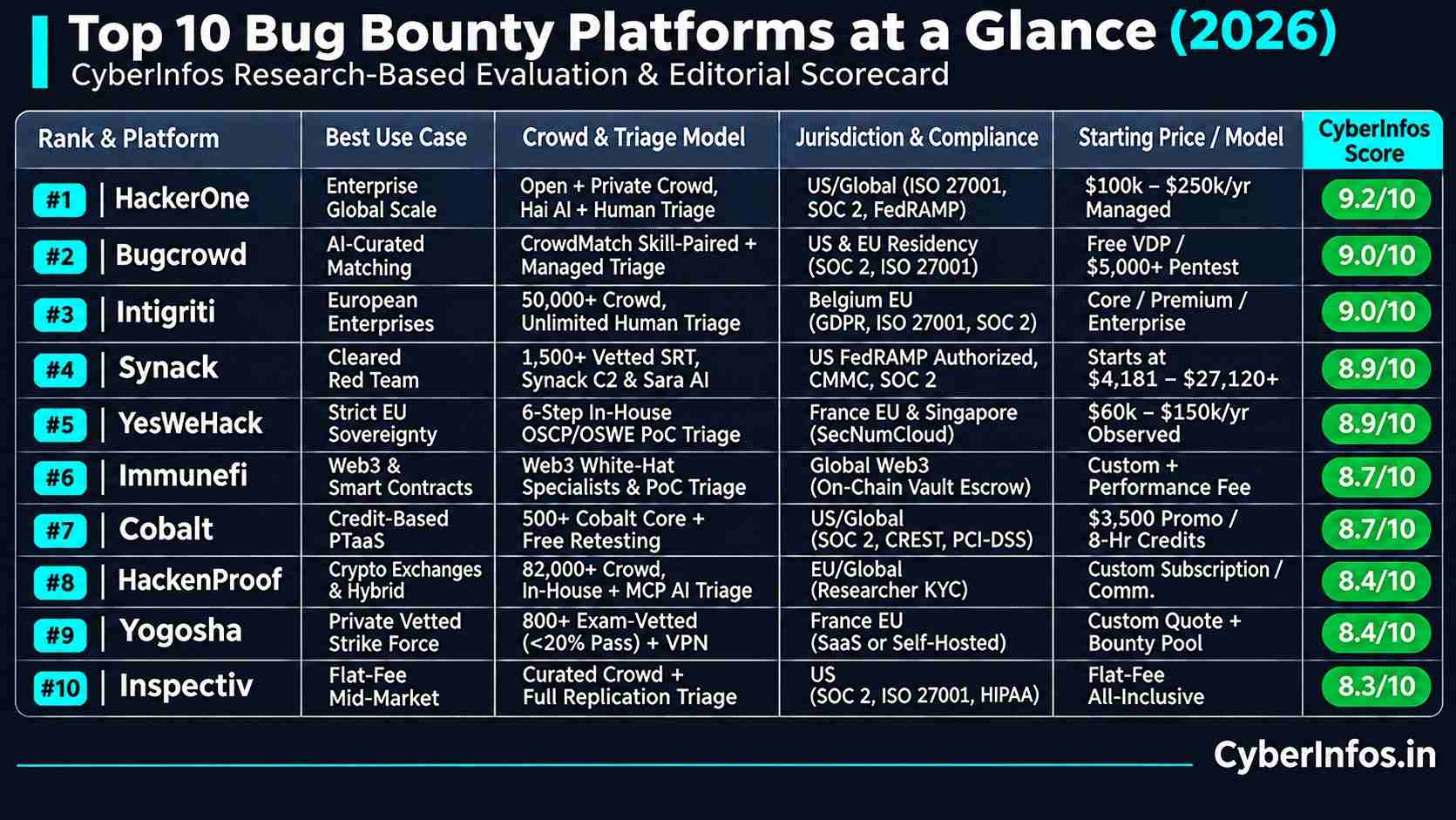
Quick Comparison Table: Top 10 Platforms Compared (November 2026)
| Product | Best For | Deployment & Residency | Key Strength | Starting Price / Procurement Model | CyberInfos Editorial Score |
|---|---|---|---|---|---|
| HackerOne | Global enterprise scale & CTEM | Cloud SaaS (US HQ; global cloud) | Hai Agentic System + Hai Triage + 2M+ researchers | Quote-based (Pro, Enterprise, Enterprise Plus); VDP ~$20k to $50k/yr; Managed bounty ~$100k to $250k+/yr (Vendr) | 9.2 / 10 |
| Bugcrowd | AI-matched researcher crowds | Cloud SaaS (US HQ + EU Data Residency) | CrowdMatch AI + FedRAMP Moderate + Mayhem fuzzing | Free VDP Compliance; VDP Basic $299 to $999/mo; PTaaS $5k to $15k/unit; Bounty ~$30k to $120k+/yr (Vendr) | 9.0 / 10 |
| Intigriti | European enterprises & mid-market | Cloud SaaS (100% EU cloud regions) | Unlimited in-house EU triage across all tiers + Triage Assist | Quote-based across Core, Premium & Enterprise plans + pay-for-impact bounty pool (Intigriti Pricing) | 9.0 / 10 |
| Synack | Vetted red team & federal/defense | Cloud SaaS + LaunchPoint+ C2 VPN | 1,500+ vetted Synack Red Team + FedRAMP Moderate (DoD IL2) + Sara AI | Published starts: Basic Platform ($0) + $5,085 (Sara Pentest), $10,283 (SynackST), $27,120 (Synack14) (Synack Pricing) | 8.9 / 10 |
| YesWeHack | Strict EU sovereignty (NIS2/DORA) | Cloud SaaS (ANSSI SecNumCloud OVHcloud) | 100% outside US CLOUD Act + 24/7 6-step OSCP/OSWE PoC reproduction (YesWeHack Triage) | Quote-based (or AWS Marketplace) + pay-for-results bounty pool | 8.9 / 10 |
| Immunefi | Web3, DeFi & L1/L2 smart contracts | Cloud SaaS + Non-Custodial Safe Vaults | 93% of Web3 critical bugs; $140M+ paid across 650+ protocols (Immunefi) | 10% performance fee on payouts (waived on annual BBP Subscription); median critical $20k | 8.7 / 10 |
| Cobalt | Credit-based PTaaS & agile teams | Cloud SaaS (US/EU cloud) | 500+ vetted Cobalt Core testers + 1 to 3 day start SLA + unlimited free retesting | $3,500/test Autonomous Pentest (promo through Dec 31, 2026); $80k to $150k/yr typical credit pack (Vendr) | 8.7 / 10 |
| HackenProof | Crypto exchanges & Web3/Web2 | Cloud SaaS + Whitelabel option | 82,000+ researchers + 2-hr triage SLA + MCP AI Server + KYC | Custom subscription or commission; DualDefense from $1,000 (HackenProof); ~$14.4k/yr base triage + 10% fee | 8.4 / 10 |
| Yogosha | Private Strike Force & self-hosting | Cloud SaaS (3DS Outscale SecNumCloud) or Self-Hosted | Exam-vetted Strike Force (<20% pass rate) + On-Premise option + built-in VPN (Yogosha) | Quote-based SaaS or self-hosted license; fixed-rate PTaaS ($500/day) & pay-for-results bounty pool | 8.4 / 10 |
| Inspectiv | Predictable mid-market AppSec | Cloud SaaS (US HQ) | Flat-fee subscription option bundling triage & payouts + Feature Testing (Inspectiv) | Quote-based flat-fee subscription (bounties & triage bundled, no mandatory escrow) (Inspectiv) | 8.3 / 10 |
Top 10 Bug Bounty Platforms Ranked & Reviewed (2026)
#1 HackerOne: Best Overall for Global Enterprise Scale & Full CTEM Lifecycle
Quick Take
CyberInfos Editorial Score: 9.2 / 10
HackerOne ranks first overall among the best bug bounty platforms under our evaluation criteria. No competitor matches its combination of a 2M+ registered researcher network (~38% global market share per QuantumSec), unified H1 Platform architecture orchestrated by the Hai Agentic System (H1 Pricing), and 35+ native DevSecOps integrations (H1 Integrations). Still, its high enterprise contract floor, add-on managed triage fees, and high contract minimums make it overkill for smaller teams.
Why It Stands Out
In June 2026, HackerOne unified its portfolio into the H1 Platform powered by the Hai Agentic System. This architecture delivers end-to-end Continuous Threat Exposure Management (CTEM) across code, cloud, web, APIs, and AI systems (CTEM Solutions; Synack Comparison).
To combat low-effort AI report floods, Hai Triage and H1 Validation deduplicate findings and confirm exploitability at a vendor-reported 95% accuracy (improving signal by 40%). Even so, the platform requires explicit human approval before changing report states (H1 Pricing; Hai Security Docs).
Under HackerOne’s August 2026 Hackbot policy, fully autonomous reporting is prohibited. Researchers must maintain a mandatory “hacker-in-the-loop” check (Hai Security Docs).
Reputation rules back up that policy. As documented by XHack’s October 2026 platform audit, researcher accounts start at 100 Reputation points and lose -5 points for a Not Applicable closure and -10 points for spam.
Key Features
- H1 Bounty & H1 Response (VDP): Bundles always-on H1 Response VDP into the base platform subscription alongside private and public bug bounty program management and EU Cyber Resilience Act disclosure workflows.
- Hai Agentic System & Prepaid Agentic Credits: Every platform edition includes prepaid Agentic Credits drawn down in real time across H1 Continuous Testing, H1 Remediation, H1 Asset Intelligence, and H1 Code Security Audit (H1 Pricing).
- H1 Pentest & H1 Bounty Challenge: Launches enhanced PTaaS engagements in 4 to 7 business days with Technical Engagement Managers (H1 Pentest Docs).
- H1 AI Red Teaming: Dedicated adversarial testing for enterprise LLMs aligned to OWASP LLM Top 10, MITRE ATLAS, and NIST AI RMF (Synack Comparison).
Security, Privacy & Compliance
According to HackerOne’s Trust Center (Assurance Profile) and the FedRAMP Marketplace, HackerOne holds SOC 2 Type II (2026), ISO/IEC 27001 and ISO 27701, ISO 29147/30111, PCI DSS, GDPR, UK Cyber Essentials Plus, and FedRAMP Tailored Low Impact SaaS (LI-SaaS) authorization. Hai runs on isolated RAG infrastructure partnered with Anthropic and AWS and never trains external models on customer data (HackerOne Trust).
Ease of Use, Deployment & Integrations
Delivered as cloud SaaS across Professional, Enterprise, and Enterprise Plus editions (H1 Pricing), HackerOne offers 35+ bidirectional and native connectors.
Supported tools include Jira (Cloud/Server), GitHub, GitLab, ServiceNow (VR/AVR/ITSM), Slack, Microsoft Teams, Azure DevOps, Linear, Splunk, Tenable, Wiz, and Armis (Integrate Tools Docs).
Pricing
- Official list pricing: 100% custom quote across Professional, Enterprise, and Enterprise Plus editions; no public dollar figures appear on H1 Pricing.
- Verified procurement benchmarks (checked November 2026): Per Vendr’s 2026 HackerOne marketplace data and HackenProof’s October 2026 pricing study, annual VDP platform access fees typically run $20,000 to $50,000/year. Self-managed bug bounty program platform fees range from $50,000 to $150,000+/year, while fully managed programs including managed triage run $100,000 to $250,000+/year (triage adds 20% to 40% over base fees per QuantumSec).
- Average annual researcher payouts per program were ~$42,000 in 2025 (HackenProof), funded separately via prepayment balance or card plus a quoted rewards service fee (SecureCoding). Multi-year contracts commonly yield 15% to 30% discounts (Vendr).
Pros
- Largest global community of 2M+ researchers with optional ID/background-vetted HackerOne Clear cohorts (Synack Comparison).
- Always-on VDP (H1 Response) and prepaid Agentic Credits included across all three platform tiers (H1 Pricing).
- Mature 35+ native integration ecosystem and strong Reputation/Signal gates against AI spam (H1 Integrations; XHack).
Cons
- High total cost of ownership; base platform fees plus 20% to 40% triage add-ons and reward service fees price out smaller teams (QuantumSec).
- FedRAMP authorization is Tailored LI-SaaS rather than full FedRAMP Moderate, limiting higher-impact federal/DoD workloads compared with Synack or Bugcrowd (Synack Comparison).
Best For
Large enterprises and Fortune 500 security teams that require maximum global researcher reach, 35+ enterprise integrations, and a unified platform spanning VDP, bug bounty, code audits, and AI red teaming.
Limitations
Commodity open-source programs have experienced reward compression. In May 2026, HackerOne’s Internet Bug Bounty cut critical open-source payouts from $9,250 to $2,257 due to sponsor pool adjustments amid rising AI-assisted report volume (HackenProof).
CyberInfos Verdict
HackerOne earns #1 over #2 Bugcrowd by 0.2 points due to its larger global researcher depth, 35+ bidirectional enterprise connectors, and unified Hai CTEM capabilities. Yet if you require full FedRAMP Moderate authorization, published VDP entry pricing, or bundled triage, Bugcrowd or Synack may fit better.
#2 Bugcrowd: Best for AI-Curated Researcher Skill Matching & Bundled Triage
Quick Take
CyberInfos Editorial Score: 9.0 / 10
Holding roughly 32% global market share (QuantumSec), Bugcrowd is HackerOne’s closest rival among the best bug bounty platforms. Between late 2025 and mid-2026, Bugcrowd acquired autonomous fuzzing vendor Mayhem Security (SecureCoding), achieved FedRAMP Moderate Authorization (sponsored by CISA) (Bugcrowd Security), added European Data Residency (Bugcrowd Press), and launched the Savant AI suite (Savant Pathseeker & Savant Vista).
Why It Stands Out
Rather than relying purely on open crowd volume, Bugcrowd uses CrowdMatch AI on its crowdsourced security Crowdcontrol platform to match specific customer environments with researchers across hundreds of skill, performance, and clearance dimensions (Bugcrowd PTaaS Guide).
What this means in practice is less noise for engineering teams. Bugcrowd pairs its AI Triage Assistant (AI Triage Blog) and Priority Queue Bypass for high-signal hunters (Priority Queue Blog) with tough March 2026 anti-AI-spam enforcement. Submitting 10 consecutive invalid reports triggers a mandatory review and a 30-day account suspension if reports appear automated without validation (XHack).
Key Features
- Managed Bug Bounty & CrowdMatch AI: Curates private and public researcher cohorts with default CVSS 4.0 support (added April 2026) and Bugcrowd’s Vulnerability Rating Taxonomy (VRT) (XHack).
- Tiered VDP Offerings: Includes a free self-managed VDP Compliance tier, VDP Basic 15 ($299/mo), VDP Basic 75 ($999/mo), and Fully Managed VDP.
- PTaaS (Standard, Plus, Max) & Savant Suite: Delivers Pen Testing as a Service with 12 months of retesting, Savant Pathseeker agentic pentesting, Savant Vista Attack Surface Management, and Mayhem coverage-guided API/code fuzzing (Fuzz Testing Blog).
Security, Privacy & Compliance
Bugcrowd holds FedRAMP Moderate Authorization (achieved March 2026, powering CISA’s federal civilian VDP platform) (CISA VDP Blog), ISO/IEC 27001:2022, SOC 2 Type II, SOC 3, PCI DSS, CREST accreditation, and GDPR compliance with a 2026 European Data Residency option (Bugcrowd Trust Center).
Ease of Use, Deployment & Integrations
Crowdcontrol offers pre-built connectors for bidirectional Jira, GitHub (push-to-issue), ServiceNow, Slack, Microsoft Teams, Azure Boards, IBM SOAR, Qualys, Kenna, Nucleus, PagerDuty, and auto-generated Nuclei templates (Platform Integrations).
Pricing
- Published VDP & PTaaS pricing (checked November 2026): On Bugcrowd’s VDP pricing page, VDP Compliance is Free, VDP Basic 15 is $299/month ($3,588/yr billed upfront), and VDP Basic 75 is $999/month ($11,988/yr billed upfront).
- On AWS Marketplace, Standard Pen Test units are listed at $5,000 (small web app or cloud config), $8,000 (medium web app or 1-platform mobile app), $13,000 (2-platform mobile app), and $15,000 (large web app), launching in 3 business days with 12 months of retesting (Stingrai).
- Private bug bounty pricing benchmarks: Per Vendr’s 2026 Bugcrowd data, private managed bug bounty platform fees start at $30,000 to $60,000/year (1 to 3 apps) and scale to $75,000 to $120,000+/year for larger scopes, plus a separate reward pool (typically $50,000 to $200,000/year, debited when a report moves from
TriagedtoUnresolvedper SecureCoding).
Pros
- Bundled managed triage and CrowdMatch AI skill pairing avoid the 20% to 40% triage add-on surcharges seen at HackerOne (QuantumSec).
- Full FedRAMP Moderate Authorization (sponsored by CISA) plus EU Data Residency (CISA VDP Blog).
- Published VDP tiers ($0, $299/mo, $999/mo) and published AWS Marketplace PTaaS unit prices ($5k to $15k with 12-month retesting) (Stingrai).
Cons
- Requesting CREST-certified testers or custom report formatting requires upgrading from Standard to the custom-quoted Plus PTaaS tier (Stingrai).
- GitHub integration is a one-way push rather than deep bidirectional sync (SecureCoding).
Best For
Mid-to-large enterprises and US civilian agencies that want AI-matched researcher cohorts, FedRAMP Moderate compliance, 12-month PTaaS retesting, or an affordable ramp into managed vulnerability disclosure.
Limitations
Although Bugcrowd offers EU data residency, organizations legally barred from contracting with US-headquartered entities subject to the US CLOUD Act must choose YesWeHack, Intigriti, or Yogosha (QuantumSec).
CyberInfos Verdict
Bugcrowd ties #3 Intigriti at 9.0/10 and takes #2 for global versatility thanks to its published VDP/PTaaS entry prices, CISA-backed FedRAMP Moderate ATO, and Mayhem fuzzing capabilities.
#3 Intigriti: Best for European Enterprises & GDPR-Native Triage
Quick Take
CyberInfos Editorial Score: 9.0 / 10
Headquartered in Antwerp, Belgium, Intigriti is Europe’s leading managed bug bounty platform, connecting 400+ active programs with 150,000+ researchers and over €60M paid in bounties (Intigriti). With 100% EU cloud hosting, ISO/IEC 27001:2022 and SOC 2 Type II certifications, and unlimited bug bounty triage included across all subscription tiers, it is our top pick for European mid-market and enterprise teams.
Why It Stands Out
Many competing vendors gate triage behind expensive add-on tiers. Intigriti takes a more buyer-friendly approach: it bundles unlimited in-house managed triage for every bug bounty program, unlimited configurable programs, and free SSO/MFA across all three of its subscription packages (Core, Premium, and Enterprise) (Intigriti Pricing; Stop Overpaying Guide).
In October 2026, Intigriti rolled out Triage Assist. This internal AI suite is operated exclusively by Intigriti’s human triage analysts to speed up validation without letting automated bots dismiss valid researcher submissions.
Key Features
- Four Program Confidentiality Modes: Run programs as Private (15 to 20 hand-picked researchers), Public, Application (researchers apply for customer approval), or Registered (open to logged-in platform users with optional ID-check enforcement) (Intigriti Bug Bounty).
- Hybrid PTaaS, Managed VDP & Live Hacking Events: Combines methodology-driven compliance pentesting (including free retesting) with outcome-based crowdsourced incentives (Intigriti PTaaS).
- 2026 Additions: Includes AI Security & Safety testing for LLMs, CrowdRecon attack surface discovery, self-serve Insights ROSI reporting, and multi-subsidiary Workspaces.
Security, Privacy & Compliance
Hosted 100% in EU cloud regions, Intigriti encrypts customer data with customer-specific AES-256-GCM keys rotated every 30 days and root keys rotated every 6 months (Intigriti Trust FAQ).
Per Intigriti’s Trust Center, it holds ISO/IEC 27001:2022 (clean June 2026 surveillance audit), AICPA SOC 2 Type II (April 2026 audit report), CREST accreditation, Microsoft SSPA compliance, and classification as an EU NIS2 Important Entity.
Ease of Use, Deployment & Integrations
Intigriti provides native connectors for Jira Cloud/Server/Data Center, Slack, Linear, Brinqa, a Model Context Protocol (MCP) connector, Webhooks, and REST API (Integrations KB). Note that native Jira sync is intentionally unidirectional (Intigriti to Jira) so custom Jira workflow transitions cannot accidentally trigger bounty payouts (Intigriti Jira KB).
Pricing
- Official tier structure (checked November 2026): Custom quotes across Core, Premium, and Enterprise plans on Intigriti Pricing, all including unlimited managed triage, transparent tier inclusions, plus a “pay-for-impact” bounty pool and optional Reward Services for researcher KYC/tax administration (Hackrate Analysis).
- Procurement context: Independent European benchmarks from QuantumSec verify that Intigriti is significantly more flexible and accessible for mid-market budgets than HackerOne’s €100,000+ contracts.
Pros
- Unlimited in-house European bug bounty triage and SSO included across all three subscription tiers (Intigriti Pricing).
- 100% EU cloud hosting with 30-day AES-256-GCM key rotation, ISO 27001:2022, SOC 2 Type II, and NIS2/DORA readiness (Intigriti Trust Center).
- Four granular program confidentiality modes (Private, Application, Registered, Public) (Intigriti Bug Bounty).
Cons
- Native Jira integration is unidirectional only; bidirectional sync or GitLab/GitHub/ServiceNow connections require API/webhooks (Intigriti Jira KB).
- Does not hold French ANSSI SecNumCloud qualification or US FedRAMP authorization.
Best For
European and UK mid-market and enterprise organizations seeking GDPR-native hosting, bundled in-house triage, and NIS2/DORA compliance without US enterprise price bloat.
Limitations
Organizations requiring on-premises self-hosting should look at Yogosha (#9), while teams requiring ANSSI SecNumCloud qualification should look at YesWeHack (#5).
CyberInfos Verdict
Intigriti earns 9.0/10, tying Bugcrowd. For European companies that want transparent tier inclusions, unlimited managed triage, compliant vulnerability disclosure, and native EU jurisdiction, Intigriti is the strongest all-around platform in Europe.
#4 Synack: Best for Cleared Red Team Assurance & Federal Compliance
Quick Take
CyberInfos Editorial Score: 8.9 / 10
Synack completed a landmark merger with NetSPI on October 5, 2026 (NetSPI & Synack Merger), combining NetSPI’s 350+ in-house pentesters with Synack’s 1,500+ background-checked Synack Red Team (SRT) and Sara AI. Synack rejects open public crowds in favor of cleared red-team testing routed through its LaunchPoint+ C2 gateway, backed by FedRAMP Moderate Authorization with DoD IL2 Reciprocity and transparent starting SKU prices.
Why It Stands Out
Open marketplaces are not built for every threat model. Every SRT member passes multi-stage technical assessments (<3% to 10% acceptance rate), government-grade background checks, and ID verification, and signs individual NDAs (Synack vs. Bugcrowd).
All testing traffic routes through Synack’s LaunchPoint+ gateway. That design gives SOC teams full session auditability and safe tunneling into internal, VPN-gated networks (Synack vs. HackerOne).
On the AI front, Sara (Synack Autonomous Red Agent, backed by 28 patents) runs a 5-step autonomous offensive pipeline, while Sara Triage ingests Tenable and Qualys outputs to eliminate 99.98% of scanner noise before human attestation (Synack vs. Bugcrowd).
Key Features
- Vetted Synack Red Team & LaunchPoint+ Gateway: 1,500+ background-checked researchers with full network traffic telemetry in the Coverage Tab (Synack Security).
- Sara AI & Sara Triage: Autonomous recon and exploit validation paired with 99.98% scanner noise reduction and human-attested PoCs (Synack Tenable Blog).
- No Variable Bounty Pool Volatility: Synack manages and funds all researcher payouts internally; customers pay fixed package or credit rates (Synack Pricing).
Security, Privacy & Compliance
Synack holds FedRAMP Moderate Authorization with DoD Impact Level 2 (IL2) reciprocity (cleared for FOUO/CUI federal workloads across 325 security controls), ISO/IEC 27001:2022, SOC 2 Type II, TX-RAMP Level 2, and CREST accreditation (Platform Security).
Ease of Use, Deployment & Integrations
Synack integrates natively with Jira, ServiceNow, Azure DevOps, Splunk, Microsoft, Palo Alto Networks, Tenable, and Qualys, and can be procured via AWS, Azure, and GCP Marketplaces, Carahsoft, and GSA Advantage (Synack Pricing).
Pricing
- Published starting packages (checked November 2026): On Synack’s official pricing page (and verified by Pentest AE):
- Basic Platform ($0) or paid Synack Platform (required paid line item for ASM, SSO, and native integrations).
- Coverage (Sara Pentest): Starts at $5,085 for 1 Standard Sara Pentest (or from $4,181 for low-complexity scopes per Pentest AE), 4 to 5 business day window.
- Compliance (SynackST): Starts at $10,283 (1 human tester, 5-day window, up to 25 unauthenticated web apps, 1 low-complexity authenticated web app, or 100 host IPs).
- Risk Reduction (Synack14/365): Starts at $27,120 for Synack14 (rotating SRT testers over 14 or 365 days across up to 50 unauthenticated web apps, 1 authenticated web app, or 250 host IPs).
- Credit terms: Synack Credits expire 12 months from purchase (Synack Pricing).
Pros
- Universal researcher background checks, NDAs, and LaunchPoint+ C2 traffic auditability (Synack vs. Bugcrowd).
- Highest US federal clearance (FedRAMP Moderate with DoD IL2 Reciprocity for FOUO/CUI) (FedRAMP Portal).
- Published starting SKU prices ($5,085, $10,283, $27,120) with zero variable bounty pool risk (Synack Pricing).
Cons
- Does not support open public crowdsourced security bug bounty program marketplaces (Rankite).
- Requires paying a separate Synack Platform fee for SSO/integrations, and credits expire after 12 months (Synack Pricing).
Best For
US federal agencies, DoD/CMMC defense contractors, banks, and enterprises that need background-checked red teamers testing internal and external assets on a predictable fixed budget.
Limitations
Note that Synack’s FedRAMP Moderate ATO covers the Synack platform and does not automatically extend to legacy NetSPI products following the October 2026 merger (NetSPI & Synack Merger).
CyberInfos Verdict
Synack scores 8.9/10 and ranks #4. It is the undisputed leader for federal, defense, and background-checked red teaming with published scope ceilings, trailing Intigriti and Bugcrowd in our bug bounty platform comparison only because it does not offer open public community bounty marketplaces.
#5 YesWeHack: Best for Strict EU Data Sovereignty Outside the US CLOUD Act
Quick Take
CyberInfos Editorial Score: 8.9 / 10
Headquartered in Paris with 160,000+ registered researchers across 50+ countries (YesWeHack ENISE 2026), YesWeHack is the premier sovereign European crowdsourced security suite. Hosted 100% in Europe on an ANSSI SecNumCloud-qualified private cloud operated by OVHcloud and staffed by a permanent 24/7 in-house OSCP/OSWE triage team, it ties Synack at 8.9/10.
Why It Stands Out
YesWeHack Triage enforces a strict operational rule: “AI accelerates, it never decides.”
Every incoming report undergoes a mandatory 6-step process: AI metadata enrichment, scope check, AI duplicate scoring, mandatory step-by-step Proof-of-Concept (PoC) reproduction under real conditions, contextual impact assessment, and 1-click CVSS/reward recommendations.
Every step is signed off by permanent, in-house security engineers holding OSCP, OSWE, and CVSS certifications (YesWeHack Triage). If a finding cannot be reproduced, it never reaches your team (0 false positives).
Key Features
- 24/7 6-Step In-House Triage: Covers nights, weekends, and holidays with mandatory PoC reproduction and a dedicated Customer Success Manager (CSM) (YesWeHack Triage).
- Full CTEM & Agentic Pentest: Launched in June 2026, Agentic Pentest deploys AI agents for same-day attack-path validation alongside Exposure Management, Vulnerability Management, VDP, and Live Hacking Events.
- Bi-Directional BugTracker Sync (
YWH2BT): Open-source Python/GUI integration engine (GitHub YWH2BT) supporting two-way synchronization with Jira, GitLab, GitHub, and ServiceNow (BugTracker KB).
Security, Privacy & Compliance
Per YesWeHack Trust & Security, the company holds ISO/IEC 27001, ISO/IEC 27017, and CREST accreditation, aligns its AI governance with ISO/IEC 42001, and hosts its platform on an ANSSI SecNumCloud-qualified private cloud (certified for SOC 2 Type II, ISO 27018, ISO 27701, and PCI DSS) (YesWeHack ECSO). Because YesWeHack is 100% European-owned and operated, it is immune to extraterritorial US CLOUD Act requests (QuantumSec).
Ease of Use, Deployment & Integrations
Available via direct contract or AWS Marketplace, YesWeHack connects to Jira, GitLab, GitHub, ServiceNow, Azure DevOps, UBIKA, Mindflow, Hackuity, and BlinkOps (YesWeHack). Note that two-way bug tracker sync requires scheduling the ywh2bt CLI/cron utility (BugTracker KB).
Pricing
- Pricing structure (checked November 2026): Custom quote across platform license, managed triage, optional CTEM modules, and a pay-for-results bounty pool (YesWeHack Bug Bounty; Hacken Comparison).
- Procurement context: Benchmarks from QuantumSec confirm competitive pricing against US platforms plus free/low-cost basic vulnerability disclosure entry options and competitive bug bounty pricing.
Pros
- 100% European jurisdiction on ANSSI SecNumCloud-qualified OVHcloud infrastructure outside the US CLOUD Act (YesWeHack News).
- Permanent in-house OSCP/OSWE triage engineers with mandatory PoC reproduction on every report (YesWeHack Triage).
- 160,000+ researchers plus bi-directional sync across Jira, GitLab, GitHub, and ServiceNow (BugTracker KB).
Cons
- Bi-directional bug tracker sync relies on deploying the
ywh2btCLI/cron engine rather than a purely cloud-hosted toggle (BugTracker KB). - Smaller North American researcher footprint than HackerOne or Bugcrowd (QuantumSec).
Best For
EU public-sector agencies, defense ministries, financial institutions under DORA, and essential entities under NIS2 that require strict immunity from the US CLOUD Act and SecNumCloud hosting.
Limitations
Not FedRAMP-authorized for US federal government procurement.
CyberInfos Verdict
YesWeHack scores 8.9/10 and ranks #5. Whenever ANSSI SecNumCloud hosting or strict legal independence from the US CLOUD Act is a hard requirement, YesWeHack is the #1 choice in the industry.
#6 Immunefi: Best for Web3, DeFi & Smart Contract Protocols
Quick Take
CyberInfos Editorial Score: 8.7 / 10
Immunefi is the dominant Web3 bug bounty program platform, commanding 85,000+ researchers, 93% of critical Web3 disclosures, and over $140 million paid out across 650+ protocols protecting $180B to $190B+ in user funds (Immunefi).
Why It Stands Out
In DeFi and Layer-1/Layer-2 protocols, a single smart contract exploit can drain an entire treasury in seconds.
To counter that threat, Immunefi established the 10% Funds-at-Risk standard (such as the Aave and Immutable programs offering up to $1M+ caps) and backs it with non-custodial on-chain Immunefi Vaults built on Safe multisig smart contracts so protocols can publicly prove liquidity. According to Immunefi’s April 2026 research, nearly every long-running program on the platform has discovered a critical bug, with a median critical payout of $20,000 compared to an estimated $25 million average exploit loss.
Key Features
- Three-Tier Managed Triage for Web3 crowdsourced security: AI triage agents filter or escalate 2 in 3 incoming reports (Immunefi), supported by human ex-auditors across Time Saver, Signal Booster, and Expert Assessment tiers (achieving a 99.3% closure accuracy rate).
- Non-Custodial Immunefi Vaults & SEAL Safe Harbor: Protocols retain multisig custody of bounty funds and can adopt the Security Alliance (SEAL) Safe Harbor framework, empowering whitehats to rescue funds during active blackhat exploits within a 6-hour recovery window (Origin Protocol Safe Harbor).
- Audit Competitions, PR Reviews & Magnus SecOps: Embeds whitehats and an AI Code Review Agent into GitHub pull requests and runs massive Attackathons (such as the $1.5M Ethereum Protocol Attackathon).
- Binding On-Chain Arbitration: Opt-in Immunefi Arbitration administered with the London Chamber of Arbitration and Mediation (LCAM) uses smart-contract Vault guards to freeze disputed funds and enforce awards in USDC (Solana Compass).
Security, Privacy & Compliance
Immunefi is SOC 2 Type II compliant (Immunefi Bug Bounty), enforces mandatory OFAC SDN and UNSC sanctions screening (Arbitration Scope), supports program-level KYC, and strictly forbids testing on live mainnet or public testnets (requiring local fork PoCs at a fixed block height).
Ease of Use, Deployment & Integrations
Connects with Slack, Discord, and PagerDuty on the BBP Subscription, integrates with GitHub via the Immunefi GitHub App, and unifies partner audits in Magnus.
Pricing
- Fee structure (checked November 2026): Standard 10% performance commission fee on valid researcher payouts with $0 onboarding fee on the baseline commission tier (Aave Governance), or an annual flat-fee BBP Subscription / Enterprise Subscription that waives the 10% commission on all payouts and bundles Magnus tooling and default triage support.
Pros
- Unmatched Web3 researcher depth (85,000+ whitehats, $140M+ paid out, 93% of critical crypto bug disclosures) (Immunefi).
- Non-custodial Safe multisig Immunefi Vaults, SEAL Safe Harbor exploit rescue, and optional binding LCAM arbitration.
- Annual BBP Subscription option eliminates the 10% payout commission (Immunefi Bug Bounty).
Cons
- Opt-in LCAM arbitration carries high legal fees (starting at £7,500), and smaller low-TVL protocols struggle to attract top whitehats without six-figure critical caps (Solana Compass).
- Not built for traditional Web2 enterprise IT or legacy compliance frameworks.
Best For
DeFi protocols, Layer-1/Layer-2 blockchains, bridges, and smart-contract teams where on-chain TVL is at risk.
Limitations
Centralized crypto exchanges and hybrid fintechs needing ISO 27001 certification and equal emphasis on Web2 mobile/API apps should compare HackenProof (#8).
CyberInfos Verdict
Immunefi earns 8.7/10 and ranks #6 overall, while standing #1 by a wide margin for on-chain Web3 and smart contract security.
#7 Cobalt: Best for Credit-Based PTaaS & Agile SDLC Retesting
Quick Take
CyberInfos Editorial Score: 8.7 / 10
Cobalt pioneered Penetration Testing as a Service (PTaaS) and is evaluated head-to-head in every enterprise bug bounty platform comparison against HackerOne and Synack by modern crowdsourced security buyers (Pentest AE). With 500+ vetted Cobalt Core pentesters, guaranteed 1-to-3 business day start SLAs, unlimited free retesting, and a published $3,500 Autonomous Pentest offer through December 31, 2026, Cobalt is the top choice for agile teams seeking predictable credit consumption.
Why It Stands Out
One Cobalt Credit represents 8 hours of offensive security testing combining Cobalt Sage AI and human Cobalt Core pentesters (Cobalt Pricing).
Unlike open bug bounties where researcher participation and payout totals fluctuate wildly, Cobalt guarantees test launch within 3 business days (Standard), 2 business days (Premium), or 1 business day (Enterprise). Even better for engineering velocity, it includes unlimited on-demand free retesting throughout your 6- or 12-month contract window (Cobalt Pricing).
Key Features
- Cobalt Autonomous Pentest ($3,500/test promo): Pairs AI agents built on 13 years of exploit data with Cobalt Core pentester oversight, delivering validated web app findings within 24 hours (Cobalt Pricing).
- Unlimited Free Retesting: Developers trigger retests directly from Jira or GitHub at zero additional credit cost (Cobalt Pricing).
- Built-In ASM & DAST: Includes Attack Surface Monitoring and 1 DAST target across all tiers, plus AI/LLM pentesting and secure code review (Cobalt Pricing).
Security, Privacy & Compliance
Cobalt supports SOC 2, ISO 27001, PCI-DSS, HIPAA, and DORA compliance reporting (Cobalt Pricing; Vendr).
Ease of Use, Deployment & Integrations
Integrates natively with Jira, GitHub, Slack, ServiceNow, and 50+ SDLC tools, plus SAML SSO across all tiers (Cobalt Pricing).
Pricing
- Published promotional price (checked November 2026): $3,500 per test for Cobalt Autonomous Pentest (must be initiated and completed before December 31, 2026) (Cobalt Pricing).
- Verified credit package benchmarks: Per Vendr’s 2026 Cobalt report, annual platform fees run $15,000 to $75,000+/year, and credit packages start around $50,000/year (a standard web app pentest uses 10 to 20 credits).
- Mid-market buyers typically invest $80,000 to $150,000/year, while enterprise continuous programs run $200,000 to $400,000+/year (with 25% to 35% volume discounts above $250k). Credits expire at year-end on Standard and Premium tiers, with up to 10% credit rollover on Enterprise (Cobalt Pricing).
Pros
- Guaranteed 1-to-3 business day launch SLAs and unlimited free retesting (Cobalt Pricing; Pentest AE).
- Published $3,500 Autonomous Pentest offer with 24-hour findings turnaround (Cobalt Pricing).
- Predictable annual credit budgeting without open bounty payout volatility.
Cons
- Does not run open pay-per-bug public bounty marketplaces or passive vulnerability disclosure queues or pay-per-bug bounty pools (Cobalt Pricing).
- Credits do not roll over on Standard/Premium tiers (Cobalt Pricing).
Best For
B2B SaaS, fintech, and healthcare engineering teams that want agile, repeatable compliance pentesting and unlimited developer retesting integrated into Jira and GitHub.
Limitations
Custom auditor attestation letters and specialized researcher pools may carry higher tier requirements or credit consumption (Vendr).
CyberInfos Verdict
Cobalt ties Immunefi at 8.7/10 and takes #7. For teams that prioritize scheduled SDLC velocity, guaranteed start times, and free retesting over open crowd hunting, Cobalt is a standout value.
#8 HackenProof: Best for Crypto Exchanges & Hybrid Web3/Web2 Stacks
Quick Take
CyberInfos Editorial Score: 8.4 / 10
Trusted by 400+ programs (including OKX, KuCoin, Sui, MetaMask, Polygon, NEAR, Avalanche, and Raiffeisen Bank) with $26M+ paid in bounties and $95B+ protected (HackenProof), HackenProof bridges Web3 smart contracts and Web2 fintech/exchange crowdsourced security infrastructure under an ISO/IEC 27001-certified roof.
Why It Stands Out
Speed of validation is HackenProof’s calling card. The platform guarantees a 2-hour first response and 2-hour first validation SLA (24/7) across three triage modes: Manual Triage, AI Triage powered by hBrain, and Hybrid Triage.
To stop 2026 AI report floods, it combines researcher reputation controls, paid submission barriers in audits (Submission Requirements), and an official Model Context Protocol (MCP) Server and Claude Code plugins (hackenproof-triage and hackenproof-bulk-triage).
It also offers DualDefense Audits: a post-audit crowdsourced validation layer for critical bugs priced at a fixed $1,000 (or 10% to 20% of the initial audit cost) that uncovers a critical flaw in 1 of every 5 engagements.
Key Features
- Hybrid Web3 + Web2 Coverage: Supports 20+ languages (Solidity, Rust, Move, Cairo, Vyper, Clarity, Tact, Go, C++, Java, Python, Swift) across smart contracts, L1/L2s, web, mobile, and APIs (HackenProof Platform).
- 2-Hour 24/7 Triage SLA & MCP Server: Combines
hBrainAI pre-screening, human reproduction, and Claude Code MCP plugins (Vulnerability Triage; MCP Docs). - Built-In Researcher KYC, PGP Encryption & Whitelabel: Client-side Bring-Your-Own-PGP-Key encryption, mandatory researcher KYC for regulated scopes (and above $5,000 lifetime earnings), and Bug Bounty Whitelabel portals (Withdraw Bounty Docs).
Security, Privacy & Compliance
Certified for ISO/IEC 27001 and aligned with ISO/IEC 27002, ISO 29147, ISO 30111, GDPR, and EU CRA reporting readiness (Security Docs; Cost Guide).
Ease of Use, Deployment & Integrations
Integrates natively with Slack, GitHub Issues, Discord, Jira, PagerDuty, Linear via Zapier, and 100+ apps via its MCP Server and REST API (HackenProof).
Pricing
- Pricing structure (checked November 2026): Flexible bug bounty pricing via custom subscription, commission-on-rewards, or hybrid managed bug bounty model (Cost Guide).
- Published historical comparisons cite $14,400/year for annual triage plus a 10% bug reward fee (HackenProof vs Immunefi). Crowdsourced Audits charge a 10% operational and judging fee with a 100% refundable upfront deposit (Audit Fee Docs), while DualDefense starts at $1,000 (DualDefense). Between March and August 2026, HackenProof paid out $4.69M across its programs (Cost Guide).
Pros
- Fast 2-hour 24/7 triage SLA backed by ISO 27001 certification, PGP encryption, and researcher KYC (Vulnerability Triage).
- Cost-effective DualDefense post-audit protection (from $1,000) and official MCP Server / Claude Code triage plugins (MCP Docs).
- Multi-currency payouts in USDC, native tokens, or fiat within 48 business hours (Withdraw Bounty Docs).
Cons
- Smaller total DeFi bounty pool ($26M+ paid vs. Immunefi’s $140M+) (GBHackers).
- Uses custodial platform balances/deposits rather than non-custodial Safe multisig vaults (Audit Fee Docs).
Best For
Centralized crypto exchanges (CEXs), Web3 wallets, L1/L2 ecosystems, and hybrid fintechs that need both smart-contract and Web2 mobile/API security with researcher KYC.
Limitations
Contract/invoice-based researcher payouts for European tax residents are restricted to ERC-20 on Ethereum and cannot withdraw to smart contract wallets (Withdraw Bounty Docs).
CyberInfos Verdict
HackenProof scores 8.4/10 and takes #8, offering the best hybrid Web3/Web2 coverage, fastest published triage SLA (2 hours), and lowest fixed overhead for crypto exchanges and fintechs.
#9 Yogosha: Best for Private Exam-Vetted Strike Force & Self-Hosted Operations
Quick Take
CyberInfos Editorial Score: 8.4 / 10
Headquartered in Paris as a subsidiary of Groupe CRÉATIVE, Yogosha operates an elite, private crowdsourced security Vulnerability Operations Center (VOC) powered by the Yogosha Strike Force (~800 to 1,100+ exam-vetted researchers with a 10% to 20% acceptance rate) (Yogosha Strike Force). It is the only platform in our top 10 offering both ANSSI SecNumCloud SaaS hosting and full On-Premise Self-Hosted deployment (Yogosha Platform).
Why It Stands Out
Every applicant to the Yogosha Strike Force must pass technical exploitation exams, report-writing (“redactional”) tests, and ID verification. That selective gate yields an 80%+ annual researcher activity rate and a 70%+ report acceptance rate (90% signal-to-noise ratio) across 10,000+ vulnerability reports (Yogosha 10,000 Reports Milestone).
In late 2026, Yogosha also launched an AI-assisted vulnerability triage capability (90% success rate) and a Yogosha MCP server that lets customers orchestrate their own AI security agents inside the VOC (Yogosha AI Transformation).
Key Features
- SaaS (3DS Outscale SecNumCloud) or Self-Hosted On-Premise Deployment: Deploy in the cloud or completely on-premises for defense, banking, or MSSP white-label operations (Yogosha Platform; Strategic Partners).
- Built-In Yogosha VPN & Activity Monitor: Whitelist a single VPN gateway and monitor active researcher counts, working hours, sessions, and HTTP request volumes in real time (Yogosha Platform).
- Collaborative Multi-Entity VOC: Bring your own internal red teamers and supply-chain partner pentesters onto the same platform to satisfy NIS2 supply-chain audit mandates (Yogosha NIS2 Guide).
Security, Privacy & Compliance
Yogosha’s SaaS platform is hosted in France on 3DS Outscale, an ANSSI SecNumCloud-qualified provider (certified for ISO 27001/27017/27018), preventing US data transfers post-Schrems II (Yogosha Privacy Policy).
Ease of Use, Deployment & Integrations
Integrates natively with Jira Cloud, Jira Server, GitLab, Slack, REST API, Webhooks, and its new October 2026 MCP server (Yogosha Public Services; Yogosha AI Transformation).
Pricing
- Pricing structure (checked November 2026): Custom bug bounty pricing quote by deployment model (SaaS vs. Self-Hosted license) covering disclosure intake and managed triage.
- Bug Bounty follows a strict pay-for-results wallet model (Yogosha Bug Bounty), whereas PTaaS engagements use fixed researcher daily rates of $500 or €500 per man-day (plus 1 man-day each for retesting and the Managerial Synthesis report) (Yogosha Pentest KB).
Pros
- Exclusive On-Premise / Self-Hosted deployment option plus SecNumCloud French SaaS hosting (Yogosha Platform).
- 70%+ valid report acceptance rate from its exam-vetted Strike Force (<20% pass rate) (Yogosha 10,000 Reports).
- Built-in VPN traffic tracking and multi-entity VOC for NIS2 supply-chain testing (Yogosha NIS2 Guide).
Cons
- Smaller researcher pool (~800 to 1,100+ hunters) cannot support massive open public bug bounty program campaigns (Hackrate Yogosha Analysis).
- Does not publish a standalone corporate SOC 2 Type II report on a public trust center.
Best For
Defense ministries, sovereign European banks, telecoms, MSSPs, and NIS2 Essential Entities needing self-hosted deployment, VPN traffic monitoring, and private exam-vetted researchers.
Limitations
Lacks native GUI connectors for ServiceNow or GitHub Issues outside its REST API/webhooks.
CyberInfos Verdict
Yogosha ties HackenProof at 8.4/10 and takes #9. Whenever on-premises self-hosting or collaborative supply-chain VOC governance is required, Yogosha stands in a class of its own.
#10 Inspectiv: Best for Predictable Flat-Fee Mid-Market Budgeting
Quick Take
CyberInfos Editorial Score: 8.3 / 10
US-based Inspectiv rounds out our top 10 by solving the #1 bug bounty pricing objection mid-market CFOs have about crowdsourced security: unpredictable bounty payouts and mandatory cash escrow lock-ups. Inspectiv offers a predictable flat-fee subscription option that bundles platform access, 100% in-house human replication, and researcher bounty payouts alongside PTaaS, Feature Testing, VDP, and DAST (Inspectiv Platform).
Why It Stands Out
On legacy platforms, security teams pay a hefty annual license fee and must still lock up $50,000 to $100,000+ in a separate bounty escrow pool. Inspectiv removes that friction with an all-inclusive flat-fee subscription option where Inspectiv absorbs payout variability and pays researchers weekly (Inspectiv Researchers).
Beyond predictable billing, Inspectiv’s separate internal Triage Services Team independently replicates every submission and manages all researcher communications behind the scenes. Teams can also pair continuous bug bounty hunting with tactical “Feature Testing” (microtests) completed in days for new code releases (Inspectiv Platform; Inspectiv PTaaS).
Key Features
- Flat-Fee Managed Bug Bounty (Escrow Optional): Bundles managed bug bounty platform access, managed triage, vulnerability disclosure, and researcher rewards into one predictable budget (Inspectiv Bug Bounty).
- Unified AppSec Platform: Combines Bug Bounty, Managed VDP, PTaaS (with up to 1 year of retesting), Feature Testing, and DAST (Inspectiv Platform).
- 100% Behind-the-Scenes Researcher Management: Internal triage engineers replicate every bug and handle all researcher Q&A before findings reach your backlog (Inspectiv Bug Bounty).
Security, Privacy & Compliance
Inspectiv provides audit-ready reporting and safe-harbor templates aligned with SOC 2, ISO 27001, ISO/IEC 29147, PCI-DSS, HIPAA, NIST, and CISA frameworks (Inspectiv VDP Compliance).
Ease of Use, Deployment & Integrations
Integrates directly with Jira, Slack, and CI/CD pipelines for mid-market engineering teams (such as ServiceTitan, Checkr, and BigCommerce) (Inspectiv Case Study).
Pricing
- Pricing structure (checked November 2026): Custom quote with a flat-fee subscription option bundling triage and payouts (Inspectiv Bug Bounty). Across public Inspectiv programs tracked on BBRadar, per-finding bounty brackets typically range from $0 to $500 up to $2,500 depending on tier and severity.
Pros
- Flat-fee subscription option eliminates surprise bounty bills and mandatory escrow lock-ups (Inspectiv Bug Bounty).
- Unifies Bug Bounty, PTaaS, VDP, DAST, and rapid release-level Feature Testing (Inspectiv Platform).
- Offloads 100% of researcher communication and reproduction to Inspectiv’s internal triage team (Inspectiv Bug Bounty).
Cons
- Smaller researcher crowd and lower top-end bounty caps ($500 to $2,500 on standard programs) than hyperscale platforms like HackerOne or Immunefi (BBRadar).
- No self-service public pricing table (Inspectiv Platform).
Best For
US Series A to D and mid-market SaaS companies that want hands-off, flat-fee continuous bug bounty and feature testing without hiring a dedicated internal program manager.
Limitations
Not designed for sovereign European cloud mandates (SecNumCloud) or US FedRAMP federal workloads.
CyberInfos Verdict
Inspectiv scores 8.3/10 and secures #10. For mid-market SaaS teams that want continuous crowdsourced testing and agile feature microtests on a fixed annual budget, Inspectiv is a compelling, low-friction choice.
Buying Guide: How to Choose the Right Bug Bounty Platform in 2026
1. Understand Real Bug Bounty Pricing & Total Cost of Ownership (TCO)
First-time buyers frequently confuse the platform subscription fee with total program cost. As documented by HackenProof’s October 2026 Cost Guide and QuantumSec, bug bounty pricing consists of four distinct blocks:
- Annual Platform License: The SaaS subscription to access the platform, reporting dashboard, and SDLC integrations ($20,000 to $150,000+/year on major enterprise platforms).
- Managed Triage Fee: Either bundled (Intigriti, YesWeHack, Bugcrowd CrowdMatch, Inspectiv) or billed as an add-on of 15% to 40% on top of base platform fees (HackenProof; QuantumSec).
- Bounty Reward Pool & Per-Bug Commission: Direct researcher payouts (plus a 10% reward commission on baseline Immunefi/HackenProof tiers or a rewards service fee at HackerOne). Typical 2026 market payout bands per CyberGuardForte and Vendr are $2,000 to $25,000+ for Critical (CVSS 9.0 to 10.0), $500 to $15,000 for High (CVSS 7.0 to 8.9), and $200 to $2,000 for Medium (CVSS 4.0 to 6.9).
- Internal Engineering & Remediation Time: Validating business context, writing patches, and verifying fixes.
Business Impact: Under-budgeting the triage or remediation layer creates immediate operational debt. When high-severity bugs sit unpatched in Jira queues past 30-day disclosure windows, organizations face both researcher disputes and regulatory reporting exposure under the EU CRA and NIS2.
2026 All-In Annual Budget Benchmarks
- Under €50,000 (~$55,000)/year: Do not buy an enterprise bug bounty platform; platform fees will outweigh your actual researcher rewards (QuantumSec). Launch a free VDP (such as Bugcrowd VDP Compliance) or a self-hosted
security.txtchannel with external triage. - Small-to-Mid-Size Private Program ($40,000 to $150,000/year all-in): Covers 1 to 3 core web apps or APIs with a capped private reward pool (HackenProof). Best fits: Intigriti, Inspectiv, HackenProof, or Cobalt.
- Mid-Market Continuous Program ($150,000 to $400,000/year all-in): Multi-asset scope with full managed triage and quarterly PTaaS (HackenProof; Vendr). Best fits: Bugcrowd, Intigriti, YesWeHack, Synack, or Cobalt.
- Mature Global Enterprise Program ($400,000 to $1.5M+/year all-in): Public and private scopes, live hacking events, and continuous global coverage (HackenProof). Best fits: HackerOne, Bugcrowd, or Synack.
2. Audit How the Platform Defends Against AI-Generated Noise
Before signing a contract, ask every vendor three questions:
- Does a human engineer reproduce every PoC before my team sees it? Platforms like YesWeHack, Intigriti, Synack, and Inspectiv guarantee human reproduction and sign-off on every report.
- What happens when a researcher submits LLM-hallucinated spam? Look for hard automated brakes such as Bugcrowd’s 30-day suspension after 10 consecutive invalid reports (XHack), HackerOne’s August 2026 Hackbot rules and Reputation/Signal gates (Hai Security Docs), or Immunefi and HackenProof’s paid-submission spam barriers (Immunefi; HackenProof).
- Does the platform support CVSS 4.0 and contextual risk scoring? CVSS 3.1 and 4.0 score the same vulnerability differently (XHack). Ensure the platform lets you lock your scoring standard and factor in real-world exploitability.
3. Match Jurisdiction to Your Regulatory Mandate
- US Federal / DoD / CMMC / FISMA: Require FedRAMP Moderate Authorization (Synack includes DoD IL2 reciprocity; Bugcrowd holds a CISA-sponsored FedRAMP Moderate ATO; HackerOne holds FedRAMP Tailored LI-SaaS). Note that formal initial FedRAMP 3PAO penetration tests must be conducted by an A2LA-accredited ISO/IEC 17020 3PAO within 6 months prior to SAR submission (XHack FedRAMP Guide).
- EU NIS2, DORA & Cyber Resilience Act (CRA): If your legal counsel prohibits US CLOUD Act jurisdiction over unpatched vulnerability data, select an EU-headquartered provider on European infrastructure: YesWeHack (France / OVHcloud SecNumCloud), Yogosha (France / 3DS Outscale SecNumCloud or Self-Hosted), or Intigriti (Belgium / 100% EU cloud).
4. Common Buying Mistakes to Avoid
- Launching a public bug bounty on Day 1 without running a private program or pentest first: You will pay thousands of dollars in bounties for obvious bugs that a single baseline pentest would have caught for a flat fee (HackenProof). Start with a 60-to-90-day invite-only private program with a capped reward pool.
- Forgetting to reserve internal engineering remediation capacity: A triage team can validate bugs, but they cannot patch your code. Agree on fix SLAs with engineering leadership before launch (HackenProof).
- Ignoring credit expiration and triage add-on clauses: Negotiate credit rollover rights (on Synack or Cobalt) and lock in multi-year triage pricing caps upfront (Pentest AE; Vendr).
Recommended Actions:
- Immediate (Days 1 to 30): Stand up an ISO 29147-aligned vulnerability disclosure policy and baseline your core web/API assets with a time-boxed pentest before offering public cash rewards.
- Short-Term (Days 30 to 90): Launch an invite-only private bug bounty program with a capped reward pool and strict human PoC reproduction rules to calibrate researcher signal and internal engineering fix velocity.
- Long-Term (Months 3 to 12): Expand scope to public or hybrid managed bug bounty coverage once remediation SLAs hold steady, and use multi-year contract renewals to negotiate 15% to 30% off platform and managed triage fees.
Frequently Asked Questions (FAQs)
1. How much does a managed bug bounty program actually cost in 2026?
According to October 2026 market data from HackenProof and Vendr, small-to-mid-size private programs typically cost $40,000 to $150,000 per year all-in (covering platform fees, triage, and researcher rewards). Mid-market programs run $150,000 to $400,000 per year, and large enterprise public programs range from $400,000 to $1.5 million+ per year.
2. What is the difference between a VDP, a Bug Bounty Program, and PTaaS?
A Vulnerability Disclosure Program (VDP) is a public safe-harbor compliance channel (mandated by the EU CRA and US BOD 20-01) that accepts vulnerability disclosure reports without mandatory cash rewards (Bugcrowd VDP).
A Bug Bounty Program actively incentivizes ethical hackers with cash rewards scaled to severity (pay-for-results) (Yogosha). Penetration Testing as a Service (PTaaS) deploys a vetted team of testers to complete a structured compliance checklist within a fixed window (e.g., 5 to 14 days) for a predictable fee or credit cost (Cobalt; Synack).
3. Which among the best bug bounty platforms is strongest for EU NIS2, DORA, and CRA compliance?
If your organization requires 100% European jurisdiction outside the US CLOUD Act, YesWeHack (France, OVHcloud SecNumCloud), Yogosha (France, 3DS Outscale SecNumCloud or Self-Hosted), and Intigriti (Belgium, 100% EU cloud) are the top choices (QuantumSec). If you develop WordPress or open-source plugins subject to the EU CRA, Patchstack mVDP automates ENISA reporting for free.
4. Can we negotiate bug bounty pricing with enterprise vendors?
Yes. Procurement benchmarks from Vendr and HackenProof show that buyers routinely secure 15% to 30% discounts off list platform and triage fees by signing multi-year commitments, paying annually upfront, committing to a minimum bounty spend, or agreeing to transition a private program to public within 12 to 18 months.
5. How do the best bug bounty platforms prevent AI-generated spam reports in 2026?
Leading platforms combine automated pre-screening with strict researcher penalties: Bugcrowd suspends accounts for 30 days after 10 consecutive invalid reports and fast-tracks proven hunters via Priority Queue Bypass; HackerOne enforces its August 2026 Hackbot human-in-the-loop rule and Reputation/Signal deductions; Intigriti uses human-operated Triage Assist; YesWeHack mandates 6-step PoC reproduction by in-house OSCP/OSWE engineers; and Immunefi and HackenProof use AI triage agents plus paid-submission barriers.
Final Recommendation: Matching the Platform to Your Buyer Profile
The reality is that no single vendor wins every scenario. Use your primary operational constraint from our bug bounty platform comparison to select among the best bug bounty platforms in 2026:
- Choose HackerOne or Bugcrowd if you are a global enterprise with a $150,000+ annual budget seeking the broadest researcher reach among the best bug bounty platforms, mature DevSecOps integrations, and combined VDP, managed bug bounty, and PTaaS workflows (pick Bugcrowd if you need full FedRAMP Moderate authorization, bundled CrowdMatch triage, or a $0/$299 VDP entry ramp).
- Choose Intigriti, YesWeHack, or Yogosha if you are a European organization evaluating the best bug bounty platforms for GDPR, NIS2, or DORA alignment (pick Intigriti for all-inclusive EU triage across Core/Premium/Enterprise plans; pick YesWeHack for ANSSI SecNumCloud hosting outside the US CLOUD Act; pick Yogosha for On-Premise Self-Hosted deployment or supply-chain VOC collaboration).
- Choose Synack or Cobalt if you prefer vetted testers and predictable SKU or credit bug bounty pricing over open public crowds (pick Synack for FedRAMP Moderate with DoD IL2 reciprocity and LaunchPoint+ C2 traffic logging; pick Cobalt for 1-to-3-day SaaS PTaaS with unlimited free retesting).
- Choose Immunefi or HackenProof if you operate in Web3 and want a specialized bug bounty program (pick Immunefi for high-TVL DeFi smart contracts, non-custodial Safe Vaults, and SEAL Safe Harbor; pick HackenProof for crypto exchanges and hybrid Web3/Web2 stacks requiring 2-hour triage SLAs and researcher KYC).
- Choose Inspectiv if you are a US mid-market SaaS team seeking a predictable flat-fee subscription among the best bug bounty platforms that bundles triage, researcher payouts, and release-level feature testing.
