

Financial-sector chief information security officers (CISOs), fraud prevention teams, and cardholders are facing a sharp rise in targeted social-engineering risk this week. Between November 19 and 21, 2026, JPMorgan Chase, Visa, and Mastercard each confirmed a separate third-party service provider incident after the n0n ransomware and extortion group published customer datasets online in the n0n Visa Mastercard JPMorgan breach, according to Malwarebytes, SecurityWeek, and Infosecurity Magazine.
Core payment networks and card numbers were not compromised, but the operational impact is still significant. Researchers reviewing the leaked files found 16000 JPMorgan customer emails tied to the invitation-only J.P. Morgan Reserve card program, plus more than 6,000 premium Visa customer profiles and Mastercard benefit-program records, per Cybernews and The Bitdefender HotforSecurity Blog.
Attackers now hold real names, phone numbers, and recent dining or travel reservations. Defenders need to escalate financial vishing OTP scam defense immediately.
Quick Answer
The n0n Visa Mastercard JPMorgan breach exposed customer names, email addresses, phone numbers, and concierge booking details from a third-party card benefit vendor leak, not from core banking or payment networks. Card numbers were not reported stolen. Even so, affected J.P. Morgan Reserve, Visa, and Mastercard cardholders face heightened targeted phishing and fake bank-call scams, and should verify every alert independently.
What Happened and Incident Timeline
The n0n extortion group listed JPMorgan Chase, Visa, and Mastercard on its dark-web leak site on November 16, 2026 with a 48-hour extortion countdown. It then published alleged customer datasets on November 19, and all three financial brands acknowledged third-party vendor compromises, per McAfee and Ostorlab.
Confirmed Facts
Third-Party Vendor Compromise Rather Than Core Payment Breach: All three institutions confirmed their internal payment networks and core banking systems were not breached. They traced the incident to external marketing, loyalty, or concierge service providers (Infosecurity Magazine / McAfee). Visa specified an Asia-Pacific service provider, Mastercard confirmed a limited exposure in a card-benefit program, and JPMorgan confirmed unauthorized access to vendor-held marketing data.
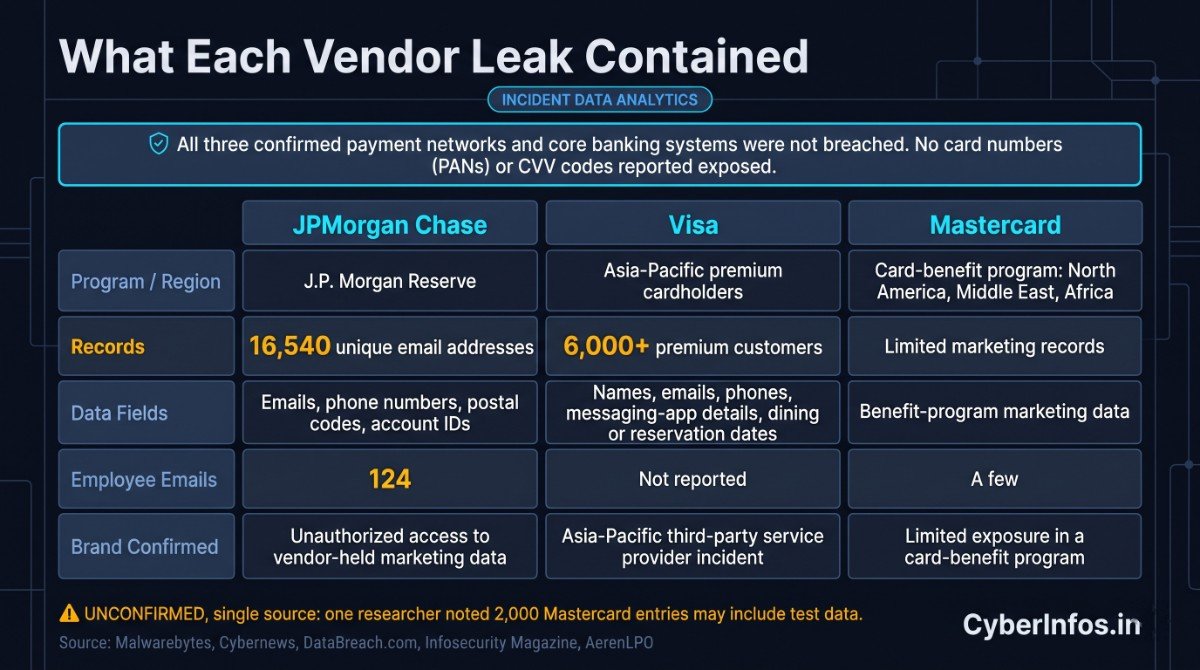
Contents of the Leaked Datasets (JPMorgan, Visa, Mastercard): Reviews by Cybernews, Malwarebytes, and DataBreach.com found a 502 KB JPMorgan file holding 16000 JPMorgan customer emails (16,540 unique addresses). Those addresses are linked to J.P. Morgan Reserve cards, typically reserved for clients with $10 million or more in managed assets per Infosecurity Magazine. The file also contains phone numbers, postal codes, account IDs, and 124 employee email addresses. The Visa dataset covered over 6,000 premium customers, with names, emails, phones, messaging-app details, and dining or reservation dates. Mastercard’s file held North America, Middle East, and Africa benefit-program marketing data plus a few employee emails.
Zero Card Numbers Exposed, Yet High Vishing Risk: Neither payment card numbers (PANs) nor CVV codes were reported exposed (Malwarebytes). Cybernews did note similar file formatting across the datasets, which suggests a shared third-party card benefit vendor leak (Malwarebytes).
Chase November 16 Outage Was Unrelated: More than 4,500 Downdetector reports hit Chase on November 16, 2026 (09:53 EST). JPMorgan Chase told Reuters the cause was an on-premise hardware software bug, not a cyberattack (Ostorlab).
Reported or Unconfirmed Claims
Identity of the Shared Third-Party Provider and Exact Intrusion Vector: As of November 21, 2026, JPMorgan Chase, Visa, and Mastercard have not publicly named the compromised third-party vendor or confirmed the initial intrusion date (Bitdefender).
Potential Test Entries in Mastercard Dataset & n0n’s Scale Claims: One researcher who analyzed 2,000 entries in the Mastercard file noted it may include test data (AerenLPO). Separately, n0n’s broader claim of “tens of thousands” of emails across hundreds of thousands of campaign interactions has not been independently verified (EM360Tech).
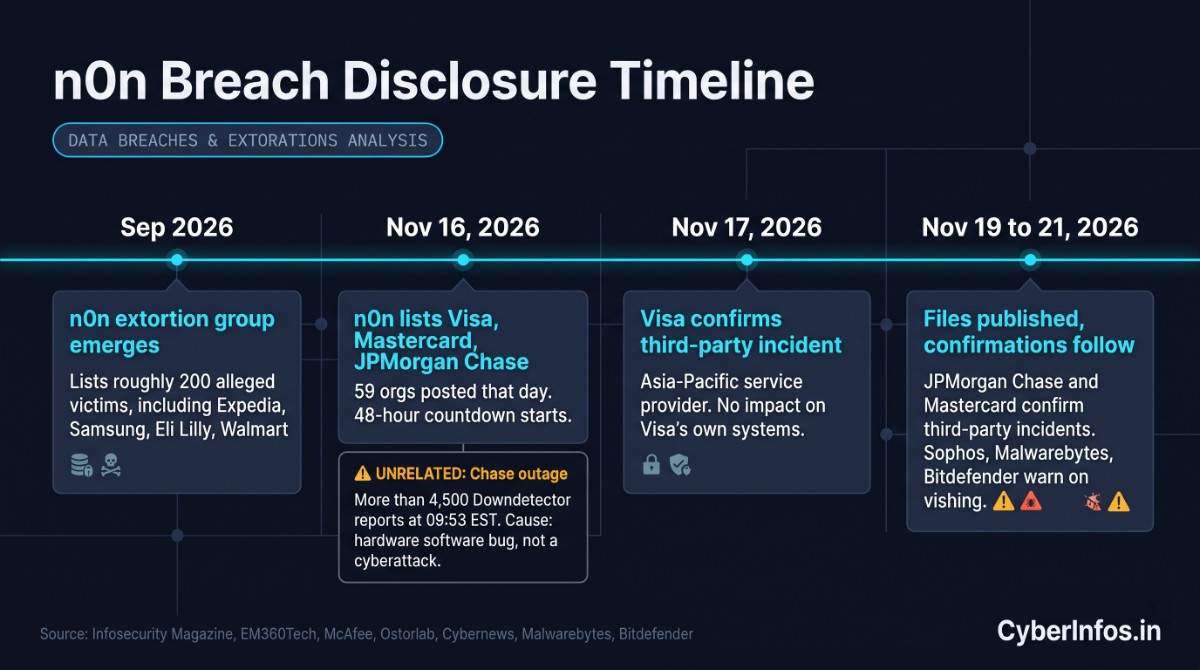
The table below outlines the confirmed chronological sequence of the n0n third-party breach disclosures.
| Date / UTC Time | Milestone / Event | Source |
|---|---|---|
| Sep 2026 | n0n extortion group first emerges, rapidly listing roughly 200 alleged victims (including Expedia, Samsung, Eli Lilly, Walmart). | Infosecurity Magazine / EM360Tech |
| Nov 16, 2026 | n0n lists Visa, Mastercard, and JPMorgan Chase (59 orgs posted that day) with a 48-hour countdown; separate Chase hardware software bug causes outage. | McAfee / Ostorlab |
| Nov 17, 2026 | Cybernews reports listings; Visa confirms an Asia-Pacific third-party service provider incident with no impact on Visa’s own systems. | Ostorlab / Cybernews |
| Nov 19 to 21, 2026 | n0n publishes the files; JPMorgan Chase and Mastercard confirm third-party incidents; Sophos, Malwarebytes, and Bitdefender warn on vishing. | Malwarebytes / Bitdefender |
Facts at a Glance
The table below summarizes the verified operational details of the n0n third-party financial leak.
| Field | Verified Information |
|---|---|
| Incident Identifier | n0n Third-Party Card-Benefit & Marketing Data Leak (No CVE ID; third-party vendor compromise) (SecurityWeek) |
| Affected Brands & Programs | JPMorgan Chase (J.P. Morgan Reserve program), Visa (Asia-Pacific premium cardholders), and Mastercard (North America, Middle East, Africa benefit program) (Malwarebytes) |
| Exposed Data Volume | ~16,000 (16,540 unique) JPMorgan customer emails + 124 employee emails; 6,000+ Visa premium records; limited Mastercard marketing records (DataBreach.com / Malwarebytes) |
| Payment Card Impact | No payment card numbers (PANs) or core banking systems affected (McAfee) |
| Attack Vector | Third-party vendor compromise (n0n typically uses infostealer-harvested logins, VPN credential stuffing, or exposed RDP per Bitdefender) |
| Threat Actor Attribution | n0n cyber-extortion / ransomware group (emerged Sept 2026; believed Russia-based per The Register / PC Doctor) Threat Actor |
| Remediation Status | Core systems unaffected; vendor investigations ongoing; targeted customer vishing alerts issued (Malwarebytes) |
Technical Attack Chain
1. How a Third-Party Marketing Vendor Compromise Turns Into High-Net-Worth Vishing
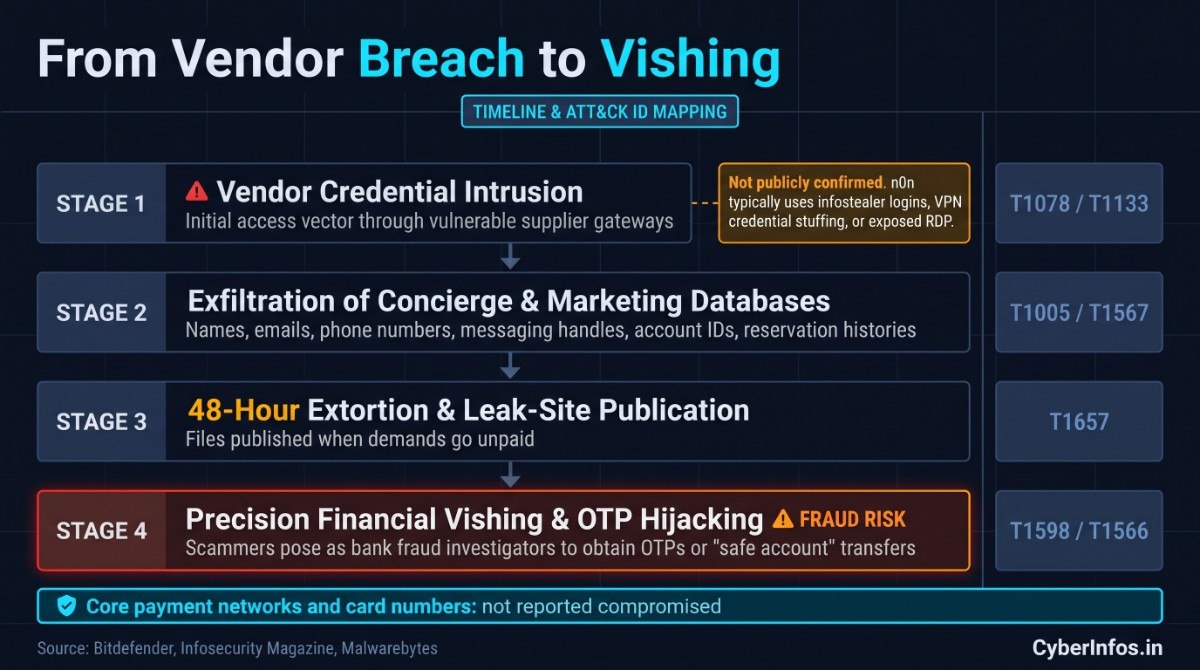
According to Bitdefender, Infosecurity Magazine, and Malwarebytes, the n0n Visa Mastercard JPMorgan breach illustrates a four-stage supply-chain and fraud chain:
- Vendor Credential Intrusion (MITRE ATT&CK T1078 / T1133): The exact entry point into the unnamed card-benefit provider is unconfirmed. What is known is that n0n typically gets in with valid credentials harvested by infostealer malware, or through credential-stuffing attacks against VPNs and exposed RDP endpoints (Bitdefender).
- Exfiltration of Concierge & Marketing Databases (T1005 / T1567): Attackers pull non-payment marketing data exposure records containing customer names, emails, phone numbers, messaging handles, account IDs, and dining or travel reservation histories, along with employee email lists (Malwarebytes).
- 48-Hour Extortion & Leak-Site Publication (T1657): n0n lists the downstream financial brands on its leak site with a 48-hour countdown, a pressure tactic that in ransomware attacks comes with threats to destroy backups per Infosecurity Magazine. When demands go unpaid, it dumps the files.
- Precision Financial Vishing & OTP Hijacking (T1598 / T1566): Armed with verified concierge booking dates and Reserve cardholder status, scammers pose as bank fraud investigators by phone, SMS, or messaging apps. Their goal is to get victims to read out one-time passcodes (OTPs) or transfer funds to “safe accounts” (Malwarebytes / Bitdefender).
Why No Payment Data Exposed Still Leaves Customers at Risk
- Concierge Booking Details Make Scams Believable: A caller who knows a cardholder’s full name, J.P. Morgan Reserve status, and exact restaurant or travel reservation date is far more likely to earn trust with a fake fraud alert (Malwarebytes).
- Employee Email Lists Enable Internal & Partner Phishing: With 124 JPMorgan employee emails and Mastercard staff addresses exposed (DataBreach.com), attackers can launch tailored business email compromise (BEC) lures against internal banking teams.
- Non-Payment Marketing Vendors Sit Outside PCI Cardholder Environments: Marketing and loyalty agencies rarely run under the same hardened segmentation as core PCI DSS payment processors. That leaves a soft perimeter around high-value customer profiles (Bitdefender).
CyberInfos Analyst Insight
- CyberInfos Assesses That Third-Party Loyalty Vendors Are the Financial Sector’s Soft Underbelly: As Sophos Counter Threat Unit noted (Infosecurity Magazine), breaching a concierge or marketing supplier is vastly different from breaching Visa’s or JPMorgan’s core network. Customers, however, face the same downstream fraud risk either way.
- From a Defensive Perspective, Whale-Hunting Reserve Cardholders Raises Vishing Stakes: Targeting J.P. Morgan Reserve clients ($10M+ managed assets) and premium Visa holders gives social engineers an unusually lucrative victim pool. Relationship managers and private-banking clients need financial vishing OTP scam defense briefings right away.
- Shared Formatting Points to Concentrated Supply-Chain Risk: Cybernews observed that the leaked files share formatting across brands (Malwarebytes). That reinforces why financial CISOs must map fourth-party concentration across shared loyalty and concierge SaaS platforms.
Indicators of Compromise and Hunting Telemetry
Because the n0n Visa Mastercard JPMorgan breach occurred at an unnamed third-party vendor, no standalone network IOCs have been published for the vendor intrusion itself. Enterprise SOCs and fraud teams should instead watch for impersonation domains, phishing emails referencing n0n breach compensation, and MFA reset spikes targeting the 124+ exposed employee emails (Bitdefender / DataBreach.com).
The table below summarizes the verified hunting surfaces and fraud indicators to monitor.
| Indicator Type | Value / Pattern | Description and Context |
|---|---|---|
| Exposed Employee Email Lists | 124 JPMorgan employee emails + limited Mastercard employee emails | High-priority spearphishing and credential-stuffing targets (DataBreach.com / Malwarebytes) |
| Vishing & Breach-Lure Themes | Unsolicited calls/SMS offering “breach compensation,” “account verification,” or “safe account” transfers | Primary fraud follow-on from non-payment marketing data exposure (Bitdefender / Malwarebytes) |
| Infostealer / VPN / RDP Access | Anomalous VPN or RDP logins to third-party marketing/loyalty vendor portals | Typical n0n initial access vector (Bitdefender) |
Use the following SIEM queries (labeled Draft for testing, not production-validated) to hunt for spearphishing lures aimed at exposed employee mailboxes and for anomalous MFA/password-reset attempts:
// Microsoft Sentinel KQL (Draft for testing, not production-validated):
// Hunt for phishing emails referencing Visa/Mastercard/JPMorgan breach compensation or unusual MFA resets
union EmailEvents, SigninLogs
| where TimeGenerated >= ago(14d)
| where (Subject has_any ("n0n", "Reserve card", "card benefit", "breach compensation", "verify your account"))
   or (ResultType != "0" and AppDisplayName has_any ("VPN", "RDP", "Mail"))
| project TimeGenerated, SenderFromAddress, RecipientEmailAddress, Subject, UserPrincipalName, IPAddress, ResultType
| order by TimeGenerated desc/* Splunk SPL (Draft for testing, not production-validated):
Detect potential breach-themed phishing or OTP/MFA fatigue spikes targeting financial staff */
(index=email OR index=o365 OR index=okta OR index=entra)
("breach compensation" OR "Reserve card" OR "safe account" OR eventType="user.mfa.factor.reset")
| stats count earliest(_time) as first_seen latest(_time) as last_seen values(src_ip) as src_ips by user, sender, subject
| sort - count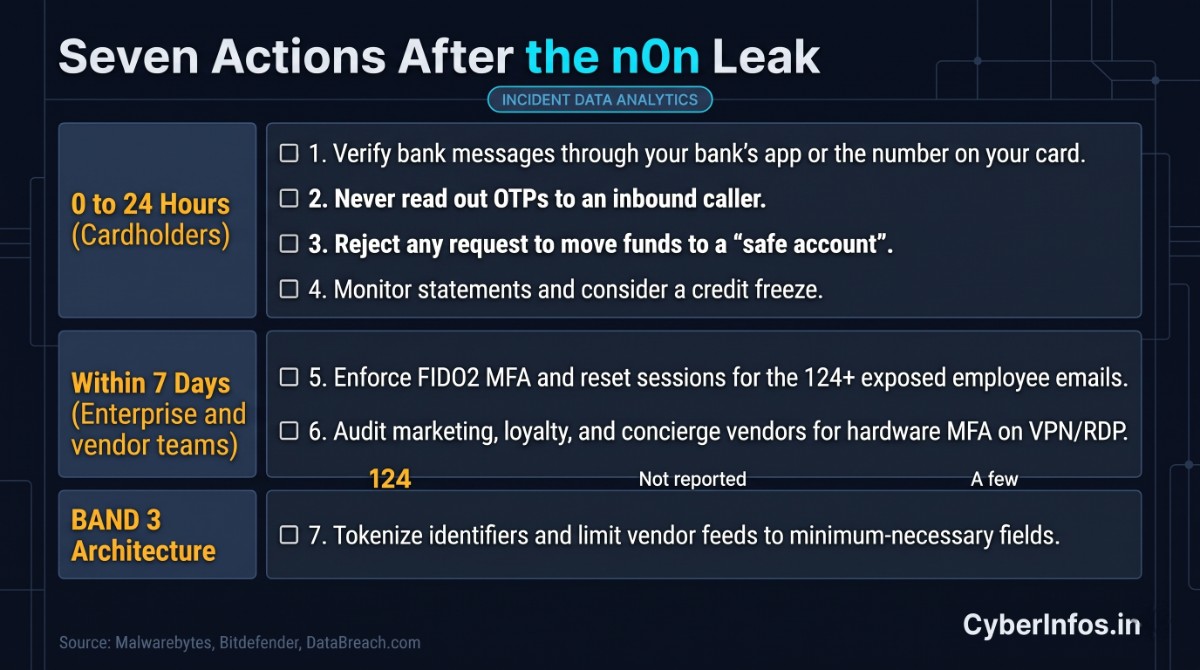
Recommended Actions
Work through these remediation and customer-protection steps across three operational phases, in line with Malwarebytes and Bitdefender guidance:
Immediate Actions (0 to 24 Hours: Victim & Cardholder Guidance)
- Verify Every Bank Message Independently: Never click links or call numbers in unexpected emails, texts, or calls claiming to be from Chase, Visa, or Mastercard. Open your bank’s official app, or call the number printed on the back of your card (Malwarebytes).
- Never Read Out OTPs or Transfer Funds to a “Safe Account”: Strengthen financial vishing OTP scam defense by refusing to share one-time verification codes with inbound callers. Reject any instruction to move funds for “protection” (Malwarebytes).
- Monitor Accounts & Consider a Credit Freeze: Review recent card statements, verify any breach-support or credit-monitoring offer before enrolling, and consider placing a credit freeze (Malwarebytes).
Short-Term Actions (Within 7 Days: Enterprise & Vendor Teams)
- Protect the 124+ Exposed Employee Email Accounts: Enforce phishing-resistant MFA (FIDO2), reset sessions, and deploy anti-spoofing rules for the exposed JPMorgan and Mastercard employee addresses (DataBreach.com).
- Audit Third-Party Marketing, Loyalty & Concierge Vendors: Confirm that every external agency holding customer names, emails, or reservation histories enforces hardware MFA on VPN/RDP access and does not share data stores across clients (Bitdefender).
Long-Term Actions (Architecture)
- Minimize PII Shared With Non-Payment Vendors: Tokenize customer identifiers and restrict booking and loyalty feeds to minimum-necessary fields, so a third-party card benefit vendor leak cannot expose high-net-worth contact lists.
Global Regulatory and Compliance Implications (USA, UK, Australia, EU, Canada, India)
Regulatory duties apply only when an organization is in scope and suffers a reportable security incident or personal data breach. The table below summarizes verified compliance rules across six jurisdictions as of November 21, 2026.
| Jurisdiction | Regulatory Framework | When It Applies and Verified Obligations |
|---|---|---|
| United States | GLBA, NYDFS 23 NYCRR 500, SEC 8-K, State Breach Laws |
When It Applies: Covered financial institutions assess NYDFS 23 NYCRR 500 (72h cyber event notice) and GLBA Safeguards third-party breach notices, while public issuers file SEC Form 8-K Item 1.05 within 4 business days if material (AOPL). |
| United Kingdom | UK GDPR (ICO) & FCA | When It Applies: Controllers notify the ICO within 72h under UK GDPR Art. 33 when UK customer contact/booking data is exposed; regulated firms notify the FCA for material third-party incidents. |
| Australia | OAIC NDB, APRA CPS 234 | When It Applies: Entities notify the OAIC under Notifiable Data Breaches if exposed details pose serious harm (including targeted financial scams), while APRA-regulated firms report material incidents under CPS 234 (AOPL). |
| European Union | DORA, EU GDPR, NIS2 | When It Applies: DORA governs ICT third-party risk and major incident reporting for EU financial entities, alongside EU GDPR (72h breach notice for customer marketing/benefit PII) and NIS2 (24h/72h/1m) (Global Compliance Map). |
| Canada | PIPEDA & OSFI | When It Applies: Private-sector entities report breaches posing real risk of significant harm under PIPEDA as soon as feasible (AOPL). |
| India | CERT-In, RBI, DPDP Rules 2025 | When It Applies: CERT-In and RBI mandate 6-hour reporting for covered entities (AOPL); DPDP Rules 2025 Rule 4 started Nov 13, 2026 and main breach rules start May 13, 2027 (WONE Global). |
This summary supports operational readiness and is not legal advice.
Frequently Asked Questions (FAQ)
What was exposed in the n0n Visa Mastercard JPMorgan breach?
The n0n Visa Mastercard JPMorgan breach exposed customer names, email addresses, phone numbers, postal codes, messaging details, and dining or travel booking records held by third-party marketing and benefit vendors, per Malwarebytes and DataBreach.com. Core payment networks and payment card numbers (PANs) were not reported compromised.
Were JPMorgan Chase’s core banking systems hacked in this incident?
No. JPMorgan Chase told Reuters its internal systems and services were unaffected. The 16000 JPMorgan customer emails (16,540 unique addresses) linked to J.P. Morgan Reserve cards came from marketing data held by outside vendors, per DataBreach.com and Infosecurity Magazine.
Visa confirmed an Asia-Pacific third-party service provider incident, Mastercard confirmed a provider breach affecting a card-benefit program, and JPMorgan confirmed vendor-held marketing data exposure. On top of that, Cybernews noted shared file formatting across the leaked datasets, which points to a third-party card benefit vendor leak, per Malwarebytes.
Why does non-payment marketing data still create serious fraud risk?
Even without card numbers, non-payment marketing data exposure hands scammers verified names, phone numbers, card-tier status, and real concierge booking dates. That makes impersonation calls, fake fraud-department alerts, and credential-harvesting text messages far more convincing to targeted high-net-worth cardholders, per Malwarebytes and Bitdefender.
How can cardholders protect themselves against fake bank calls right now?
Cardholders can strengthen financial vishing OTP scam defense by hanging up on unsolicited fraud calls and calling the official number on the back of their card. They should never share one-time passcodes (OTPs) with inbound callers, and should refuse any urgent request to move funds into “safe accounts,” per Malwarebytes and Bitdefender.
Final Thoughts
The n0n Visa Mastercard JPMorgan breach shows that attackers do not need to penetrate a bank’s core payment rails to put elite cardholders at risk. Compromising a single third-party concierge, loyalty, or marketing vendor gives social engineers everything they need to craft convincing impersonation calls and OTP-theft lures.
Brief your customers and private-banking teams on fake bank-call scams today. Lock down exposed employee email accounts with phishing-resistant MFA, and audit data-minimization rules for every external marketing partner. Share how your organization governs third-party loyalty and concierge vendors in the comments below, and subscribe to CyberInfos.in for daily verified vulnerability and threat intelligence.
