

The Cognizant TriZetto breach has exposed the sensitive healthcare and personal data of more than 3.4 million patients, quickly becoming one of the most consequential healthcare data breach 2026 incidents reported so far. Security analysts say the TriZetto Provider Solutions data breach highlights the growing risk posed by healthcare technology vendors that process massive volumes of protected patient data.
The attack targeted systems operated by TriZetto Provider Solutions, a healthcare IT subsidiary of Cognizant. These systems sit quietly in the background of the U.S. healthcare ecosystem, powering billing workflows, eligibility verification, and insurance claims processing for providers across the country. Patients rarely see this infrastructure but their data flows through it constantly.
And that’s where things get complicated.
Healthcare organizations increasingly depend on third-party technology vendors to manage patient records, insurance workflows, and critical backend operations. The arrangement improves efficiency, no doubt. But it also expands the attack surface dramatically. When a vendor such as TriZetto is compromised, the consequences ripple outward touching hundreds of healthcare providers and millions of patients whose data was processed through the platform.
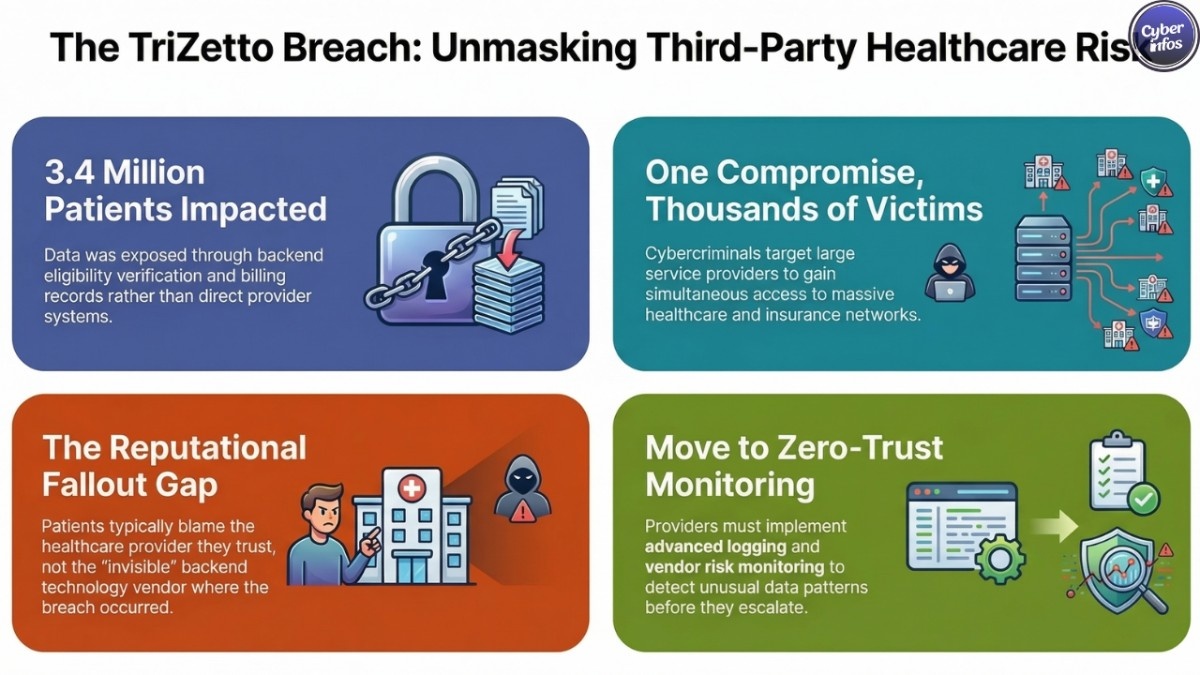
According to breach notifications and regulatory filings, attackers accessed historical insurance eligibility verification records, exposing sensitive personal and insurance-related information. In total, the 3.4 million patients data exposed incident underscores just how fragile healthcare supply chains can be when cybersecurity controls fall short.
What’s striking here is the scale. One compromised platform. Millions of patient records.
In fact, cybersecurity analysts say the Cognizant TriZetto breach may become one of the defining examples of a large-scale healthcare data breach 2026 involving third-party vendor infrastructure.
In this article, we break down what happened in the Cognizant TriZetto breach, how the attack likely unfolded, who is affected, and the security lessons healthcare organizations need to absorb quickly if they want to avoid becoming the next headline after the TriZetto Provider Solutions data breach.
What Happened: Cognizant TriZetto Breach Incident Breakdown
The TriZetto Provider Solutions data breach came to light after suspicious activity was detected within a web portal used by healthcare providers to verify patient insurance eligibility.
That portal may sound mundane. In reality, it’s a critical operational system used every day by hospitals, clinics, and billing teams trying to confirm insurance coverage before treatment begins.
According to breach disclosures filed with the Maine Attorney General’s Office, unauthorized access was detected on October 2, 2025, triggering an internal investigation. Cognizant and TriZetto brought in external cybersecurity experts to analyze the compromise and determine exactly what information had been accessed during the Cognizant TriZetto breach.
Investigators eventually determined that attackers had accessed systems containing eligibility verification transaction data the records healthcare providers rely on to confirm a patient’s insurance coverage prior to treatment.
The scale became clearer as the investigation progressed.
The breach is believed to have affected 3,433,965 individuals, confirming that 3.4 million patients data exposed in the Cognizant TriZetto breach were stored in these records.
TriZetto stated that the compromised data may include:
- Full names
- Addresses
- Dates of birth
- Social Security numbers
- Health insurance member IDs
- Medicare beneficiary identifiers
- Health plan and provider information
For patients whose information appears in those records, the exposure isn’t theoretical. Social Security numbers combined with insurance identifiers create a particularly valuable package for identity thieves one reason the TriZetto Provider Solutions data breach is being closely watched by healthcare regulators.
The company reported the breach to regulators and began notifying affected healthcare partners in December 2025, with individual patient notifications beginning in early 2026.
Security researchers reviewing the Cognizant TriZetto breach say the incident does not appear to involve ransomware. Instead, the activity suggests unauthorized access intended for data harvesting, a tactic becoming increasingly common in major healthcare data breach 2026 incidents.
No flashing ransom note. No locked systems. Just data quietly leaving the building.
How the Breach Works?
Although detailed forensic findings have not been publicly released, the available evidence suggests attackers gained access through a web portal associated with eligibility verification systems used by TriZetto.
These portals allow healthcare providers to log in and check whether a patient’s insurance plan covers specific procedures. Behind the scenes, the systems store enormous volumes of historical transaction records and many of those records contain protected health information (PHI).
Think of it as a digital insurance verification desk.
Every time a patient schedules a procedure, a provider checks that desk to confirm insurance coverage. Over months and years, the desk fills with records: patient identifiers, insurance details, provider information, eligibility confirmations.
Now imagine attackers quietly slipping behind that desk.
If access controls fail whether through stolen credentials, poorly configured permissions, or an unpatched vulnerability attackers can browse or extract those records without disrupting daily operations. Staff keep logging in. Insurance checks continue. Everything looks normal on the surface. Meanwhile, the data is being siphoned off.
Unlike ransomware attacks that loudly encrypt systems and demand payment, data-harvesting intrusions prioritize stealth. Attackers often remain inside a compromised environment for months, slowly collecting valuable records while avoiding detection.
And that appears to be what happened in the Cognizant TriZetto breach.
In the TriZetto case, investigators believe unauthorized access began nearly a year before detection, making the TriZetto Provider Solutions data breach particularly concerning for healthcare cybersecurity professionals monitoring healthcare data breach 2026 trends.
Who Is at Risk?
The Cognizant TriZetto breach affects patients whose healthcare providers relied on TriZetto’s eligibility verification and billing services.
The tricky part is that most patients may have never heard of TriZetto.
That’s the reality of modern healthcare infrastructure. Large backend platforms process enormous volumes of patient data even though patients rarely interact with those companies directly.
The breach impacts individuals whose data was processed through participating healthcare organizations and insurance networks using TriZetto systems. According to regulatory filings, more than 3.4 million individuals were affected in the Cognizant TriZetto breach, confirming that 3.4 million patients data exposed may have originated from eligibility verification records.
Groups potentially impacted include:
- Patients of healthcare providers using TriZetto software
- Individuals whose insurance eligibility was verified through TriZetto systems
- Medicare beneficiaries whose identifiers were included in eligibility records
Healthcare organizations connected to the TriZetto platform may also face operational, legal, and reputational risks following the TriZetto Provider Solutions data breach.
And here’s the uncomfortable reality: when a vendor breach occurs, patients typically blame the healthcare provider they trust not the invisible technology vendor sitting behind the scenes. That reputational fallout can last years.
Expert Analysis: Why This Matters
The TriZetto healthcare data breach affecting 3.4 million patients highlights a structural cybersecurity problem in healthcare: third-party vendor risk.
Healthcare providers today rely heavily on specialized vendors to handle claims processing, insurance eligibility checks, billing platforms, and electronic health record integrations. Each vendor effectively becomes part of the provider’s digital infrastructure.
But each vendor also introduces another potential point of failure.
Guidance from the Cybersecurity and Infrastructure Security Agency (CISA) and the U.S. Department of Health and Human Services (HHS) has repeatedly warned about the growing risks associated with vendor ecosystems in healthcare cybersecurity.
And yet incidents like the Cognizant TriZetto breach keep happening.
The TriZetto Provider Solutions data breach fits into a broader pattern seen across the healthcare sector in recent years: attackers increasingly target large service providers rather than individual hospitals. It’s simple economics for cybercriminals.
Compromise a single vendor, and you gain potential access to thousands of organizations simultaneously which is exactly why vendor compromises are now driving many large healthcare data breach 2026 incidents.
Security analysts reviewing the Cognizant TriZetto breach have also pointed to the long detection window. If attackers maintained access for months before discovery, it suggests monitoring systems may not have detected unusual access patterns or bulk data activity. That’s the part many organizations overlook.
Logs exist. Alerts exist. But without strong monitoring and response processes, those signals often go unnoticed until investigators start digging after a breach.
Which reinforces the need for healthcare organizations to implement zero-trust access controls, advanced logging, and vendor risk monitoring throughout their digital supply chains to prevent another TriZetto Provider Solutions data breach.
What You Should Do Right Now
Organizations and individuals affected by the Cognizant TriZetto breach should take immediate steps to reduce potential risks following the 3.4 million patients data exposed incident.
Waiting rarely ends well after a data breach.
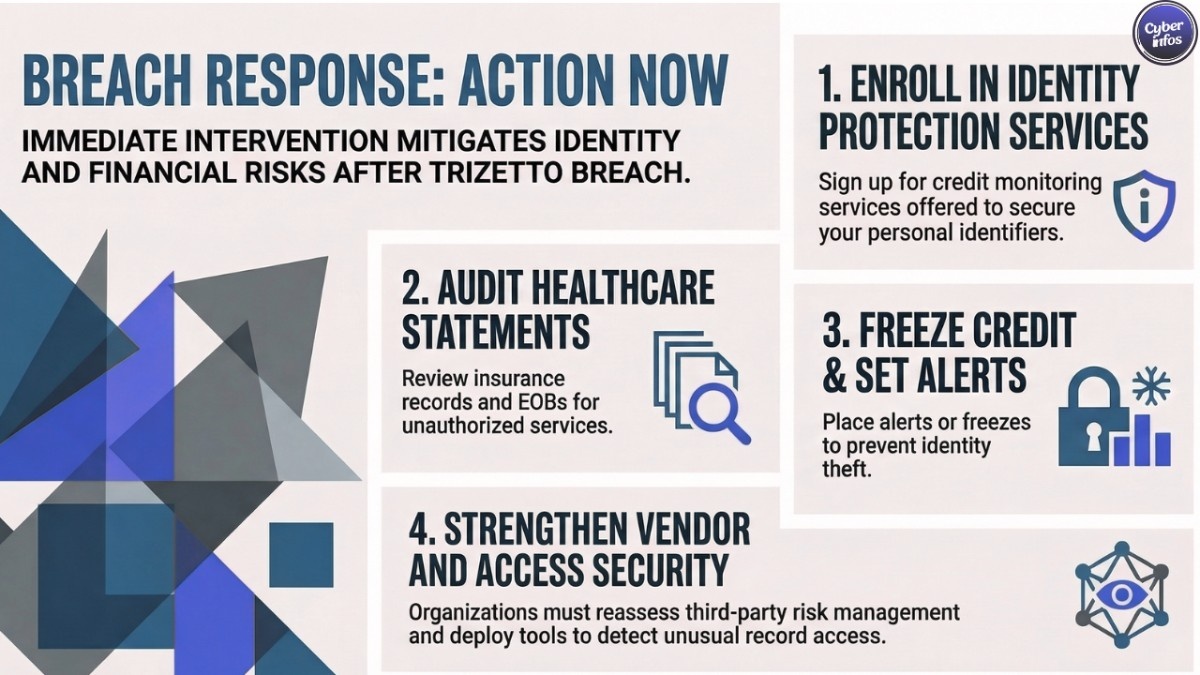
1. Enroll in Credit Monitoring
Affected individuals should sign up for any identity protection or credit monitoring services offered following the Cognizant TriZetto breach.
2. Monitor Healthcare Statements
Patients should closely review Explanation of Benefits (EOB) statements and insurance records for unfamiliar medical services after the TriZetto Provider Solutions data breach.
3. Place Fraud Alerts or Credit Freezes
If Social Security numbers or other identifiers were exposed in the 3.4 million patients data exposed incident, placing a fraud alert or credit freeze can reduce the risk of identity theft.
4. Implement Vendor Security Reviews
Healthcare organizations should reassess their third-party risk management programs following the Cognizant TriZetto breach.
5. Strengthen Access Monitoring
Organizations should deploy monitoring tools capable of detecting unusual access to sensitive healthcare records, especially after large incidents like the TriZetto Provider Solutions data breach.
6. Improve Incident Response Planning
Healthcare providers should ensure their incident response plans include third-party vendors, particularly after major incidents like the Cognizant TriZetto breach and other healthcare data breach 2026 events.
Timeline of Events
November 19, 2024
Unauthorized access to TriZetto systems reportedly begins.
October 2, 2025
TriZetto detects suspicious activity within its web portal environment.
December 9, 2025
Healthcare partners begin receiving breach notifications related to the Cognizant TriZetto breach.
February 2026
Affected individuals start receiving formal breach notifications.
March 2026
Public reporting confirms that 3.4 million patients’ data was exposed in the TriZetto Provider Solutions data breach.
Final Thoughts
The Cognizant TriZetto breach is a stark reminder that healthcare cybersecurity risks rarely stop at hospital walls.
Behind every hospital network sits a web of technology vendors handling protected health information billing platforms, eligibility systems, analytics tools, data processors. Each one processes sensitive data. Each one becomes part of the healthcare attack surface.
And when one of those vendors is compromised, the blast radius can extend to millions of patients, as seen in the TriZetto Provider Solutions data breach where 3.4 million patients data exposed became one of the most widely reported healthcare data breach 2026 incidents.
For healthcare organizations, the incident reinforces the need for vendor risk management, continuous monitoring, and strong identity controls across their supply chains.
Because the uncomfortable truth is this: attackers have already realized that healthcare vendors are some of the most efficient targets in modern cyberattacks. And the Cognizant TriZetto breach shows exactly why.
