
Close Menu
  • Home
  • Cyber security
    • Mobile security
    • Computer Security
    • Malware
  • Cyber news
    • Data breaches
  • Top10
  • Cyber Insurance
  • Cyber law & Compliance
  • About us
X (Twitter) Instagram Threads LinkedIn WhatsApp
Trending
  • Cognizant TriZetto Breach Exposes Data of 3.4M Patients
  • AI-Assisted Penetration Testing with Kali Linux: Claude AI and MCP Transform Ethical Hacking
  • Iran Cyber Attacks 2026: Hacktivist Surge Hits 110 Targets
  • Perplexity Comet Browser Vulnerability Exploited via Calendar Invite
  • Android Security Update Fixes 129 Flaws, Zero-Day
  • AI-Powered Cyber Attacks Surge 89% in 2025 Crisis Breakouts
  • Claude Distillation Attacks: 16M API Exchanges Exposed
  • Google Antigravity Suspension Hits OpenClaw Users
Monday, March 9
Cyber infos
X (Twitter) LinkedIn WhatsApp
  • Home
  • Cyber security
    • Mobile security
    • Computer Security
    • Malware
  • Cyber news
    • Data breaches
  • Top10
  • Cyber Insurance
  • Cyber law & Compliance
  • About us
Cyber infos
Data breaches

Flickr Confirms Potential Data Breach via Third-Party Email Service

V DiwaharBy V DiwaharFebruary 6, 2026No Comments5 Mins Read
Share Facebook Twitter Pinterest LinkedIn WhatsApp Copy Link
Share
Facebook Twitter Pinterest Threads Copy Link

Flickr has confirmed a potential data breach involving a third-party email service provider, raising concerns that user account metadata may have been exposed. While there is no evidence of a direct compromise of Flickr’s core systems, the incident could still affect a significant portion of its user base estimated at around 35 million monthly users.

The incident was disclosed on 5 February 2026, with public reporting emerging over 5–6 February. Flickr says it acted quickly after being alerted, but investigations are still ongoing.

Below is a clear breakdown of what happened, what data is at risk, and what users should do next.

Table of Contents hide
1 What happened in this data breach ?
2 What data may have been exposed
3 Does this really affect “35 million users”?
4 Why this still matters: real-world risks
5 What Flickr users should do right now
6 What we know about the investigation
7 Frequently Asked Questions (FAQ)
8 Final Thoughts

What happened in this data breach ?

According to Flickr, the company was notified of a vulnerability in a system operated by one of its external email service providers on 5 February 2026.

The flaw may have allowed unauthorized access to some Flickr user information processed or stored by that provider.

Flickr says it disabled access to the affected system within hours.

An internal investigation and third-party review are now underway.

Importantly, Flickr stresses this was a supply-chain issue, not a breach of Flickr’s own production databases.

At this stage, the incident is being described as a potential data exposure, not a confirmed large-scale data theft.

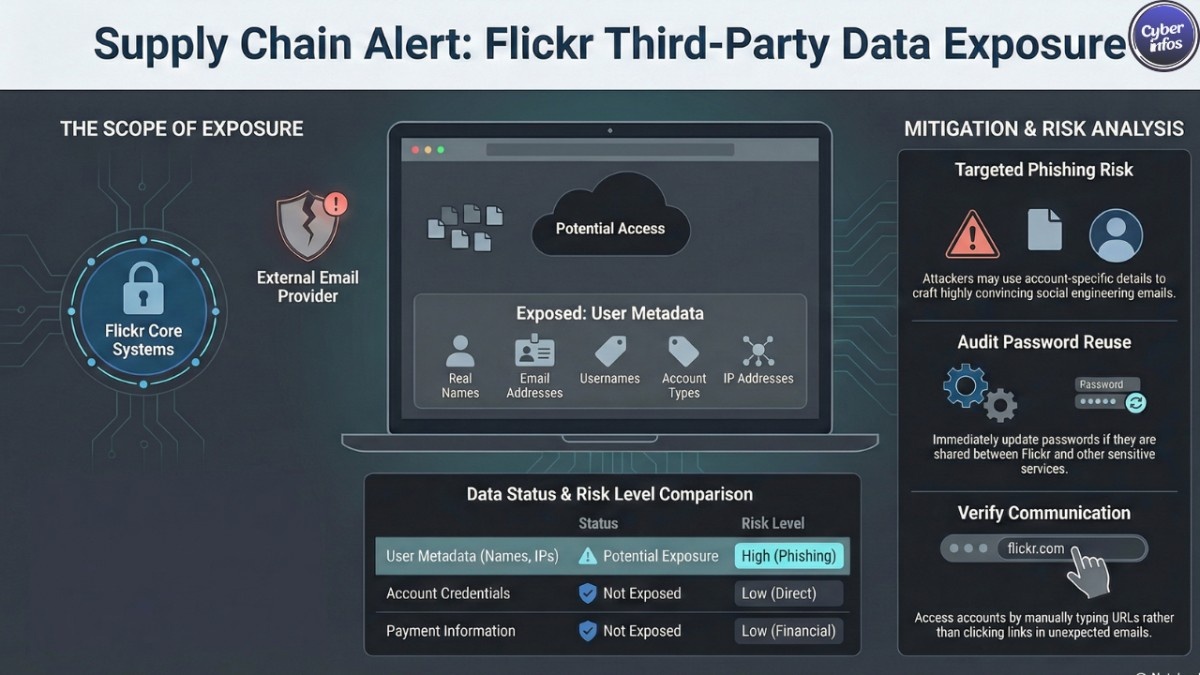
What data may have been exposed

Based on Flickr’s user notifications and security reporting, the following information may have been accessible:

  • Real name (member name)
  • Email address
  • Flickr username
  • Account type (Free or Pro)
  • IP addresses
  • General location inferred from IP
  • Platform activity and usage metadata

What was not exposed

Flickr and independent reports consistently state that:

  • Passwords were not exposed
  • Payment card details were not exposed

While this limits direct financial risk, the exposed data set is still highly valuable for phishing and impersonation attacks.

Does this really affect “35 million users”?

Not necessarily — at least not yet.

Flickr reports approximately 35 million monthly active users, but:

  • Flickr has not confirmed how many accounts were actually accessed or affected.
  • Official says the flaw “may have allowed unauthorized access to some member information.”
  • No specific victim count has been disclosed.

This means headlines claiming “35 million users breached” represent a worst-case scenario, not a confirmed scope.

A more accurate framing is:

Flickr discloses potential third-party data exposure; millions of users advised to remain vigilant.
Flickr Confirms Potential Data Breach via Third-Party Email Service

Why this still matters: real-world risks

1. Highly targeted phishing scams

Attackers could send convincing fake Flickr or SmugMug emails, using:

  • Your real name
  • Your Flickr username
  • Accurate account references (Free vs Pro)
  • Location-aware timing

Common lures may include:

  • “Copyright infringement” warnings
  • Fake password reset notices
  • Pro subscription renewal alerts

2. Account takeover via password reuse

If you reuse passwords across services, attackers may attempt credential stuffing, even though Flickr passwords were not leaked.

3. Privacy profiling

IP and activity metadata can be used to:

  • Infer location patterns
  • Correlate identities across platforms
  • Enhance social-engineering attacks

What Flickr users should do right now

1. Be extremely cautious with emails

Do not click links in unexpected Flickr-related emails.

Be wary of urgency, threats, or requests to “verify” your account.

Access your account only by manually typing flickr.com into your browser.

Flickr states it will never ask for your password via email.

2. Change reused passwords immediately

Even as a precaution:

  • If your Flickr password is reused anywhere else, change it everywhere.
  • Use a unique, long password for Flickr.
  • A password manager can help prevent reuse going forward.

3. Strengthen account security

  • Verify your recovery email and account details.
  • Enable two-factor authentication (2FA) on your email account and other critical services tied to your Flickr login.

4. Watch for warning signs

Over the next few weeks, watch for:

  • Emails from look-alike domains (e.g. flickr-support[.]com)
  • Messages referencing your real Flickr activity to gain trust
  • Unexpected changes to your Flickr profile or settings

What we know about the investigation

  • Flickr says access to the affected system has been fully disabled.
  • Impacted users are being notified directly via email.
  • Additional safeguards and third-party monitoring controls are being implemented.

As of now, there are no confirmed reports of a public data dump tied to this incident on major breach forums or monitoring services. That could change as investigations continue.

Frequently Asked Questions (FAQ)

Was Flickr hacked directly?
No. Flickr says the issue originated with a third-party email service provider, not Flickr’s own infrastructure.

Were passwords or credit cards leaked?
No. Flickr states passwords and payment data were not exposed.

Should I delete my Flickr account?
There is no indication this is necessary. Improving email and password hygiene is a more effective response.

Is this incident fully resolved?
The affected system has been shut down, but the investigation is still ongoing.

Final Thoughts

This incident highlights a growing reality of modern cybersecurity: even secure platforms can be affected by third-party supply-chain weaknesses.

While there is no evidence (yet) of mass exploitation, Flickr users should treat this as a serious warning and take basic protective steps now especially against phishing.

Staying cautious today can prevent account takeovers and identity misuse tomorrow.

📲 Join our WhatsApp channel for real-time breach and scam alerts

🔗 Follow us on LinkedIn for ongoing cybersecurity updates and analysis

Share. Facebook Twitter Pinterest Threads Telegram Email LinkedIn WhatsApp Copy Link
Previous ArticleRecord 31.4 Tbps DDoS Attack Exposes AISURU/Kimwolf Botnet Power
Next Article How Attackers Use Company Language to Guess Passwords
V Diwahar
  • Website
  • LinkedIn

V Diwahar is a final-year B.E Cybersecurity student, independent security researcher, and founder of CyberInfos.in an - global cybersecurity analysis blog delivering technical depth, expert threat intelligence, and actionable security guidance to readers across the US, UK, Europe, Asia, and beyond. With hands-on academic and practical experience in ethical hacking, network security, malware analysis, penetration testing, vulnerability research, and digital forensics, I brings a practitioner's perspective to every article going beyond headlines to analyse what vulnerabilities and breaches actually mean, who is genuinely at risk, and what every reader should do about it right now. Every article published on CyberInfos.in is built on verified technical research CVE details cross-referenced with nvd.nist.gov, attack mechanics explained using real tools and lab environments, and expert analysis that challenges official statements when the evidence demands it. I founded CyberInfos.in with a single mission: to fill the gap between generic press-release rewrites and inaccessible technical papers delivering cybersecurity analysis that is deep enough for security professionals, clear enough for business owners, and actionable enough for everyone.

Related Posts

Cognizant TriZetto Breach Exposes Data of 3.4M Patients

March 8, 2026
Read More

Adidas Investigates Alleged Data Breach – 815,000 Records of Customer Data Stolen

February 20, 2026
Read More

Record 31.4 Tbps DDoS Attack Exposes AISURU/Kimwolf Botnet Power

February 6, 2026
Read More
Add A Comment
Leave A Reply Cancel Reply

Cyber news

PayPal Data Breach: 6-Month SSN Exposure Shocks Small Businesses

February 21, 2026

SmarterMail Vulnerabilities Actively Exploited in Ransomware Attacks

February 19, 2026

Dell RecoverPoint Zero-Day Vulnerability Exploited by Chinese Hackers Since Mid-2024

February 18, 2026

UK Cyber Essentials Campaign Urges SMEs to Lock the Digital Door

February 17, 2026

Top 10

Top 10 Cybersecurity Resolutions Every User Should Make in 2026

January 1, 2026

Top 10 Best Autonomous Endpoint Management Tools in 2026

November 14, 2025

Top 10 Best API Security Testing Tools in 2026

October 29, 2025

10 Best Free Malware Analysis Tools–2026

July 1, 2025

mobile security

Android Security Update Fixes 129 Flaws, Zero-Day

March 3, 2026

PromptSpy Android Malware Marks First Use of Generative AI in Mobile Attacks

February 20, 2026

Google Is Finally Letting Users Change Gmail Address – Here’s How It Works

December 26, 2025

Securing Mobile Payments and Digital Wallets: Tips for Safe Transactions

December 19, 2025
Cyber Insurance

A Step-by-Step Checklist to Prepare Your Business for Cyber Insurance (2026 Guide)

December 14, 2025

Is Your Business Really Protected? A Deep Dive Into Cyber Liability Coverage

December 6, 2025

What Cyber Insurance Doesn’t Cover & How to Fix the Gaps

December 1, 2025

Top Cyber Risks Today and How Cyber Insurance Protects You in 2026

November 28, 2025

What Every Business Owner Must Know Before Buying Cyber Insurance in 2026

November 26, 2025
Recents

Cognizant TriZetto Breach Exposes Data of 3.4M Patients

March 8, 2026

AI-Assisted Penetration Testing with Kali Linux: Claude AI and MCP Transform Ethical Hacking

March 6, 2026

Iran Cyber Attacks 2026: Hacktivist Surge Hits 110 Targets

March 5, 2026

Perplexity Comet Browser Vulnerability Exploited via Calendar Invite

March 4, 2026

Android Security Update Fixes 129 Flaws, Zero-Day

March 3, 2026
Pages
  • About us
  • Contact us
  • Disclaimer
  • Privacy policy
  • Sitemaps
  • Terms and conditions
About us

We delivers trusted cybersecurity updates, expert analysis, and online safety tips. We help individuals and businesses understand cyber threats and protect their digital world with accurate, easy-to-read information.

Partners
White Hat Hub Partner
X (Twitter) LinkedIn WhatsApp
  • Contact us
  • Sitemaps
© 2026 Cyberinfos - All Rights are Reserved

Type above and press Enter to search. Press Esc to cancel.