
Close Menu
  • Home
  • Cyber security
    • Mobile security
    • Computer Security
    • Malware
  • Cyber news
    • Data breaches
  • Top10
  • Cyber Insurance
  • Cyber law & Compliance
  • About us
X (Twitter) Instagram Threads LinkedIn WhatsApp
Trending
  • Cognizant TriZetto Breach Exposes Data of 3.4M Patients
  • AI-Assisted Penetration Testing with Kali Linux: Claude AI and MCP Transform Ethical Hacking
  • Iran Cyber Attacks 2026: Hacktivist Surge Hits 110 Targets
  • Perplexity Comet Browser Vulnerability Exploited via Calendar Invite
  • Android Security Update Fixes 129 Flaws, Zero-Day
  • AI-Powered Cyber Attacks Surge 89% in 2025 Crisis Breakouts
  • Claude Distillation Attacks: 16M API Exchanges Exposed
  • Google Antigravity Suspension Hits OpenClaw Users
Monday, March 9
Cyber infos
X (Twitter) LinkedIn WhatsApp
  • Home
  • Cyber security
    • Mobile security
    • Computer Security
    • Malware
  • Cyber news
    • Data breaches
  • Top10
  • Cyber Insurance
  • Cyber law & Compliance
  • About us
Cyber infos
Cyber attacks

Google Antigravity Suspension Hits OpenClaw Users

V DiwaharBy V DiwaharFebruary 24, 2026No Comments6 Mins Read
Share Facebook Twitter Pinterest LinkedIn WhatsApp Copy Link
Share
Facebook Twitter Pinterest Threads Copy Link

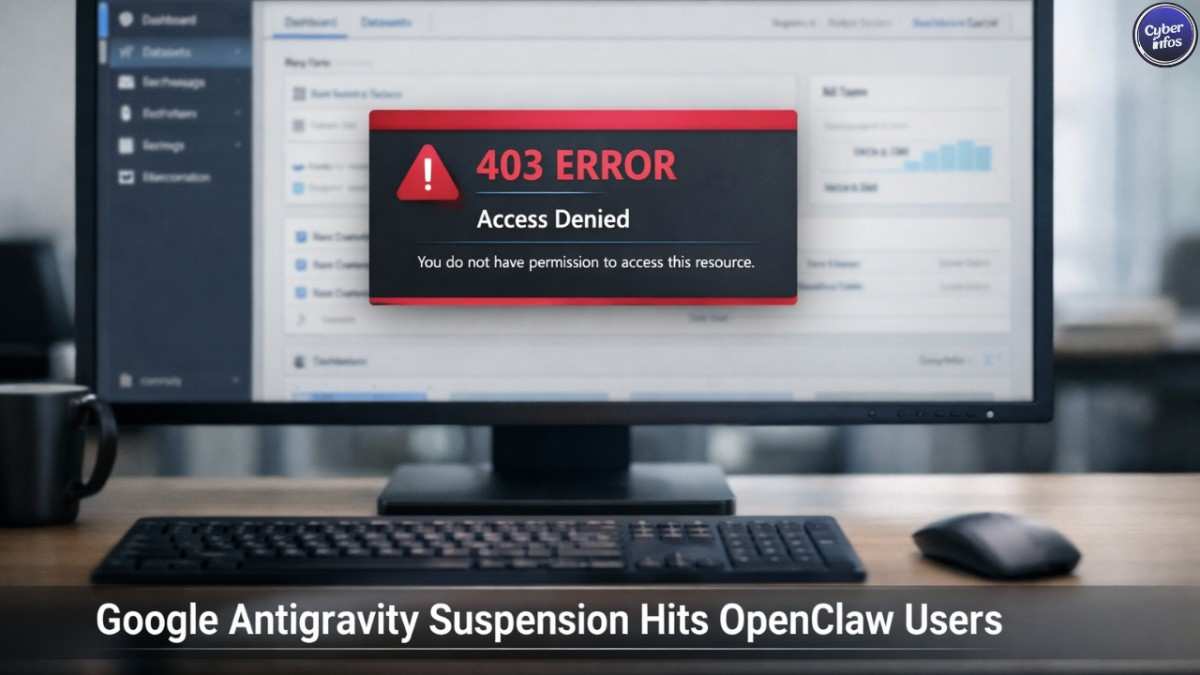
Google’s Google Antigravity suspension wave has sent a jolt through the AI developer ecosystem, leaving thousands of OpenClaw users abruptly cut off from Gemini model access. What initially looked like a routine backend capacity hiccup quickly spiraled into account restrictions, persistent 403 errors, and growing accusations that Google had overcorrected. And here’s where it gets uncomfortable.

The enforcement action zeroes in on developers who used the OpenClaw OAuth plugin to tap into subsidized Gemini model tokens through Google’s Antigravity platform Google DeepMind’s developer-facing gateway to Gemini AI infrastructure. Google says the setup violated its AI terms of service by funneling non-Antigravity products through Antigravity backend systems. In other words: access was granted, but the usage model crossed a line.What’s striking here is how quickly the tone shifted from “technical strain” to “policy enforcement.” That usually signals something bigger behind the scenes.The move reflects a broader industry recalibration. Generative AI platforms are wrestling with token arbitrage, infrastructure strain, and eye-watering compute bills. Subsidies were always a growth strategy. They were never meant to be permanent.

In this article, we break down what happened, how the abuse mechanism worked, who is affected, and what developers should do next to avoid similar bans.

Table of Contents hide
1 What Happened: Google Suspends Antigravity Access Over OpenClaw Integration
2 How the Vulnerability Works
3 Who Is at Risk?
4 Expert Analysis: Why This Matters
5 What You Should Do Right Now
6 Timeline of Events
7 Final thoughts

What Happened: Google Suspends Antigravity Access Over OpenClaw Integration

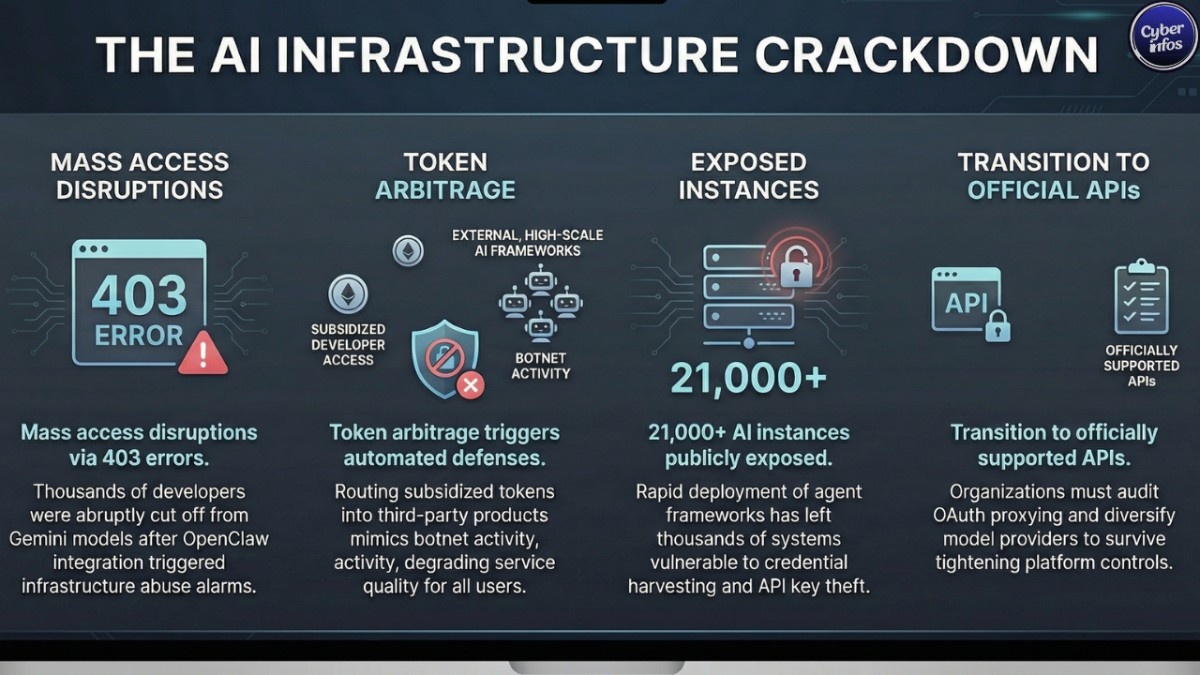
In mid-February 2026, users of OpenClaw began reporting sudden 403 errors while attempting to access Google’s Antigravity developer platform. No warning banners. No graceful degradation. Just hard stops.

OpenClaw, launched in November 2025, exploded in popularity surpassing 219,000 GitHub stars by enabling users to deploy local AI agents capable of handling email workflows, browser automation, and multi-step task orchestration. For developers hungry to experiment with agentic systems, it felt like rocket fuel.

Many authenticated through Google’s Antigravity platform to gain access to premium-tier models such as Gemini 2.5 Pro at subsidized developer pricing. But instead of building directly within Antigravity’s intended framework, usage was routed through OpenClaw’s OAuth plugin. Functionally, that turned Antigravity infrastructure into a backend engine for a third-party product.

That’s the part that triggered alarms.

According to public comments from Varun Mohan, the traffic surge “tremendously degraded the quality of service for our users.” Automated monitoring systems flagged patterns consistent with infrastructure abuse and token arbitrage the kind of activity that, from the backend, can look indistinguishable from bot-driven API scraping.

Google maintains that enforcement actions were scoped only to Antigravity product access for violating accounts. Still, multiple users have reported broader disruptions across Google services. Whether that’s spillover, misconfiguration, or perception is still being debated in developer forums.

The suspension wave landed just as Anthropic updated its policies to explicitly prohibit third-party OAuth integrations that obscure product-level consumption. Different vendor, same direction of travel.

AI platforms are tightening the perimeter. Fast.
Google Antigravity Suspension Hits OpenClaw Users
Google Antigravity Suspension

How the Vulnerability Works

This wasn’t a traditional breach. No zero-day. No credential stuffing campaign.

It was infrastructure economics colliding with platform policy.

  1. Developers authenticated to Antigravity using Google accounts.
  2. OpenClaw’s OAuth plugin retrieved access tokens for Gemini APIs.
  3. Rather than operating strictly inside Antigravity’s ecosystem, OpenClaw used those tokens to power its independent AI agent framework.
  4. Automated agent workloads generated sustained backend spikes, degrading shared infrastructure performance.

Think of it this way: imagine buying discounted tickets intended for a developer preview screening then piping that stream into a commercial theater. The ticket was valid. The redistribution model wasn’t.

That’s token arbitrage in action exploiting pricing or access asymmetries between subsidized developer environments and production-grade consumption.

From a security operations perspective, abnormal API bursts triggered enforcement heuristics. Infrastructure abuse patterns often resemble early-stage botnet activity. When automated agents hammer endpoints at scale, automated defense systems don’t pause to ask about developer intent.

They shut it down.

Who Is at Risk?

  • Developers relying on OpenClaw’s OAuth integration
  • AI Ultra subscribers paying $249.99 per month
  • Teams accessing Gemini 2.5 Pro via Antigravity
  • Organizations running OpenClaw agents in production pipelines

For individual developers, the damage is inconvenience and lost access. For startups running demos or client pilots, it’s downtime, contractual pressure, and credibility on the line.

Security researchers have flagged more than 21,000 publicly exposed OpenClaw instances vulnerable to configuration harvesting and infostealer campaigns. That means misconfigured agents could expose API keys or local credentials.

It’s sitting on Shodan.

Most teams deploying agent frameworks are moving fast. Compliance reviews tend to lag. That imbalance rarely ends well.

Expert Analysis: Why This Matters

The Google Antigravity suspension marks a visible inflection point in AI governance.

Over the past year, AI vendors aggressively subsidized model access to drive ecosystem adoption. Growth came first. Guardrails came later. But as inference workloads balloon and GPU capacity tightens, the financial calculus changes.

OpenClaw creator Peter Steinberger publicly labeled Google’s move “draconian” and announced plans to remove Antigravity support. Meanwhile, competitors like OpenAI have appeared more permissive toward third-party harnesses, deepening philosophical splits across ecosystems.

The broader signal is unmistakable: AI platforms are shifting toward tighter control planes and clearer monetization boundaries.

There’s also a geopolitical layer. China’s Ministry of Industry and Information Technology recently warned about misconfigured AI agent systems creating systemic cybersecurity exposure.

Agentic AI is powerful. But power without governance scales risk just as efficiently as it scales productivity.

What You Should Do Right Now

  1. Review Google Antigravity Terms of Service – Validate architectural alignment with usage boundaries.
  2. Avoid OAuth Proxying for Production Systems – Use officially supported APIs.
  3. Audit Exposed Instances – Harden configs and rotate API keys.
  4. Monitor Account Activity Logs – Watch for abnormal token spikes.
  5. Diversify Model Providers – Reduce single-vendor dependency risk.
  6. Document Vendor Dependencies in Risk Assessments – Treat AI APIs as critical operational assets.

Most organizations won’t act until access disappears.

Timeline of Events

  • January 2026 → OpenClaw launches publicly
  • January 2026 → Growth surpasses 200K GitHub stars
  • Mid-February 2026 → Developers report 403 errors
  • February 23, 2026 → Varun Mohan addresses enforcement publicly
  • Late February 2026 → Community pivots to forks like Nanobot and IronClaw

Final thoughts

The Google Antigravity suspension isn’t just a ToS dispute. It’s a preview of how AI ecosystems are maturing — and hardening.

Convenience-driven integrations feel harmless in early growth phases. They rarely stay that way once real infrastructure strain enters the picture.

The real question isn’t whether platforms will clamp down again. It’s whether your architecture can survive when they do.

Share. Facebook Twitter Pinterest Threads Telegram Email LinkedIn WhatsApp Copy Link
Previous ArticlePayPal Data Breach: 6-Month SSN Exposure Shocks Small Businesses
Next Article Claude Distillation Attacks: 16M API Exchanges Exposed
V Diwahar
  • Website
  • LinkedIn

V Diwahar is a final-year B.E Cybersecurity student, independent security researcher, and founder of CyberInfos.in an - global cybersecurity analysis blog delivering technical depth, expert threat intelligence, and actionable security guidance to readers across the US, UK, Europe, Asia, and beyond. With hands-on academic and practical experience in ethical hacking, network security, malware analysis, penetration testing, vulnerability research, and digital forensics, I brings a practitioner's perspective to every article going beyond headlines to analyse what vulnerabilities and breaches actually mean, who is genuinely at risk, and what every reader should do about it right now. Every article published on CyberInfos.in is built on verified technical research CVE details cross-referenced with nvd.nist.gov, attack mechanics explained using real tools and lab environments, and expert analysis that challenges official statements when the evidence demands it. I founded CyberInfos.in with a single mission: to fill the gap between generic press-release rewrites and inaccessible technical papers delivering cybersecurity analysis that is deep enough for security professionals, clear enough for business owners, and actionable enough for everyone.

Related Posts

Iran Cyber Attacks 2026: Hacktivist Surge Hits 110 Targets

March 5, 2026
Read More

Perplexity Comet Browser Vulnerability Exploited via Calendar Invite

March 4, 2026
Read More

AI-Powered Cyber Attacks Surge 89% in 2025 Crisis Breakouts

February 25, 2026
Read More
Add A Comment
Leave A Reply Cancel Reply

Cyber news

PayPal Data Breach: 6-Month SSN Exposure Shocks Small Businesses

February 21, 2026

SmarterMail Vulnerabilities Actively Exploited in Ransomware Attacks

February 19, 2026

Dell RecoverPoint Zero-Day Vulnerability Exploited by Chinese Hackers Since Mid-2024

February 18, 2026

UK Cyber Essentials Campaign Urges SMEs to Lock the Digital Door

February 17, 2026

Top 10

Top 10 Cybersecurity Resolutions Every User Should Make in 2026

January 1, 2026

Top 10 Best Autonomous Endpoint Management Tools in 2026

November 14, 2025

Top 10 Best API Security Testing Tools in 2026

October 29, 2025

10 Best Free Malware Analysis Tools–2026

July 1, 2025

mobile security

Android Security Update Fixes 129 Flaws, Zero-Day

March 3, 2026

PromptSpy Android Malware Marks First Use of Generative AI in Mobile Attacks

February 20, 2026

Google Is Finally Letting Users Change Gmail Address – Here’s How It Works

December 26, 2025

Securing Mobile Payments and Digital Wallets: Tips for Safe Transactions

December 19, 2025
Cyber Insurance

A Step-by-Step Checklist to Prepare Your Business for Cyber Insurance (2026 Guide)

December 14, 2025

Is Your Business Really Protected? A Deep Dive Into Cyber Liability Coverage

December 6, 2025

What Cyber Insurance Doesn’t Cover & How to Fix the Gaps

December 1, 2025

Top Cyber Risks Today and How Cyber Insurance Protects You in 2026

November 28, 2025

What Every Business Owner Must Know Before Buying Cyber Insurance in 2026

November 26, 2025
Recents

Cognizant TriZetto Breach Exposes Data of 3.4M Patients

March 8, 2026

AI-Assisted Penetration Testing with Kali Linux: Claude AI and MCP Transform Ethical Hacking

March 6, 2026

Iran Cyber Attacks 2026: Hacktivist Surge Hits 110 Targets

March 5, 2026

Perplexity Comet Browser Vulnerability Exploited via Calendar Invite

March 4, 2026

Android Security Update Fixes 129 Flaws, Zero-Day

March 3, 2026
Pages
  • About us
  • Contact us
  • Disclaimer
  • Privacy policy
  • Sitemaps
  • Terms and conditions
About us

We delivers trusted cybersecurity updates, expert analysis, and online safety tips. We help individuals and businesses understand cyber threats and protect their digital world with accurate, easy-to-read information.

Partners
White Hat Hub Partner
X (Twitter) LinkedIn WhatsApp
  • Contact us
  • Sitemaps
© 2026 Cyberinfos - All Rights are Reserved

Type above and press Enter to search. Press Esc to cancel.