

Enterprise security teams and password-manager administrators are auditing their vendor supply-chain exposure this week after a confirmed backend intrusion at 1Password. Disclosed on November 25, 2026 in 1Password’s official incident update and reported by SecurityWeek, the 1Password GitHub breach began when an intruder hijacked an employee’s corporate GitHub account, pushed malicious code into backend services, and pulled administrative customer records alongside private repository source code.
Here is the immediate good news: customer password vaults, master passwords, and Secret Keys were never accessed or exposed to the attacker. Still, the incident creates real operational risk for defenders.
According to The Hacker News, the intruder reached the company’s continuous integration and delivery (CI/CD) environment and copied customer names, email addresses, public keys, Secure Remote Password (SRP) parameters, and emailed provisioning tokens. Security leaders need to brief employees on targeted phishing immediately and tighten CI/CD developer identity risk across their own engineering pipelines.
Quick Answer
The 1Password GitHub breach grew out of an employee GitHub account compromise that 1Password began investigating on November 19, 2026. That access let an intruder inject malicious backend code, enter CI/CD infrastructure, and steal customer names, emails, SRP parameters, and provisioning tokens. Because of 1Password’s architecture, the 1Password encrypted vaults safe status holds: vaults and Secret Keys were completely untouched. Users do not need to reset their master passwords, though everyone must stay alert for targeted phishing.
Facts at a Glance
The table below summarizes the verified operational and technical facts of the 1Password backend intrusion as of November 27, 2026.
| Field | Verified Information |
|---|---|
| Incident Identifier | 1Password November 2026 Backend & GitHub Security Incident (1Password) |
| Affected Service / Scope | Backend administrative services, private GitHub repositories, and CI/CD environment; client apps, browser extensions, and customer vaults unaffected |
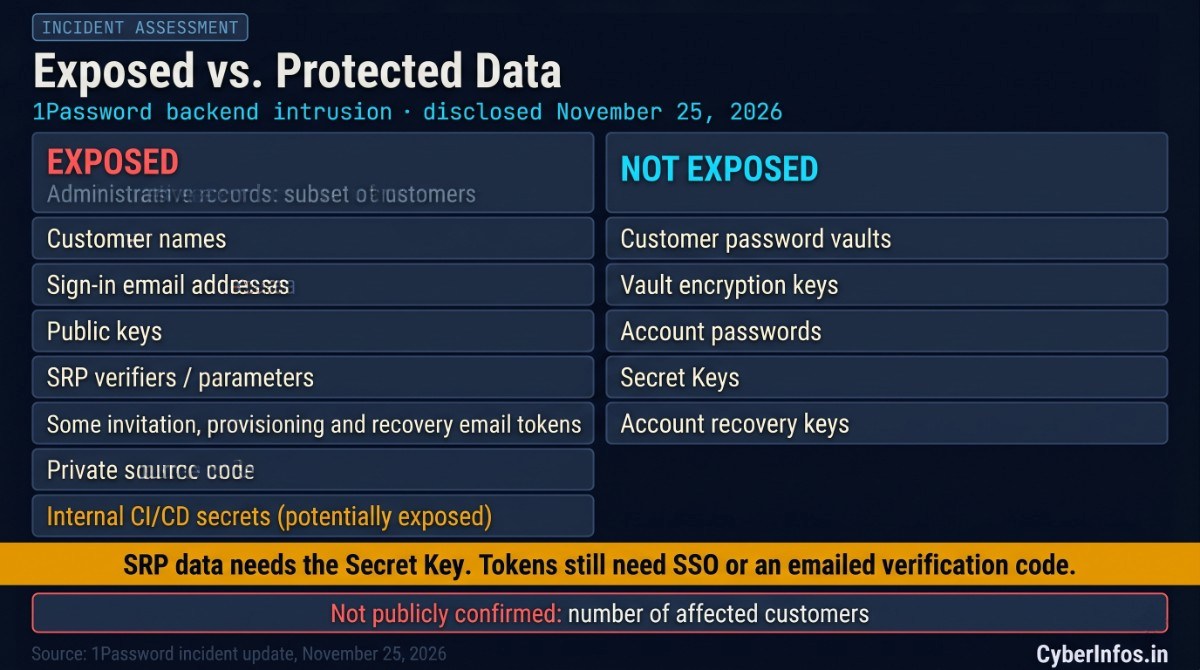
| Exposed Data | Customer names, sign-in email addresses, account/user IDs, creation and last sign-in timestamps, public keys, SRP verifiers/parameters, some invitation/provisioning/recovery email tokens, non-secret metadata, private source code, and potential CI/CD infrastructure secrets |
| Data Not Exposed | Customer password vaults, vault encryption keys, account passwords, Secret Keys, and account recovery keys |
| Exploit / Intrusion Status | Confirmed employee GitHub account compromise via a stolen token; investigation began Nov 19, 2026; zero confirmed customer account takeovers |
| Threat Actor Attribution | Unattributed as of November 27, 2026 |
| Remediation Status | Compromised GitHub account disabled, stolen token revoked, clean services restored, internal credentials rotated, recovery codes lengthened from 6 digits to 10 alphanumeric characters |
What Happened and Incident Timeline
According to Infosecurity Magazine, 1Password launched an internal security investigation on November 19, 2026 after spotting signs that an unauthorized actor had accessed an employee’s corporate GitHub account. Using that trusted developer identity, the intruder read private source code and pushed malicious changes into backend services. Those altered services then downloaded administrative records for a subset of customers.
Confirmed Facts
-
Zero Access to Customer Password Vaults: 1Password emphasized that its zero-knowledge encryption model kept 1Password encrypted vaults safe. As ThaiCERT’s advisory notes, 1Password never stores users’ account passwords or Secret Keys on its servers. Without a customer’s Secret Key, stolen SRP verifiers cannot be used to log in or brute-force vault contents.
-
Provisioning Tokens & Code-Length Hardening: The attacker copied tokens embedded in certain emailed invitation, provisioning, and account-recovery links affecting a small group of users, all of whom were notified directly. Why this matters: those tokens cannot unlock an account by themselves. Completing the sign-in or recovery flow still requires single sign-on (SSO) or an emailed verification code, which 1Password lengthened from 6 numeric digits to 10 alphanumeric characters as a precaution.
-
Private Source Code & CI/CD Credentials: The intruder copied proprietary source code from private repositories (which 1Password confirmed holds no user secrets) and entered the CI/CD system where internal infrastructure credentials reside. In response, 1Password rotated potentially exposed internal secrets, restored clean backend services, and brought in independent cybersecurity experts to verify containment.
Reported or Unconfirmed Claims
-
Victim Count, Initial Token Theft & Branch Protections: As HackenProof’s incident review and independent analysts point out, several key details remain undisclosed as of November 27, 2026. 1Password has not shared the exact number of affected customers, how the intruder initially stole the employee’s GitHub token, or whether the malicious backend push bypassed pull-request reviews.
Timeline
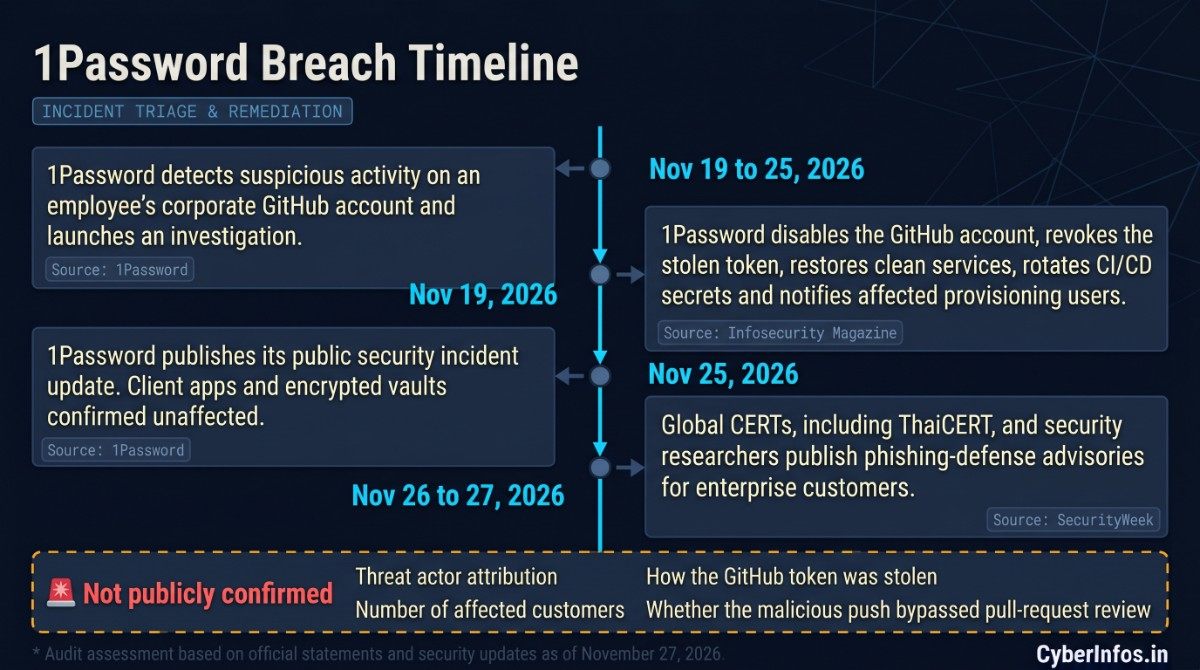
The table below tracks the verified sequence of events from initial investigation through public disclosure.
| Date / UTC Time | Milestone / Event | Source |
|---|---|---|
| Nov 19, 2026 | 1Password detects suspicious activity on an employee’s corporate GitHub account and launches an investigation. | 1Password |
| Nov 19 to 25, 2026 | 1Password disables the GitHub account, revokes the stolen token, restores clean services, rotates CI/CD secrets, and notifies affected provisioning users. | Infosecurity Magazine |
| Nov 25, 2026 | 1Password publishes its public security incident update; client apps and encrypted vaults confirmed unaffected. | 1Password |
| Nov 26 to 27, 2026 | Global CERTs (including ThaiCERT) and security researchers publish phishing-defense advisories for enterprise 1Password customers. | SecurityWeek |
Technical Attack Chain
From Compromised Developer Token to Backend Data Exfiltration
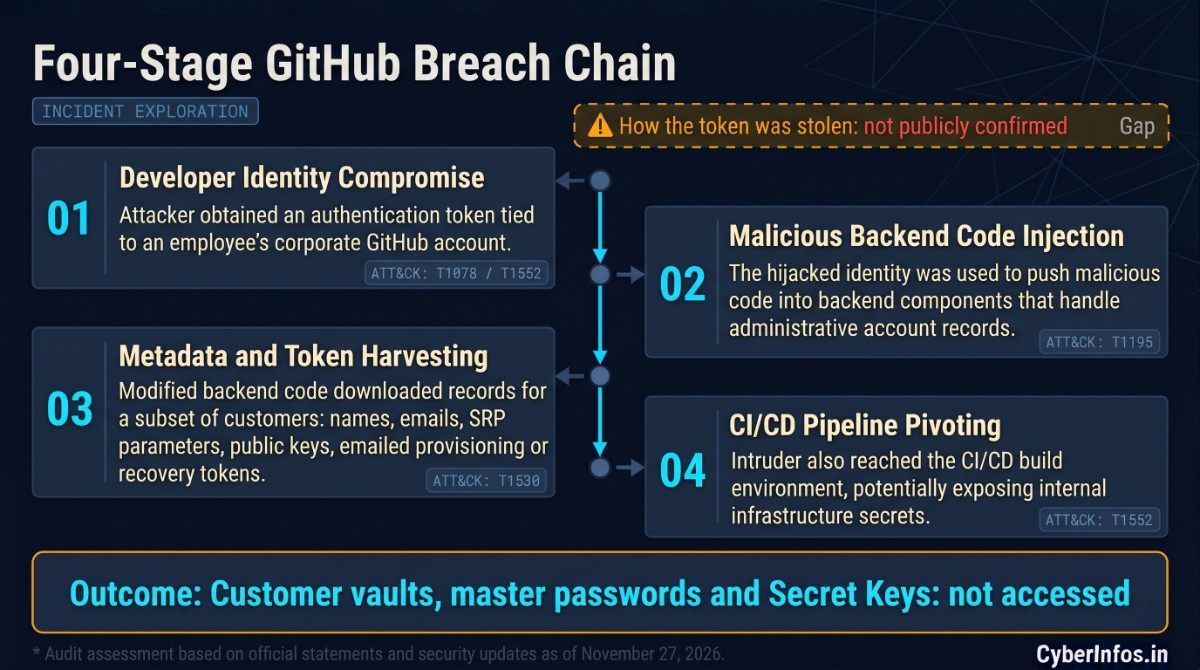
Based on 1Password’s disclosure and analysis from the Aviatrix Threat Research Center, the 1Password GitHub breach followed a four-stage software supply-chain intrusion path:
-
Developer Identity Compromise (MITRE ATT&CK T1078 / T1552): An attacker obtained an authentication token tied to an employee’s corporate GitHub account, gaining trusted entry into private repositories without setting off immediate alarms.
-
Malicious Backend Code Injection (T1195): Using the hijacked GitHub identity, the intruder pushed malicious code into backend server components that handle administrative account records.
-
Automated Metadata & Token Harvesting (T1530): Once live, the modified backend code downloaded records for a subset of customers, pulling names, emails, SRP parameters, public keys, and emailed provisioning or recovery tokens.
-
CI/CD Pipeline Pivoting (T1552): The intruder also reached 1Password’s CI/CD build environment, exposing internal infrastructure secrets before containment teams cut access and rotated credentials.
Why Patching Alone May Not Be Enough
1Password revoked the stolen GitHub token and restored clean backend services. Yet DEV Community technical analysis highlights an uncomfortable reality: stolen customer names, email addresses, and account timestamps are now permanently in attacker hands. Social engineering crews routinely pair breach headlines with real account metadata to make lures look authentic. That makes provisioning token phishing defense essential even when encrypted vaults remain completely untouched.
CyberInfos Analyst Insight
-
CyberInfos Assesses That Developer Identities Now Rival Production Endpoints as Tier-1 Targets: One stolen corporate GitHub token bridged private source code, CI/CD secrets, and live backend services. For engineering leaders, CI/CD developer identity risk demands phishing-resistant hardware MFA and strict branch-protection gates.
-
Zero-Knowledge Vault Architecture Contained What Could Have Been Catastrophic: Because 1Password never stores customer Secret Keys or plaintext vault keys on its servers, a backend code-injection breach resulted in metadata theft rather than mass credential exposure.
-
Emailed Account-Recovery Metadata Fuels High-Precision Support Scams: Even when provisioning tokens require SSO or a 10-character email code, attackers holding real user names and sign-in timestamps can craft convincing “urgent account verification” lures.
Indicators of Compromise and Hunting Telemetry
1Password has not released attacker IP addresses, GitHub token identifiers, or malicious commit hashes as of November 27, 2026. Enterprise defenders using 1Password should focus their hunts on identity-provider (SSO) logs, corporate email gateways for 1Password-themed phishing lures, and their own GitHub and CI/CD audit logs for unreviewed pushes.
| Indicator Type | Value / Pattern | Description and Context |
|---|---|---|
| Targeted Phishing Lures | Emails, SMS, or calls claiming 1Password vault re-verification, password resets, or unexpected invitations | Primary downstream threat enabled by exposed customer names and emails (ThaiCERT / SecurityWeek) |
| Identity Provider (SSO) Logs | Failed or anomalous SSO logins and unexpected 1Password provisioning/recovery requests | Detects attempts to abuse exposed provisioning tokens or phished credentials (HackenProof) |
| GitHub & CI/CD Audit Telemetry | Unexpected branch-protection overrides, direct pushes without PR approval, or personal access token (PAT) exports | Helps enterprises harden their own pipelines against employee GitHub account compromise patterns (DEV Community) |
Use the following SIEM queries (labeled Draft for testing, not production-validated) to hunt for 1Password-themed phishing emails and anomalous SSO activity:
Code snippet
// Microsoft Sentinel KQL (Draft for testing, not production-validated):
// Hunt for 1Password-themed phishing lures or unusual SSO/provisioning sign-ins
union EmailEvents, SigninLogs
| where TimeGenerated >= ago(14d)
| where (Subject has_any ("1Password", "Secret Key", "vault", "provisioning", "account recovery") and SenderFromDomain !endswith "1password.com")
   or (AppDisplayName has "1Password" and ResultType != "0")
| project TimeGenerated, SenderFromAddress, RecipientEmailAddress, Subject, UserPrincipalName, IPAddress, ResultType
| order by TimeGenerated desc
Splunk SPL
/* Splunk SPL (Draft for testing, not production-validated):
   Detect spoofed 1Password phishing emails or failed SSO authentication spikes */
(index=email OR index=o365 OR index=okta OR index=entra)
("1Password" AND ("Secret Key" OR "recovery" OR "verify" OR "invitation"))
| stats count earliest(_time) as first_seen latest(_time) as last_seen values(src_ip) as src_ips by user, sender, subject
| sort - count
Recommended Actions
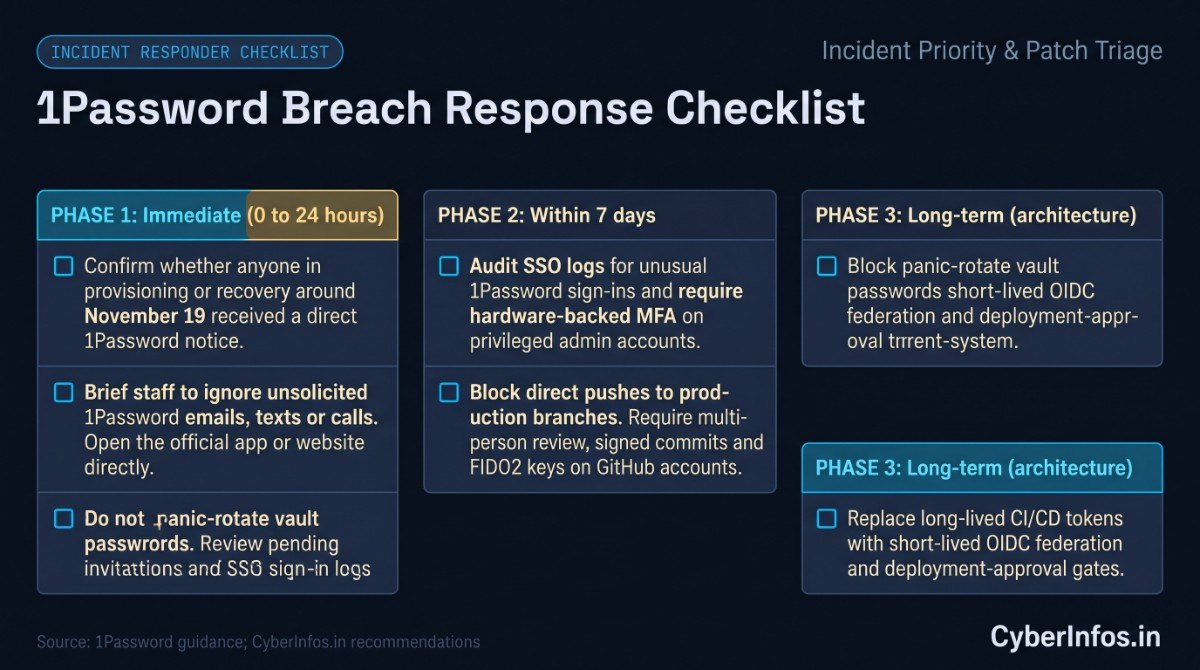
Execute the following numbered steps across three operational phases for both 1Password customers and enterprise engineering teams.
Immediate (0 to 24 Hours)
-
Check for Direct 1Password Breach Notifications: Confirm whether your organization or any user going through provisioning or account recovery around November 19 received a direct notice from 1Password about exposed email tokens.
-
Brief Staff on Provisioning Token Phishing Defense: Warn employees never to click links in unsolicited emails, texts, or calls claiming to be 1Password support asking for master passwords, Secret Keys, or verification codes; tell them to open the official app or website directly instead.
-
Do Not Panic-Rotate Vault Passwords: Follow 1Password’s guidance that master passwords and stored vault items remain protected. Focus your team’s energy on checking pending invitations and reviewing SSO sign-in logs.
Short-Term (Within 7 Days)
-
Audit Enterprise SSO Logs & High-Value Accounts: Inspect Okta, Entra ID, or other SSO logs for unusual 1Password authentication attempts, and verify that privileged admin accounts enforce hardware-backed MFA.
-
Enforce Signed Commits & Mandatory PR Reviews Internally: Apply the lessons of the 1Password GitHub breach to your own engineering org by blocking direct pushes to production branches, requiring multi-person code review, and enforcing FIDO2 hardware keys on GitHub accounts.
Long-Term (Architecture)
-
Isolate CI/CD Secrets With Short-Lived OIDC Tokens: Replace long-lived static repository tokens and CI/CD secrets with short-lived OpenID Connect (OIDC) federation and strict deployment-approval gates.
Global Regulatory and Compliance Implications
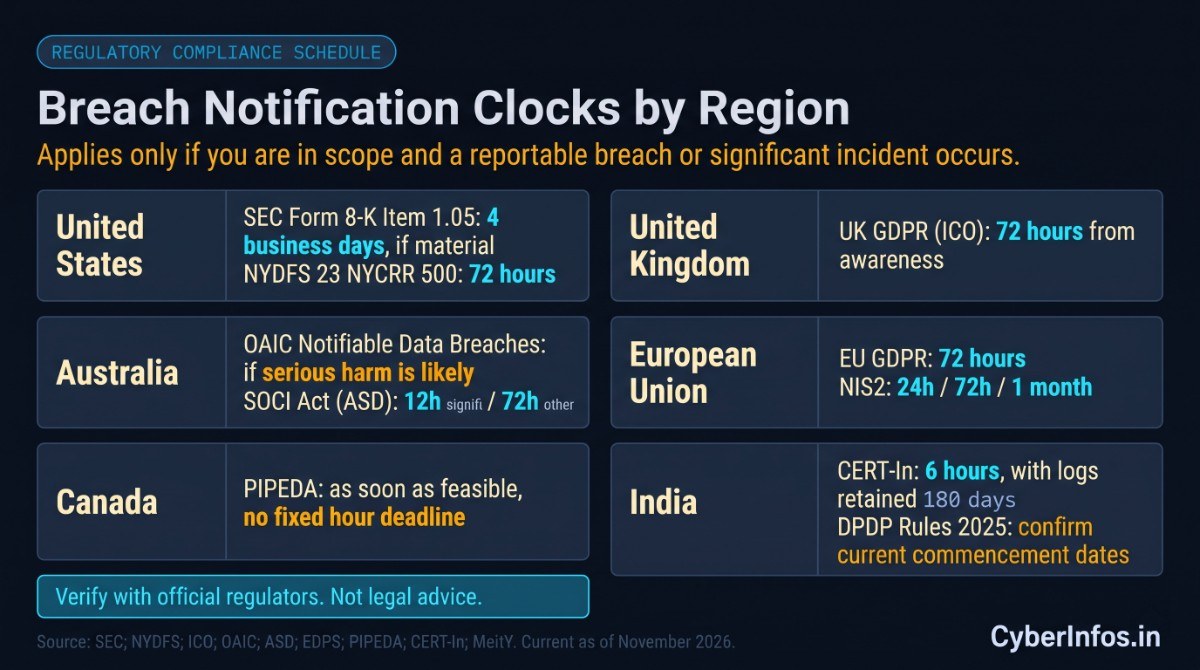
Regulatory notification duties apply only when an organization falls in scope of a given framework and experiences a reportable personal data breach or significant security incident. The table below summarizes verified obligations as of November 27, 2026.
| Jurisdiction | Regulatory Framework | When It Applies and Verified Obligations |
|---|---|---|
| United States | SEC Form 8-K, State Breach Laws, NYDFS 23 NYCRR 500 | When It Applies: Public companies file SEC Form 8-K Item 1.05 within 4 business days if a vendor or internal CI/CD breach is material; covered financial entities assess NYDFS 23 NYCRR 500 (72-hour notice) when privileged access controls or customer PII are affected. |
| United Kingdom | UK GDPR (ICO) & NCSC CAF | When It Applies: Controllers notify the ICO within 72 hours of awareness when UK customer names and email addresses are compromised in a reportable breach; essential-service operators align developer-identity controls with NCSC guidance. |
| Australia | OAIC Notifiable Data Breaches & SOCI Act (ASD) | When It Applies: Entities notify the OAIC if exposed customer contact data and phishing risks pose serious harm; critical infrastructure operators follow ASD SOCI Act timelines (12h significant / 72h other) only when core operations are impacted. |
| European Union | EU GDPR & NIS2 | When It Applies: Controllers notify supervisory authorities within 72 hours under EU GDPR when EU user names, emails, and metadata are exposed; in-scope NIS2 entities follow 24h/72h/1m reporting for significant operational incidents. |
| Canada | PIPEDA | When It Applies: Private-sector entities report breaches posing a real risk of significant harm as soon as feasible under PIPEDA, with no fixed hour deadline. |
| India | CERT-In & DPDP Rules 2025 | When It Applies: Covered entities report unauthorized system/supply-chain access to CERT-In within 6 hours and retain logs for 180 days; confirm current phased DPDP Rules 2025 breach notification commencement dates before relying on statutory timelines. |
Official regulatory filing portals for US SEC/CISA, UK ICO/NCSC, Australian OAIC/ASD, EU GDPR/NIS2 authorities, Canadian OPC (PIPEDA), and Indian CERT-In/MeitY should be consulted directly for jurisdiction-specific incident notifications.
This summary supports operational readiness and is not legal advice.
Frequently Asked Questions
Were my saved passwords or 1Password vaults stolen in the 1Password GitHub breach?
No. 1Password confirmed that customer password vaults, vault encryption keys, account passwords, and Secret Keys were never accessed or available to the attacker. Because 1Password uses zero-knowledge encryption, server-side backend access could not decrypt stored user secrets.
Should 1Password users change their master password or stored passwords right now?
No universal password rotation is required. 1Password confirmed that client apps, browser extensions, and vault encryption keys were unaffected. Users should instead stay alert for phishing messages impersonating 1Password and verify any pending account invitations directly inside the app.
How did an employee GitHub account compromise lead to customer data theft?
The attacker used a compromised corporate GitHub token to access private repositories and push malicious code into backend services. Those modified backend components then downloaded administrative customer records, including names, emails, public keys, and SRP parameters, before 1Password contained the intrusion.
Can attackers use the stolen provisioning tokens or SRP parameters to hijack accounts?
No, not on their own. 1Password confirmed that SRP verifiers cannot authenticate without the customer’s Secret Key, and exposed invitation or recovery tokens still require SSO authentication or an emailed verification code, which 1Password lengthened to 10 alphanumeric characters.
What is the biggest ongoing risk for organizations using 1Password?
Targeted social engineering is the primary lingering risk. Because attackers obtained verified names, email addresses, and account sign-in timestamps for a subset of customers, employees must reject unsolicited support calls or emails asking for Secret Keys, master passwords, or recovery codes.
Final Thoughts
The 1Password GitHub breach shows that zero-knowledge vault encryption protects secrets at rest, yet developer identities and CI/CD pipelines remain prime targets for metadata theft. Your immediate priority is confirming whether your organization received a provisioning-token notice, briefing staff on fake 1Password support lures, and auditing your own GitHub and SSO controls.
Longer term, enforce phishing-resistant MFA, protected branches, and short-lived OIDC credentials across every engineering pipeline. Has your security team reviewed its developer GitHub permissions and CI/CD secret-rotation policies this week? Share your approach in the comments below, and subscribe to CyberInfos.in for daily verified vulnerability and threat intelligence.
