


When more than $100 billion in digital assets rely on smart contracts, security isn’t abstract. It’s immediate. A single overlooked bug can move markets, freeze funds, or drain liquidity in minutes. That’s the backdrop against which EVMbench arrives.
EVMbench is a newly released AI blockchain security benchmark designed to evaluate how well AI systems handle AI smart contract security challenges including smart contract vulnerability detection, patch validation, and full exploit execution. Built by OpenAI in collaboration with Paradigm, the benchmark doesn’t just measure coding ability. It tests whether AI can operate responsibly inside environments where mistakes carry real financial consequences.And that distinction matters.
Because as automated smart contract auditing tools become more common, the industry needs a reliable way to measure whether they’re actually improving or simply moving faster.
What Is EVMbench and Why It Matters
At a glance, EVMbench might look like just another testing framework. In reality, it’s far more structured than that.
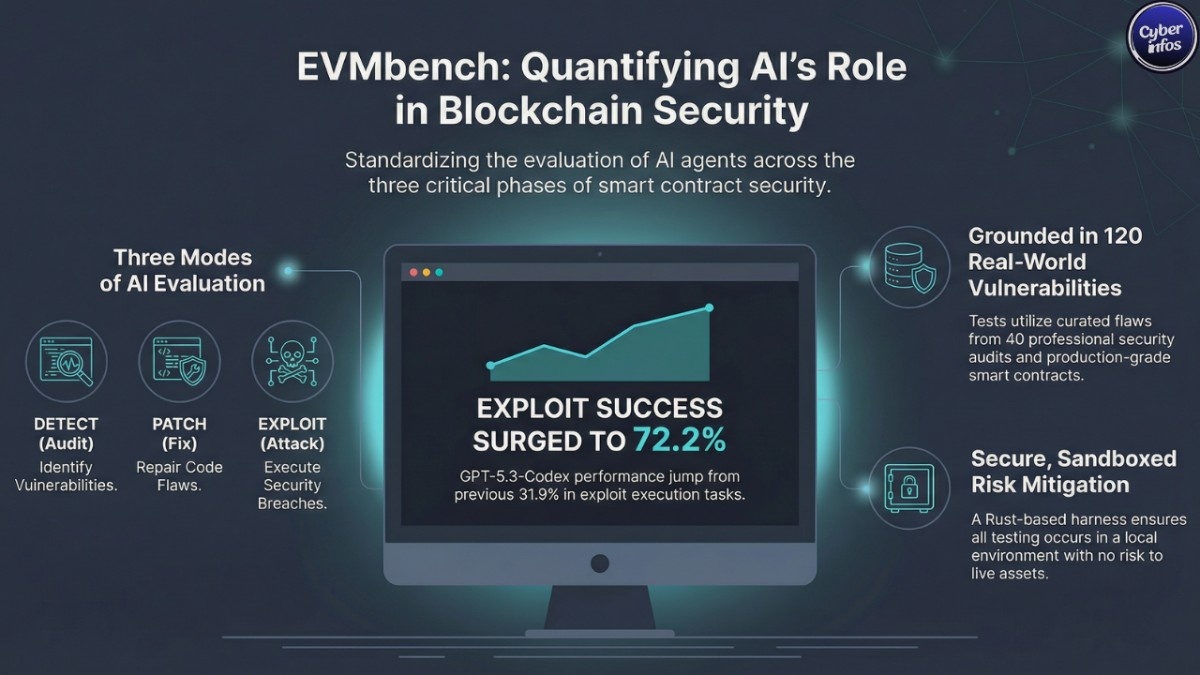
EVMbench draws on 120 carefully curated vulnerabilities sourced from 40 professional security audits. Many originated from competitive review platforms like Code4rena, where real auditors race to uncover high-impact flaws. That means the dataset isn’t hypothetical it reflects the kinds of issues that have already surfaced in production-grade smart contracts.
The benchmark also incorporates scenarios from the Tempo blockchain auditing process, expanding coverage into payment-oriented smart contracts. With stablecoins playing a larger role in everyday transactions, evaluating AI smart contract security in payment logic isn’t optional it’s necessary.
So EVMbench isn’t testing toy problems. It’s examining code patterns that secure billions in value.
EVMbench Evaluation Modes: How AI Smart Contract Security Is Measured
To make results meaningful, EVMbench evaluates AI systems across three distinct modes. Each mirrors a real-world phase of smart contract security.
Detect Mode in EVMbench
In Detect mode, AI agents perform smart contract vulnerability detection by auditing repositories and identifying known flaws. Scores reflect recall accuracy against verified audit findings.
This is where nuance begins to show. AI models can surface obvious vulnerabilities quickly. But they sometimes stop after identifying the first issue. Human auditors, on the other hand, tend to keep going checking edge cases, state changes, and interaction effects.
Comprehensive review still requires sustained reasoning.
Patch Mode in EVMbench
Patch mode tests automated smart contract auditing in a more demanding way. Agents must remove vulnerabilities while preserving intended contract behavior.
That sounds straightforward, but it rarely is. Eliminating a flaw without breaking core functionality demands context awareness. It’s one thing to delete risky logic; it’s another to maintain system integrity.
Automated tests and exploit simulations validate whether patches succeed. Subtle logic errors, especially those involving access control or state transitions, remain difficult for AI systems to address cleanly.
Exploit Mode in EVMbench
Exploit mode shifts the lens to offense. Here, agents attempt full end-to-end attacks within a sandboxed blockchain environment. And this is where performance stands out.
Under exploit testing, GPT-5.3-Codex reached 72.2%, a sharp improvement from GPT-5’s earlier 31.9%. Clear objectives drain funds, retry if needed, optimize strategy align closely with how models iterate.
That doesn’t mean Ethereum exploit detection AI is ready for autonomous operations on live networks. But it does show measurable progress in controlled conditions.
How EVMbench Operates Safely
Security testing in blockchain environments carries inherent risk, so EVMbench runs entirely inside deterministic infrastructure.
OpenAI built a Rust-based harness that deploys contracts predictably and restricts unsafe RPC methods. All exploit tasks execute within a local Anvil sandbox. No live networks. No real assets. No unintended consequences. This design ensures reproducibility while containing risk.
Still, OpenAI acknowledges a limitation: EVMbench cannot always distinguish between legitimate new findings and false positives when AI systems identify issues beyond the human baseline.
That’s not trivial. In production environments, false positives create noise, slow response times, and complicate remediation workflows. Benchmarks help measure capability. They don’t eliminate complexity.
What EVMbench Means for the Blockchain Ecosystem
For everyday crypto users, stronger AI smart contract security tools could eventually reduce catastrophic exploit events. That’s the hopeful view.
For startups building DeFi or payment systems, automated smart contract auditing may lower review costs and speed development cycles but only if combined with experienced oversight.
For security researchers, EVMbench finally provides a standardized AI blockchain security benchmark for comparing models objectively. That kind of reproducibility has been missing from much of the AI security conversation.
In short, EVMbench introduces structure to an area that previously relied heavily on anecdotal performance claims.
Practical Security Advice Beyond EVMbench
Even with advances in AI smart contract security, strong fundamentals remain essential.
Organizations deploying smart contracts should:
- Conduct independent audits before launch
- Implement formal verification for critical logic
- Deploy bug bounty programs to incentivize review
- Use time-locked upgrades to reduce governance risk
- Monitor on-chain activity continuously for anomalies
AI blockchain security benchmark improvements don’t replace layered defense. They complement it.
Security, especially in decentralized systems, is rarely about a single tool. It’s about process discipline.
EVMbench and Broader Cybersecurity Investment
Alongside EVMbench, OpenAI committed $10 million in API credits through its Cybersecurity Grant Program to support defensive research, particularly in open-source ecosystems and critical infrastructure.
The company also expanded Aardvark, its security research agent, into private beta. That move suggests a dual emphasis: advancing AI smart contract security capabilities while strengthening safeguards around their deployment.
Benchmarks alone don’t define responsibility. Implementation does.
FAQ: EVMbench and AI Smart Contract Security
What is EVMbench used for?
EVMbench is an AI blockchain security benchmark that evaluates AI smart contract security performance across detection, patching, and exploit execution tasks.
How does AI detect smart contract vulnerabilities?
Through smart contract vulnerability detection workflows, AI analyzes contract logic, control flow, and potential exploit paths. However, comprehensive audits still benefit from human expertise.
Can AI exploit Ethereum smart contracts?
Yes. EVMbench demonstrates measurable progress in Ethereum exploit detection AI within sandboxed environments designed for safe testing.
How does EVMbench support automated smart contract auditing?
By standardizing evaluation tasks, EVMbench allows researchers to track improvements in automated smart contract auditing performance over time.
Is EVMbench reflective of real-world blockchain risk?
Partially. While EVMbench simulates high-severity flaws, it cannot fully replicate production governance dynamics or complex multi-contract interactions.
Final Thoughts
EVMbench marks an important shift in how the industry measures AI smart contract security progress. By creating a structured AI blockchain security benchmark, OpenAI and its collaborators have provided a clearer lens into smart contract vulnerability detection and exploit performance.
Exploit capabilities are improving quickly. Comprehensive auditing and safe remediation remain more complex. For ecosystems securing billions in value, that gap deserves attention.
EVMbench doesn’t replace experienced auditors. It doesn’t eliminate adversarial risk. But it does move the conversation from speculation to measurable capability and that’s a meaningful step forward.
