
Close Menu
  • Home
  • Cyber security
    • Mobile security
    • Computer Security
    • Malware
  • Cyber news
    • Data breaches
  • Top10
  • Cyber Insurance
  • Cyber law & Compliance
  • About us
X (Twitter) Instagram Threads LinkedIn WhatsApp
Trending
  • Cognizant TriZetto Breach Exposes Data of 3.4M Patients
  • AI-Assisted Penetration Testing with Kali Linux: Claude AI and MCP Transform Ethical Hacking
  • Iran Cyber Attacks 2026: Hacktivist Surge Hits 110 Targets
  • Perplexity Comet Browser Vulnerability Exploited via Calendar Invite
  • Android Security Update Fixes 129 Flaws, Zero-Day
  • AI-Powered Cyber Attacks Surge 89% in 2025 Crisis Breakouts
  • Claude Distillation Attacks: 16M API Exchanges Exposed
  • Google Antigravity Suspension Hits OpenClaw Users
Monday, March 9
Cyber infos
X (Twitter) LinkedIn WhatsApp
  • Home
  • Cyber security
    • Mobile security
    • Computer Security
    • Malware
  • Cyber news
    • Data breaches
  • Top10
  • Cyber Insurance
  • Cyber law & Compliance
  • About us
Cyber infos
Cyber attacks

CVE-2026-1731: Critical BeyondTrust RCE Exploited

V DiwaharBy V DiwaharFebruary 18, 2026Updated:February 18, 2026No Comments6 Mins Read
Share Facebook Twitter Pinterest LinkedIn WhatsApp Copy Link
Share
Facebook Twitter Pinterest Threads Copy Link
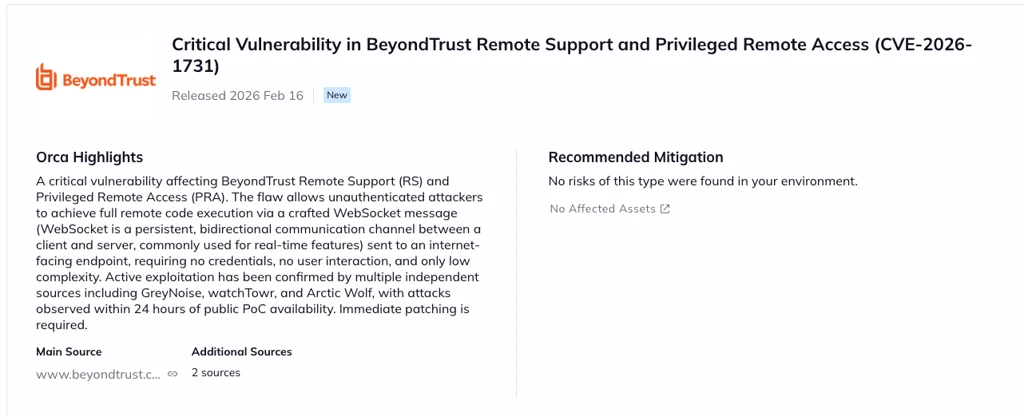
CVE-2026-1731 has quickly become one of the most urgent enterprise vulnerabilities of 2026. The flaw affects BeyondTrust Remote Support (RS) and BeyondTrust Privileged Remote Access (PRA) appliances and carries a CVSS v4 score of 9.9 about as severe as it gets.
Disclosed on February 6, 2026, and added to the U.S. Cybersecurity and Infrastructure Security Agency (CISA) Known Exploited Vulnerabilities (KEV) catalog just a week later, CVE-2026-1731 is not theoretical. It’s being exploited in the wild. And because it’s a pre-authentication remote code execution vulnerability, attackers don’t need credentials, MFA tokens, or user interaction to gain a foothold.For organizations that rely on BeyondTrust as a secure gateway to privileged systems, this isn’t just another patch cycle item. It’s a potential master key exposure.
Table of Contents hide
1 Incident Overview: What Is CVE-2026-1731?
2 How the CVE-2026-1731 Attack Works
3 Who Is at Risk?
4 Post-Exploitation Activity Observed
5 Protection & Mitigation for CVE-2026-1731
6 Official Commentary and Industry Response
7 Additional Safety Considerations
8 FAQ: CVE-2026-1731
9 Final Thoughts
10 External Authority Resources

Incident Overview: What Is CVE-2026-1731?

CVE-2026-1731 is a pre-authentication remote code execution (RCE) vulnerability affecting:

  • BeyondTrust Remote Support (RS) versions 25.3.1 and earlier
  • BeyondTrust Privileged Remote Access (PRA) versions 22.1 through 24.3.4
  • Legacy PRA versions prior to 22.1

The flaw stems from improper input validation that enables command injection through specially crafted WebSocket requests. An attacker can execute arbitrary operating system commands simply by interacting with an exposed internet-facing appliance.

According to reports from researchers and incident responders, exploitation activity began shortly after proof-of-concept (PoC) details became public. Within 24 hours of publication, internet-wide scanning was observed.
CVE-2026-1731: Critical BeyondTrust RCE Exploited

CISA formally added CVE-2026-1731 to its KEV catalog on February 13, 2026, signaling confirmed active exploitation and federal urgency.

How the CVE-2026-1731 Attack Works

The attack flow is technically straightforward almost alarmingly so.

Step 1: Reconnaissance

The attacker sends a GET request to:

/get_portal_info

This returns a configuration value (x-ns-company) required to establish a valid WebSocket session.

No authentication required.

Step 2: Malicious WebSocket Connection

Using that extracted value, the attacker connects to the /nw WebSocket endpoint and submits a crafted message containing a manipulated version string.

That string triggers command injection at the operating system level.

There are no credentials needed. No MFA prompts. No user clicks.

For security teams, that simplicity is the real danger. Once exploit code exists publicly and it does automation follows quickly.

Who Is at Risk?

Risk depends largely on deployment model.

SaaS Customers

BeyondTrust automatically patched hosted SaaS instances on February 2, 2026. If you’re fully cloud-hosted and received vendor confirmation, exposure is likely mitigated.

Self-Hosted and On-Premises Deployments

This is where the real exposure lies.

Security researchers have identified approximately 8,500 internet-exposed on-premises appliances. These systems remain vulnerable until administrators manually apply the appropriate patch or upgrade.

Organizations most at risk include:

  • Enterprises using PRA for privileged vaulting
  • Managed service providers (MSPs)
  • Financial institutions with internal remote access gateways
  • Healthcare providers using RS for support workflows

Because PRA often stores SSH keys, admin passwords, and session tokens, compromise may lead directly to domain-level access.

Post-Exploitation Activity Observed

Incident response teams have documented consistent attacker behavior after successful exploitation.

Observed techniques include:

  • Deployment of SimpleHelp RMM, renamed and repurposed as a persistent backdoor
  • Access to credential vaults containing passwords and SSH keys
  • Lateral movement to internal systems
  • Execution of net user and net group for privilege escalation
  • Creation of new administrative accounts

In other words, attackers are not just testing access they’re operationalizing it.

For organizations that exposed PRA externally before patching, compromise assessment should be considered mandatory.

Protection & Mitigation for CVE-2026-1731

If you haven’t patched yet, treat this as an emergency change window.

Immediate Actions

  • Upgrade to RS 25.3.2+ or apply patch BT26-02-RS
  • Upgrade PRA to 25.1.1+ or apply patch BT26-02-PRA
  • Upgrade legacy PRA to a supported version before patching

If patching cannot occur immediately:

  • Restrict access using IP allowlists or VPN enforcement
  • Block or monitor WebSocket traffic to the /nw endpoint at your WAF
  • Temporarily disable the web portal if exposure cannot be controlled

Detection & Threat Hunting

Security teams should:

  • Monitor child processes spawned by the BeyondTrust service account
  • Investigate unexpected executions of curl, wget, bash, or sh
  • Review Windows logs for net user and net group commands
  • Check for renamed binaries in C:\ProgramData\ or Linux equivalents
  • Audit vault access logs for unusual retrieval activity

Assume breach if exposure occurred before remediation.

Official Commentary and Industry Response

The inclusion of CVE-2026-1731 in the CISA Known Exploited Vulnerabilities catalog significantly raises the urgency level for federal agencies and contractors.

Multiple security vendors have also issued detection guidance and threat intelligence updates, noting automated exploitation attempts.

The pattern mirrors previous high-impact remote access appliance vulnerabilities: once public exploit details appear, opportunistic and targeted actors move quickly.

Additional Safety Considerations

  • Rotate all privileged credentials stored in PRA
  • Revoke and reissue SSH keys if vault exposure is suspected
  • Revalidate MFA enforcement for all admin workflows
  • Review outbound connections from the appliance for suspicious C2 traffic
  • Conduct a full forensic review if the system was internet-facing

For many organizations, BeyondTrust appliances sit at the intersection of identity, access, and infrastructure. Treating them as “just another appliance” underestimates their strategic importance.

FAQ: CVE-2026-1731

Is CVE-2026-1731 actively exploited?

Yes. Active exploitation has been confirmed, and CISA added it to the KEV catalog on February 13, 2026.

Does CVE-2026-1731 require authentication?

No. It is a pre-authentication RCE vulnerability, meaning attackers do not need credentials or user interaction.

Are SaaS customers vulnerable?

BeyondTrust automatically patched SaaS instances on February 2, 2026. Self-hosted deployments require manual updates.

What makes CVE-2026-1731 especially dangerous?

Because it affects privileged access infrastructure, successful exploitation may expose credential vaults, SSH keys, and session tokens allowing rapid lateral movement.

Should we assume compromise if exposed?

If your appliance was internet-facing and unpatched after disclosure, organizations should strongly consider conducting a compromise assessment.

Final Thoughts

CVE-2026-1731 is not simply another remote code execution vulnerability it targets the very systems designed to protect privileged access. The combination of pre-auth exploitation, public PoCs, and active scanning activity makes it a high-priority threat for enterprises.

Organizations running BeyondTrust Remote Support or Privileged Remote Access must patch immediately, restrict exposure, and assess for compromise if internet-facing systems were left unpatched.

With vulnerabilities like CVE-2026-1731, speed matters but so does thoroughness.

External Authority Resources

  • CISA Known Exploited Vulnerabilities Catalog
  • BeyondTrust Security Advisory Portal
Share. Facebook Twitter Pinterest Threads Telegram Email LinkedIn WhatsApp Copy Link
Previous ArticleUK Cyber Essentials Campaign Urges SMEs to Lock the Digital Door
Next Article Dell RecoverPoint Zero-Day Vulnerability Exploited by Chinese Hackers Since Mid-2024
V Diwahar
  • Website
  • LinkedIn

V Diwahar is a final-year B.E Cybersecurity student, independent security researcher, and founder of CyberInfos.in an - global cybersecurity analysis blog delivering technical depth, expert threat intelligence, and actionable security guidance to readers across the US, UK, Europe, Asia, and beyond. With hands-on academic and practical experience in ethical hacking, network security, malware analysis, penetration testing, vulnerability research, and digital forensics, I brings a practitioner's perspective to every article going beyond headlines to analyse what vulnerabilities and breaches actually mean, who is genuinely at risk, and what every reader should do about it right now. Every article published on CyberInfos.in is built on verified technical research CVE details cross-referenced with nvd.nist.gov, attack mechanics explained using real tools and lab environments, and expert analysis that challenges official statements when the evidence demands it. I founded CyberInfos.in with a single mission: to fill the gap between generic press-release rewrites and inaccessible technical papers delivering cybersecurity analysis that is deep enough for security professionals, clear enough for business owners, and actionable enough for everyone.

Related Posts

Iran Cyber Attacks 2026: Hacktivist Surge Hits 110 Targets

March 5, 2026
Read More

Perplexity Comet Browser Vulnerability Exploited via Calendar Invite

March 4, 2026
Read More

AI-Powered Cyber Attacks Surge 89% in 2025 Crisis Breakouts

February 25, 2026
Read More
Add A Comment
Leave A Reply Cancel Reply

Cyber news

PayPal Data Breach: 6-Month SSN Exposure Shocks Small Businesses

February 21, 2026

SmarterMail Vulnerabilities Actively Exploited in Ransomware Attacks

February 19, 2026

Dell RecoverPoint Zero-Day Vulnerability Exploited by Chinese Hackers Since Mid-2024

February 18, 2026

UK Cyber Essentials Campaign Urges SMEs to Lock the Digital Door

February 17, 2026

Top 10

Top 10 Cybersecurity Resolutions Every User Should Make in 2026

January 1, 2026

Top 10 Best Autonomous Endpoint Management Tools in 2026

November 14, 2025

Top 10 Best API Security Testing Tools in 2026

October 29, 2025

10 Best Free Malware Analysis Tools–2026

July 1, 2025

mobile security

Android Security Update Fixes 129 Flaws, Zero-Day

March 3, 2026

PromptSpy Android Malware Marks First Use of Generative AI in Mobile Attacks

February 20, 2026

Google Is Finally Letting Users Change Gmail Address – Here’s How It Works

December 26, 2025

Securing Mobile Payments and Digital Wallets: Tips for Safe Transactions

December 19, 2025
Cyber Insurance

A Step-by-Step Checklist to Prepare Your Business for Cyber Insurance (2026 Guide)

December 14, 2025

Is Your Business Really Protected? A Deep Dive Into Cyber Liability Coverage

December 6, 2025

What Cyber Insurance Doesn’t Cover & How to Fix the Gaps

December 1, 2025

Top Cyber Risks Today and How Cyber Insurance Protects You in 2026

November 28, 2025

What Every Business Owner Must Know Before Buying Cyber Insurance in 2026

November 26, 2025
Recents

Cognizant TriZetto Breach Exposes Data of 3.4M Patients

March 8, 2026

AI-Assisted Penetration Testing with Kali Linux: Claude AI and MCP Transform Ethical Hacking

March 6, 2026

Iran Cyber Attacks 2026: Hacktivist Surge Hits 110 Targets

March 5, 2026

Perplexity Comet Browser Vulnerability Exploited via Calendar Invite

March 4, 2026

Android Security Update Fixes 129 Flaws, Zero-Day

March 3, 2026
Pages
  • About us
  • Contact us
  • Disclaimer
  • Privacy policy
  • Sitemaps
  • Terms and conditions
About us

We delivers trusted cybersecurity updates, expert analysis, and online safety tips. We help individuals and businesses understand cyber threats and protect their digital world with accurate, easy-to-read information.

Partners
White Hat Hub Partner
X (Twitter) LinkedIn WhatsApp
  • Contact us
  • Sitemaps
© 2026 Cyberinfos - All Rights are Reserved

Type above and press Enter to search. Press Esc to cancel.