
Close Menu
  • Home
  • Cyber security
    • Mobile security
    • Computer Security
    • Malware
  • Cyber news
    • Data breaches
  • Top10
  • Cyber Insurance
  • Cyber law & Compliance
  • About us
X (Twitter) Instagram Threads LinkedIn WhatsApp
Trending
  • Cognizant TriZetto Breach Exposes Data of 3.4M Patients
  • AI-Assisted Penetration Testing with Kali Linux: Claude AI and MCP Transform Ethical Hacking
  • Iran Cyber Attacks 2026: Hacktivist Surge Hits 110 Targets
  • Perplexity Comet Browser Vulnerability Exploited via Calendar Invite
  • Android Security Update Fixes 129 Flaws, Zero-Day
  • AI-Powered Cyber Attacks Surge 89% in 2025 Crisis Breakouts
  • Claude Distillation Attacks: 16M API Exchanges Exposed
  • Google Antigravity Suspension Hits OpenClaw Users
Monday, March 9
Cyber infos
X (Twitter) LinkedIn WhatsApp
  • Home
  • Cyber security
    • Mobile security
    • Computer Security
    • Malware
  • Cyber news
    • Data breaches
  • Top10
  • Cyber Insurance
  • Cyber law & Compliance
  • About us
Cyber infos
Cyber security

How Attackers Use Company Language to Guess Passwords

V DiwaharBy V DiwaharFebruary 10, 2026No Comments5 Mins Read
Share Facebook Twitter Pinterest LinkedIn WhatsApp Copy Link
Share
Facebook Twitter Pinterest Threads Copy Link

Passwords remain one of the most fragile points in modern security. Organizations often strengthen authentication by adding complexity length requirements, special characters, rotation rules but these controls frequently clash with human behavior. When passwords become hard to remember, users fall back on what feels familiar.

In many environments, that familiarity comes directly from the organization itself. Company names, product terms, locations, and internal language quietly shape how users create passwords, even when they believe they’re choosing something unique.Attackers have long understood this pattern. Instead of relying on artificial intelligence or massive generic dictionaries, many credential attacks begin with something far simpler: harvesting an organization’s own language and converting it into highly targeted password guesses. This approach is efficient, repeatable, and far more effective than broad brute-force attempts.
That reality explains why NIST SP 800-63B explicitly warns against context-specific passwords derived from service names, usernames, or organizational terms. Enforcing that guidance, however, requires understanding how attackers build and operationalize these wordlists in real-world attacks because many defenses still assume password guessing relies on generic datasets.
Table of Contents hide
1 Where Targeted Wordlists Really Come From
2 From Public Content to Passwords Guesses
3 Why Password Complexity Rules Still Fail
4 Who Is Most at Risk
5 How to Defend Against Targeted Wordlist Attacks
6 Align Password Policy With Real-World Attacks
7 FAQ
8 Final Thoughts

Where Targeted Wordlists Really Come From

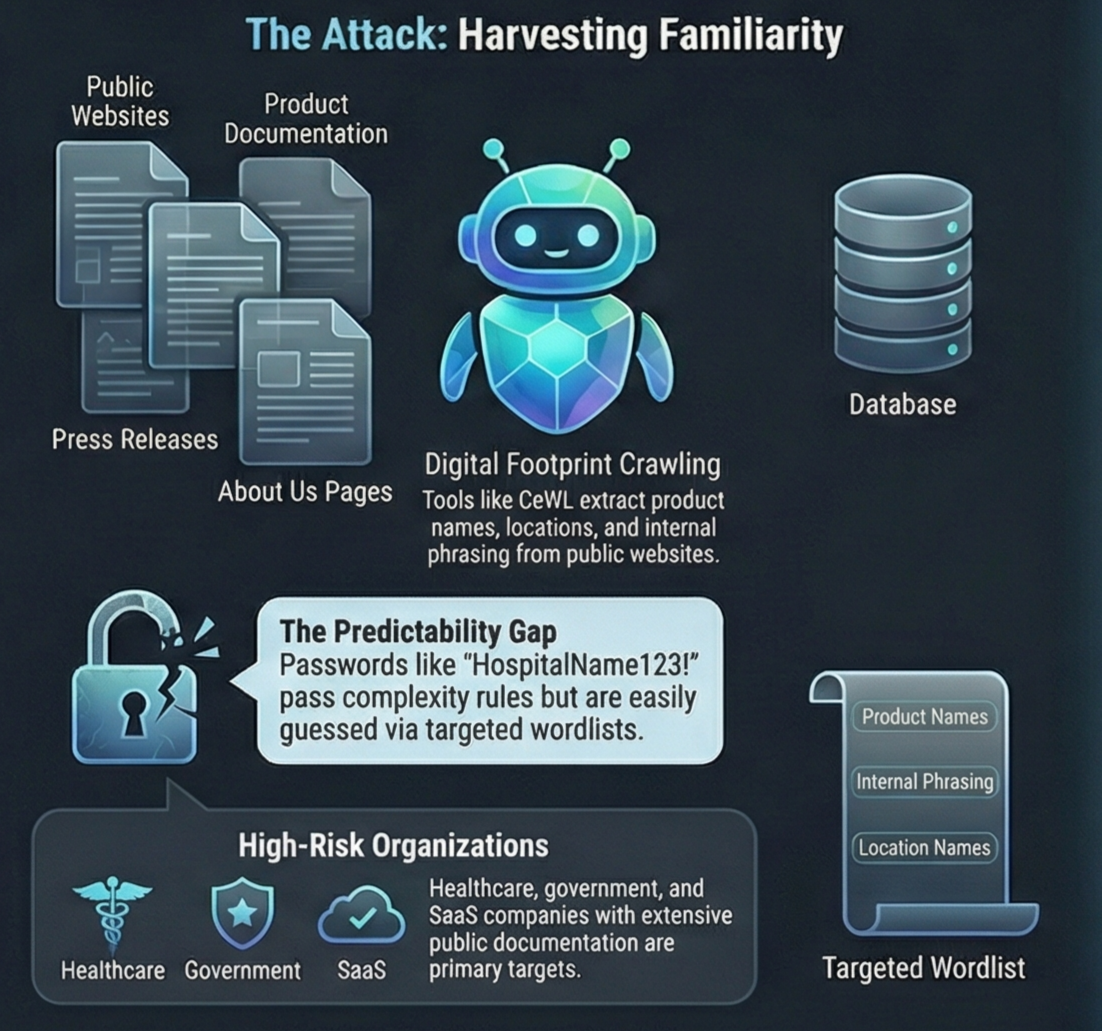
One of the most common tools used for this purpose is CeWL (Custom Word List generator). CeWL is an open-source web crawler that extracts words from websites and compiles them into structured lists. It comes preinstalled in popular penetration-testing distributions like Kali Linux and Parrot OS, which lowers the barrier to entry for both attackers and defenders.

Attackers use CeWL to crawl an organization’s public-facing digital footprint its website, documentation portals, blogs, and help pages. The goal isn’t volume, but relevance.

Typical output includes:

  • Organization and product names
  • Internal phrasing exposed in documentation
  • Industry-specific terminology
  • Location names and service descriptions

These terms rarely appear in generic password dictionaries, but they closely mirror the language users encounter daily. As a result, they disproportionately influence how passwords are constructed.

The effectiveness of this approach lies not in sophistication, but in precision.

From Public Content to Passwords Guesses

CeWL allows attackers to control crawl depth, minimum word length, and file types, filtering out low-value results. The harvested words become a high-confidence base set for password generation.

Consider a healthcare organization. Its public site may reference:

  • The hospital’s name or abbreviation
  • City or regional identifiers
  • Medical services, treatments, or departments

These words are rarely used as standalone passwords. Instead, attackers apply predictable transformations: numeric suffixes, capitalization, seasonal patterns, or appended symbols.

Once password hashes are obtained often via third-party breaches or infostealer malware tools like Hashcat apply these mutation rules at scale. Millions of highly relevant candidates can be tested efficiently with far higher success rates than generic lists.

The same wordlists can also be used against live authentication services, where attackers rely on low-and-slow techniques to evade lockouts and monitoring.
How Attackers Use Company Language to Guess Passwords

Why Password Complexity Rules Still Fail

The critical problem is that many of these passwords technically meet complexity requirements.

A password such as HospitalName123! satisfies default Active Directory rules: length, uppercase, lowercase, numbers, and symbols. Yet within a healthcare environment, it is dangerously predictable.

Analysis of billions of compromised passwords consistently shows the same pattern: when passwords are built from familiar organizational language, added complexity does little to restore true unpredictability. The base term carries too much contextual meaning.

This is precisely the attack surface that CeWL-derived wordlists exploit.

Who Is Most at Risk

Organizations with a strong public presence are particularly exposed, including:

  • Healthcare providers
  • Educational institutions
  • Government agencies
  • SaaS companies with extensive documentation
  • Enterprises with branded internal platforms

Risk increases when employees are encouraged to “make passwords memorable” without guidance on avoiding contextual language. The more an organization’s terminology appears in daily workflows, the more likely it is to appear directly or indirectly in passwords.

How to Defend Against Targeted Wordlist Attacks

1. Block context-derived and compromised passwords

Prevent users from creating passwords based on organization-specific language such as company names, products, internal projects, or industry terms. At the same time, block passwords already exposed in known data breaches.

Specops Password Policy allows organizations to enforce custom exclusion dictionaries and continuously scan Active Directory against more than 5.4 billion known-compromised passwords directly disrupting CeWL-style attacks.

2. Enforce meaningful length, not just complexity

Require passphrases of at least 15 characters. Length and unpredictability provide far more protection than symbol-heavy but context-based passwords.

3. Enable multi-factor authentication (MFA)

MFA does not prevent password compromise, but it dramatically limits impact. Even simple MFA significantly reduces the value of stolen credentials across Windows logon, VPNs, and RDP.

Align Password Policy With Real-World Attacks

Treat passwords as an active security control, not a static compliance checkbox. Policies that prevent context-derived, previously exposed, or easily inferred passwords remove much of the value attackers gain from targeted wordlists.

When combined with MFA, these controls reflect how credential attacks actually occur, rather than how we assume they do.

FAQ

What is a targeted password wordlist?

A targeted wordlist is built from organization-specific language harvested from public websites and documentation, making password guesses far more accurate.

Why are company names dangerous in passwords?

Attackers routinely collect and mutate company names, products, and locations, making these terms highly predictable.

Does password complexity still matter?

Yes, but only alongside length and unpredictability. Complexity alone does not protect against context-based guessing.

Can MFA stop wordlist attacks?

MFA doesn’t stop password guessing, but it prevents stolen credentials from being used on their own.

Final Thoughts

Password attacks rarely rely on randomness anymore. They rely on familiarity. By understanding how attackers weaponize an organization’s own language, defenders can move beyond outdated complexity rules and deploy controls that meaningfully reduce risk.

Blocking context-derived passwords, enforcing long passphrases, and enabling MFA creates an authentication strategy aligned with real-world threats without adding unnecessary friction for users.

Stay ahead of emerging threats: Join our WhatsApp channel for real-time security alerts.
Follow us on LinkedIn for daily cybersecurity insights and breaking news.

Share. Facebook Twitter Pinterest Threads Telegram Email LinkedIn WhatsApp Copy Link
Previous ArticleFlickr Confirms Potential Data Breach via Third-Party Email Service
Next Article Claude Artifacts ClickFix macOS Infostealer: Dangerous AI Malware Campaign
V Diwahar
  • Website
  • LinkedIn

V Diwahar is a final-year B.E Cybersecurity student, independent security researcher, and founder of CyberInfos.in an - global cybersecurity analysis blog delivering technical depth, expert threat intelligence, and actionable security guidance to readers across the US, UK, Europe, Asia, and beyond. With hands-on academic and practical experience in ethical hacking, network security, malware analysis, penetration testing, vulnerability research, and digital forensics, I brings a practitioner's perspective to every article going beyond headlines to analyse what vulnerabilities and breaches actually mean, who is genuinely at risk, and what every reader should do about it right now. Every article published on CyberInfos.in is built on verified technical research CVE details cross-referenced with nvd.nist.gov, attack mechanics explained using real tools and lab environments, and expert analysis that challenges official statements when the evidence demands it. I founded CyberInfos.in with a single mission: to fill the gap between generic press-release rewrites and inaccessible technical papers delivering cybersecurity analysis that is deep enough for security professionals, clear enough for business owners, and actionable enough for everyone.

Related Posts

AI-Assisted Penetration Testing with Kali Linux: Claude AI and MCP Transform Ethical Hacking

March 6, 2026
Read More

Iran Cyber Attacks 2026: Hacktivist Surge Hits 110 Targets

March 5, 2026
Read More

AI-Powered Cyber Attacks Surge 89% in 2025 Crisis Breakouts

February 25, 2026
Read More
Add A Comment
Leave A Reply Cancel Reply

Cyber news

PayPal Data Breach: 6-Month SSN Exposure Shocks Small Businesses

February 21, 2026

SmarterMail Vulnerabilities Actively Exploited in Ransomware Attacks

February 19, 2026

Dell RecoverPoint Zero-Day Vulnerability Exploited by Chinese Hackers Since Mid-2024

February 18, 2026

UK Cyber Essentials Campaign Urges SMEs to Lock the Digital Door

February 17, 2026

Top 10

Top 10 Cybersecurity Resolutions Every User Should Make in 2026

January 1, 2026

Top 10 Best Autonomous Endpoint Management Tools in 2026

November 14, 2025

Top 10 Best API Security Testing Tools in 2026

October 29, 2025

10 Best Free Malware Analysis Tools–2026

July 1, 2025

mobile security

Android Security Update Fixes 129 Flaws, Zero-Day

March 3, 2026

PromptSpy Android Malware Marks First Use of Generative AI in Mobile Attacks

February 20, 2026

Google Is Finally Letting Users Change Gmail Address – Here’s How It Works

December 26, 2025

Securing Mobile Payments and Digital Wallets: Tips for Safe Transactions

December 19, 2025
Cyber Insurance

A Step-by-Step Checklist to Prepare Your Business for Cyber Insurance (2026 Guide)

December 14, 2025

Is Your Business Really Protected? A Deep Dive Into Cyber Liability Coverage

December 6, 2025

What Cyber Insurance Doesn’t Cover & How to Fix the Gaps

December 1, 2025

Top Cyber Risks Today and How Cyber Insurance Protects You in 2026

November 28, 2025

What Every Business Owner Must Know Before Buying Cyber Insurance in 2026

November 26, 2025
Recents

Cognizant TriZetto Breach Exposes Data of 3.4M Patients

March 8, 2026

AI-Assisted Penetration Testing with Kali Linux: Claude AI and MCP Transform Ethical Hacking

March 6, 2026

Iran Cyber Attacks 2026: Hacktivist Surge Hits 110 Targets

March 5, 2026

Perplexity Comet Browser Vulnerability Exploited via Calendar Invite

March 4, 2026

Android Security Update Fixes 129 Flaws, Zero-Day

March 3, 2026
Pages
  • About us
  • Contact us
  • Disclaimer
  • Privacy policy
  • Sitemaps
  • Terms and conditions
About us

We delivers trusted cybersecurity updates, expert analysis, and online safety tips. We help individuals and businesses understand cyber threats and protect their digital world with accurate, easy-to-read information.

Partners
White Hat Hub Partner
X (Twitter) LinkedIn WhatsApp
  • Contact us
  • Sitemaps
© 2026 Cyberinfos - All Rights are Reserved

Type above and press Enter to search. Press Esc to cancel.