


Ironically observed globally as Cybersecurity Awareness Month, October 2026 instead delivered one of the most destructive waves of digital exploitation in modern history. Threat intelligence analysts and enterprise defenders have already dubbed this period Black October 2026 cyberattacks. Across thirty-one days, the Top 10 cybersecurity incidents in October 2026 exposed critical single points of failure across Web3 custody, core internet interpreters, artificial intelligence pipelines, and public key infrastructure.
The financial shockwaves were led by the historic Binance $6.3 billion hack, where attackers compromised developer infrastructure to drain ten blockchains in twenty minutes. Simultaneously, enterprise patch teams scrambled to mitigate PHP2Shell CVE-2026-109618 and Oracle CVE-2026-101767, while AI engineering teams battled the LiteLLM supply chain attack on PyPI.
From the eMudhra weak key incident in India to kinetic IoT sabotage in French supermarkets and massive October 2026 data breaches, these ten incidents reshaped the global threat landscape.
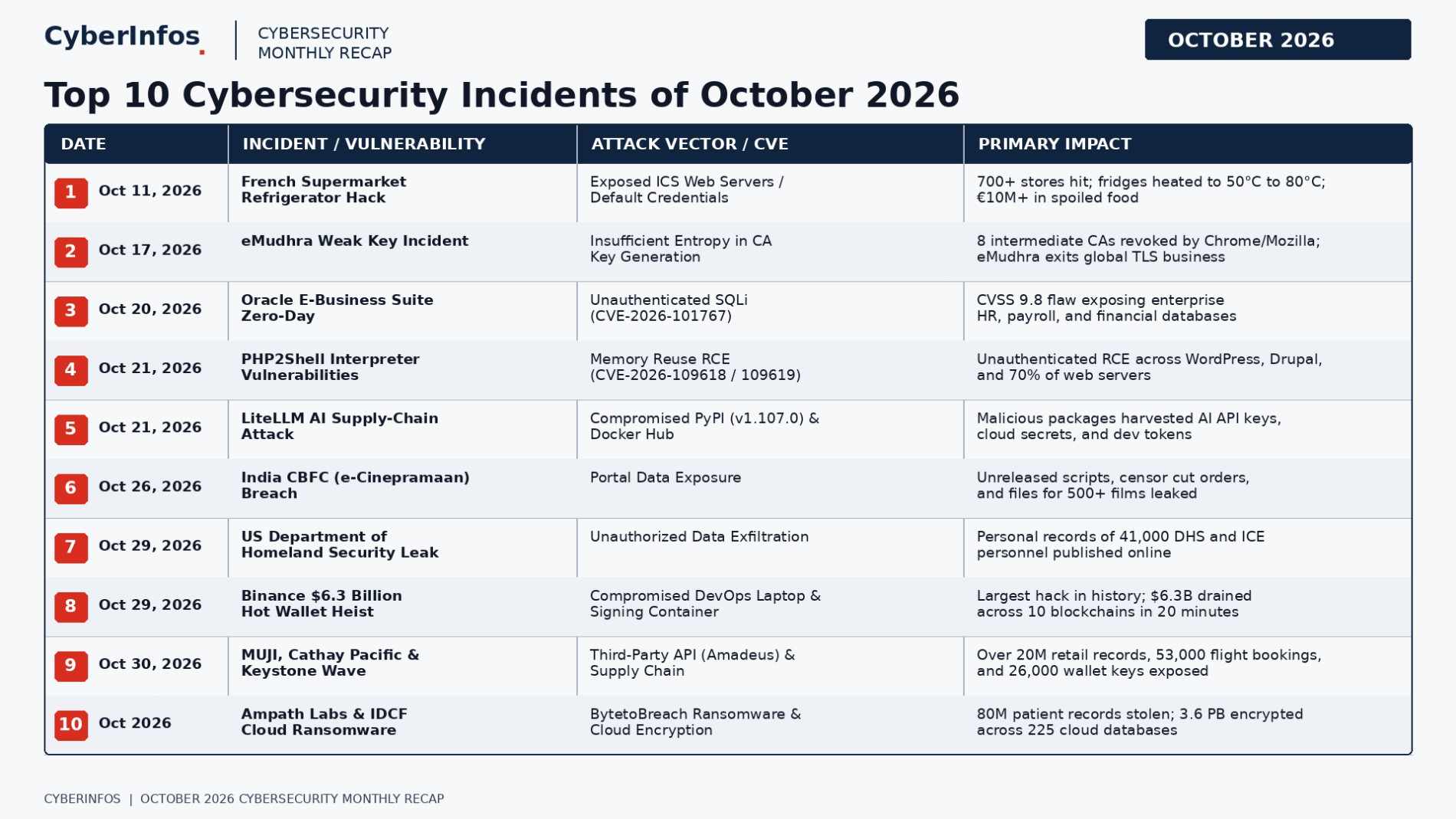
Quick Summary: Top 10 Cybersecurity Incidents of October 2026
| Date | Incident / Vulnerability | Attack Vector / CVE | Primary Impact |
|---|---|---|---|
| Oct 11, 2026 | French Supermarket Refrigerator Hack | Exposed ICS Web Servers / Default Credentials | 700+ stores hit; fridges heated to 50°C to 80°C; €10M+ in spoiled food |
| Oct 17, 2026 | eMudhra Weak Key Incident | Insufficient Entropy in CA Key Generation | 8 intermediate CAs revoked by Chrome/Mozilla; eMudhra exits global TLS business |
| Oct 20, 2026 | Oracle E-Business Suite Zero-Day | Unauthenticated SQLi (CVE-2026-101767) |
CVSS 9.8 flaw exposing enterprise HR, payroll, and financial databases |
| Oct 21, 2026 | PHP2Shell Interpreter Vulnerabilities | Memory Reuse RCE (CVE-2026-109618 / 109619) |
Unauthenticated RCE across WordPress, Drupal, and 70% of web servers |
| Oct 21, 2026 | LiteLLM AI Supply-Chain Attack | Compromised PyPI (v1.107.0) & Docker Hub |
Malicious packages harvested AI API keys, cloud secrets, and dev tokens |
| Oct 26, 2026 | India CBFC (e-Cinepramaan) Breach | Portal Data Exposure | Unreleased scripts, censor cut orders, and files for 500+ films leaked |
| Oct 29, 2026 | US Department of Homeland Security Leak | Unauthorized Data Exfiltration | Personal records of 41,000 DHS and ICE personnel published online |
| Oct 29, 2026 | Binance $6.3 Billion Hot Wallet Heist | Compromised DevOps Laptop & Signing Container | Largest hack in history; $6.3B drained across 10 blockchains in 20 minutes |
| Oct 30, 2026 | MUJI, Cathay Pacific & Keystone Wave | Third-Party API (Amadeus) & Supply Chain | Over 20M retail records, 53,000 flight bookings, and 26,000 wallet keys exposed |
| Oct 2026 | Ampath Labs & IDCF Cloud Ransomware | BytetoBreach Ransomware & Cloud Encryption | 80M patient records stolen; 3.6 PB encrypted across 225 cloud databases |
Detailed Threat Breakdown: Top 10 Cybersecurity Incidents in October 2026
1. The Record-Breaking $6.3 Billion Binance Hot Wallet Heist
On October 29, 2026, starting at 20:05 UTC, attackers drained approximately $6.3 billion in digital assets from cryptocurrency exchange Binance across ten blockchains in roughly 20 minutes. A second wave struck Avalanche and Polygon wallets three hours later, making the Binance $6.3 billion hack more than four times larger than the $1.46 billion Bybit breach of February 2025.
Threat actors did not break Binance’s encryption or leak raw private keys. Instead, initial forensic findings revealed that attackers compromised a DevOps engineer’s laptop, pivoted into an internal service container, and abused signing infrastructure to submit unauthorized withdrawal transactions that processed as legitimate requests. While Tether and Circle froze nearly $3 billion in stablecoins, over $3.3 billion in Bitcoin and Ether entered laundering pipelines. [Read More]
CyberInfos Analyst Insight: Developer endpoints are the new perimeter. When a single engineer’s workstation can reach production signing containers, zero-trust segmentation has failed.
2. PHP2Shell (CVE-2026-109618 & CVE-2026-109619) Threatens 70% of the Web
On October 21, 2026, the core PHP development team released emergency patches for two critical vulnerabilities tracked as CVE-2026-109618 and CVE-2026-109619, collectively dubbed PHP2Shell. Discovered by security researchers at Wiz, the flaws stem from memory-management errors in the core PHP interpreter, specifically the reuse of freed memory and persistent invalid internal states between HTTP requests.
Because PHP2Shell CVE-2026-109618 allows unauthenticated remote code execution (RCE) and process memory disclosure, researchers quickly demonstrated working exploits against default installations of WordPress, Drupal, and Joomla. Both the US National Security Agency (NSA) and Indian cybersecurity authorities issued urgent advisories warning enterprises to upgrade immediately to patched PHP versions 8.2.35, 8.3.36, 8.4.27, and 8.5.12. [Read More]
Recommended Action: Audit all external-facing LAMP stacks immediately and deploy emergency Web Application Firewall (WAF) virtual patches to block malformed request state manipulation.
3. LiteLLM PyPI & Docker Software Supply-Chain Attack
On October 21, 2026, the AI engineering ecosystem suffered a severe blow when attackers compromised the release infrastructure of LiteLLM, a widely used open-source gateway for managing multiple large language model APIs. Using stolen developer credentials, threat actors manipulated the release workflow to publish a malicious package, version 1.107.0, to the Python Package Index (PyPI) between 11:39 and 13:23 UTC, alongside poisoned container images on Docker Hub.
During that window, the LiteLLM supply chain attack deployed credential-stealing malware and remote-access backdoors into production AI environments. The payload specifically harvested browser credentials, cloud service secrets, developer authentication tokens, and commercial LLM API keys.
Why this matters: AI pipelines hold keys to an organization’s most sensitive proprietary data and high-cost compute credits. Affected teams must rebuild container environments from scratch and rotate every exposed API token and cloud secret. [Read More]
4. eMudhra Cryptographically Weak CA Keys Force Exit from Global TLS Business
On October 17, 2026, a security researcher disclosed a catastrophic cryptographic failure involving eMudhra, a major Indian digital trust provider and certificate authority (CA). The investigation revealed that private keys tied to eight intermediate CA certificates had been generated with insufficient randomness during an April 2025 key-generation ceremony.
Because weak entropy made it mathematically feasible for adversaries to recover the private keys and forge fraudulent SSL/TLS certificates trusted by web browsers, browser vendors took immediate emergency action. Google blocked the public keys via Chrome’s CRLSet mechanism, and Mozilla pushed revocations to Firefox via OneCRL without requiring browser restarts.
Although no fraudulent end-entity certificates were issued in the wild, the loss of ecosystem trust following the eMudhra weak key incident was fatal: on October 22, eMudhra announced its permanent withdrawal from the global SSL/TLS certificate business. [Read More]
5. Critical Oracle E-Business Suite Unauthenticated SQL Injection (CVE-2026-101767)
Enterprise ERP environments faced an urgent patch scramble on October 20, 2026, when Oracle released a critical security update for Oracle E-Business Suite (EBS). Tracked as Oracle CVE-2026-101767 and assigned a near-maximum CVSS severity score of 9.8, the vulnerability is an unauthenticated SQL injection flaw residing in core web-accessible EBS components.
Because the flaw requires zero user interaction or prior login credentials, remote attackers scanning exposed EBS portals can execute arbitrary SQL commands, achieve remote code execution on the underlying server, and exfiltrate highly sensitive corporate financial, payroll, supply chain, and human resources data. Given the historical precedent of ransomware groups targeting Oracle ERP systems for extortion, CISA and global CERT teams mandated expedited patching windows for all enterprise deployments.
Business Impact: Unpatched ERP vulnerabilities expose complete corporate balance sheets and employee PII, triggering severe regulatory penalties under GDPR and India’s DPDP Act. [Read More]
6. The French Supermarket Refrigerator Cyberattack (OT/ICS Sabotage)
On October 11, 2026, an unprecedented operational technology (OT) cyberattack bridged the gap between digital exploitation and physical destruction across Europe. Threat actors targeted internet-exposed Danfoss AK-SM800A refrigeration controllers across more than 700 French supermarkets, including major chains like Coopérative U and Intermarché.
Many of the legacy industrial control systems (ICS) ran unpatched web servers accessible over the public internet using the default username admin and the current date as the password. Instead of simply shutting the units down, hackers remotely reprogrammed the refrigerators into furnaces, heating cold-storage units to between 50°C and 80°C (176°F) overnight.
The attack sparked electrical fires and forced grocers across France, Belgium, and the Netherlands to discard tons of spoiled meat and dairy, causing over €10 million in physical property damage in the first direct cyberattack on a national food cold chain. [Read More]
7. US Department of Homeland Security (DHS) 41,000-Employee Data Leak
On October 29, 2026, federal law enforcement in the United States confronted a severe operational security crisis when threat actors leaked the personal records of more than 41,000 Department of Homeland Security (DHS) employees online. The exposed dataset included sensitive personally identifiable information (PII) belonging to active Immigration and Customs Enforcement (ICE) personnel and federal security officials.
Unlike typical commercial breaches driven purely by financial fraud, the exposure of federal law enforcement rosters creates immediate physical safety, doxxing, and counter-intelligence risks. Foreign intelligence services and domestic extremist groups can cross-reference leaked federal employee names with residential databases and social media profiles to target agents via spear-phishing or physical intimidation.
DHS immediately launched a forensic investigation alongside federal cyber agencies to determine the compromised contractor or portal vector and issued identity protection protocols for affected staff. [Read More]
8. India’s Central Board of Film Certification (CBFC) e-Cinepramaan Breach
In late October 2026, India’s media and entertainment sector was shaken when the Central Board of Film Certification (CBFC) launched an investigation into a major data exposure on its official e-Cinepramaan portal. First reported on October 26, the security incident compromised confidential regulatory documents linked to more than 500 film titles, including dozens of high-budget commercial feature films.
While the breach did not involve raw video files of unreleased movies, attackers accessed sensitive certification applications containing complete shooting scripts, mandatory censor cut orders, certification certificates, and private theatrical distribution agreements.
For Indian production houses, leaked shooting scripts and distribution contracts ahead of theatrical release represent severe intellectual property theft and commercial sabotage. The incident also intensified calls from Indian cybersecurity experts for mandatory Digital Personal Data Protection (DPDP) security audits across government e-governance portals. [Read More]
9. “Black October” Retail & Travel Wave: MUJI, Cathay Pacific, Polymarket & Keystone
During the final week of October 2026, a concentrated wave of third-party and platform compromises exposed over 20 million consumer records globally:
-
Cathay Pacific & Japanese Airlines (Oct 30): A security breach at aviation IT provider Amadeus exposed passenger details across 53,000 Cathay Pacific bookings, 92,000 Japan Airlines records, and 37,800 ANA bookings.
-
MUJI & Retail Breaches (Oct 30): Global retail brand MUJI disclosed a massive customer data breach alongside earlier October attacks on Pizza Hut Japan’s payment API and H&M.
-
Polymarket Account Takeovers (Oct 30): Attackers compromised over 700 active trading accounts on prediction market Polymarket, automatically liquidating positions and draining $2.65 million.
-
Keystone Hardware Wallet (Oct 30): Crypto hardware wallet maker Keystone confirmed the theft of 26,000 customer records and verification keys, creating severe targeted phishing risks for cold-storage owners. [Read More]
10. Mega-Ransomware & Cloud Destruction: Ampath Labs, IDCF Cloud & Zeabur
Rounding out October 2026 data breaches was a series of devastating ransomware and cloud infrastructure wipeouts that paralyzed healthcare and hosting providers:
-
Ampath Laboratories: The BytetoBreach ransomware group attacked pathology giant Ampath Laboratories, claiming the exfiltration of 80 million patient records containing national identity numbers, medical histories, and physical addresses.
-
IDCF Cloud (IDC Frontier): A massive ransomware attack encrypted 225 databases holding 3.6 petabytes (PB) of data, disrupting 495 companies and local Japanese governments and exposing 6.09 million JR East customer records.
-
Zeabur Cloud Shutdown: Cloud PaaS provider Zeabur suffered its second catastrophic breach after attackers exploited plaintext internal credentials, exposing 3.2 million environment variables across 321,810 accounts and forcing the company to shut down permanently.
-
PwC Group: The Everest ransomware gang claimed the theft of 590.69 GB (108,426 files) from internal PwC HR and learning systems. [Read More]
Frequently Asked Questions (FAQs)
Q1: What was the biggest cybersecurity breach in October 2026?
The largest breach was the October 29, 2026 Binance hack, where attackers compromised a DevOps engineer’s laptop and internal signing container to drain $6.3 billion across 10 blockchains in 20 minutes.
Q2: What are the PHP2Shell vulnerabilities discovered in October 2026?
PHP2Shell refers to CVE-2026-109618 and CVE-2026-109619, two critical memory-management vulnerabilities in the core PHP interpreter patched on October 21, 2026, that allow unauthenticated remote code execution on WordPress, Drupal, and Joomla servers.
Q3: How did the LiteLLM supply chain attack happen on October 21, 2026?
Attackers used compromised developer credentials to publish a malicious version of LiteLLM (v1.107.0) to PyPI and Docker Hub, deploying malware designed to steal LLM API keys, cloud secrets, and developer tokens.
Q4: Why did Indian CA eMudhra exit the global SSL/TLS business in October 2026?
On October 17, 2026, a researcher discovered that eight intermediate CA certificates operated by eMudhra had cryptographically weak private keys generated with poor randomness. After Chrome and Firefox blocked the keys, eMudhra exited the global TLS market on October 22.
Q5: How did hackers heat French supermarket refrigerators in October 2026?
On October 11, 2026, hackers accessed internet-exposed Danfoss refrigeration controllers across 700+ French supermarkets using default credentials (admin and the current date), raising fridge temperatures to 50°C to 80°C and spoiling millions of euros in food.
Final Thoughts: Strategic Lessons from Black October 2026
Examining the Top 10 cybersecurity incidents in October 2026 makes one operational reality unmistakably clear: traditional perimeter defenses cannot stop modern supply-chain and identity-based compromises. The Black October 2026 cyberattacks demonstrated that threat actors no longer need to brute-force production cryptography when they can compromise a single developer laptop, poison a PyPI package, or exploit default credentials on an internet-facing refrigeration controller.
Whether defending against unauthenticated ERP flaws like Oracle CVE-2026-101767 or isolating web servers from PHP2Shell CVE-2026-109618, security operations centers (SOCs) must shift toward continuous exposure management. Furthermore, the LiteLLM supply chain attack, the eMudhra weak key incident, and the surge in October 2026 data breaches prove that third-party vendor risk and developer workstation hygiene require boardroom-level enforcement.
Organizations that enforce hardware-backed multi-factor authentication, strict runtime container isolation, and automated patch verification will be the only ones resilient enough to survive the evolving 2027 threat landscape.
