


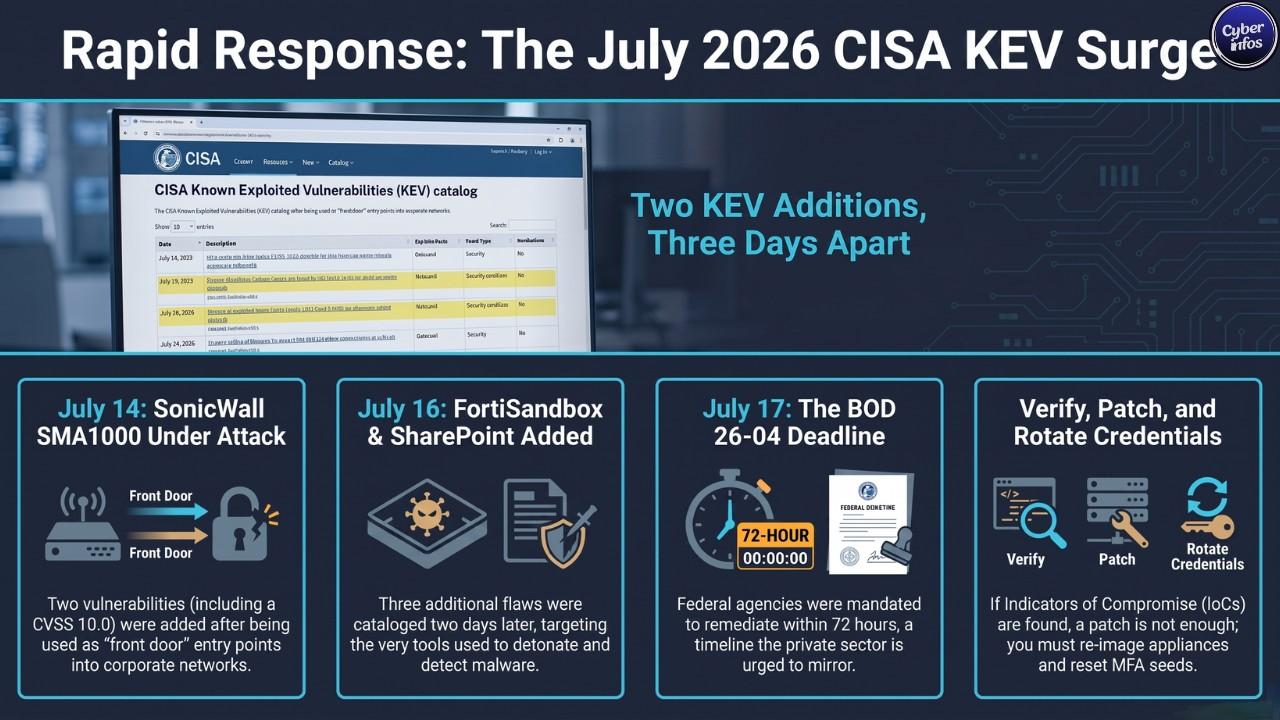
If you’re running SonicWall SMA1000 appliances or Fortinet’s FortiSandbox platform, the past two weeks handed you two separate reasons to drop what you’re doing. On July 14, 2026, CISA added a critical SonicWall SMA1000 vulnerability to its Known Exploited Vulnerabilities (KEV) catalog. Two days later came a second batch, this one covering FortiSandbox and Microsoft SharePoint flaws. Neither is theoretical. Both are confirmed under active exploitation.
This SonicWall SMA1000 vulnerability isn’t a routine patch-Tuesday footnote, and it shouldn’t be treated like one. SMA1000 appliances sit directly on the internet as the front door into corporate networks. FortiSandbox appliances, meanwhile, are trusted to safely detonate malware for the rest of the security stack – which is exactly why a compromise there is so damaging.
When either gets breached, the blast radius extends well past the appliance itself. Here’s what actually happened, which CVEs matter most, and what your team needs to do about it today.
Quick Answer
The SonicWall SMA1000 vulnerability tracked as CVE-2026-15409 (CVSS 10.0, unauthenticated SSRF) and CVE-2026-15410 (CVSS 7.2, authenticated code injection) were added to CISA’s KEV catalog on July 14, 2026, with a federal remediation deadline of July 17. Patch to hotfix versions 12.4.3-03453 or 12.5.0-02835 immediately, then check for the indicators of compromise SonicWall published in its advisory.
What Happened: CISA’s July 2026 KEV Additions
CISA’s Known Exploited Vulnerabilities catalog is deliberately narrow. It only lists CVEs with confirmed real-world exploitation, not just a scary CVSS score sitting in a vendor advisory. On July 14, 2026, CISA added two SonicWall SMA1000 vulnerabilities to the catalog. Two days later, on July 16, three more entries followed: two FortiSandbox command injection flaws and a Microsoft SharePoint deserialization vulnerability. All five now fall under CISA’s Binding Operational Directive (BOD) 26-04, which requires federal civilian agencies to remediate on a fixed schedule tied to risk.
You don’t have to work for a federal agency for that to matter. The KEV listing remains the clearest public signal available that a bug isn’t theoretical anymore – these flaws aren’t sitting in a lab somewhere. They’re being used against real organizations right now.
The SonicWall SMA1000 Vulnerability, Explained
SonicWall’s Secure Mobile Access 1000 Series is an enterprise SSL VPN gateway. Mid-size and large organizations use it, along with government agencies and managed security service providers, to give remote employees and contractors access to internal applications. It’s designed to be internet-facing by nature – which means any flaw in it is immediately reachable by anyone on the internet. That’s exactly what happened here.
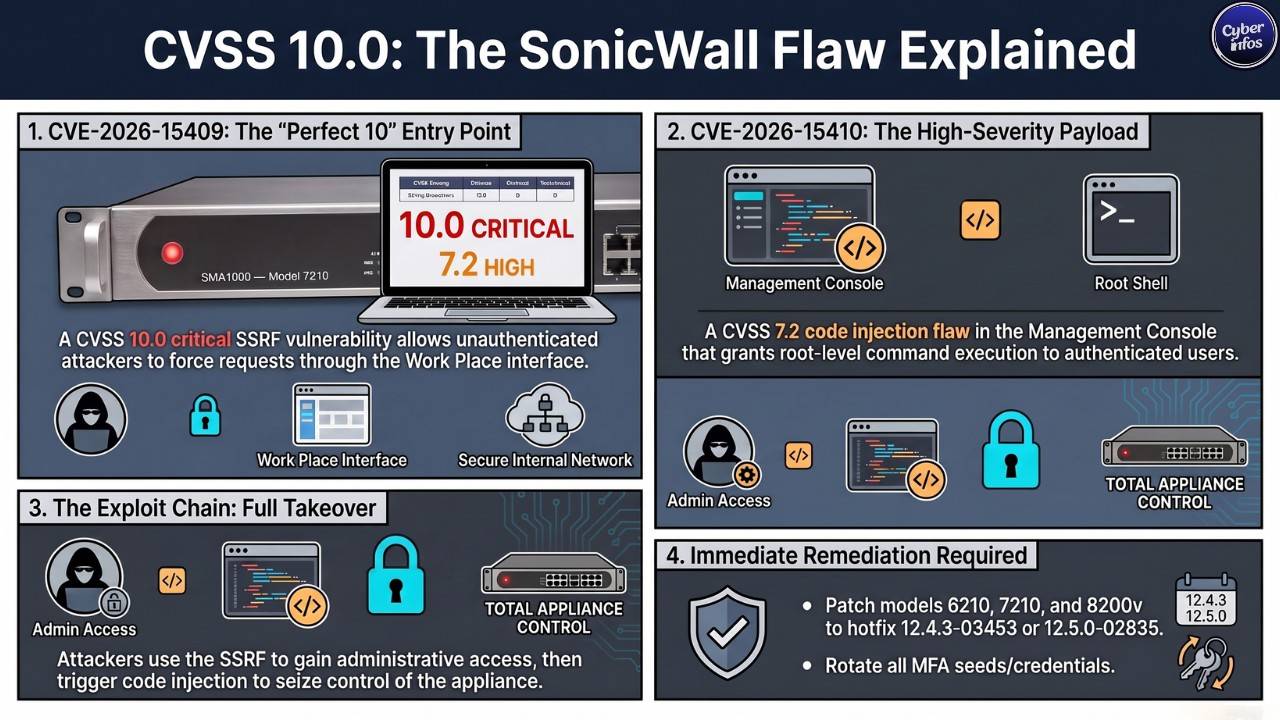
CVE-2026-15409 is a critical server-side request forgery (SSRF) vulnerability in the SMA1000 Appliance Work Place interface, rated a perfect CVSS 10.0. It lets a remote, unauthenticated attacker force the appliance to make requests to locations it shouldn’t be able to reach. That includes internal, localhost-only services that were never meant to be internet-exposed in the first place.
CVE-2026-15410 is a separate, high-severity (CVSS 7.2) code injection flaw in the SMA1000 Appliance Management Console. On its own, it requires administrator-level access. But that’s precisely the kind of access an attacker can obtain by first exploiting CVE-2026-15409 – which is where this stops being two unrelated bugs and starts being an attack chain.
SonicWall’s affected models are the 6210, 7210, and 8200v, running specific 12.4.3 and 12.5.0 platform-hotfix builds. SSL VPN functionality on standard SonicWall firewalls and the separate SMA 100 Series is not affected this is specific to the 1000 Series appliance line.
How the Exploit Chain Actually Works
Rapid7’s Managed Detection and Response team actually caught this one before SonicWall’s advisory went public. Their researchers observed targeted zero-day exploitation running through a websocket proxy feature at the /wsproxy endpoint of the SonicWall WorkPlace portal – that’s the SSRF entry point. From there, attackers pivot. They’ve been observed abusing a path-traversal flaw in the appliance’s remove_hotfix workflow to escalate to root-level command execution, effectively chaining the two CVEs into full appliance takeover.
Once inside, the impact stops being theoretical fast. Security researchers tracking active incidents describe attackers harvesting session databases and TOTP multi-factor authentication seeds, then using those stolen credentials to pivot laterally into victims’ Active Directory environments. That’s the real cost of this SonicWall SMA1000 vulnerability. It isn’t just an appliance problem – it’s a foothold into everything the appliance was supposed to protect.
FortiSandbox: Three CVEs, One Pattern
While SonicWall dominated headlines, Fortinet’s FortiSandbox platform quietly racked up its third exploited CVE of 2026. Easy to miss, harder to ignore. FortiSandbox exists to safely detonate suspicious files and URLs in an isolated environment, which is exactly why a compromise of the sandbox itself is so dangerous – it can undermine detection across an entire security stack.
CVE-2026-39808 and CVE-2026-39813 were both patched by Fortinet in April 2026. Exploitation didn’t start until mid-June, though, when CrowdSec’s detection network caught the first in-the-wild attempts and began tracking dozens of malicious IP addresses actively probing the flaw. CVE-2026-25089 followed a different timeline: a related OS command injection issue affecting the Web UI’s “start VNC” feature, patched more recently and already under exploitation within days, according to Fortinet’s own incident disclosures.
Here’s why the pattern matters for prioritization. Unlike the SonicWall CVEs, at least one of the FortiSandbox flaws already has a public proof-of-concept and detection template circulating. That materially lowers the bar for opportunistic attackers and it’s a good argument for treating this as urgent even without direct evidence your organization is being targeted specifically.
Who’s Affected and What to Patch
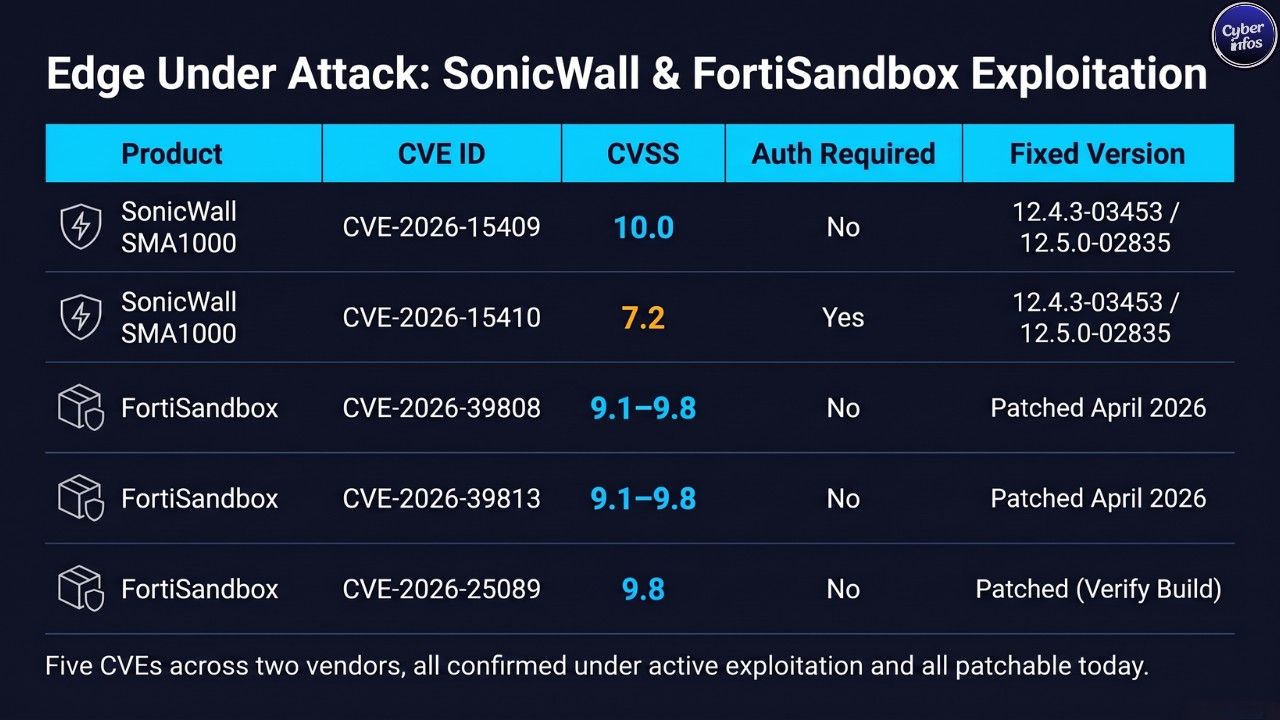
| Product | CVE | CVSS | Auth Required | Fixed Version |
|---|---|---|---|---|
| SonicWall SMA1000 | CVE-2026-15409 | 10.0 | No | 12.4.3-03453 / 12.5.0-02835 |
| SonicWall SMA1000 | CVE-2026-15410 | 7.2 | Yes (admin) | 12.4.3-03453 / 12.5.0-02835 |
| FortiSandbox | CVE-2026-39808 | 9.1–9.8 | No | Patched April 2026 – verify applied |
| FortiSandbox | CVE-2026-39813 | 9.1–9.8 | No | Patched April 2026 – verify applied |
| FortiSandbox | CVE-2026-25089 | 9.8 | No | Patched – verify applied |
If you’re running any of the affected FortiSandbox versions (4.4.0 through 4.4.8, or 5.0.0 through 5.0.5, depending on the CVE), don’t assume you’re safe just because you patched recently – verify each CVE individually, since these three were disclosed and fixed at different points across the year. Unlike the SonicWall SMA1000 vulnerability, which was disclosed and exploited within days, the FortiSandbox flaws show how a patched-but-unapplied CVE can sit exposed for months before attackers catch up.
Checking for Indicators of Compromise
SonicWall published specific indicators of compromise alongside its advisory and recommends organizations actively hunt for them rather than assuming a clean patch is sufficient. If any of those indicators are present, SonicWall’s own guidance is unambiguous: re-image physical appliances or redeploy virtual ones from a known-clean image, rotate all user and administrator passwords, and reset time-based one-time password (TOTP) tokens for every account tied to the appliance.
For FortiSandbox, review authentication, web access, and appliance management logs for unexpected requests to job-detail or tracer-behavior endpoints, and treat any unexplained file creation in monitored directories as a potential sign of successful command injection.
Incident Response If You Find IoCs
- Isolate the affected appliance from the network immediately.
- Preserve logs before any reimaging, for forensic review.
- Rotate all credentials and MFA seeds associated with the appliance – assume they’re compromised, not just potentially exposed.
- Review Active Directory for signs of lateral movement originating from the appliance’s network segment.
- Re-image or redeploy from a verified clean, patched image rather than patching in place.
- Document the timeline for compliance and, if applicable, breach notification obligations.
BOD 26-04 and the Federal Deadline
CISA’s Binding Operational Directive 26-04, “Prioritizing Security Updates Based on Risk,” is what turns a KEV listing into a hard deadline for U.S. federal civilian agencies. For the SonicWall SMA1000 vulnerability entries, that deadline was July 17, 2026 – just three days after the advisory was published. BOD 26-04 doesn’t legally bind private-sector organizations, but CISA explicitly encourages everyone to treat KEV entries with the same urgency federal agencies are required to, and for good reason: a listing on the KEV catalog is one of the strongest public signals available that a vulnerability is being actively weaponized.
Why Edge Appliances Keep Getting Hit
CyberInfos Analyst Insight: VPN gateways and sandbox appliances share a structural weakness that has nothing to do with any single vendor’s code quality. They’re intentionally internet-facing. They typically hold elevated privileges within the network. And they’re often deployed once, then left alone for long stretches without active monitoring.
That combination is exactly what makes them a consistently attractive target class not bad engineering, just an unavoidable set of tradeoffs that attackers know how to exploit. It’s why security teams should treat “edge appliance patching” as an ongoing operational priority, not a one-time project that only gets revisited when a headline forces the issue. The recurrence of exploited VPN and sandbox appliance CVEs across 2026 is a pattern worth building a standing review process around, not something to keep reacting to case by case.
Actionable Checklist
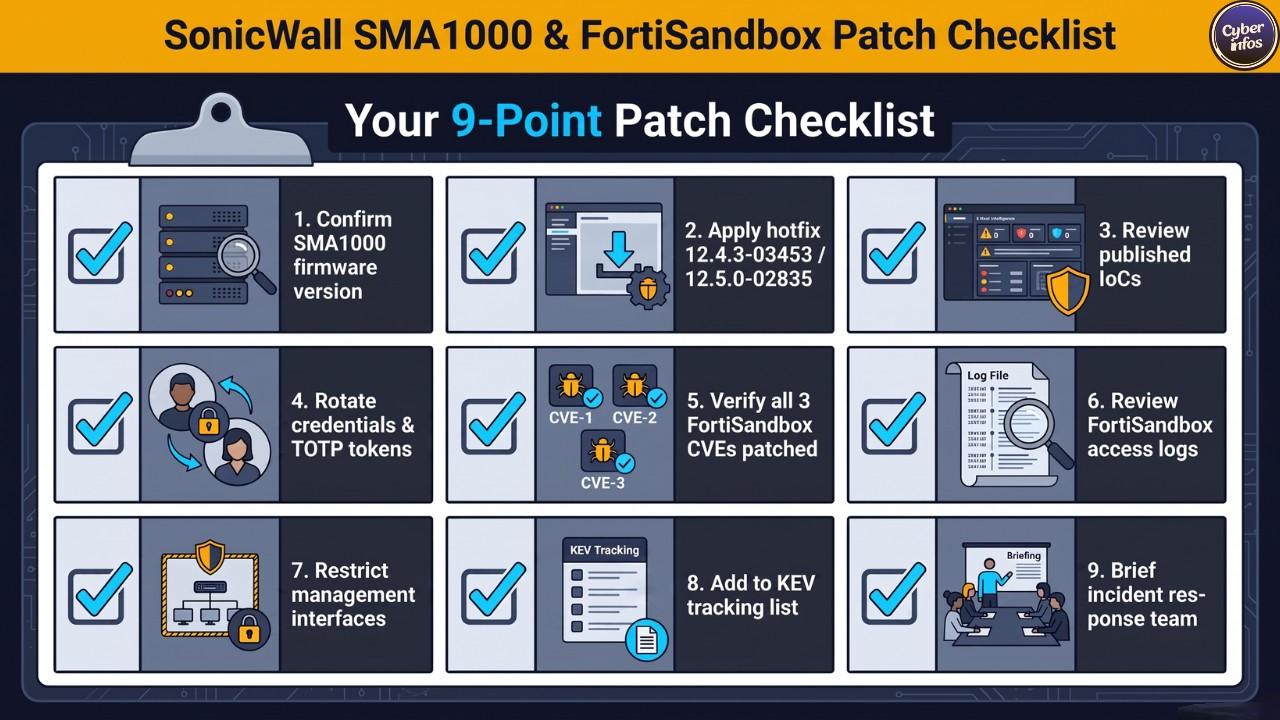
- Confirm your SonicWall SMA1000 model and current firmware version
- Apply hotfix 12.4.3-03453 or 12.5.0-02835 (or later)
- Review SonicWall’s published indicators of compromise
- Rotate credentials and TOTP tokens if any IoC is present
- Confirm all three FortiSandbox CVEs are patched, not just the most recent one
- Review FortiSandbox access logs for suspicious job-detail/tracer-behavior requests
- Restrict management interfaces to trusted networks where patching isn’t immediately possible
- Add both CVE families to your vulnerability management platform’s tracked-KEV list
- Brief your incident response team on the exploit chain details in this article
FAQ
What is the SonicWall SMA1000 vulnerability everyone’s talking about?
It refers to two CVEs – CVE-2026-15409 (a critical, unauthenticated SSRF flaw) and CVE-2026-15410 (a high-severity, authenticated code injection flaw) – both added to CISA’s KEV catalog on July 14, 2026 after confirmed active exploitation.
Is SonicWall SMA1000 still vulnerable after patching?
Not if you’ve applied hotfix 12.4.3-03453, 12.5.0-02835, or a later release. However, if the appliance was already compromised before patching, the patch alone won’t remove an attacker’s existing foothold check for indicators of compromise separately.
How do I know if my SonicWall SMA1000 was compromised?
Review the specific indicators of compromise published in SonicWall’s advisory, check for unexpected sessions or TOTP resets, and inspect logs for connections through the /wsproxy endpoint from unfamiliar sources.
What is the CISA KEV catalog and why does it matter?
It’s a running list of vulnerabilities CISA has confirmed are being actively exploited in real-world attacks, as opposed to theoretical risk. A KEV listing means attackers are already using the flaw, not that they might someday.
What is BOD 26-04?
Binding Operational Directive 26-04 is CISA’s framework requiring U.S. federal civilian agencies to remediate KEV-listed vulnerabilities within set timeframes based on risk. It doesn’t legally apply to private companies, but CISA recommends everyone follow the same urgency.
Are standard SonicWall firewalls affected by this SonicWall SMA1000 vulnerability?
No. SonicWall has confirmed that SSL VPN functionality on standard SonicWall firewalls and the separate SMA 100 Series product line are not affected by CVE-2026-15409 or CVE-2026-15410.
What versions of FortiSandbox are vulnerable?
Depending on the specific CVE, affected versions span FortiSandbox 4.4.0 through 4.4.8 and 5.0.0 through 5.0.5, including FortiSandbox Cloud and PaaS variants. Confirm your exact build against each CVE individually.
Can a FortiSandbox compromise lead to ransomware deployment?
Security researchers analyzing the exploit chain note that a compromised sandbox appliance can be used to pivot into internal networks, disable malware detection, and potentially support further attacks including ransomware deployment though this depends on how the appliance is segmented in your environment.
Is there public exploit code for these vulnerabilities?
For FortiSandbox’s CVE-2026-39808, yes – a working proof-of-concept and a public detection template are already circulating, which lowers the bar for attackers. For the SonicWall SMA1000 vulnerability, no public proof-of-concept had been reported as of the most recent research available.
When is the CISA remediation deadline for these vulnerabilities?
For the SonicWall SMA1000 entries, CISA set a July 17, 2026 deadline for federal agencies. Private organizations don’t have a hard deadline but should treat KEV-listed CVEs as immediate priorities regardless.
Do I need to reimage my appliance, or is patching enough?
Patching prevents future exploitation but doesn’t remove an attacker who already gained access. If any indicator of compromise is present, SonicWall recommends re-imaging or redeploying from a clean image rather than patching in place.
Why are VPN and sandbox appliances targeted so often?
They’re internet-facing by design, hold elevated network privileges, and are frequently under-monitored relative to their risk level a combination that consistently makes them attractive targets across vendors, not just SonicWall and Fortinet.
Final Thoughts
The SonicWall SMA1000 vulnerability and the FortiSandbox command injection flaws are two separate incidents that happened to land in the same narrow window. Different vendors, same category of risk. Treating them as one triage exercise makes operational sense, because both target the class of appliance sitting at your network’s edge with elevated privilege exactly the systems that deserve the fastest patch cycle you have, not the slowest.
So if you haven’t already: confirm your SonicWall SMA1000 firmware version, apply the hotfix, and check the published indicators of compromise. Do the same version-by-version check across all three FortiSandbox CVEs while you’re at it. Then take this as a prompt to build edge-appliance patching into a standing review cycle instead of a reactive one.
The SonicWall SMA1000 vulnerability, in particular, is a useful case study in how fast a KEV listing can turn into a live incident. Treat every future advisory with that same urgency.
Follow CyberInfos.in for ongoing coverage of CISA KEV catalog additions and practitioner-level breakdowns of the vulnerabilities that actually matter for your environment.
