
Close Menu
  • Home
  • Cyber security
    • Mobile security
    • Computer Security
    • Malware
  • Cyber news
    • Data breaches
  • Top10
  • Cyber Insurance
  • Cyber law & Compliance
  • About us
X (Twitter) Instagram Threads LinkedIn WhatsApp
Trending
  • Microsoft Patch Tuesday January 2026: 112 Vulnerabilities Fixed, 3 Zero-Days
  • n8n Supply Chain Attack Exposes Risks in Community Automation Integrations
  • Cybersecurity weekly report: January 4–10, 2026 – Breaches, Ransomware & Patches
  • Malicious Chrome Extensions Stole ChatGPT and DeepSeek Chats From 900,000+ Users
  • Latest Alert: CVE-2025-68668 Exposes Critical n8n Security Flaw
  • Lessons Learned from Mongobleed Vulnerability (CVE-2025-14847)
  • Top 10 Cybersecurity Resolutions Every User Should Make in 2026
  • New Year, New Threats: Emerging Malware Families to Watch in 2026
Friday, January 16
Cyber infosCyber infos
X (Twitter) Instagram LinkedIn WhatsApp
  • Home
  • Cyber security
    • Mobile security
    • Computer Security
    • Malware
  • Cyber news
    • Data breaches
  • Top10
  • Cyber Insurance
  • Cyber law & Compliance
  • About us
Cyber infosCyber infos
Cyber news

Google Ends Dark Web Scanning in 2026 – How to Protect Your Data Now

Cyber infosBy Cyber infosDecember 17, 2025No Comments4 Mins Read
Facebook Twitter Pinterest LinkedIn Email WhatsApp Copy Link
Follow Us
X (Twitter) Instagram LinkedIn WhatsApp Telegram Threads
Share
Facebook Twitter Pinterest Threads Copy Link

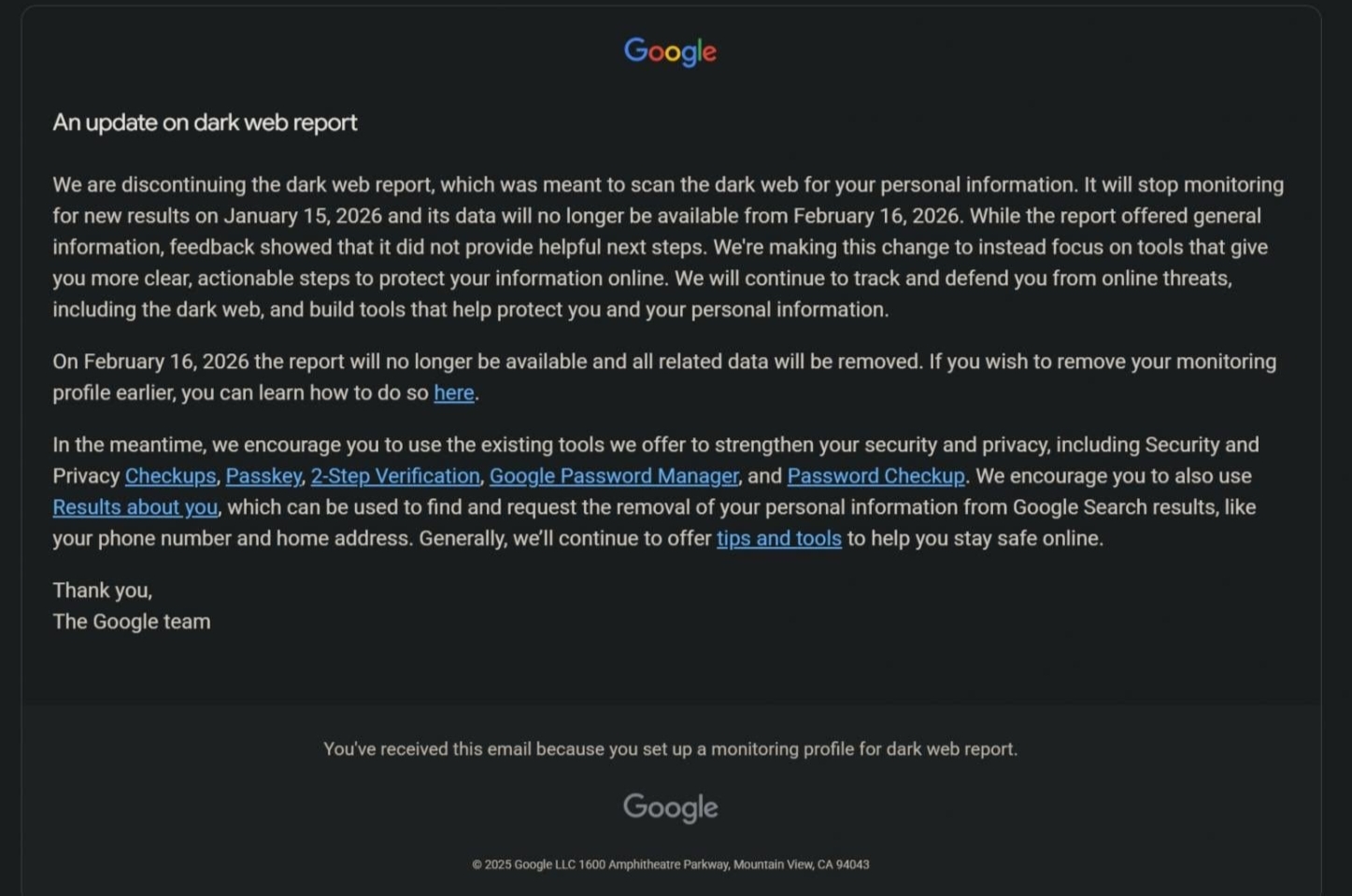
Google has officially announced that it will  discontinue its Dark Web Report feature in 2026, a tool designed to alert users when their personal information appeared on the dark web. While this move may surprise many users, Google says the decision is based on feedback that the feature lacked clear, actionable guidance.Google Ends Dark Web Scanning in 2026

So what does this change really mean for your online security—and how should you respond? This guide breaks down the announcement, explains the risks, and outlines smarter alternatives to protect your personal data.
 

Google Ends Dark Web Scanning in 2026 – How to Protect Your Data Now
(Source: Google mail)
Table of Contents hide
1 What Was Google’s Dark Web Report?
2 When Is Google Shutting Down the Dark Web Report?
3 Why Google Is Discontinuing the Dark Web Report
4 What Security Tools Will Google Continue to Offer?
5 Is This a Security Risk for Users?
6 What You Should Do Now to Stay Secure
7 Should You Use a Dark Web Monitoring Alternative?
8 Final Thoughts
9 Frequently Asked Questions (FAQs)

What Was Google’s Dark Web Report?

Google’s Dark Web Report was a monitoring feature that scanned known dark web sources for exposed personal information, such as:

  • Email addresses
  • Phone numbers
  • Usernames
  • Passwords linked to data breaches

If a match was found, users received a notification indicating that their data might be compromised.

However, the report largely stopped at alerts, leaving users unsure about what steps to take next.

When Is Google Shutting Down the Dark Web Report?

Google has confirmed a two-phase shutdown timeline:

Key Dates to Know

  • January 15, 2026 – Monitoring for new dark web results will stop
  • February 16, 2026 – The Dark Web Report will be fully discontinued, and all related data will be deleted

After February 16, 2026, users will no longer be able to access previous reports or monitoring data.

Why Google Is Discontinuing the Dark Web Report

According to Google, the decision is driven by user feedback and evolving security priorities.

Google’s Key Reasons

  • The report offered general awareness, but
  • It did not provide clear next steps for affected users
  • Users benefit more from preventive security tools than passive alerts

Google is now focusing on tools that actively reduce risk rather than simply notifying users after exposure has occurred.

What Security Tools Will Google Continue to Offer?

Although dark web monitoring is ending, Google will continue to support and expand several security and privacy tools:

Google Security & Privacy Tools Still Available

  • Security Checkup – Reviews account security settings
  • Privacy Checkup – Helps control data visibility and sharing
  • 2-Step Verification (2FA) – Strong protection against account takeovers
  • Passkeys – Passwordless authentication
  • Google Password Manager
  • Password Checkup – Alerts for compromised credentials
  • “Results About You” Tool – Request removal of personal data from Google Search

Google believes these tools provide direct protection, rather than reactive warnings.

Google Ends Dark Web Scanning in 2026 – How to Protect Your Data Now

Is This a Security Risk for Users?

Not necessarily—but it does shift responsibility more toward the user.

What You Lose

  • Automatic dark web exposure alerts
  • Centralized breach notifications inside Google

What You Gain (If Used Properly)

  • Stronger account protection
  • Reduced likelihood of breaches
  • Better control over exposed personal data

The real risk lies in ignoring proactive security measures.

What You Should Do Now to Stay Secure

If you previously relied on Google’s Dark Web Report, consider taking the following steps:

Recommended Security Actions

  1. Enable 2-Step Verification on all major accounts
  2. Replace weak or reused passwords immediately
  3. Use a trusted password manager
  4. Run Google’s Security and Privacy Checkups
  5. Remove exposed personal data using “Results About You”
  6. Consider third-party breach monitoring services for alerts

Prevention is now more important than detection.

Should You Use a Dark Web Monitoring Alternative?

If dark web alerts are important for your risk profile, third-party services may still offer value—especially for businesses, executives, and high-risk users.

However, no monitoring service can prevent breaches. Strong authentication, unique passwords, and account hygiene remain the most effective defenses.

Final Thoughts

Google’s decision to shut down its Dark Web Report reflects a broader industry trend: alerts alone are not enough. While losing a monitoring feature may feel like reduced protection, the reality is that proactive security tools provide far greater long-term safety.

If users adopt Google’s recommended protections—or supplement them wisely—this change can actually result in stronger overall security, not weaker.

Frequently Asked Questions (FAQs)

Is Google’s Dark Web Report being replaced?

No. Google is not offering a direct replacement, but is emphasizing preventive security tools instead.

Will my existing dark web data be saved?

No. All Dark Web Report data will be deleted after February 16, 2026.

Is this email from Google legitimate?

Yes. The notification is an official message from Google Search.

Can I delete my dark web monitoring profile early?

Yes. Google provides an option to remove your monitoring profile before the shutdown.

Do I still need breach monitoring?

For many users, strong passwords and 2FA provide better protection than breach alerts alone.


Stay ahead of cybersecurity changes.
👉 Follow CyberInfos for updates on data breaches, online privacy, and digital security best practices.

Follow on X (Twitter) Follow on Instagram Follow on LinkedIn Follow on WhatsApp Follow on Threads
Share. Facebook Twitter Pinterest Threads Telegram Email LinkedIn WhatsApp Copy Link
Previous ArticleHow to Prevent SIM Swap Attacks and Protect Your Mobile Number in 2026
Next Article Securing Mobile Payments and Digital Wallets: Tips for Safe Transactions
Cyber infos
  • Website

Related Posts

Microsoft Patch Tuesday January 2026: 112 Vulnerabilities Fixed, 3 Zero-Days

January 14, 2026
Read More

n8n Supply Chain Attack Exposes Risks in Community Automation Integrations

January 13, 2026
Read More

Malicious Chrome Extensions Stole ChatGPT and DeepSeek Chats From 900,000+ Users

January 7, 2026
Read More
Add A Comment
Leave A Reply Cancel Reply

Cyber news

Microsoft Patch Tuesday January 2026: 112 Vulnerabilities Fixed, 3 Zero-Days

January 14, 2026

n8n Supply Chain Attack Exposes Risks in Community Automation Integrations

January 13, 2026

Malicious Chrome Extensions Stole ChatGPT and DeepSeek Chats From 900,000+ Users

January 7, 2026

Latest Alert: CVE-2025-68668 Exposes Critical n8n Security Flaw

January 6, 2026

Top 10

Top 10 Cybersecurity Resolutions Every User Should Make in 2026

January 1, 2026

Top 10 Best Autonomous Endpoint Management Tools in 2026

November 14, 2025

Top 10 Best API Security Testing Tools in 2026

October 29, 2025

10 Best Free Malware Analysis Tools–2026

July 1, 2025

mobile security

Google Is Finally Letting Users Change Gmail Address – Here’s How It Works

December 26, 2025

Securing Mobile Payments and Digital Wallets: Tips for Safe Transactions

December 19, 2025

How to Prevent SIM Swap Attacks and Protect Your Mobile Number in 2026

December 16, 2025

How to Use a VPN to Protect Your Privacy in 2026 (Step-by-Step Guide)

December 13, 2025
Archives
Cyber Insurance

A Step-by-Step Checklist to Prepare Your Business for Cyber Insurance (2026 Guide)

December 14, 2025

Is Your Business Really Protected? A Deep Dive Into Cyber Liability Coverage

December 6, 2025

What Cyber Insurance Doesn’t Cover & How to Fix the Gaps

December 1, 2025

Top Cyber Risks Today and How Cyber Insurance Protects You in 2026

November 28, 2025

What Every Business Owner Must Know Before Buying Cyber Insurance in 2026

November 26, 2025
Recents

Microsoft Patch Tuesday January 2026: 112 Vulnerabilities Fixed, 3 Zero-Days

January 14, 2026

n8n Supply Chain Attack Exposes Risks in Community Automation Integrations

January 13, 2026

Cybersecurity weekly report: January 4–10, 2026 – Breaches, Ransomware & Patches

January 13, 2026

Malicious Chrome Extensions Stole ChatGPT and DeepSeek Chats From 900,000+ Users

January 7, 2026

Latest Alert: CVE-2025-68668 Exposes Critical n8n Security Flaw

January 6, 2026
Pages
  • About us
  • Contact us
  • Disclaimer
  • Privacy policy
  • Sitemaps
  • Terms and conditions
About us

We delivers trusted cybersecurity updates, expert analysis, and online safety tips. We help individuals and businesses understand cyber threats and protect their digital world with accurate, easy-to-read information.

Partners
White Hat Hub Partner
X (Twitter) Instagram Pinterest LinkedIn WhatsApp Threads
  • Contact us
  • Sitemaps
© 2026 Cyberinfos - All Rights are Reserved

Type above and press Enter to search. Press Esc to cancel.