


A suspected China-nexus espionage group exploited a VMware vCenter zero-day for more than two months before Broadcom shipped a patch on November 19, and that was only one of the week’s defining stories. On November 16, an attacker slipped malicious JavaScript into Optimizely’s platform. For most of the day, that code ran on websites belonging to 178 organizations, including the BBC, CNN and Zoom.
Automation connects almost every headline. The European Commission confirmed an AI-assisted intrusion, Amazon documented AI agents discovering and exploiting a zero-day autonomously, and F6 spotted signs of an AI assistant inside scripts targeting a Cisco Expressway cluster. Patch queues grew just as quickly: CISA added eight actively exploited flaws across two catalog updates, PHP shipped seven new critical fixes, and Java4Shell hit OpenJDK.
This cybersecurity weekly report separates verified facts from active claims. In this weekly cybersecurity news roundup, the common thread is speed at scale. Among all the cybersecurity news this week, one priority stands out: patch vCenter and Cisco Expressway first, then verify whether an intruder beat you to it.
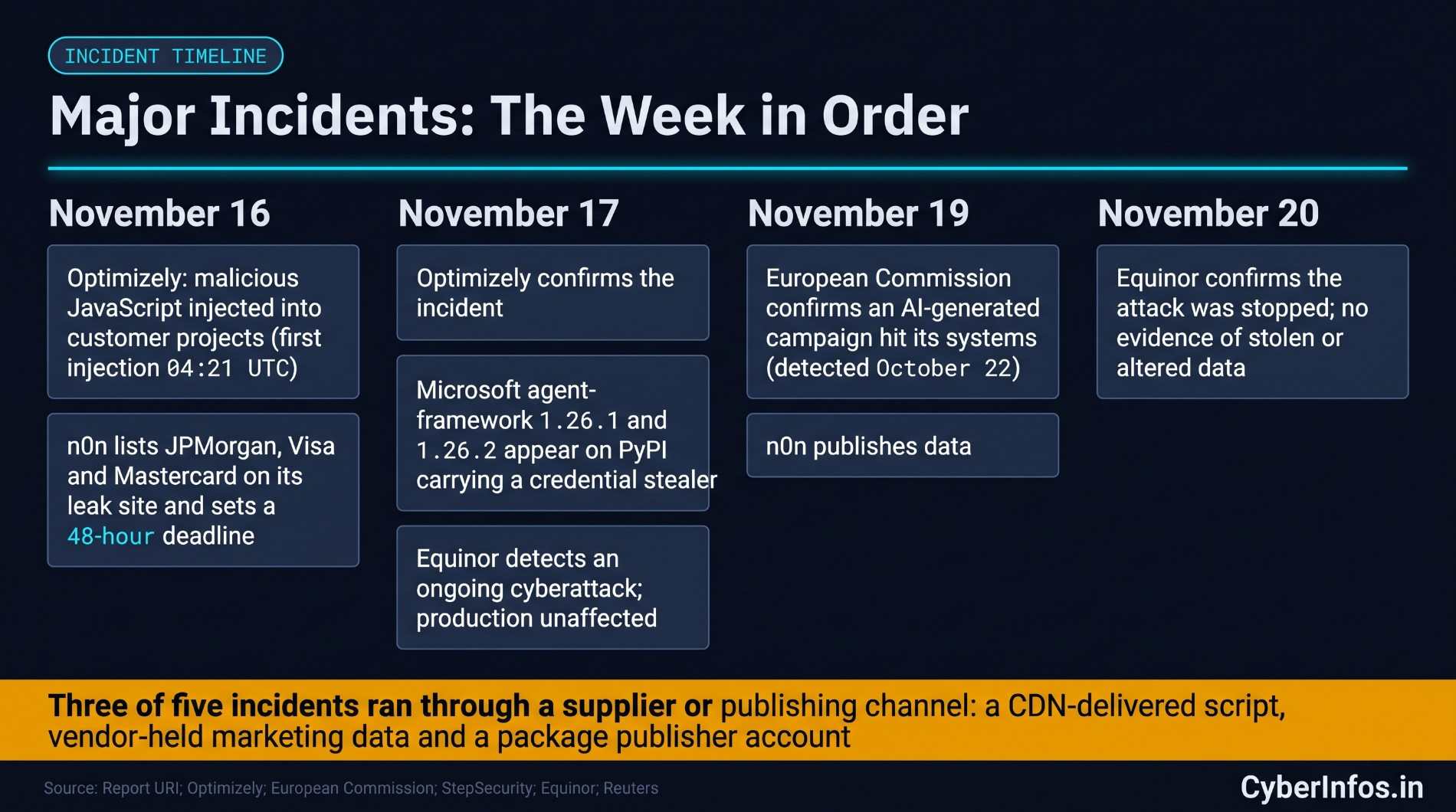
Major Incidents
The largest cybersecurity incidents this week shared one clear trait: the weakest link sat outside the victim’s own perimeter or took minimal skill to reach.
1. Optimizely: Supply-Chain Attack Reaches Visitors of 178 Organizations
On November 16, an attacker exploited a flaw in Optimizely’s Experimentation platform and injected malicious JavaScript into the Project JavaScript field of customer projects. Because the snippets still loaded from Optimizely’s own content delivery network, browsers trusted the code automatically.
Report URI researchers found infected code in 188 of the 1,611 snippets they inspected, tied to 178 organizations including Zoom, the BBC, CNN, Salesforce, GitLab, IKEA and HSBC. The first injection appeared at 04:21 UTC, and all affected files were clean by 23:11 UTC. Optimizely confirmed the breach on November 17, stating it had patched the flaw, purged the malicious code and secured impacted accounts.
The payload served multiple goals. It swapped cryptocurrency wallet addresses, skimmed payment card details entered into first-party forms, and captured cookies and page screenshots. On iPhones and iPads, the script delivered two iOS exploit kits that Report URI identified as Coruna and DarkSword, prompting advice to update to iOS 18.7.3 or later, or iOS 26.3 or later. Payment cards entered inside hosted payment iframes stayed out of reach.
The attacker remains unnamed, and Report URI expects the true victim count to climb since it could only scan snippets discovered in time. That browser-level reach made Optimizely one of the most consequential stories in cybersecurity news this week, even though none of the 178 organizations were breached directly.
For SOC teams, the lesson is mechanical: a third-party script inherits the full privileges of the host page, and Report URI’s follow-up crawl flagged weak Content Security Policy rules as a stubborn blind spot. For executives, it is a stark vendor-risk problem. [Read more]
2. European Commission: AI-Assisted Intrusion Confirmed 28 Days After Detection
European Commission spokesperson Thomas Regnier confirmed on November 19 that an AI-generated campaign had hit Commission systems. Teams detected the intrusion on October 22 and took several applications offline for roughly ten days, including the Sysper HR platform and the MyPMO medical-reimbursement system.
Regnier noted investigators have found no evidence of a data breach affecting staff as a whole, while inquiries continue alongside CERT-EU and the European Data Protection Supervisor. The Associated Press reported this as the first time the bloc disclosed an attack involving an AI tool.
Politico reported that CERT-EU identified ARTEX, a publicly available AI penetration-testing framework, during the activity. Because the Commission has not officially named the tool, treat the ARTEX attribution as media reporting rather than a confirmed finding. CERT-EU had already warned in early November that ARTEX’s public release would accelerate threat-actor adoption, and community forks remain online after the original repository came down in October. [Read more]
3. JPMorgan, Visa and Mastercard: Vendor Data Leaked After a 48-Hour Deadline
The extortion group n0n listed all three financial giants on its leak site on November 16, set a 48-hour countdown, and dumped files on November 19. JPMorgan stated attackers targeted third-party vendors and likely accessed marketing records containing customer names and email addresses, with zero impact on core services.
Visa tied the claims to an Asia-Pacific service provider and confirmed no payment data such as card numbers was exposed. Mastercard reported limited exposure of non-payment email addresses for a small group of cardholders in a single benefit program. None of the three named the vendor involved.
Reviewing the leaked files, Reuters spotted what appeared to be 124 employee email addresses and over 16,000 JPMorgan customer email addresses, though it could not independently verify the dump. For this cybersecurity weekly report, treat those volume figures as claims and reviewer tallies rather than confirmed totals. What is verified is that all three organizations acknowledged third-party exposure. [Read more]
4. Microsoft agent-framework: Poisoned PyPI Releases Steal Cloud and CI Credentials
On November 17, versions 1.26.1 and 1.26.2 of Microsoft’s agent-framework package landed on PyPI carrying a credential stealer. Published 33 minutes apart, they leave version 1.26.0 as the last clean release. A .pth startup hook triggered the malware every time Python launched in an infected environment, even if no script imported the package.
It harvested environment variables and credential files for Azure, Git, Docker, npm, pip and Hugging Face, then queried cloud services for fresh Azure, Azure DevOps and GitHub Actions tokens. StepSecurity noted the malware only attempts those token requests, with no confirmation that services issued them.
PyPI quarantined both releases. Microsoft has not explained how attackers gained publishing rights. The Register reported that the pattern pointed to unauthorized access to an administrator account in Microsoft’s GitHub organization, and a Microsoft spokesperson confirmed several repositories were switched to private during the investigation. Researchers advise treating any host that installed either build as credential-compromised. [Read more]
5. Equinor and Skagerak Energi: Norwegian Energy Firms Report Attacks
Rounding out the major cybersecurity incidents this week, two Norwegian energy firms disclosed separate network events. Equinor announced on November 17 that it had detected an active cyberattack on certain IT systems while production remained untouched.
By November 19, Equinor said the campaign did not appear specifically aimed at the company, and on November 20 it confirmed the attack had been stopped with no evidence of stolen or altered data. Skagerak Energi reported suspicious activity suggesting an attempted attack one day after Equinor’s initial notice. Neither firm named a suspect, and Dark Reading noted no evidence currently links the two cases. [Read more]
ANALYST INSIGHT: Across the cybersecurity incidents this week, three of five ran through a supplier or publishing channel rather than direct perimeter defenses: a CDN script, vendor marketing databases and a package publisher account. The European Commission case shows the flip side, where off-the-shelf offensive tooling lowers the barrier to entry. Attackers are investing less effort in hardened perimeters and more in fragile dependencies. Inventory every third party allowed to execute in your browsers and CI pipelines, and monitor changes there as tightly as internal code.
New Vulnerabilities & Patches
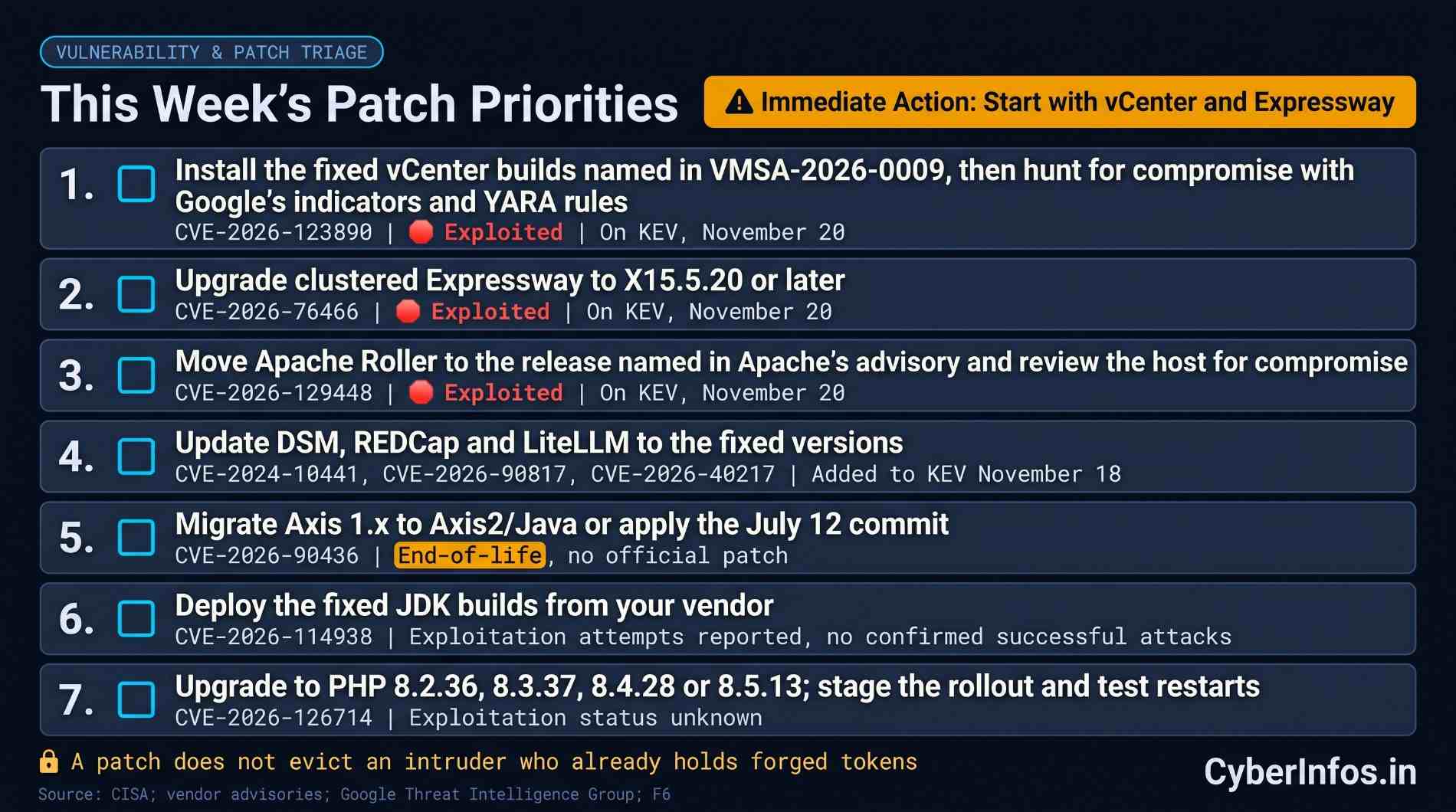
Most of the urgent cybersecurity threats this week converged on a single list. CISA added eight flaws to its Known Exploited Vulnerabilities (KEV) catalog on November 18 and November 20, while defenders also fielded a major OpenJDK disclosure and a sweeping PHP release.
[CVE] CVE-2026-123890 | Broadcom | VMware vCenter Server | CVSS: 9.8 | Exploited: Yes
An authentication bypass allows a remote, unauthenticated attacker to claim an administrator session on vCenter Server. Broadcom patched it on November 19 under advisory VMSA-2026-0009 alongside four other flaws across vCenter, SDDC Manager and VMware Tools for Windows, offering no workaround. Although Broadcom’s advisory omits exploitation details, Google Threat Intelligence Group and Mandiant report that Armory Castle has exploited the flaw since early September. CISA added it to KEV on November 20.
[PATCH] Deploy the fixed builds in VMSA-2026-0009 immediately, then hunt for prior intrusion using the indicators and YARA rules in Google’s report. Patching alone will not evict an attacker holding forged tokens.
[CVE] CVE-2026-76466 | Cisco | Expressway Core and Expressway Edge | CVSS: 9.8 | Exploited: Yes
An unauthenticated remote attacker can execute root commands, strictly on clustered Expressway deployments. Cisco disclosed the flaw on October 21 and fixed it in Expressway X15.5.20 with no workaround; deployments on X14 or earlier must upgrade. After a proof-of-concept hit GitHub, F6 reported attackers compromising two internet-facing X15.5.3 nodes at an unnamed Russian organization before pivoting to two internal cluster nodes. Cisco’s advisory still listed no known malicious use at the time of F6’s report. CISA added the flaw to KEV on November 20.
[PATCH] Upgrade clustered Expressway appliances to X15.5.20 or later. If immediate patching is impossible, F6 advises blocking TCP ports 4371 to 4372 except between trusted cluster nodes and auditing the Erlang system log for exploitation traces.
[CVE] CVE-2026-129448 | Apache | Roller 4.0.0 through 6.1.4 | CVSS: 9.8 | Exploited: Yes
An XML-RPC deserialization flaw enables unauthenticated remote code execution. Apache confirmed active exploitation, and CISA added it to KEV on November 20 with mandatory forensic triage. CISA highlighted that this record covers the same underlying flaw as CVE-2026-82384 across a broader version range, meaning teams tracking only the older ID risk missing exposed servers.
[PATCH] Upgrade to the patched release in Apache’s advisory and inspect affected hosts for signs of compromise.
CISA’s November 18 Additions
-
[CVE] CVE-2024-10441 | Synology | DiskStation Manager | CVSS: 9.8 | Exploited: Yes: Previously linked to C3RB3R ransomware on NAS appliances. Fixed in DSM 7.2.2-72806-1 and 7.2.1-69057-6.
-
[CVE] CVE-2026-40217 | BerriAI | LiteLLM | CVSS: 8.8 | Exploited: Yes: Code injection in the guardrails test endpoint. Google Threat Intelligence Group observed attackers escalating limited inference keys into admin credentials during LLMjacking campaigns. Fixed in builds after April 8, 2026.
-
[CVE] CVE-2026-90436 | Apache | Axis 1.x | CVSS: 9.8 | Exploited: Yes: End-of-life software with no official patch, chained with N-able N-central flaws to deploy cryptominers.
-
[CVE] CVE-2026-90817 | Vanderbilt University | REDCap | CVSS: 9.8 | Exploited: Yes: Code injection reachable via a valid public survey hash. Safe Security tracked an XMRig loader disguised as image files. Fixed in 16.0.49, 17.3.10 and 17.4.4.
[PATCH] Update DSM, REDCap and LiteLLM to fixed versions. Migrate Axis 1.x to Axis2/Java or apply the July 12 commit. Federal deadlines landed on November 21 for DSM, REDCap and Axis, and December 2 for LiteLLM.
Java4Shell: OpenJDK Base64 Flaw Hits Widely Used Java Applications
[CVE] CVE-2026-114938 | OpenJDK and Oracle Java SE | Base64 decoder | CVSS: 9.2 (CVSS 4.0, Calif) or 8.1 (CVSS 3.1, Oracle) | Exploited: Exploitation attempts reported, no confirmed successful attacks
A memory-corruption bug in OpenJDK’s AVX-512 Base64 decoding path can crash a JVM or, with precise exploitation, yield code execution. Only x86-64 processors supporting AVX-512 VBMI hit the vulnerable code path; ARM64 systems are unaffected. Oracle and OpenJDK shipped fixes on November 17.
Calif demonstrated unauthenticated code execution against default installs of Keycloak, Jira, Confluence, Artifactory, Jenkins and PingFederate. Even so, VulnCheck and watchTowr do not anticipate mass exploitation, noting that reliable code execution requires heap grooming plus a separate memory leak, whereas crashing services is straightforward. CISA still urged immediate patching.
[PATCH] Roll out patched vendor JDK builds. Where upgrades lag, launch the JVM with -XX:-UseBASE64Intrinsics or -XX:UseAVX=2 and enforce strict Base64 size limits at the application boundary.
PHP: Seven More Critical Fixes Four Weeks After PHP2Shell
[CVE] CVE-2026-126714 | PHP | Session handling (phpAfterShell) | CVSS: 9.2 (CVSS 4.0) | Exploited: Exploitation status unknown
PHP’s November 19 update resolved 18 flaws across supported branches, including seven rated critical at 9.2. Infosecurity Magazine noted exploitation generally requires non-default or uncommon configurations.
Discovered by Depthfirst using AI models, phpAfterShell abuses file-based session handling during file uploads. The release landed four weeks after the emergency PHP2Shell patches, a fixture of recent weekly cybersecurity news since attackers began targeting internet-facing security appliances with it.
[PATCH] Upgrade to PHP 8.2.36, 8.3.37, 8.4.28 or 8.5.13; PHP 8.1 and older are end-of-life. Stage deployments and test service restarts carefully given the post-patch NSANet outage detailed below.
PRIORITY ACTION: Across the cybersecurity threats this week, vCenter and Expressway demand immediate action because both sit above or at the edge of enterprise endpoints. Every cybersecurity weekly report carries a long patch queue, yet these two KEV entries carry extra urgency: Mandiant observed vCenter intrusions traversing Linux appliances that lacked EDR. CISA’s BOD 26-04 mandates forensic triage for federal agencies on high-risk KEV flaws, and private teams should follow suit. With exploitation stretching back to early September, applying the patch does not prove a host was clean beforehand.
Ransomware Activity
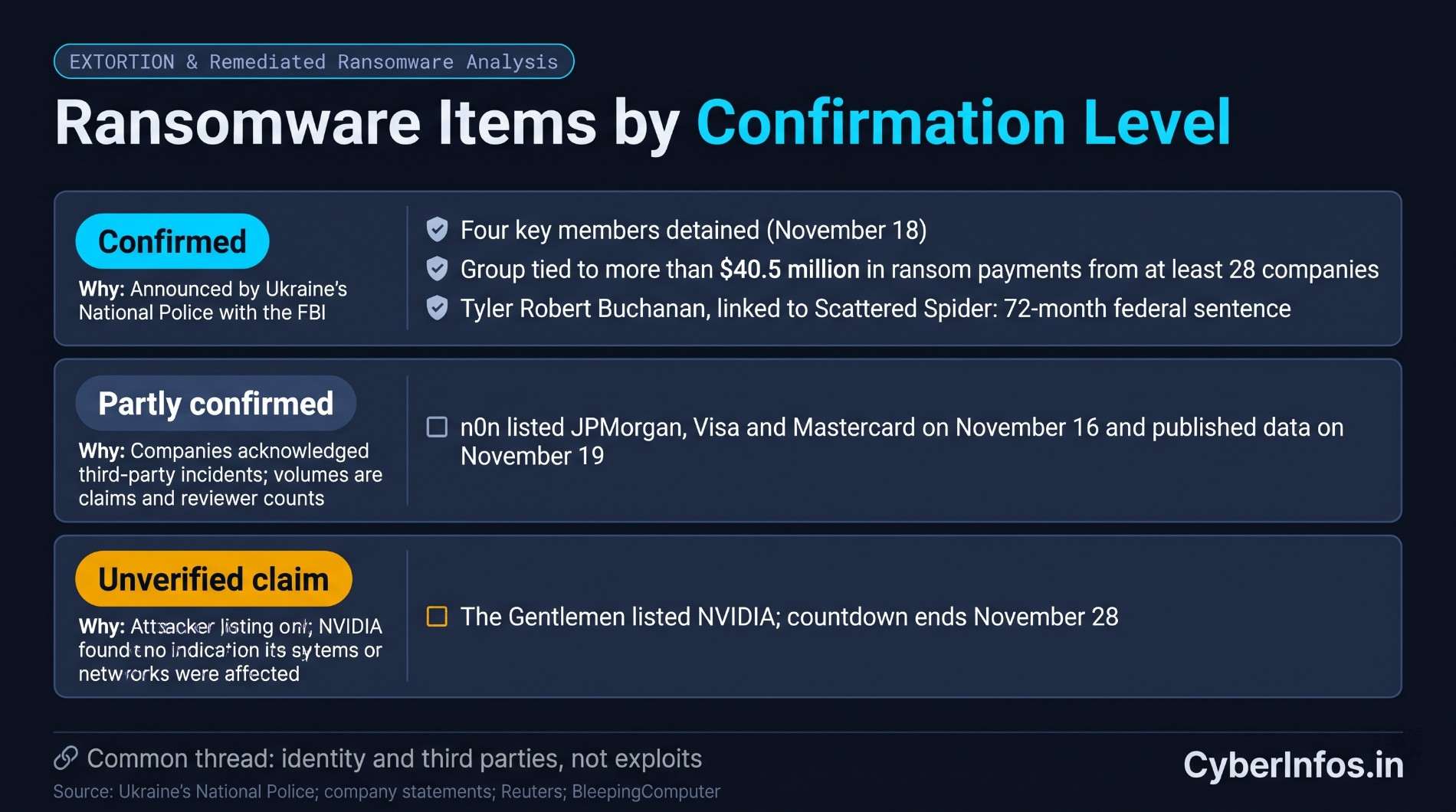
The ransomware updates in this cybersecurity weekly report blend confirmed arrests with unverified extortion claims, so labels matter. The n0n leak covered under Major Incidents falls into that same mixed bucket, where victims partly corroborated an extortion claim.
The Gentlemen: NVIDIA Listing Remains an Unverified Claim
The Gentlemen ransomware operation listed NVIDIA on its leak portal with a deadline expiring November 28, offering zero proof of compromise. NVIDIA told BleepingComputer it found no sign its own systems or networks were impacted and is investigating a possible third-party partner incident. After launching last year as a closed outfit, The Gentlemen pivoted to a ransomware-as-a-service model giving affiliates up to 90 percent of payouts, claiming over 1,100 victims. Until NVIDIA or a partner confirms details, treat the post strictly as an unverified claim. [Read more]
Ukraine and the FBI Detain Four Members of a Vishing-Led Ransomware Network
In rare welcome cybersecurity news this week, Ukraine’s National Police and the FBI announced on November 18 that they had detained four core members of a group linked to more than $40.5 million in ransoms from at least 28 companies.
Authorities said the crew counted at least 27 members inside a broader 60-person network spanning eight jurisdictions, including former Conti operators. Attackers posed as IT support over the phone, deploying an AI-generated voice platform to talk staff into surrendering credentials or installing remote-access tools before exfiltrating data and encrypting files.
According to Ukraine’s acting police chief, one US victim paid $5 million following a $10 million demand. Raids recovered nearly $370,000 and €20,000 in cash, and the four detainees face up to 15 years in prison. Separately, Scattered Spider affiliate Tyler Robert Buchanan received a 72-month federal prison sentence, closing out sentencing for all five defendants in that case. [Read more]
ANALYST INSIGHT: Taken alongside the third-party cybersecurity incidents this week, the ransomware picture points away from software exploits and toward identity and partner risk. The Ukrainian operation started with phone calls, n0n hit vendor data, and the NVIDIA listing points toward a partner. Helpdesk caller verification, tight controls on remote-access software and a current inventory of data-holding vendors belong beside patching on every ransomware checklist.
Threat Intelligence
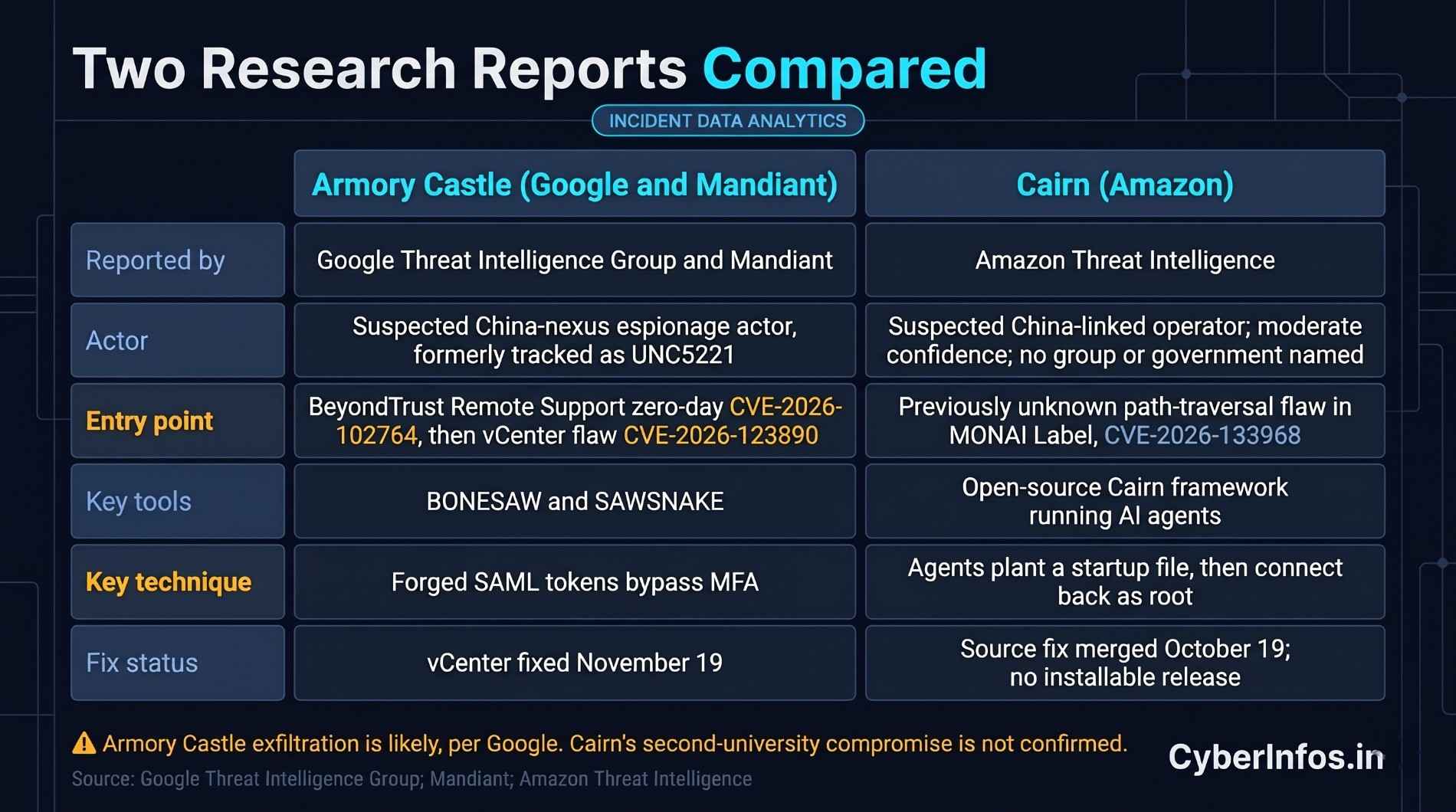
Among the cybersecurity threats this week, the deepest technical findings came from two research teams: Google and Mandiant on a China-nexus espionage chain, and Amazon on autonomous AI agents. Both investigations in this cybersecurity weekly report show how quickly attackers chain edge flaws with automation.
Armory Castle: From a BeyondTrust Zero-Day to vCenter, ESXi and Domain Data
Rarely does weekly cybersecurity news surface a single intrusion chain with this much operational detail. Google Threat Intelligence Group and Mandiant profiled a suspected China-nexus espionage group, formerly tracked as UNC5221, that has targeted edge and security appliances with zero-days and n-days since 2023.
In the documented breach, operators entered via CVE-2026-102764, a BeyondTrust Remote Support zero-day disclosed in October. They moved onto EDR-less internal Linux appliances and deployed BONESAW, a Go exploit targeting the vCenter flaw, to create an SSO administrator account and steal vCenter’s directory database containing token-signing keys. A second tool, SAWSNAKE, extracted those keys and forged SAML tokens to bypass MFA and impersonate any user.
From vCenter, intruders pivoted to an ESXi host, planted SSH public keys, and pulled the Active Directory database and registry hives directly from a Windows VM’s virtual disk. They staged the stolen archive back on the BeyondTrust appliance for likely exfiltration. Google assesses BONESAW was engineered for wide operations and flagged five previously unseen malware families and utilities inside the victim network. [Read more]
-
[TTP] Forged SAML authentication tokens: SAWSNAKE used copied signing keys to impersonate users and bypass MFA.
-
[TTP] Rogue administrator account creation: BONESAW created an unauthorized SSO administrator account in vCenter.
-
[TTP] SSH key persistence on ESXi: Public SSH keys added to hypervisor hosts following vCenter takeover.
-
[TTP] Credential-database theft from VM disks: Active Directory database and registry hives extracted via the hypervisor.
-
[IOC] Tool name | BONESAW | Go-based exploit tool for CVE-2026-123890
-
[IOC] Tool name | SAWSNAKE | SAML token-forging utility; see Google’s report for full indicators and YARA rules
Cairn: AI Agents Find and Exploit a Zero-Day Without Step-by-Step Direction
While most cybersecurity threats this week still relied on human operators, Amazon’s Cairn reconstruction shows autonomous agents moving from reconnaissance to file writes in minutes. Amazon Threat Intelligence reported that a suspected China-linked operator used the open-source Cairn framework to direct AI agents against MONAI Label, an open-source medical-imaging server, uncovering an unknown path-traversal flaw and hijacking a university host.
Amazon pieced together the intrusion after finding the operator’s Cairn control panel exposed online without a password. Over roughly 48 hours in September, the agents mapped the server and achieved arbitrary file writes in about 11 minutes. In a later session, they dropped a Python startup script and triggered a model-training job to launch Python and return a root shell.
Amazon suspects the operator targeted a second university without confirming a breach. Citing Simplified Chinese prompts and China Standard Time configurations, Amazon links the activity to a China-connected actor with moderate confidence while naming no specific group or state. The narrative relies solely on Amazon’s reconstruction and shows no evidence of stolen patient records. [Read more]
[CVE] CVE-2026-133968 | MONAI Project | MONAI Label 0.8.5 and earlier | CVSS: 9.8 | Exploited: Yes
Authentication ships disabled by default. Maintainers merged a source fix on October 19, though the advisory still lacks a packaged release.
[PATCH] Restrict untrusted network exposure, enable authentication, run MONAI Label under a low-privilege account and verify builds include the October commit. Audit servers for unexpected Python startup files and unusual training jobs.
Industry & Regulatory News
Government alerts dominated the policy side of weekly cybersecurity news, adding operational context to the cybersecurity threats this week.
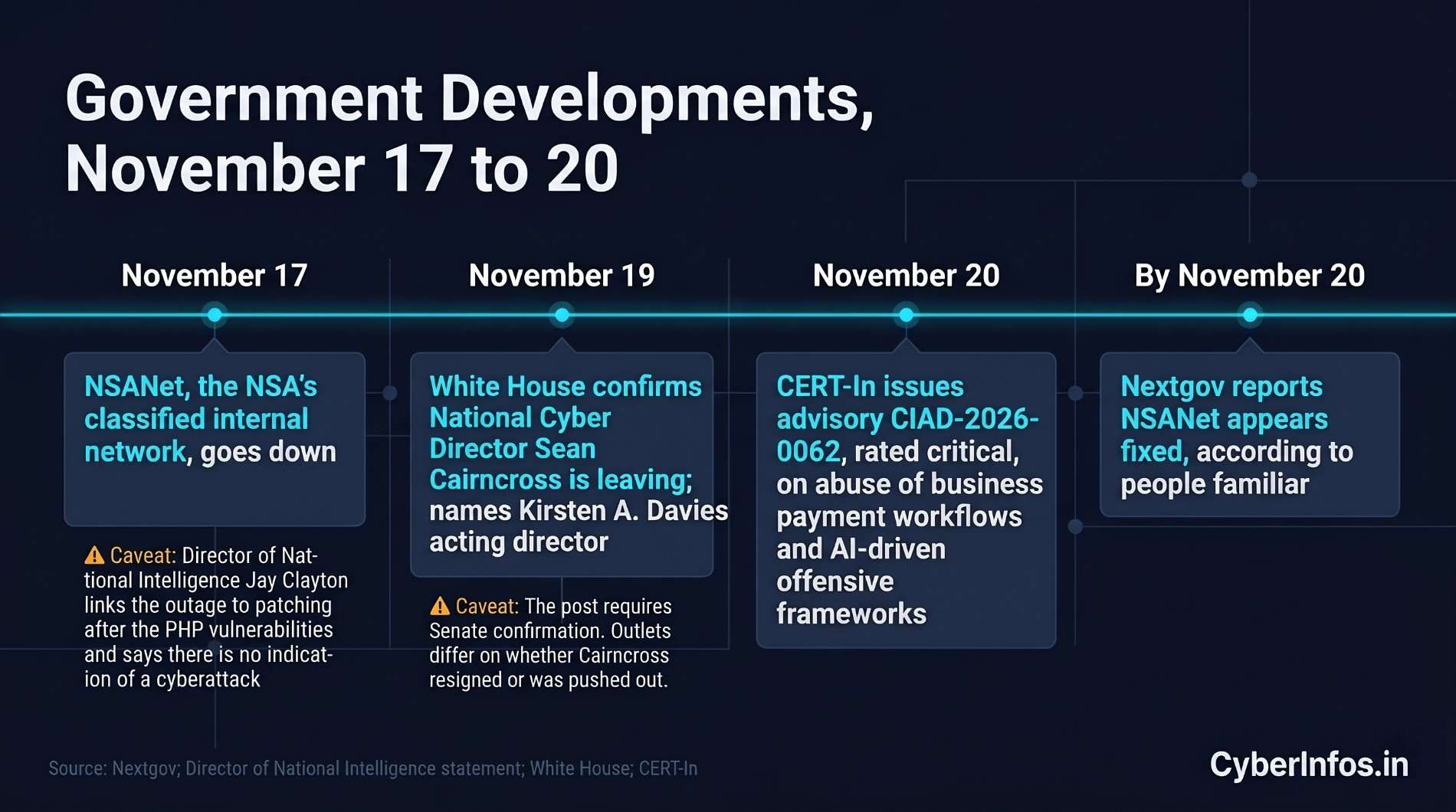
CERT-In: Attackers Are Rewriting the Records Behind Payments
On November 20, CERT-In published critical advisory CIAD-2026-0062, titled “Abuse of Business Payment Workflows and Use of AI-Driven Agentic Offensive Frameworks across Sectors.” The alert documents unauthorized transactions stretching beyond banks and financial institutions into technology providers running government-linked payment flows and vendor payout platforms.
Rather than attacking payment APIs directly, threat actors are altering underlying business records and approval chains so fraudulent transfers clear routine automated checks. CERT-In warned that weak independent verification and reconciliation allow manipulated records to slip through, while agentic AI frameworks compress the gap from reconnaissance to exploitation.
The advisory reiterates India’s mandatory six-hour incident-reporting rule and directs defenders to earlier advisories CIAD-2026-0046, CIAD-2026-0049, CIAD-2026-0058 and blueprint CISG-2026-02. [Read more]
US National Cyber Director: Cairncross Out, Davies Acting
The White House confirmed on November 19 that National Cyber Director Sean Cairncross is departing, naming Pentagon chief information officer Kirsten A.
Davies as acting director. Filling the post permanently requires Senate confirmation, and officials have not clarified whether Davies will retain her Pentagon duties. News outlets remain divided on whether Cairncross resigned voluntarily or was pushed out, leaving only the departure and acting appointment as verified facts.
NSANet Outage: Officials Blame Patching, Not an Attack
Operational disruption also surfaced in cybersecurity news this week when NSANet, the NSA’s classified internal network, went offline on November 17. Director of National Intelligence Jay Clayton attributed the outage to emergency PHP patching, explaining that several systems failed to restart cleanly and stressing there was no sign of a cyberattack.
Nextgov reported by November 20 that service appeared restored, citing people familiar with the matter. Separately, JPMorgan Chase blamed its November 16 disruption on a software bug in internal hardware, unrelated to the n0n leak, and officials see no link between the outages.
Looking Ahead
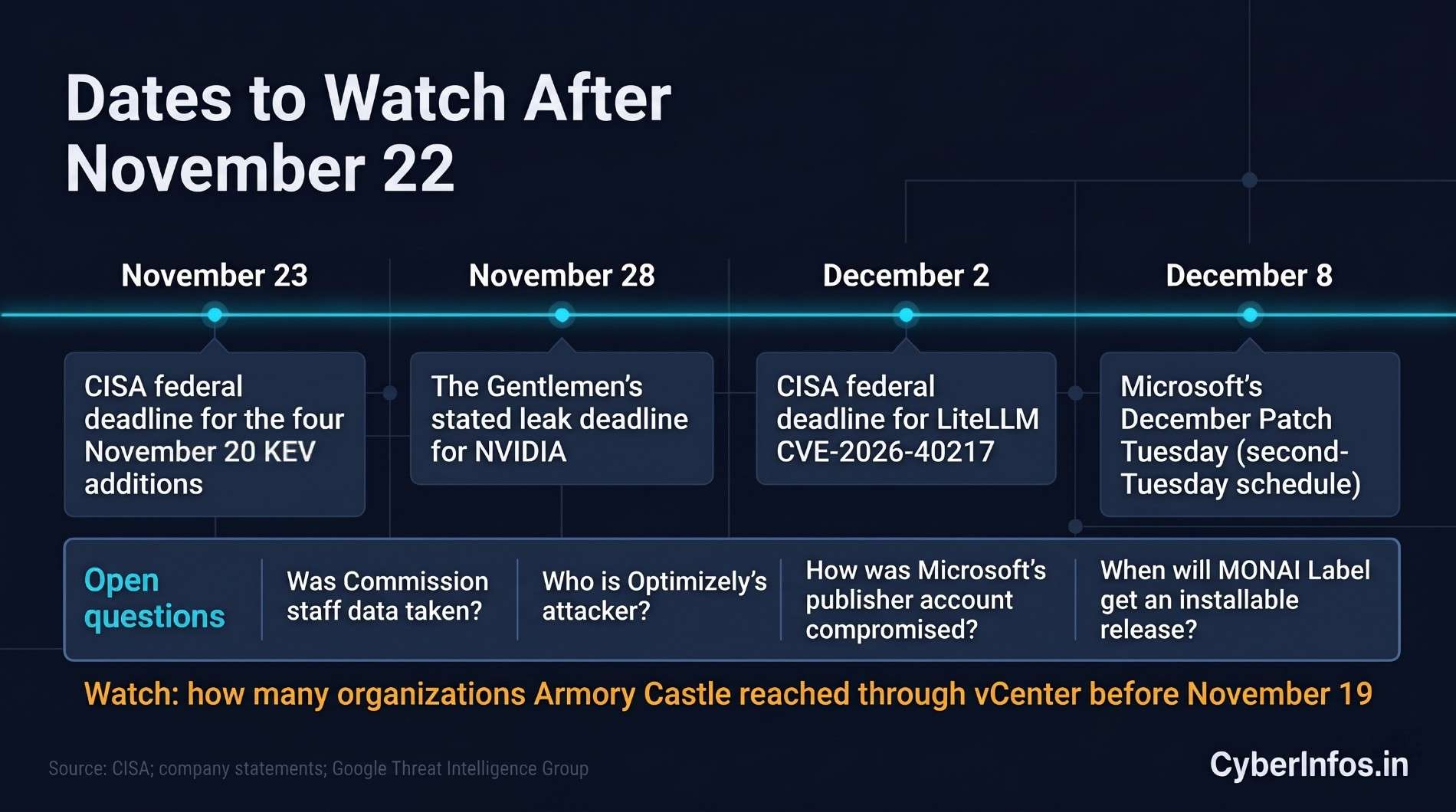
Three open investigations and four hard deadlines shape the follow-up to this cybersecurity weekly report and next week’s weekly cybersecurity news.
First comes the federal clock. CISA’s November 20 KEV additions (vCenter, Expressway, Apache Roller and SAP NetWeaver’s CVE-2025-42884) carry a tight November 23 deadline.
Second are the unresolved disclosures. Neither the European Commission nor the European Data Protection Supervisor has confirmed whether staff records were exposed. Optimizely’s attacker remains unidentified while Report URI expects victim numbers to grow. Microsoft has yet to detail how its publishing account was breached, and MONAI Label still awaits an installable patched release.
Third sit active extortion timers. The Gentlemen’s countdown for NVIDIA expires November 28, though NVIDIA maintains it sees no sign its own network was hit.
UPCOMING EVENTS:
-
November 23: CISA federal deadline for the four November 20 KEV additions
-
November 28: The Gentlemen’s stated leak deadline for NVIDIA
-
December 2: CISA federal deadline for LiteLLM CVE-2026-40217
-
December 8: Microsoft’s December Patch Tuesday (second-Tuesday schedule)
[WATCH]: The unresolved question closing this cybersecurity weekly report is how many organizations Armory Castle reached through vCenter before November 19. What is confirmed: the group exploited CVE-2026-123890 from early September, Mandiant worked multiple intrusions, operators deployed custom tooling against EDR-less appliances, and Broadcom’s advisory omitted exploitation.
What remains unknown: the total victim count and sectors hit, whether rival groups now hold working exploits, and whether the BeyondTrust-to-vCenter playbook extends to other edge gear. Teams running vCenter must guard the management plane like a tier-zero asset: patch immediately, lock down management interfaces, forward appliance logs to a SIEM, and hunt for forged SAML logins and rogue SSO admins. For defenders tracking cybersecurity news this week and next, post-patch compromise assessments are the metric that matters.
