


Cybersecurity news this week had a common thread: the tools that sit between organizations and their systems. N-able pulled its hosted N-central platform offline after a researcher published exploits for 33 flaws, and attackers were inside servers within hours of a second proof-of-concept release.
Check Point disclosed that attackers had chained a zero-day with the PHP2Shell bugs to root firewall gateways and wipe VMware ESXi hosts in Israel. The FBI warned that the open-source ARTEX framework can take an intruder from first contact to privileged access in under three hours.
In France, La Poste confirmed that a subsidiary lost the contact details of 22 million people. A Microsoft 365 outage, a Vanderbilt University ransomware claim and a GitHub credential-theft campaign rounded out the week.
This cybersecurity weekly report covers November 9 to 15, 2026. Where an older story appears, it is here because something new happened to it this week, and we say what.
Major Incidents
The cybersecurity incidents this week were mostly stories about trusted intermediaries. We start with the one that reached furthest.
1. N-able N-central: Public Exploits, a Shutdown and a Second Wave of Zero-Days
Over the weekend of November 7-8, researcher Sean Bales published proof-of-concept code for more than 30 N-central flaws, collectively called Able2Shell. He said he skipped coordinated disclosure because he was unhappy that N-able had not patched two flaws he reported in another product. N-able disputes that he used its reporting channels. On Monday, November 9, N-able took its hosted N-central environments offline and told on-premises customers to disconnect their servers.
By November 12 the company had released N-central 2026.4 HF2, which it says fixes every flaw exploitable without authentication, and brought hosted environments back. The remaining bugs need an authenticated account or extra conditions, and later hotfixes will cover them. N-able reported scanning that matched the public exploit code, but no compromise of its hosted servers at that point.
Then came a second drop. On November 12 Bales published 4EverAble2Shell, which chains an Apache Axis flaw (CVE-2026-90436, CVSS 9.8) with an unspecified N-central bug on servers with the Legacy API enabled. He also released Agent2Shell, roughly a dozen flaws that can run commands as SYSTEM on managed Windows agents.
Researchers at Lupovis and Huntback saw servers compromised about five hours after publication. The attackers installed an XMRig cryptominer with persistence. Huntback reported that 19 of the victims had already applied the latest N-able patches. N-able restricted the Legacy API and Intune integration, and on November 13 said it had found additional indicators of compromise at specific customers.
The miner is the only payload reported so far. The access behind it is the real problem: root on a server that manages customer endpoints. For an MSP, a hit should be handled as a full compromise, not a cleanup job. [Read more]
2. Check Point Gateways: PHP2Shell Chain Ends in an ESXi Wiper
Check Point disclosed CVE-2026-123039, a local privilege escalation flaw in the Gaia OS DynamicCLI interface, after seeing it exploited against what it called a couple of dozen customers. The root daemon listens on a world-writable local socket and never authenticates callers. Secondary reporting rates it CVSS 7.8.
Check Point’s research lays out the whole chain. Attackers entered through the Mobile Access portal using the PHP2Shell flaws (CVE-2026-109618 and CVE-2026-109619), escalated to root with CVE-2026-123039, and planted webshells and the TSGA backdoor. In Israeli cases they then moved over SSH to VMware ESXi hosts and ran a wiper called destroy_v6.
The activity began October 30 against Israeli organizations. A second wave on November 2 hit multiple countries and sectors without the destructive stage. A note left on ESXi hosts rejected ransom talks and carried political messages, which led researchers to raise the possibility of a false flag. Check Point tentatively linked the backdoor to PhiliKit, a framework ESET has associated with the cluster UNC5221, but said it could not attribute the activity with confidence.
The fix is the November Jumbo Hotfix, with internet-facing Mobile Access portals first. Check Point’s interim step is to stop the dynamic_server process. PHP patched the older PHP2Shell bugs on October 21 and CISA added them to its KEV catalog on October 26, so this story returned through the new zero-day and the wiper findings. [Read more]
3. Maileva (La Poste): Contact Data of 22 Million Recipients Exposed
La Poste told AFP on Saturday, November 14 that its subsidiary Maileva suffered a cyberattack in mid-September. The attackers exposed the first names, last names and postal addresses of 22 million people. These are recipients of mail sent through Maileva’s business clients, so most have no relationship with the company.
Maileva handles invoices, registered letters and payslips for small and mid-sized firms and says it has more than 70,000 users. It has notified CNIL, warned client companies and filed a complaint, and a judicial investigation is open.
The retrieved reporting does not say who was responsible, how they got in or whether the data is for sale. The intrusion dates to mid-September; the disclosure is this week. Expect phishing that borrows the look of invoices and reminders from real senders. [Read more]
4. Cursor: A Supplier Key Led to a Tampered Claude Code Extension
Cursor disclosed on October 29 that tampered versions 2.1.312 and 2.1.313 of the Claude Code extension were served from its marketplace for about 11 hours, reaching up to 5,000 users. On November 13 it published how the attacker got there.
According to reporting on Cursor’s account, an attacker obtained a key Cursor had given to supplier Fireworks AI. They used it to copy shared storage holding historical coding-agent records, mostly from 2025 and from sessions outside Privacy Mode.
Some of those records contained unremoved credentials. The credentials opened corporate services (archived non-production repositories, limited support data, email and usage metrics), and a further credential let the attacker place malicious copies in the marketplace cache.
The tampering did not occur in Anthropic’s own distribution or in Open VSX. Microsoft’s analysis found code that collected host details, added an attacker SSH key and tried to set up persistence, with success depending on machine permissions.
Cursor says fewer than 0.01% of customers had API credentials exposed, that its production systems and Privacy Mode data were not compromised, and that the last attacker activity was blocked on November 1. Uninstalling the extension alone may not remove what it left behind. [Read more]
5. Microsoft 365: A Two-Day Outage That Was Not an Attack
Outlook, Teams, SharePoint and Copilot were disrupted from November 12 into November 13, with Downdetector reports from 74 countries within about an hour. Microsoft said there was no evidence of malicious activity. It attributed the failure to a problem introduced during an earlier network capacity upgrade that surfaced after a recent network change. Servers failed automated health checks, and the remaining infrastructure took on extra traffic.
Microsoft has promised a post-incident report. Security teams should still expect phishing that offers to “restore access”. [Read more]
ANALYST INSIGHT: Here is what the cybersecurity incidents this week had in common. An RMM vendor, a supplier’s stored key, a mail-processing subsidiary and a firewall’s portal each gave attackers a path to many downstream victims. Two details make it worse. Nineteen of the compromised N-central servers were already patched, and Check Point’s wiper stage reached ESXi hosts that sat behind the gateway. Patch status alone did not tell defenders whether they were clean.
Vulnerabilities & Patches
Among the cybersecurity threats this week, exploited edge devices and an enormous Microsoft release stood out. Counts for Microsoft’s November 10 Patch Tuesday differ by outlet. Dark Reading and CSO counted about 1,093 to 1,094 Microsoft CVEs, 63 of them critical, while BleepingComputer and Infosecurity Magazine reported 1,235. The retrieved reports do not reconcile the gap. They do agree on one actively exploited zero-day.
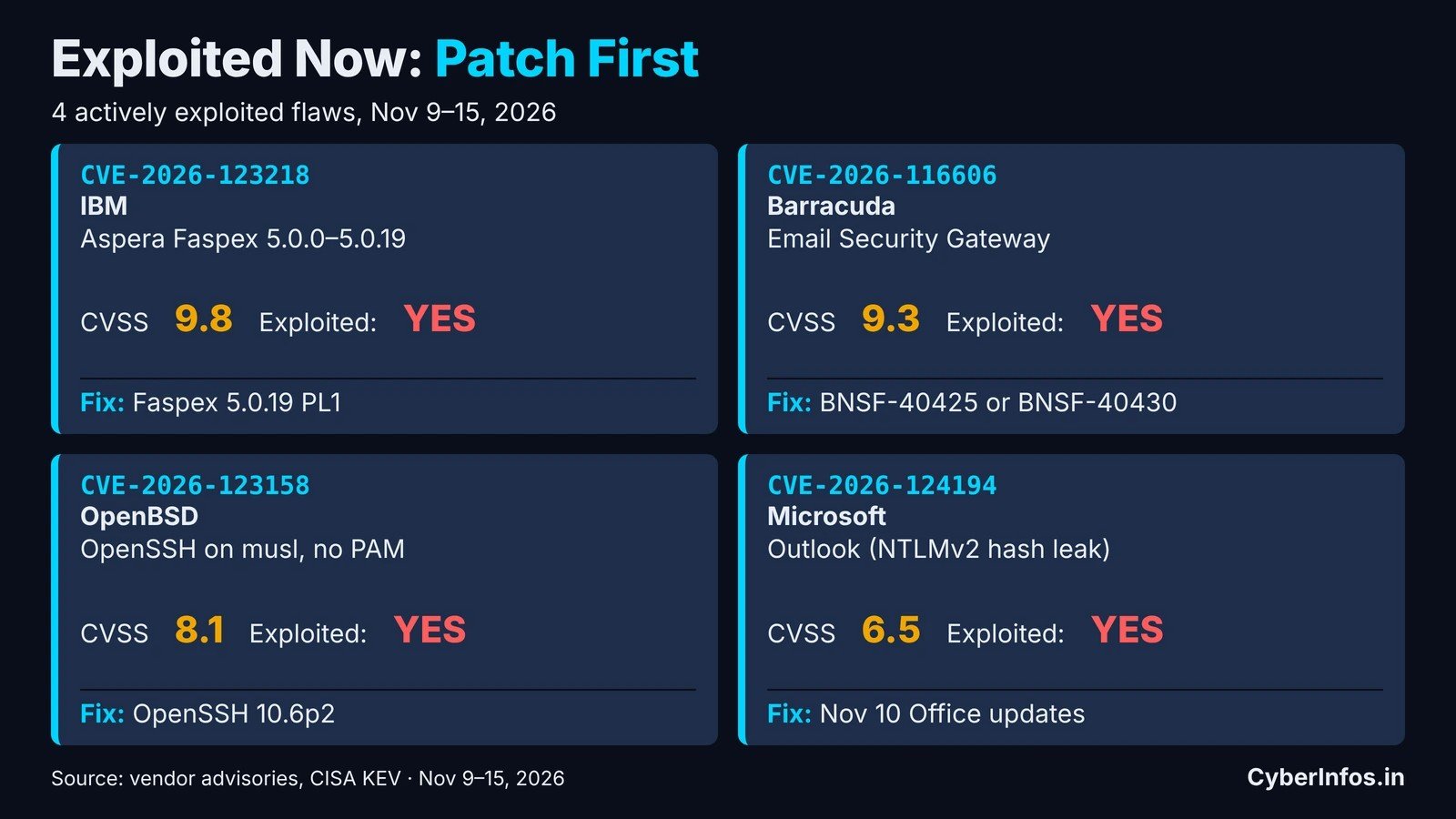
[CVE] CVE-2026-124194 | Microsoft | Outlook (Microsoft 365 Apps, Office LTSC 2021 and 2024) | CVSS: 6.5 | Exploited: Yes
Opening a malicious Office file can make Outlook connect to an attacker-controlled location without the usual external-content warning. That exposes the user’s NTLMv2 hash for relay or cracking. CSO reported that Microsoft credited an Anthropic researcher using Claude with the find.
[PATCH] Install the November 10 Office updates. Until then, email filtering and user awareness reduce exposure.
[CVE] CVE-2026-125350 | Google | Chrome | CVSS: not stated in retrieved sources | Exploited: Yes
Fixed in Chrome 157.0.8103.50 on November 9, this is the eighth Chrome zero-day of 2026 according to Ivanti’s Chris Goettl. Chromium-based browsers such as Edge need the update too. CERT-In also rated a Chrome vulnerability note critical on November 10.
[PATCH] Update Chrome and relaunch the browser; confirm Edge and other Chromium builds.
[CVE] CVE-2026-123158 | OpenBSD | OpenSSH (musl libc without PAM, such as Alpine Linux) | CVSS: 8.1 | Exploited: Yes
Disclosed November 5 with OpenSSH 10.6p2, this “SSHole” flaw lets an unauthenticated attacker send an oversized password and log into accounts that have no usable password. It returned to attention when CISA added it to KEV on November 9 with a November 12 federal deadline. The same batch included GPUStack (CVE-2026-102895), SignalWire FreeSWITCH (CVE-2026-116779, CVSS 9.8, fixed in 1.11.3) and IBM Aspera Faspex.
[PATCH] Upgrade to OpenSSH 10.6p2 or your distribution’s package and restart sshd. Debian, Ubuntu and other glibc systems are not affected.
[CVE] CVE-2026-123218 | IBM | Aspera Faspex 5.0.0 through 5.0.19 | CVSS: 9.8 | Exploited: Yes
An authorization bypass that can lead to full administrator rights. Public exploitation details are thin.
[PATCH] Upgrade to Faspex 5.0.19 PL1 and verify the faspex-core image build.
[CVE] CVE-2026-116606 | Barracuda | Email Security Gateway | CVSS: 9.3 | Exploited: Yes
Barracuda confirmed that attackers are chaining this pre-authentication bypass with CVE-2026-111560 to gain root on its appliances. A small number of organizations were affected, and exploitation needs access to the admin interface. Patches shipped November 2, and CISA added both flaws to KEV on November 10 with a November 13 deadline.
[PATCH] Apply BNSF-40425 (9.4.017 and later) or BNSF-40430 (earlier builds), and keep management interfaces off the internet.
[CVE] CVE-2026-119618 | Apache | HTTP Server mod_http2 (2.4.55 through 2.4.70) | CVSS: 9.8 | Exploited: Unknown
An unauthenticated race condition that can lead to remote code execution. Anthropic’s OSS Scanner reported it October 26, and Google Cloud researchers reported it on November 3. Wiz says 64% of cloud environments hold vulnerable resources.
[PATCH] Upgrade to 2.4.71 or disable HTTP/2.
Other items. SAP’s ICM2Shell flaws (CVE-2026-76964 and CVE-2026-89126, CVSS 10) let unauthenticated attackers run code through WebSocket handling. Exploitation status is unknown, though Onapsis gave SAP a working exploit. Citrix patched 28 NetScaler ADC and Gateway flaws, nine of them critical, plus a critical NetScaler Console bug (CVE-2026-120869, CVSS 9.4); Citrix did not report exploitation. Microsoft’s critical Exchange (CVE-2026-118207) and Windows LDAP (CVE-2026-119958) bugs both score 9.8.
SignDrop is a different case. This Windows privilege escalation to SYSTEM has a public PoC and no patch yet. Microsoft says Defender blocks it and that it has seen no exploitation, and Cyderes found no in-the-wild use.
PRIORITY ACTION: Patch edge appliances with confirmed exploitation first: Check Point gateways (Jumbo Hotfix) and Barracuda ESG. Then move to Exchange servers and domain controllers, which Zero Day Initiative’s Dustin Childs said to patch first to stop zero-click compromise.
Ransomware Activity
Ransomware stayed in the weekly cybersecurity news mostly through one new group.
BYOD: Vanderbilt University Claim
Vanderbilt announced a cyberattack on Monday, November 9, asked people to shut down devices and leave campus Wi-Fi, and began restoring some services on November 10. Separately, the BYOD ransomware group listed the university on its leak site. It claims it encrypted databases and stole more than one million Social Security numbers plus student, employee and research records.
That is an attacker claim. Vanderbilt has not confirmed what was taken, and the reported figure is unverified.
BYOD is new. Ransomware analyst Allan Liska told The Record its first victim appeared September 29. It has also claimed Michigan State University and the University of New Mexico, where a hospital diverted ambulances.
For context, Halcyon reported a 40% rise in ransomware activity from July to September, with 111 groups claiming 2,766 attacks in 122 countries. Trellix reported record numbers of groups and victim posts from April to September. Both reports came out the week before, so we use them only as background.
Operation Endgame: Gootloader, CastleRAT and StealC Infrastructure Seized
Europol and partners in nine countries seized 235 servers and 257 domains tied to the Gootloader loader, the CastleRAT remote access trojan and the StealC infostealer. Germany’s BKA said investigators recovered about 6.4 million stolen logins belonging to more than 40,000 victims. CastleRAT accounted for 120 servers and 39 domains. StealC had been hit in June and rebuilt. No arrests were announced.
ANALYST INSIGHT: The takedown targets the access layer that ransomware crews buy, and BYOD shows how quickly a new crew can fill gaps. Both fit what Trellix described as ransomware power spreading across many faster, lighter operators. One week of data does not make a trend, but the two stories point the same way.
Threat Intelligence
Cybersecurity threats this week also included AI-driven tooling, credential theft in developer pipelines and a worm aimed at IT technicians.
ARTEX: FBI Flash Alert on an AI Intrusion Framework
On Friday, November 13 the FBI said the open-source ARTEX framework can automate intrusion phases “at machine speed,” with some intrusions reaching privileged access in under three hours. The tool appeared on GitHub in August. Its developer removed the repository after misuse became public, but the FBI says forks, archived copies and a commercial version keep it available. Censys counted over 1,600 exposed ARTEX consoles.
ARTEX can drive any AI model, including Claude, GPT, DeepSeek, GLM, Grok and Kimi. The FBI says Chinese models, led by DeepSeek Flash models, dominate attacker instances.
Victim sectors include financial services, government, technology, defense, semiconductors, energy, healthcare, manufacturing, telecoms and legal. The FBI notes that agents map trust between organizations and favor neglected systems such as partner portals and legacy services.
Amazon’s own report the same day described Chinese-nexus groups using ARTEX for large-scale theft of credentials to AI models, and a separate campaign aimed at crypto exchanges’ identity checks. Microsoft earlier tied ARTEX to a China-aligned actor in the ConnectWise Cloud Backup breach, which Dark Reading says reached more than 2,250 Microsoft 365 and Azure environments.
[TTP] Automated reconnaissance through exfiltration: AI agents chain steps against many targets at once, with time to privileged access under three hours in some cases.
[TTP] Abuse of trusted OAuth application credentials: stolen ConnectWise application credentials gave cross-tenant access (Dark Reading).
wfx-loot: Stolen GitHub Tokens Push a CI Secret Stealer
Aikido reports that 4,837 compromised GitHub accounts opened probe pull requests in 61,764 repositories from November 10. The pull requests were titled “docs: dependency audit notes” and checked for write access. Roughly 92% remain open.
The payload, a 1,500-line shell script, ran in at least 1,806 repositories, a number Aikido says may understate impact. It arrived by editing workflows, adding an npm postinstall hook, or creating a throwaway branch with a rogue workflow. GitHub’s approval gate stopped the workflow methods, but the npm hook slipped past because it changed no workflow file.
The script dumps repository and organization secrets, reads runner memory, harvests cloud credentials and AI-service keys, and exchanges OIDC tokens for cloud sessions. It adds persistence that survives rotation: AWS role trust policies that accept any account and Azure federated credentials. By Thursday the exfiltration had moved to a Telegram chat.
StepSecurity traced 173 probes to tokens issued to the Fly.io GitHub App. Fly.io confirmed the tokens leaked from build directories and said it was not breached. About a fifth of the accounts had been hit in October’s GhostAction campaign. Other outlets cite totals above 60,000 or 66,000 repositories, so treat the exact count as unsettled.
[TTP] Valid accounts with stolen tokens: attackers act as the legitimate user to inject workflows and hooks.
[IOC] Azure federated credential name | wfx-ci-* | Persistence on affected applications; also check AWS role trust policies that accept any account.
[IOC] Pull request title | docs: dependency audit notes | Probe PRs from compromised accounts; also Packagist neuronai-studio 3.14.3 shipped the payload.
SCKit: A Worm That Rides Technician Sessions
Huntress reported SCKit, a toolkit used in attacks on managed service providers through ScreenConnect. It installs rogue ScreenConnect clients, and when a technician connects to an infected machine it hijacks the session to reach other managed machines. Huntress saw 288 endpoints across 48 organizations within 90 minutes.
ConnectWise disabled five third-party extensions across about 400 partner environments, and Microsoft published its own analysis on November 13. Sources differ on the entry point. CyberScoop tied the spread to one of those extensions, while Blackpoint told The Record the toolkit exploits CVE-2026-84869 and that the existing patch blocks it.
[TTP] Remote management tool abuse: the legitimate Run Command feature pushed a second, attacker-controlled client.
ANALYST INSIGHT: Three stories in a few weeks, N-able N-central, SCKit and the ConnectWise breach, target the software IT providers use to manage their customers. That is a pattern across several data points, not a prediction. The shared lesson for MSPs is that management consoles deserve the same exposure review and logging as domain controllers.
Industry & Regulatory News
Google Project Zero Replaces “90+30” With “Full X”
This was the cybersecurity news this week most likely to change vendor planning. Project Zero published a new disclosure policy on November 13. Vulnerabilities are now disclosed 90 days after they are reported, with no extra soak time after a fix. The window drops to 60 days on February 2, 2027 and to 30 days on January 3, 2028. Vendor service levels and non-patch mitigations will need to keep pace.
CERT-In Advisories
India’s CERT-In rated a Chrome vulnerability note critical on November 10 (CIVN-2026-0544) and urged updates. Earlier, on November 4, it issued a critical advisory on “Crafty Falcon,” an AI-assisted actor targeting banks, lenders, fintechs and crypto exchanges through payment APIs. The second advisory predates this reporting week and is included for readers in Indian financial services.
Looking Ahead
For readers planning next week’s work, the cybersecurity threats this week that still need action are mostly unfinished patches and open investigations.
First, watch N-able. Hotfixes for the authenticated N-central flaws are still pending, the Legacy API restriction affects integrations, and N-able has identified indicators of compromise at some customers.
Second, expect more from Microsoft. It has promised a post-incident report on the outage, and it is investigating SignDrop with no patch announced.
Third, watch Maileva for details on the intrusion and any claim of responsibility, and Vanderbilt for confirmation of what data was taken.
UPCOMING EVENTS: November 20, federal deadline for the SonicWall SonicOS SSLVPN SAML bypass (CVE-2026-19868), added to KEV on November 6. December 8, expected December Patch Tuesday. February 2, 2027, Project Zero moves to “Full 60.” Next week’s cybersecurity weekly report will track the first two.
[WATCH]: N-able N-central’s remaining exposure. What is known: public exploits exist for more than 30 flaws plus two later chains, attackers took over servers within about five hours, and some of those servers were fully patched. What is unknown: how many MSPs are compromised, what follows the cryptominer, and whether the unauthenticated fixes hold against 4EverAble2Shell variants. Defenders should care because one compromised RMM server controls every endpoint it manages.
