

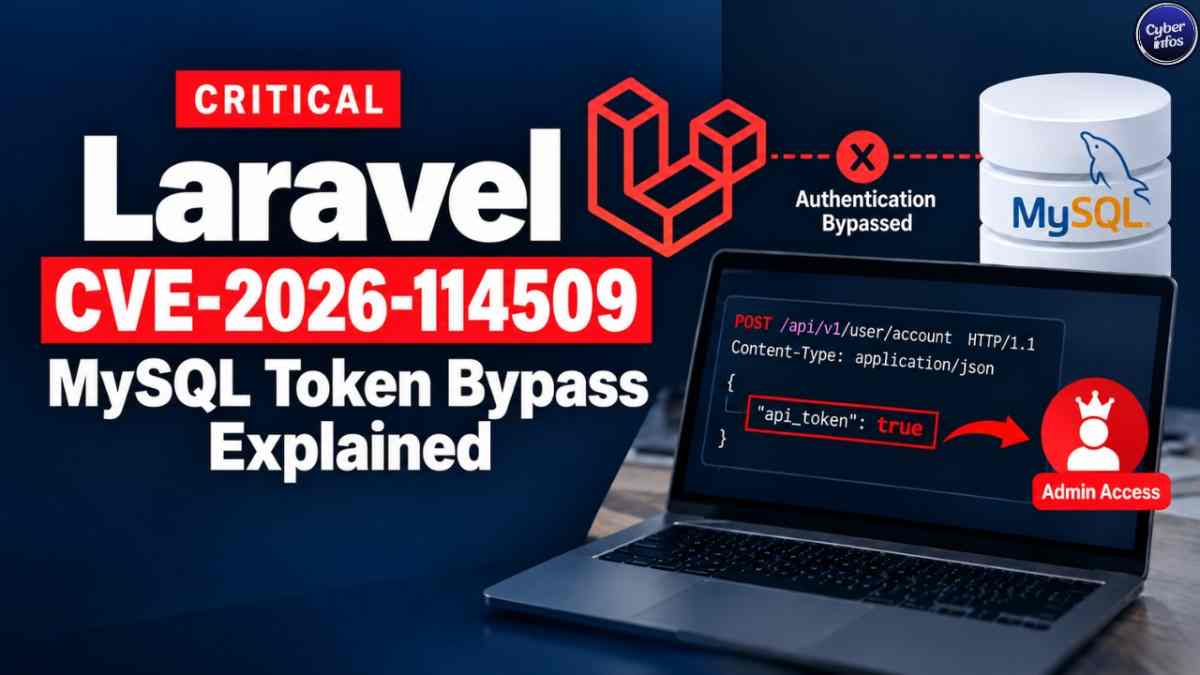
A critical authentication bypass in the world’s most widely used PHP application framework is now public, and weaponized exploit tooling is already circulating. Over the past 48 hours, global threat intelligence feeds, independent vulnerability research labs, and national cyber response teams have confirmed that threat actors are probing enterprise API gateways for CVE-2026-114509.
The flaw sits in Laravel’s native API token authentication driver and carries a CVSS v4.0 base rating of 9.2 Critical. An unauthenticated remote attacker can skip access controls entirely and impersonate administrative accounts on exposed API endpoints, with no valid bearer credentials required.
The disclosure follows emergency advisories from national computer security incident response teams, most notably Italy’s Agenzia per la Cybersicurezza Nazionale (ACN Italy CSIRT Alert) and Paraguay’s national cybersecurity center (CERT-PY Advisory).
Here is the operational catch. Teams that rely only on routine dependency managers can still be exposed, because updating packages without cycling long-lived application worker processes leaves vulnerable code active in server memory. Closing that gap takes a clear grasp of how loose relational database type coercion meets web application parameter deserialization.
Quick Answer
CVE-2026-114509 is a critical Laravel TokenGuard authentication bypass flaw (CVSS v4.0 9.2 / CVSS v3.1 9.8, CWE-287 / CWE-704). It affects Laravel Framework releases prior to 12.68.0 and 13.29.0 running on MySQL or MariaDB backends. Unauthenticated remote adversaries submit crafted non-string JSON values, such as boolean flags or integers, to bypass token lookups and hijack existing user or administrative accounts.
Engineering teams must immediately apply the Laravel 12.68.0 security update (or 13.29.0), restart persistent application runtimes such as Laravel Octane and background queue daemons, and configure perimeter edge rules to filter malformed API authentication parameters.
What Happened & Incident Timeline
The vulnerability originated in Laravel’s native TokenGuard driver, a lightweight authentication mechanism for stateless API services. On October 21, 2026, the Laravel security team pushed unscheduled maintenance updates under GitHub security advisories GHSA-f9x3-7vq9-cph6 and GHSA-5wcm-3v2w-8362.
The primary advisory resolved CVE-2026-114509. The secondary notice addressed CVE-2026-114508 (CVSS 6.5), a companion vulnerability that allows unauthorized data destruction through manipulated Eloquent relationship queries on otherwise read-only endpoints.
Public exploit demonstrations appeared shortly after the GitHub advisories went live. They showed how a standard HTTP JSON body can trigger the authentication bypass against default MySQL deployments. Security researchers at Rapid7 Vulnerability Database and QadrLabs Security Advisory reported active reconnaissance scans against internet-facing microservices within hours of the code release.
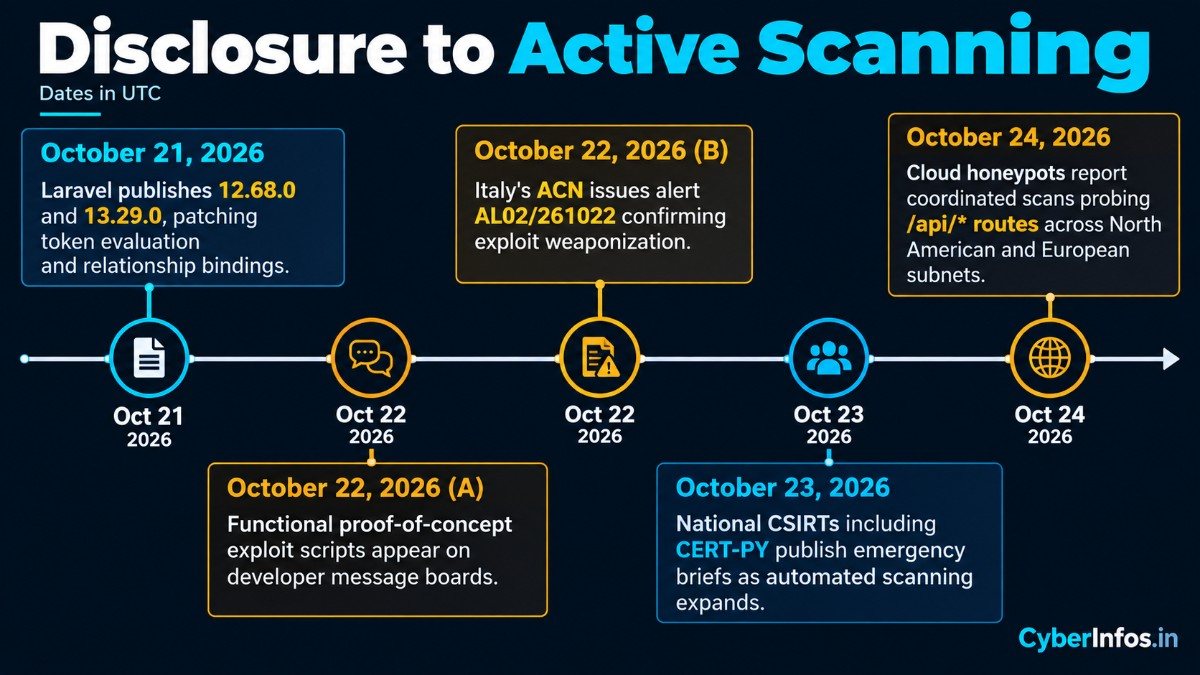
| Date & Time (UTC) | Milestone & Intelligence Update |
|---|---|
| October 21, 2026 | Laravel engineering core publishes framework versions 12.68.0 and 13.29.0 patching token evaluation and relationship bindings. |
| October 22, 2026 | Functional proof-of-concept exploit scripts targeting token validation logic appear publicly on developer message boards. |
| October 22, 2026 | Italy’s National Cybersecurity Agency (ACN) issues national security alert AL02/261022 confirming exploit weaponization. |
| October 23, 2026 | National CSIRT bodies including CERT-PY publish emergency threat briefs as automated scanning expands globally. |
| October 24, 2026 | Cloud honeypots report coordinated reconnaissance campaigns probing /api/* routes across North American and European subnets. |
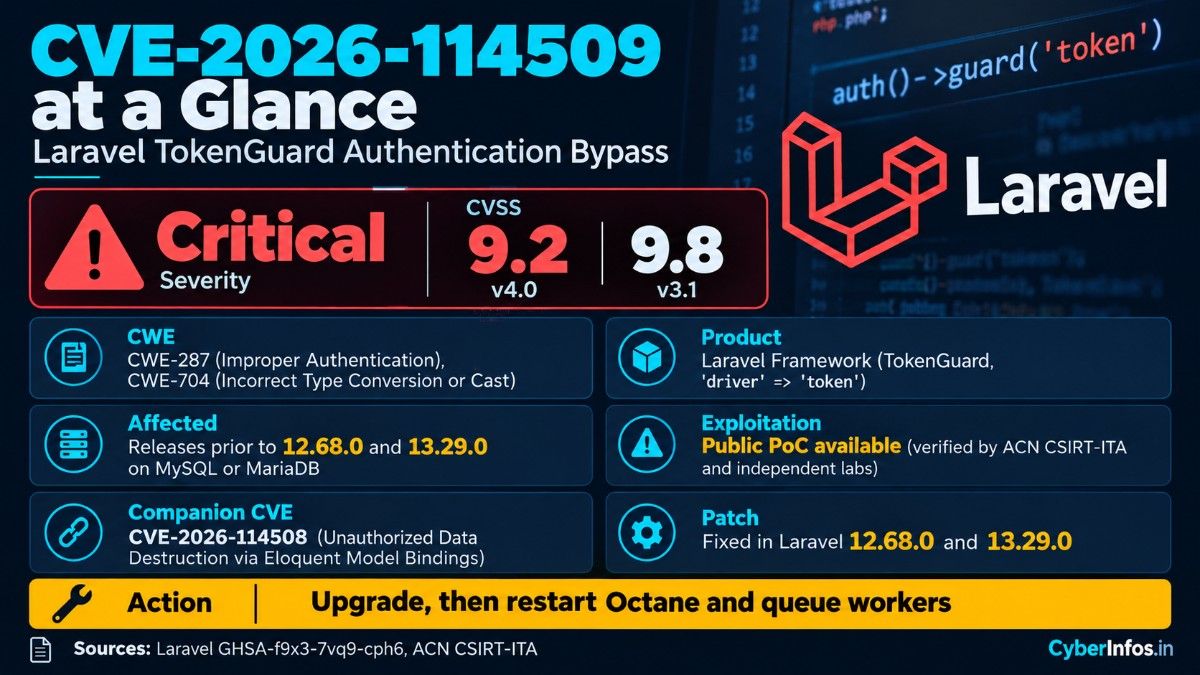
Threat Facts at a Glance
| Security Dimension | Verified Technical Specification |
|---|---|
| Vulnerability Identifier | CVE-2026-114509 |
| Companion Identifier | CVE-2026-114508 (Unauthorized Data Destruction via Eloquent Model Bindings) |
| Severity & CVSS Score | CVSS v4.0 9.2 Critical (CVSS:4.0/AV:N/AC:L/AT:P/PR:N/UI:N/VC:H/VI:H/VA:H/SC:N/SI:N/SA:N) |
| Common Weakness Enumeration | CWE-287 (Improper Authentication) & CWE-704 (Incorrect Type Conversion or Cast) |
| Exploitation Prerequisites | Application configures ‘driver’ => ‘token’ in config/auth.php backed by MySQL or MariaDB |
| Attack Vector & Access | Remote / Network Reachable / Zero Authentication / No User Interaction Required |
| Exploit Availability | Publicly Available Exploit PoC (Verified by ACN CSIRT-ITA & Independent Labs) |
| Target Architecture | Laravel REST APIs, Microservice Gateways, and Headless Applications using TokenGuard |
Affected and Fixed Versions
Laravel follows an established enterprise lifecycle policy, and security patches exist only for the current 12.x and 13.x branches. Teams running discontinued releases have two options: upgrade immediately, or put custom perimeter input filtering in front of the application.
| Framework Line | Vulnerable Releases | Remediated Release | Lifecycle Status |
|---|---|---|---|
| Laravel 13.x | Releases prior to 13.29.0 | Laravel 13.29.0 | Actively Maintained |
| Laravel 12.x | Releases prior to 12.68.0 | Laravel 12.68.0 | Actively Maintained |
| Laravel 11.x & Prior | All 11.x, 10.x, and older versions | None (End-of-Life) | Obsolete (Manual Mitigation Mandatory) |
| Laravel Sanctum / Passport | Unaffected unless TokenGuard is actively invoked | N/A | Inherently Resilient by Design |
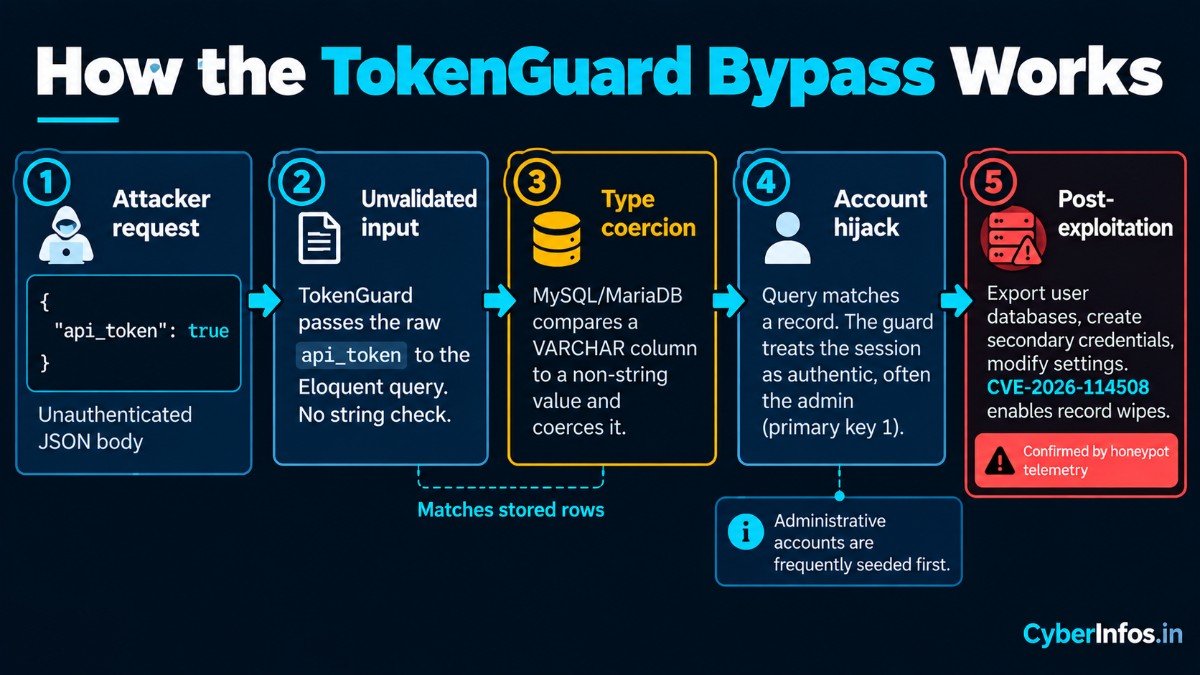
Technical Attack Chain
1. Insecure Credential Handling in TokenGuard
When a request hits an API route, Laravel checks the guard configuration declared in config/auth.php. In setups using the traditional token driver (‘driver’ => ‘token’), the incoming token is read through $request->bearerToken() or $request->input(‘api_token’). Before the fixed release, the framework passed that raw, unvalidated input straight into the Eloquent query builder. Nothing confirmed the credential was a string.
2. Exploiting MySQL Dynamic Type Juggling
The core of the problem is a MySQL non-string credential bypass. In MySQL and MariaDB, comparing a character column (such as api_token VARCHAR(80)) against a non-string value in a SQL WHERE clause triggers automatic type coercion. If an unauthenticated adversary sends a JSON body where api_token is boolean true or an integer, the database evaluates that condition against stored rows. Under MySQL’s loose comparison model, non-empty alphanumeric token strings evaluate to true when compared with boolean true or numeric 0, so the query matches database records.
# Example Proof-of-Concept API Request targeting vulnerable TokenGuard
curl -X POST "https://api.target-enterprise.com/api/v1/user/account" \
     -H "Content-Type: application/json" \
     -H "Accept: application/json" \
     -d '{"api_token": true}'
3. Account Hijacking & Administrative Takeover
Once the database returns a matching record, TokenGuard treats the session as authentic. Administrative accounts are usually the first records created during database seeding, often with primary key 1, so a generic truthy match frequently returns the root administrator profile. The attacker gains administrative privileges without ever holding, or guessing, the secret token.
4. What the Attacker Did Next
After taking over an administrative API account, threat actors move quickly into post-exploitation and lateral movement. Telemetry from honeypot nodes shows attackers calling internal administrative utilities to export user databases, generate secondary persistent credentials, and modify application settings.
They also pair this access with the companion flaw CVE-2026-114508, using manipulated relational bindings on destructive API routes to wipe associated database records. The result is significant service disruption.
Why Patching Alone May Not Be Enough
Updating the packages in composer.lock is not enough for modern high-performance architectures. Lingering execution state survives in three places, and teams need to account for all of them.
- Persistent Memory Runtimes (Laravel Octane): Application servers such as Swoole, RoadRunner, and FrankenPHP keep application state and class definitions in memory. If you update Composer dependencies on disk without a hot reload, the vulnerable framework classes keep running.
- Background Queue Daemon Workers: Workers managed through Horizon or Supervisor (php artisan queue:work) run as continuous PHP processes. Until they are restarted after deployment, asynchronous jobs that process incoming API events keep executing the unpatched token verification logic.
- Serialized Framework Configuration Caches: Production systems that use php artisan config:cache and php artisan route:cache keep serving cached provider bindings until the cache is cleared.
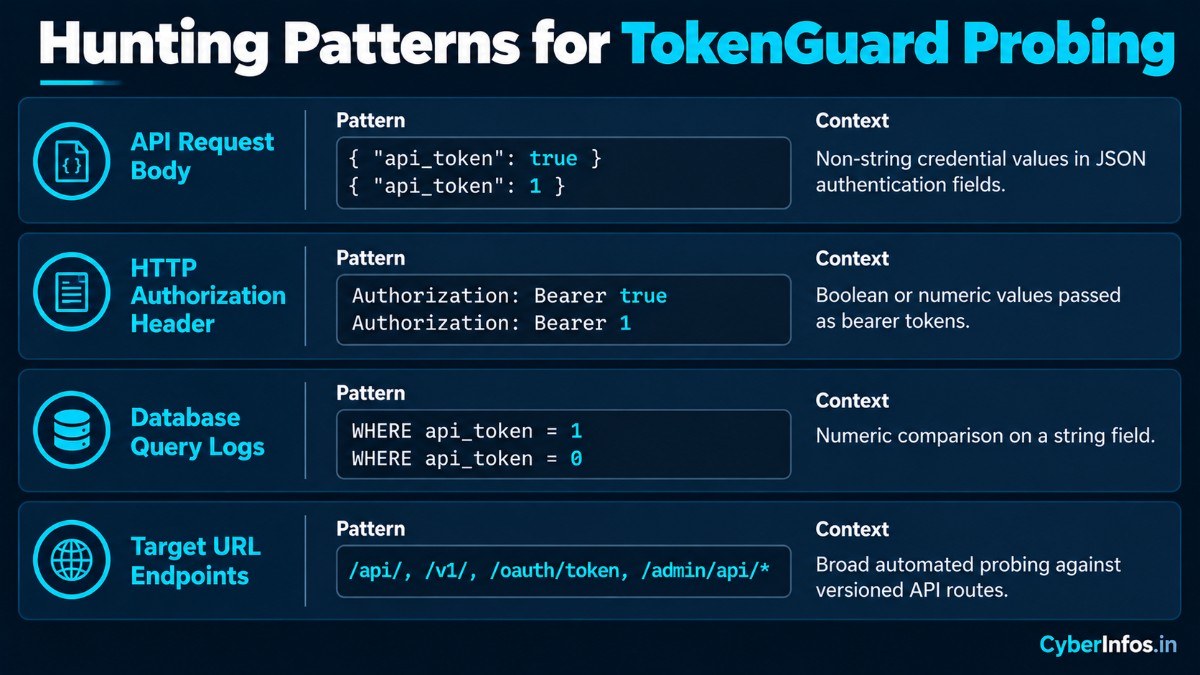
Indicators of Compromise (IOCs) & Hunting Telemetry
Security operations centers should inspect API gateway logs, reverse proxy telemetry, and web application firewall events for requests carrying non-standard authentication parameters.
| Telemetry Source | Hunting Pattern / Regular Expression | Malicious Context |
|---|---|---|
| API Request Body | api_token":\s*(truefalse |
Non-string credential values in JSON authentication fields |
| HTTP Authorization Header | Bearer\s+(true0 |
Boolean or numeric values passed as bearer tokens |
| Database Query Logs | WHERE `api_token` = 1 or WHERE `api_token` = 0 |
Relational query logs showing numeric comparison on string fields |
| Target URL Endpoints | /api/, /v1/, /oauth/token, /admin/api/* | Broad automated probing against versioned API routes |
{
  "event": "waf_signature_match",
  "rule_id": "SEC-LARAVEL-2026-001",
  "matched_parameter": "api_token",
  "received_data_type": "boolean",
  "payload_sample": "{\"api_token\": true}",
  "disposition": "blocked"
}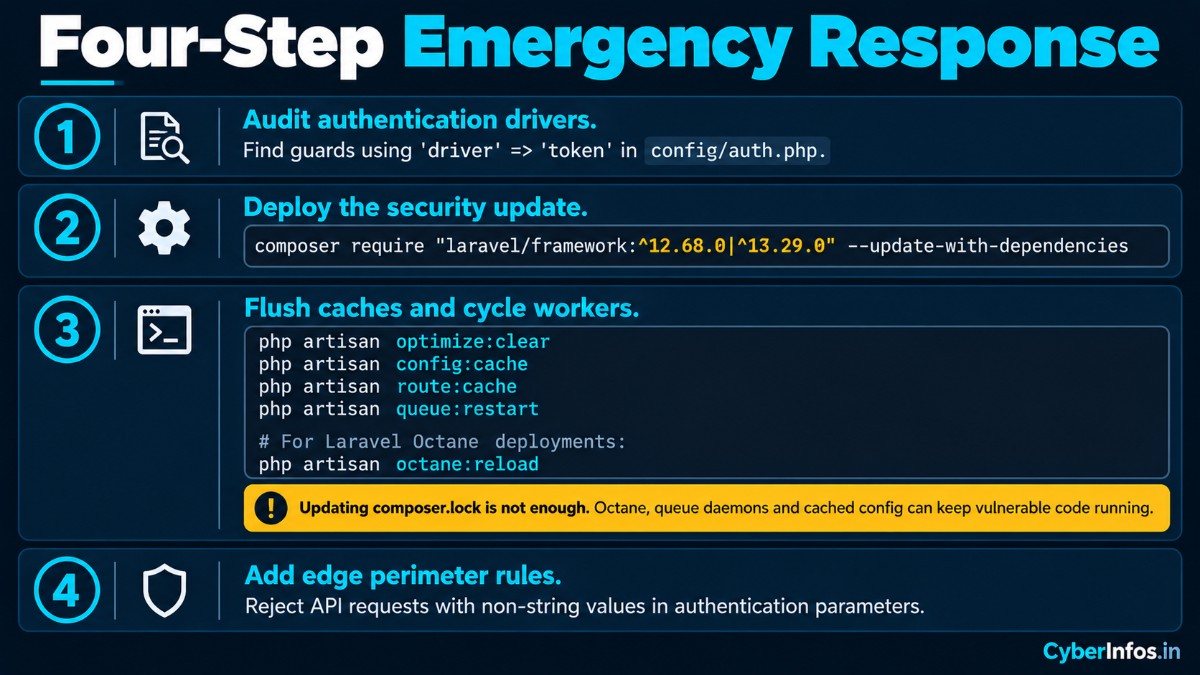
SOC & IT Emergency Response Checklist
- Audit Authentication Drivers: Review config/auth.php across all codebases and identify any guard configured with ‘driver’ => ‘token’.
- Deploy Framework Security Updates: Upgrade production composer packages to the latest security releases.
composer require "laravel/framework:^12.68.0|^13.29.0" --update-with-dependencies- Flush Application Cache & Cycle Workers: Clear serialized configuration files and terminate persistent daemon processes so they reload from disk.
   php artisan optimize:clear
   php artisan config:cache
   php artisan route:cache
   php artisan queue:restart
   # For Laravel Octane deployments:
php artisan octane:reload- Implement Edge Perimeter Rules: Configure web application firewall inspection rules to reject API requests that carry non-string values in authentication parameters.
Global Regulatory & Compliance Implications
Unauthorized administrative access can trigger statutory notification duties. Security leaders managing international infrastructure should check each jurisdiction below.
- United States (CISA, SEC, & CIRCIA): Public entities must evaluate the materiality of unauthorized API access under SEC disclosure rules within four business days. Critical infrastructure operators subject to CIRCIA face 72-hour reporting windows for significant cyber incidents.
- United Kingdom (NCSC & ICO): Under UK GDPR guidelines, breaches involving unauthorized access to consumer records or database corruption require formal notification to the Information Commissioner’s Office within 72 hours.
- Australia (ASD & SOCI Act): Organizations managing assets governed by the Security of Critical Infrastructure Act must report critical availability impacts to the Australian Signals Directorate within 12 hours. General data incidents must be reported within 72 hours.
- European Union (NIS2 Directive & GDPR): Covered entities must send an early warning notification within 24 hours of identifying a significant cyber incident, followed by comprehensive incident documentation within 72 hours.
- India (CERT-In Directives): Under Section 70B(6) of the Information Technology Act and CERT-In directions, Indian commercial enterprises and cloud providers must report unauthorized system access and credential compromises to CERT-In within 6 hours of discovery.
CyberInfos Analyst Insight
This vulnerability is a textbook case of type confusion at the boundary between an application runtime and a database engine. Modern PHP has strong scalar type declarations, but a framework still has to accept untrusted payloads from external clients in many serialization formats.
The risk appears when an authentication guard takes incoming parameters without enforcing strict types. The database then interprets those values under legacy coercion rules, and automated adversaries are well equipped to exploit that. For engineering leaders, the lesson is architectural: authentication gates must validate input strictly at the perimeter. Treating query execution as an implicit type validator is a standing risk.
Frequently Asked Questions (FAQ)
Does this issue affect applications utilizing Laravel Sanctum or Passport?
No. Laravel Sanctum and Laravel Passport use dedicated personal access token tables with cryptographically hashed secrets and strict string type comparison, which makes them immune to this specific bypass vector.
Are PostgreSQL database backends susceptible to this vulnerability?
PostgreSQL enforces strict type checking by default. Passing an integer or boolean into a character column query raises an explicit type mismatch error instead of triggering automatic coercion. Even so, updating framework dependencies remains necessary to address related query binding weaknesses.
How should organizations protect legacy, unsupported Laravel releases?
Deployments that cannot take an immediate major framework upgrade should add custom global HTTP middleware that inspects every incoming request and rejects any request where an authentication parameter fails an is_string() validation check.
Final Thoughts
Security teams cannot afford to delay remediation of critical authentication flaws like CVE-2026-114509. Functional exploit code is public, and threat actors will keep widening automated scans against enterprise web applications.
Audit your production configurations, deploy the necessary security releases, and restart persistent runtime daemons now to protect corporate assets against unauthorized takeover.
