


Every SOC analyst evaluating the best SIEM tools 2026 has to offer runs into the same problem: the category has split into at least three different product types wearing the same three-letter acronym. There’s the classic log-search-and-correlate platform, the cloud-native pay-as-you-go service, and the newer AI-driven SecOps suite that bundles SIEM with XDR and SOAR. They are not interchangeable, and picking the wrong one means either drowning in per-GB ingestion bills or under-investing in detection depth.
2026 has added real complexity to this SIEM platform comparison. IBM sold QRadar’s SaaS business to Palo Alto Networks, pushing cloud customers toward Cortex XSIAM while QRadar’s on-premises line stays under IBM. Exabeam and LogRhythm finished merging in 2024 and consolidated onto a single cloud architecture. Google finished rebranding Chronicle into Google Security Operations. None of that is cosmetic it changes which vendor you’re actually buying from and what their roadmap looks like five years out.
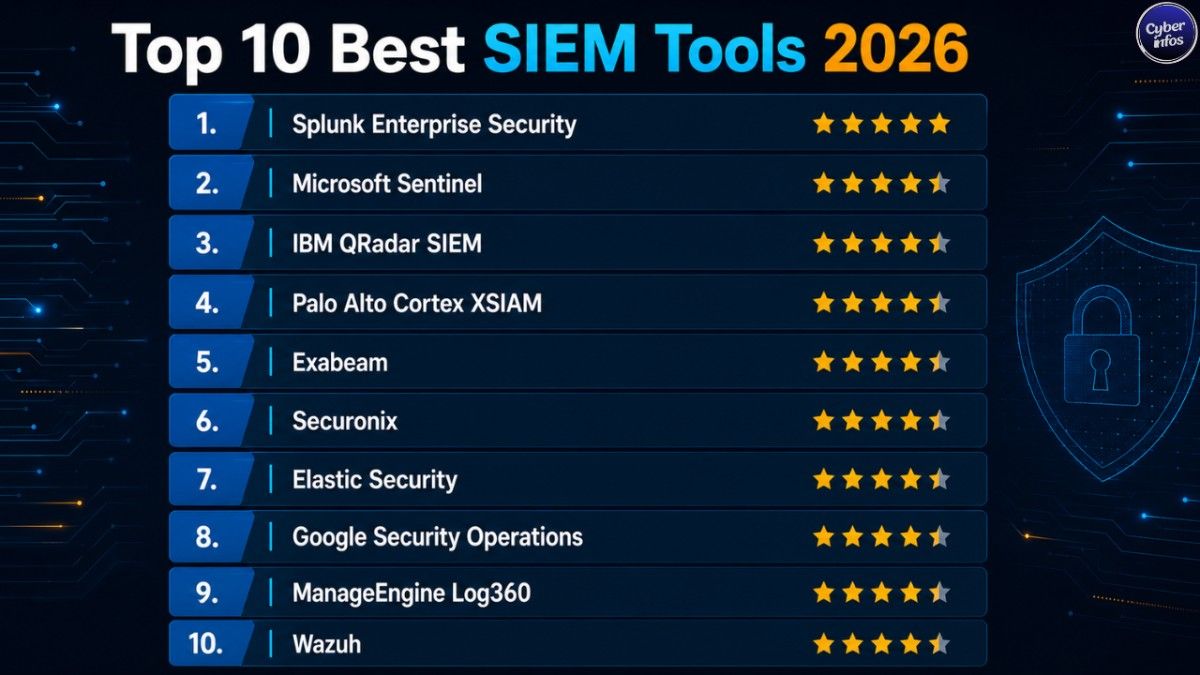
This guide is built for SOC analysts, security engineers, and CISOs running an enterprise SIEM ranking exercise right now, not for casual buyers. We compare ten platforms Splunk Enterprise Security, Microsoft Sentinel, IBM QRadar, Palo Alto Cortex XSIAM, Exabeam, Securonix, Elastic Security, Google Security Operations, ManageEngine Log360, and Wazuh on detection depth, pricing transparency, deployment fit, and real operational cost. Splunk Enterprise Security tops the list for mature detection-engineering teams, but the right pick for your SOC depends heavily on your data volume, compliance obligations, and existing cloud stack.
Quick Comparison: Top SIEM Tools for SOC Teams in 2026
| Rank | Product | Best For | Price | Rating | Key Feature |
|---|---|---|---|---|---|
| 1 | Splunk Enterprise Security | Mature detection engineering teams | ~$1,800–$2,700/GB-day (custom) | 4.8/5 | Risk-Based Alerting + SPL search |
| 2 | Microsoft Sentinel | Microsoft 365 / Azure-heavy SOCs | $2.46–$5.59/GB ingested | 4.6/5 | Native Defender XDR integration |
| 3 | IBM QRadar SIEM | On-premises & regulated enterprises | EPS/FPM or MVS licensing (custom) | 4.5/5 | 700+ integrations, AI-assisted triage |
| 4 | Palo Alto Cortex XSIAM | AI-driven SecOps consolidation | Custom enterprise quote | 4.5/5 | 3,000+ AI detectors, SIEM+XDR+SOAR+ASM |
| 5 | Exabeam (New-Scale Fusion) | UEBA & insider threat detection | From ~$250/user/yr (custom enterprise) | 4.4/5 | Entity timeline UEBA |
| 6 | Securonix Unified Defense SIEM | Behavioral analytics at scale | Capacity + per-user (custom) | 4.3/5 | Snowflake-native architecture |
| 7 | Elastic Security | High-volume log analytics on a budget | From ~$95/mo (Cloud); custom at scale | 4.3/5 | Lowest per-GB cost, open-core |
| 8 | Google Security Operations | Predictable, headcount-based pricing | $30–$140 per employee/yr | 4.2/5 | Mandiant threat intel built in |
| 9 | ManageEngine Log360 | SMBs and mid-market budgets | From ~$595/yr | 4.0/5 | Per-device pricing, AD auditing |
| 10 | Wazuh | Zero-budget, technically capable teams | $0 (Cloud tier custom) | 3.9/5 | Free, fully customizable detection |
How We Evaluated These SIEM Platforms
Evaluation Criteria
- Features — detection depth, UEBA, SOAR, and out-of-the-box correlation content
- Ease of Use — admin overhead, query language learning curve, and analyst onboarding time
- Performance — ingestion throughput, query latency, and alert-to-investigation speed
- Support — SLA structure, documentation quality, and professional services availability
- Security — platform hardening, data residency options, and access controls
- Integrations — breadth of connectors across EDR, cloud, identity, and network sources
- Scalability — how cost and performance behave as log volume or headcount grows
- Value for Money — total cost of ownership relative to detection and compliance outcomes
Testing Process
Our rankings combine hands-on SOC experience with several of these platforms, direct review of current vendor pricing and technical documentation, cross-referencing against Gartner Magic Quadrant, Forrester Wave, and IDC MarketScape positioning, and analysis of verified user feedback on G2, PeerSpot, and TrustRadius. We weighted recent ownership and architecture changes — the IBM-to-Palo Alto QRadar transition and the Exabeam-LogRhythm merger, in particular — heavily, since they affect long-term roadmap risk as much as current feature sets.
Disclaimer
SIEM pricing is overwhelmingly quote-based and shifts with negotiated discounts, commitment tiers, and regional rates. The figures in this guide reflect publicly documented list pricing and third-party cost analyses as of mid-2026; always request a current quote and run a proof-of-concept against your own log volume before signing a multi-year contract.
The Top 10 SIEM Tools for 2026, Ranked
1. Splunk Enterprise Security (Cisco) – Best Overall
Rating: ⭐⭐⭐⭐⭐ (4.8/5)
Quick Take: The most mature, deeply customizable enterprise SIEM on the market, with a per-GB pricing model that rewards disciplined data governance and punishes anyone who skips it.
Overview
Splunk became part of Cisco after the 2024 acquisition, but Enterprise Security (ES) the premium security app layered on the core Splunk platform remains the reference point most other SIEMs get measured against. It’s built for SOCs with dedicated detection engineers who want to write and tune their own correlation logic rather than rely entirely on vendor-supplied rules. Large enterprises and MSSPs make up the bulk of its customer base.
Key Features
- ✅ Search Processing Language (SPL) for custom correlation searches and ad hoc threat hunting
- ✅ Risk-Based Alerting (RBA) that aggregates low-fidelity signals into fewer, higher-confidence notables
- ✅ Massive Splunkbase ecosystem of prebuilt content packs, apps, and integrations
- ✅ Flexible deployment across self-hosted Enterprise, Splunk Cloud Platform, and hybrid setups
- ✅ MITRE ATT&CK-mapped correlation searches with built-in PCI DSS, HIPAA, and SOX dashboards
Pros
- ✅ Unmatched flexibility for custom detection engineering and ad hoc investigation
- ✅ Largest talent pool and community content library of any SIEM, which eases hiring
- ✅ Strong compliance reporting available out of the box
Cons
- ❌ Per-GB/day ingestion pricing punishes high-volume environments without active data tiering
- ❌ Steep SPL and dashboard learning curve without dedicated detection engineers on staff
Pricing
Splunk Enterprise (self-hosted) is licensed per GB of data indexed per day, with list pricing roughly $1,800–$2,700/GB-day annually depending on commitment tier. Splunk Cloud Platform offers ingest-based or workload-based (SVC) pricing, and the Enterprise Security add-on typically layers another 50–100% on top of base platform cost for SIEM-specific correlation. A free 500MB/day tier exists for testing only and lacks SIEM functionality.
Best For
Large enterprises and MSSPs with dedicated detection-engineering staff and budget for premium licensing.
Our Verdict
Splunk Enterprise Security is the platform most SOC analysts already know how to use, which counts for a lot when you’re hiring. It rewards investment in detection engineering with genuinely best-in-class flexibility, but the per-GB economics mean it’s the wrong choice if your team can’t commit to active data lifecycle management.
Bottom Line
⭐⭐⭐⭐⭐ If your SOC has the staff to operationalize it, nothing else matches Splunk’s detection depth and ecosystem maturity.
2. Microsoft Sentinel – Best for Cloud-Native & Microsoft-Centric SOCs
Rating: ⭐⭐⭐⭐⭐ (4.6/5)
Quick Take: A genuinely cloud-native SIEM with no infrastructure to manage, and now a tiered data architecture built specifically to control runaway ingestion costs.
Overview
Sentinel runs on Azure Monitor Log Analytics and sits inside Microsoft’s broader unified security operations platform alongside Defender XDR. There’s nothing to provision or patch — you onboard a workspace and start ingesting. For organizations already standardized on Microsoft 365 and Azure, it’s frequently the path of least resistance into a real SIEM.
Key Features
- ✅ KQL (Kusto Query Language) for hunting queries and analytics rules
- ✅ Deep native integration with Microsoft Defender XDR, Entra ID, and M365 telemetry
- ✅ Four-tier data architecture — Analytics, Basic, Auxiliary, and Data Lake — for cost-optimized retention
- ✅ Built-in automation via Logic Apps playbooks and a growing native automation rule engine
- ✅ Content hub with templates and connectors spanning 300+ data sources
Pros
- ✅ Fast time-to-value for Microsoft-heavy environments; no infrastructure to manage
- ✅ Commitment-tier pricing meaningfully cuts effective per-GB cost at scale
- ✅ Tight Defender XDR integration shortens investigation time for hybrid Microsoft estates
Cons
- ❌ Costs escalate quickly without disciplined log-tiering across Analytics, Basic, and Data Lake
- ❌ Less flexible for heavily non-Microsoft, multi-cloud, or legacy on-prem environments
Pricing
Pay-as-you-go runs roughly $4.30–$5.59 per GB ingested depending on region. Commitment tiers starting at 100 GB/day bring the effective rate down to around $2.46–$2.96/GB, scaling further at higher volumes. The newer Data Lake tier ingests at roughly $0.05/GB with low-cost long-term storage for compliance retention. A 10 GB/day free trial runs for the first 31 days.
Best For
Organizations standardized on Microsoft 365/Azure that want a cloud-native SIEM with zero infrastructure overhead.
Our Verdict
Sentinel earns its place near the top of any SIEM platform comparison 2026 buyers run, mainly because the Microsoft ecosystem is so large that “good enough cloud-native SIEM with deep Defender integration” beats “best-in-class but infrastructure-heavy” for a huge share of buyers. The data-tiering complexity is real, but manageable with discipline.
Bottom Line
⭐⭐⭐⭐⭐ The default smart choice for any SOC already living inside Microsoft 365 and Azure.
3. IBM QRadar SIEM – Best for On-Premises & Regulated Enterprises
Rating: ⭐⭐⭐⭐ (4.5/5)
Quick Take: A long-standing on-premises workhorse for regulated industries, now operating with a cloud roadmap that’s effectively been handed to Palo Alto Networks.
Overview
QRadar has anchored regulated-industry SOCs banking, government, critical infrastructure for well over a decade and has repeatedly been named a Gartner Magic Quadrant SIEM Leader. In 2024, Palo Alto Networks acquired QRadar’s SaaS assets and intellectual property; SaaS customers are being migrated toward Cortex XSIAM, while the on-premises QRadar Suite remains under IBM with continued support, updates, and bug fixes. That makes it, in 2026, primarily an on-premises and hybrid play rather than a cloud-first one.
Key Features
- ✅ Events Per Second (EPS) and Flows Per Minute (FPM) based correlation engine
- ✅ AI-assisted threat prioritization and incident scoring
- ✅ 700+ prebuilt integrations and a free, capped Community Edition for training
- ✅ Compliance and audit reporting tailored to banking, government, and healthcare
- ✅ Hardware appliance, virtual appliance, or Managed Virtual Server (MVS) licensing options
Pros
- ✅ Proven reliability in regulated, security-mature enterprises
- ✅ On-premises continuity for organizations that can’t move telemetry to the cloud
- ✅ Usage-based EPS/FPM and MVS licensing is more transparent than opaque per-GB schemes
Cons
- ❌ Cloud/SaaS roadmap uncertainty following the Palo Alto Networks asset sale
- ❌ Slower, dated UI and steeper learning curve compared to newer cloud-native competitors
Pricing
QRadar uses EPS/FPM-based licensing for hardware or virtual appliances, or an Enterprise MVS model based on the count of managed servers, both quote-based with subscription or perpetual options for on-prem deployments. A free Community Edition is capped at 50 EPS and 5,000 events per minute on a single, unsupported node useful for learning and small-scale testing only.
Best For
Regulated, security-mature enterprises that need to keep SIEM infrastructure on-premises.
Our Verdict
QRadar’s detection and compliance capabilities remain solid, and on-prem buyers shouldn’t be scared off by the SaaS headlines. But anyone evaluating QRadar for a net-new cloud deployment should price Cortex XSIAM in parallel, since that’s where IBM’s own roadmap is now pointing cloud customers.
Bottom Line
⭐⭐⭐⭐ Still a safe, capable choice for on-prem regulated SOCs just confirm your deployment model before signing.
4. Palo Alto Networks Cortex XSIAM – Best for AI-Driven SecOps Consolidation
Rating: ⭐⭐⭐⭐ (4.5/5)
Quick Take: Less a traditional SIEM than a unified SIEM, XDR, SOAR, and attack surface management platform built around AI-driven alert correlation.
Overview
Launched in 2022 and expanded aggressively since, Cortex XSIAM is now the landing platform for migrating IBM QRadar SaaS customers following the 2024 asset acquisition. Instead of presenting analysts with a raw alert stream, it correlates low-confidence signals from endpoint, network, identity, and cloud telemetry into a much smaller number of high-fidelity incidents using Palo Alto’s Precision AI models.
Key Features
- ✅ Automated correlation of low-confidence signals into high-fidelity incidents
- ✅ 3,000+ out-of-the-box detectors across endpoint, network, identity, and cloud sources
- ✅ Native attack surface management (ASM) inside the same console
- ✅ Cortex XSIAM for Cloud extends detection and response into cloud workloads
- ✅ Built-in case management and automated playbooks without separate core SOAR licensing
Pros
- ✅ Genuinely reduces alert fatigue through ML-driven incident correlation, not just dashboards
- ✅ Strong fit for organizations consolidating SIEM, XDR, SOAR, and ASM into one platform
- ✅ Backed by heavy roadmap investment and the IBM QRadar migration pipeline
Cons
- ❌ Premium-priced consolidation play, less appealing if you only need traditional log search
- ❌ Younger platform than Splunk or QRadar, so third-party community content is still catching up
Pricing
Cortex XSIAM is sold on a custom enterprise quote based on endpoints, data sources, and ingestion volume; there’s no published per-GB list price. IBM Consulting offers no-cost migration services for QRadar SaaS customers moving over, which materially changes the buying calculus for anyone already in that position.
Best For
Enterprises consolidating SIEM, XDR, SOAR, and attack surface management into a single AI-driven platform.
Our Verdict
XSIAM is the clearest example of where the SIEM category is heading: fewer standalone tools, more AI-correlated incidents instead of raw alerts. It’s not the right fit if you specifically want a flexible, vendor-neutral log-search platform, but for teams ready to consolidate, it delivers real operational relief.
Bottom Line
⭐⭐⭐⭐ The strongest pick for SOCs ready to trade platform sprawl for AI-driven consolidation.
5. Exabeam (New-Scale Fusion) – Best for UEBA & Insider Threat Detection
Rating: ⭐⭐⭐⭐ (4.4/5)
Quick Take: The deepest behavioral analytics engine in the SIEM market, now backed by LogRhythm’s data-ingestion pedigree after their 2024 merger.
Overview
Exabeam and LogRhythm completed their merger in July 2024. The combined company kept the Exabeam name and standardized on the New-Scale cloud SIEM architecture, discontinuing LogRhythm’s on-prem Axon product. New-Scale Fusion blends core SIEM functionality with Exabeam’s long-standing strength: UEBA built specifically to catch insider threats and compromised accounts that signature-based rules tend to miss.
Key Features
- ✅ UEBA-driven risk scoring and entity timeline reconstruction across users, hosts, and accounts
- ✅ Prebuilt correlation rules and TDIR (threat detection, investigation, response) workflows
- ✅ New-Scale Analytics for behavioral baselining without heavy manual tuning
- ✅ Nova platform layering AI-assisted investigation and lightweight SOAR (Nova Respond) on top
- ✅ 500+ integrations across cloud, identity, EDR, and on-prem sources
Pros
- ✅ Best-in-class UEBA for insider threats and compromised credentials
- ✅ Modular pricing lets teams license only the capabilities they actually need
- ✅ Migration credits available for legacy LogRhythm customers moving to New-Scale
Cons
- ❌ Modular per-source/per-user pricing can stack unpredictably without careful use-case scoping
- ❌ Loses on raw log-volume economics against Splunk or Sentinel for very high ingestion
Pricing
Exabeam licenses per user and per source across the Fusion SIEM, Nova, and New-Scale Analytics tiers. Published reference pricing starts around $250/user/year for entry tiers, with full enterprise deployments quote-based. Legacy LogRhythm customers migrating to Nova have reportedly received first-year credits worth 20–40% of new license value.
Best For
SOCs prioritizing insider threat detection, privileged-user monitoring, and behavioral analytics.
Our Verdict
If your biggest detection gap is “trusted users doing untrustworthy things,” Exabeam’s UEBA depth is hard to beat, and the LogRhythm merger has only strengthened its data-ingestion foundation. Just scope your use cases tightly before signing — modular pricing punishes vague requirements.
Bottom Line
⭐⭐⭐⭐ The strongest choice when insider threat and identity-centric detection is the core requirement.
6. Securonix Unified Defense SIEM – Best for Advanced Behavioral Analytics at Scale
Rating: ⭐⭐⭐⭐ (4.3/5)
Quick Take: A cloud-native, Snowflake-backed SIEM with deep identity-centric UEBA, best suited to teams already invested in the Snowflake data ecosystem.
Overview
Securonix Unified Defense SIEM runs its analytics layer on customer-owned Snowflake infrastructure, which decouples storage economics from analytics compute. That architecture gives security teams direct visibility and control over their data warehouse costs instead of accepting a vendor’s bundled pricing — though it also means an extra bill to manage.
Key Features
- ✅ Identity-centric UEBA with privileged-user behavioral baselines
- ✅ Snowflake-native architecture separating storage cost from analytics compute
- ✅ Prebuilt content library mapped to MITRE ATT&CK and insider-threat use cases
- ✅ Capacity-plus-per-user pricing model for more predictable scaling
- ✅ Native SOAR and case management for end-to-end investigation workflows
Pros
- ✅ Identity and privileged-access analytics rival Exabeam’s UEBA depth
- ✅ Decoupled storage/compute architecture can reduce long-term TCO for Snowflake-native teams
- ✅ Aggressively priced against Exabeam and QRadar in the mid-to-high enterprise tier
Cons
- ❌ Snowflake compute is billed separately and can equal or exceed the Securonix license at scale
- ❌ Best value requires existing or planned Snowflake infrastructure
Pricing
Securonix’s foundational tier is a capacity-plus-per-user annual license, quote-based, excluding Snowflake compute typically add 30–60% for a comparable Snowflake bill at the same capacity. Multi-year commitments above roughly 100,000 EPS routinely earn 25–30% off list price.
Best For
Enterprises with, or planning, Snowflake infrastructure that want deep identity and behavioral analytics.
Our Verdict
Securonix is a legitimate UEBA alternative to Exabeam, and its Snowflake-native model is genuinely appealing for data teams already standardized on that warehouse. Model the Snowflake compute cost carefully before comparing the headline license price against competitors it’s frequently the larger line item.
Bottom Line
⭐⭐⭐⭐ A strong UEBA contender, best evaluated alongside your existing (or planned) Snowflake footprint.
7. Elastic Security – Best Value for High-Volume Log Analytics
Rating: ⭐⭐⭐⭐ (4.3/5)
Quick Take: Open-core flexibility and the most cost-efficient per-GB pricing among major platforms, in exchange for a steeper do-it-yourself curve.
Overview
Elastic Security is built on the same Elastic Stack Elasticsearch and Kibana used for general logging and observability, adding SIEM detection rules, endpoint security, and ML-based anomaly detection on top. That shared foundation lets teams consolidate SIEM, observability, and search use cases on one platform instead of running separate tools.
Key Features
- ✅ Unified platform for SIEM, observability, and search/logging reduces tool sprawl
- ✅ Prebuilt detection rules mapped to MITRE ATT&CK plus ML-based anomaly detection
- ✅ Self-managed open-core or Elastic Cloud deployment options
- ✅ Searchable snapshots and frozen-tier storage cut long-retention costs materially
- ✅ Flexible query options via Elasticsearch DSL and ES|QL for custom hunting
Pros
- ✅ Lowest per-GB ingestion cost among major commercial SIEMs at high volume (1TB+/day)
- ✅ Open-core model avoids hard vendor lock-in; self-hosting remains a genuine option
- ✅ Doubles as an observability/logging platform, consolidating tooling and TCO
Cons
- ❌ Requires more in-house engineering to tune detections and manage cluster operations
- ❌ Inter-node data transfer and Enterprise-tier support surcharges can hide real cost
Pricing
Elastic Cloud Hosted tiers start around $95–$184/month for small deployments, with the Platinum tier (ML/SIEM features) starting near $131/month. Mid-market deployments (100–500 GB/day) commonly run $10,000–$50,000/month on Elastic Cloud. Self-managed Enterprise subscriptions typically start at $150,000+/year for large-scale, high-volume deployments.
Best For
Engineering-capable teams with high data volumes who want the lowest per-GB cost without sacrificing detection depth.
Our Verdict
Elastic Security is the rare SIEM that gets cheaper, relatively speaking, the more data you throw at it — a direct contrast to Splunk and Sentinel’s per-GB economics. The tradeoff is real: you’ll need cluster-management skills in-house, but for high-volume environments with engineering capacity, the math works strongly in Elastic’s favor.
Bottom Line
⭐⭐⭐⭐ The best per-GB value for teams willing to invest engineering time instead of license fees.
8. Google Security Operations (formerly Chronicle) – Best for Predictable Pricing at Scale
Rating: ⭐⭐⭐⭐ (4.2/5)
Quick Take: A per-employee pricing model that removes per-GB anxiety entirely, backed by native Mandiant threat intelligence.
Overview
Originally launched as Backstory in 2019 and rebranded Google Security Operations in April 2024 after absorbing the Siemplify SOAR acquisition, this platform runs on Google’s own infrastructure and is built around essentially unmetered log retention. Instead of billing per gigabyte ingested, Google charges per employee a structural difference that changes the entire cost conversation for data-heavy organizations.
Key Features
- ✅ Per-employee, tiered pricing (Standard / Enterprise / Enterprise Plus) with effectively unlimited ingestion
- ✅ Native Mandiant threat intelligence integration for IOC enrichment
- ✅ Unified SecOps SOAR (formerly Siemplify) in the same console as SIEM
- ✅ 300+ SOAR integrations and 700+ maintained data parsers
- ✅ Long, searchable retention without separate archive-tier complexity
Pros
- ✅ Pricing predictability that scales with headcount, not log volume ideal for data-heavy environments
- ✅ Strong out-of-the-box via Mandiant
- ✅ Independent studies commonly cite fast payback periods relative to per-GB competitors
Cons
- ❌ Per-employee model can be less economical for small-headcount, high-data-volume environments (e.g., OT/IoT-heavy networks)
- ❌ Deepest value requires buy-in to the broader Google Cloud ecosystem
Pricing
Standard tier runs roughly $30–$50 per employee per year, Enterprise tier $60–$95, and Enterprise Plus $100–$140. A 1,000-employee organization on the Enterprise tier lands around $60,000–$95,000/year before negotiated discounts, with multi-year, high-headcount commits routinely earning 25–35% off list.
Best For
Data-heavy organizations that want predictable, headcount-based pricing instead of per-GB billing.
Our Verdict
Google Security Operations solves a specific, real pain point the dread of an unexpected per-GB overage bill by tying cost to something that changes slowly: headcount. For network-heavy, low-headcount environments the math flips, so model your specific ratio of employees to log volume before committing.
Bottom Line
⭐⭐⭐⭐ The clearest answer for SOCs that want to stop worrying about ingestion volume entirely.
9. ManageEngine Log360 – Best Budget Pick for SMBs
Rating: ⭐⭐⭐⭐ (4.0/5)
Quick Take: The most budget-predictable SIEM on this list, with per-device/per-source pricing that avoids per-GB surprise bills entirely.
Overview
Part of the broader ManageEngine/Zoho IT management suite, Log360 bundles core SIEM with Active Directory auditing, cloud access governance, and file-server monitoring for mid-market teams that don’t want to assemble a multi-vendor security stack from scratch.
Key Features
- ✅ Per-device and per-syslog-source pricing for predictable budgeting
- ✅ Built-in Active Directory, file server, and Microsoft 365 auditing
- ✅ Machine-learning-based UEBA with risk scoring (lighter-weight than Exabeam or Securonix)
- ✅ 1,000+ prebuilt compliance reports covering PCI DSS, HIPAA, and GDPR
- ✅ On-premises, cloud, or hybrid deployment options
Pros
- ✅ Transparent, predictable pricing scaling with device/source count, not data volume
- ✅ Strong identity/Active Directory auditing useful for mid-market AD-heavy environments
- ✅ Fast time-to-value with minimal dedicated SIEM engineering required
Cons
- ❌ Detection and behavioral-analytics depth trails enterprise platforms like Splunk or CrowdStrike against sophisticated, persistent adversaries
- ❌ Less suited to large, multi-regulatory enterprises needing FedRAMP-level compliance automation
Pricing
Entry plans start around $595/year for small environments under 50 devices. Mid-market and enterprise pricing scales with device/source count, typically landing in the low-to-mid five figures annually. A free trial and demo are available.
Best For
Small and mid-sized businesses wanting predictable SIEM costs without per-GB ingestion risk.
Our Verdict
Log360 won’t out-detect a Splunk or Securonix deployment against a determined APT, but that’s not the buyer it’s built for. For SMBs that need real compliance reporting and AD-centric visibility without hiring a dedicated SIEM engineer, it delivers genuine, predictable value.
Bottom Line
⭐⭐⭐⭐ The most sensible budget entry point for SMBs that still need credible compliance coverage.
10. Wazuh – Best Free, Open-Source SIEM
Rating: ⭐⭐⭐⭐ (3.9/5)
Quick Take: The only genuinely free, enterprise-capable SIEM in this list at the cost of real engineering investment to run it well.
Overview
Wazuh is an open-source security monitoring platform (GPLv2) covering log analysis, host-based intrusion detection, and file integrity monitoring, built on components shared with the broader Elastic/OpenSearch ecosystem. It has become a common starting point for SOC analysts learning detection engineering before moving to commercial platforms.
Key Features
- ✅ Free, open-source manager, indexer, and dashboard with no licensing cost
- ✅ File integrity monitoring and host-based intrusion detection alongside log correlation
- ✅ Active community plus a managed Wazuh Cloud option for hosted infrastructure
- ✅ Compliance mapping for PCI DSS, GDPR, and other common frameworks
- ✅ Fully customizable rule sets for teams with security engineering capacity
Pros
- ✅ Zero license cost the only realistic free option for teams without enterprise SIEM budget
- ✅ Full transparency and customizability of detection logic, ideal for learning and skill-building
- ✅ Genuinely enterprise-capable for log analysis and threat detection at small-to-mid scale
Cons
- ❌ Production deployment isn’t free in practice infrastructure and engineering can run $15,000–$40,000+/year at mid-market scale
- ❌ Lacks the polished UX, formal support SLAs, and advanced AI/UEBA depth of commercial platforms
Pricing
The core software is $0, open source under GPLv2. A managed Wazuh Cloud tier bundling infrastructure and support is available on a quote basis. Realistic all-in cost for a mid-market self-hosted deployment infrastructure plus a dedicated engineer typically runs $145,000–$200,000/year fully loaded once staffing is counted.
Best For
Budget-constrained teams, students, and SOC analysts who want full control of detection logic and are willing to invest engineering time instead of license fees.
Our Verdict
Wazuh earns its spot honestly: it’s the only platform on this list with a real $0 license cost, and it’s a legitimately good way to learn SIEM internals. Just budget the engineering time realistically “free” software still needs someone to run it.
Bottom Line
⭐⭐⭐⭐ The right call for teams with engineering capacity and no SIEM licensing budget.
SIEM Buying Guide: What to Look for When Choosing a Platform
Beyond the product-by-product comparison above, a handful of factors decide whether a SIEM deployment actually succeeds or quietly turns into shelfware.
Feature Set
Detection content, UEBA, and SOAR depth matter more than the length of a feature checklist. Prioritize platforms whose out-of-the-box correlation rules map to MITRE ATT&CK techniques relevant to your actual threat model. Red flag: a vendor that can’t clearly explain how their detection logic gets updated as new techniques emerge.
Ease of Use
A SIEM your analysts can’t query efficiently under pressure during an incident isn’t doing its job. Weigh the learning curve of the query language (SPL, KQL, Elasticsearch DSL) against your team’s existing skills, and budget real training time regardless of vendor claims about “intuitive” interfaces.
Performance
Query latency and alert-to-investigation speed compound during an active incident. Test search performance against your own representative log volume during a proof-of-concept rather than trusting vendor benchmarks run on idealized datasets.
Security
The platform holding your most sensitive telemetry needs its own hardening: granular role-based access control, audit logging of analyst actions, and clear data residency options if you operate under regional data protection requirements.
Integrations
Check connector coverage against your actual data sources EDR, identity provider, cloud platforms, network appliances not just a marketing slide claiming “1,000+ integrations.” A platform missing a connector for your core EDR vendor adds real custom-parser work later.
Support
SLA structure and escalation paths matter most during a live incident, not during the sales cycle. Confirm response-time commitments for Severity 1 issues and whether professional services or implementation partners are required to reach production readiness.
Scalability
Model your log volume or headcount three years out, not just today. Per-GB pricing models (Splunk, Sentinel) create direct cost exposure as data grows; per-employee (Google SecOps) and per-device (Log360) models scale differently. Pick the model that matches your organization’s actual growth trajectory.
Pricing
Get the total cost of ownership, not the headline license price. Staffing alone commonly runs $150,000–$250,000 per analyst FTE, with 5–7 FTEs needed for genuine 24/7 SOC coverage platform licensing is often only 30–40% of what a SIEM actually costs in production.
CyberInfos Analyst InsightThe single most common SIEM buying mistake we see isn’t picking the wrong vendor it’s signing a multi-year per-GB contract based on current log volume and then onboarding three new data sources in year two. Model your year-three ingestion before you negotiate, not after.
Common SIEM Buying Mistakes
- Choosing based on price only. The cheapest license often hides the largest total cost once staffing, professional services, and overage fees are counted.
- Ignoring scalability. A platform that’s affordable at 50 GB/day can become unaffordable at 500 GB/day under the wrong pricing model.
- Not testing free trials or proof-of-concepts. Vendor demos use clean, curated data; your own messy log sources will behave differently.
- Overlooking support quality. A platform with great features and a slow Severity 1 response time still fails you during an actual incident.
- Focusing only on features. A long feature checklist means nothing if your team lacks the staff to operationalize half of it.
- Underestimating data ingestion growth. Per-GB SIEM bills can double within 18 months as cloud, SaaS, and EDR sources get added — model that growth before signing.
Frequently Asked Questions
Which is the best SIEM tool overall?
Splunk Enterprise Security ranks as the best overall SIEM for 2026 thanks to its detection-engineering flexibility, massive third-party content ecosystem, and proven track record across large, mature SOCs. It’s the platform most security professionals already have experience with, which significantly eases hiring and onboarding. The tradeoff is cost: per-GB ingestion pricing requires real discipline to keep under control as data volumes grow.
Which SIEM is best for beginners?
Microsoft Sentinel is the easiest entry point for teams new to SIEM, since it’s fully cloud-native with no infrastructure to provision and offers a generous free trial tier. Organizations already on Microsoft 365 benefit from documentation and native integrations that flatten the learning curve further. ManageEngine Log360 is a reasonable alternative for very small teams that want minimal operational overhead and prebuilt compliance reports out of the box.
Which is best for enterprises?
It depends on what “enterprise” means for your organization. Splunk Enterprise Security suits large SOCs that want maximum detection-engineering flexibility, while Palo Alto Cortex XSIAM fits enterprises consolidating SIEM, XDR, SOAR, and attack surface management into one AI-driven platform. IBM QRadar remains the safer choice for regulated enterprises that must keep telemetry on-premises.
Which is the most affordable?
Wazuh is free at the software level, making it the most affordable option outright, though production deployments still require real infrastructure and engineering investment. Among commercially licensed and supported platforms, ManageEngine Log360 is the most affordable, with predictable per-device pricing starting around $595/year for small environments.
Are free versions worth using?
Free tiers like Wazuh’s core software or IBM QRadar’s capped Community Edition are genuinely useful for learning SIEM internals, running small-scale labs, or supporting very small environments. They become less viable at production scale, where the “free” software still requires real infrastructure and dedicated engineering time — often $15,000–$40,000+ per year for a mid-market deployment once that’s factored in.
How much should I budget for a SIEM?
Budgets vary enormously by scale. SMBs can realistically run a supported SIEM like ManageEngine Log360 for a low five-figure annual sum. Mid-market organizations running Microsoft Sentinel or Elastic Security at moderate volume typically budget tens of thousands of dollars per month. Large enterprises running Splunk or Sentinel at 1TB+/day commonly spend $600,000 to over $1 million annually once licensing, storage, and analyst staffing are included.
Which has the best support?
IBM QRadar and Splunk both maintain large, established enterprise support organizations with formal SLA tiers and extensive professional services arms, backed by IBM Consulting and Splunk Professional Services respectively. Microsoft Sentinel benefits from Microsoft’s broader enterprise support agreements for organizations already on Azure or Microsoft 365 support plans.
Which offers the best security/detection capability?
Palo Alto Cortex XSIAM currently leads on raw AI-driven detection breadth, with 3,000+ out-of-the-box detectors correlating signals across endpoint, network, identity, and cloud telemetry into high-fidelity incidents. Splunk Enterprise Security and Exabeam remain strong alternatives, particularly where custom detection engineering or deep UEBA for insider threats is the priority.
What alternatives should I consider beyond this list?
Buyers running a broader enterprise SIEM ranking exercise should also evaluate CrowdStrike Falcon Next-Gen SIEM (strong if already on the Falcon endpoint platform), Sumo Logic, Devo, Rapid7 InsightIDR, Fortinet FortiSIEM, LogPoint, and Stellar Cyber, each of which fits specific deployment models or budget tiers not fully covered by the top 10 above.
How do I choose between the top two options?
Between Splunk Enterprise Security and Microsoft Sentinel, the decision usually comes down to environment and team skills. Choose Splunk if you need maximum detection-engineering flexibility across multi-cloud, legacy, or non-Microsoft infrastructure and have staff who know SPL. Choose Sentinel if your organization is Microsoft 365/Azure-centric and you want a cloud-native SIEM with zero infrastructure overhead and tight Defender XDR integration.
Final Recommendations
Best OverallSplunk Enterprise Security wins on sheer detection-engineering flexibility, ecosystem maturity, and the largest available talent pool of any SIEM on this list.
Best Budget OptionManageEngine Log360 delivers predictable, device-based pricing and credible compliance reporting without the per-GB ingestion risk that drives up costs on larger platforms.
Best Enterprise SolutionPalo Alto Networks Cortex XSIAM wins for enterprises ready to consolidate SIEM, XDR, SOAR, and attack surface management into one AI-driven platform backed by aggressive ongoing investment.
Best Small Business ChoiceManageEngine Log360 again, this time for its bundled Active Directory and Microsoft 365 auditing — most SMBs need that identity visibility as much as raw SIEM correlation.
Best Free OptionWazuh is the only platform here with a genuine $0 license cost, making it the right call for teams with engineering capacity and no SIEM budget at all.
How We Rank
- Security Features – 30%
- Ease of Use – 20%
- Performance – 15%
- Customer Support – 15%
- Price/Value – 10%
- Extra Features – 10%
Whichever platform you land on, the strongest predictor of SIEM success isn’t the vendor logo it’s whether your team actually has the staff and time to tune detections, write playbooks, and operationalize the tool day to day. Run a proof-of-concept against your real log volume before signing anything, and revisit this enterprise SIEM ranking annually; 2026 has already shown how quickly vendor ownership and roadmaps can shift underneath a platform you’ve built your SOC around.
CyberInfos.in independently researches and evaluates every platform in this guide using vendor documentation, analyst reports (Gartner, Forrester, IDC), G2/PeerSpot verified user reviews, and direct SOC practitioner experience. We do not accept vendor sponsorships, and this ranking is not influenced by affiliate partnerships.
