

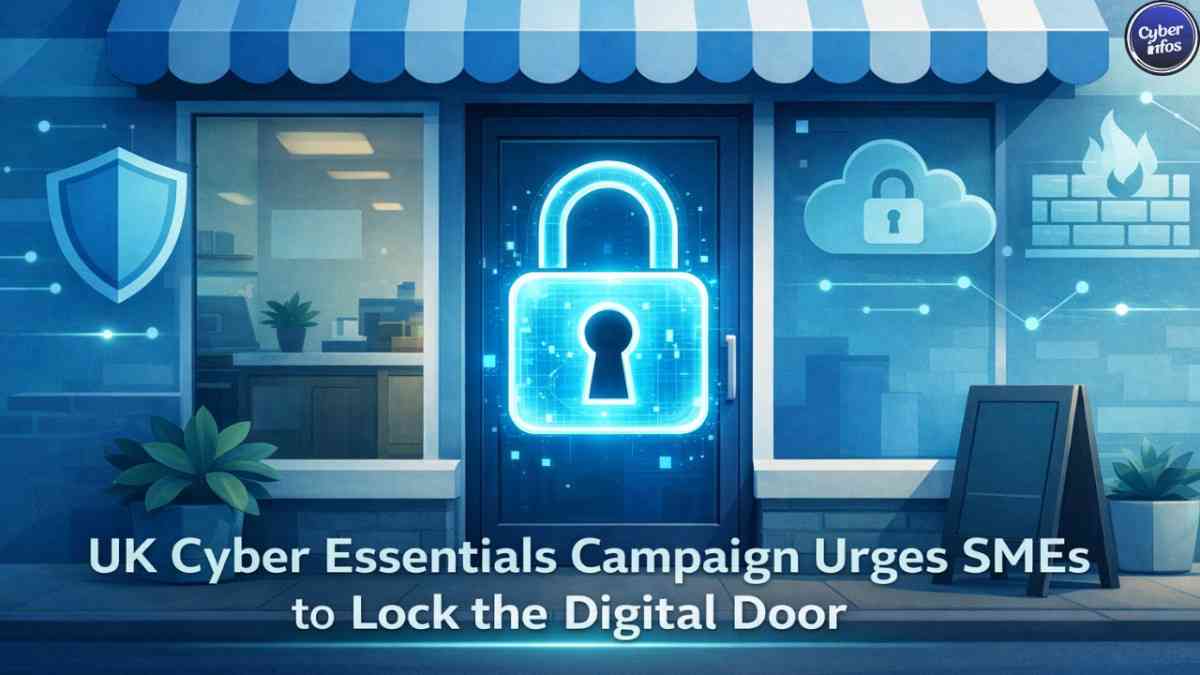
The UK Cyber Essentials campaign, launched on February 16, 2026, carries a message that feels both simple and urgent: if you wouldn’t leave your office unlocked overnight, don’t leave your business exposed online.
Led by the UK Government, the campaign focuses on helping small and medium-sized businesses (SMEs) take practical, affordable steps to protect themselves from cyber criminals. It avoids technical overwhelm and instead promotes straightforward security habits that dramatically reduce risk.
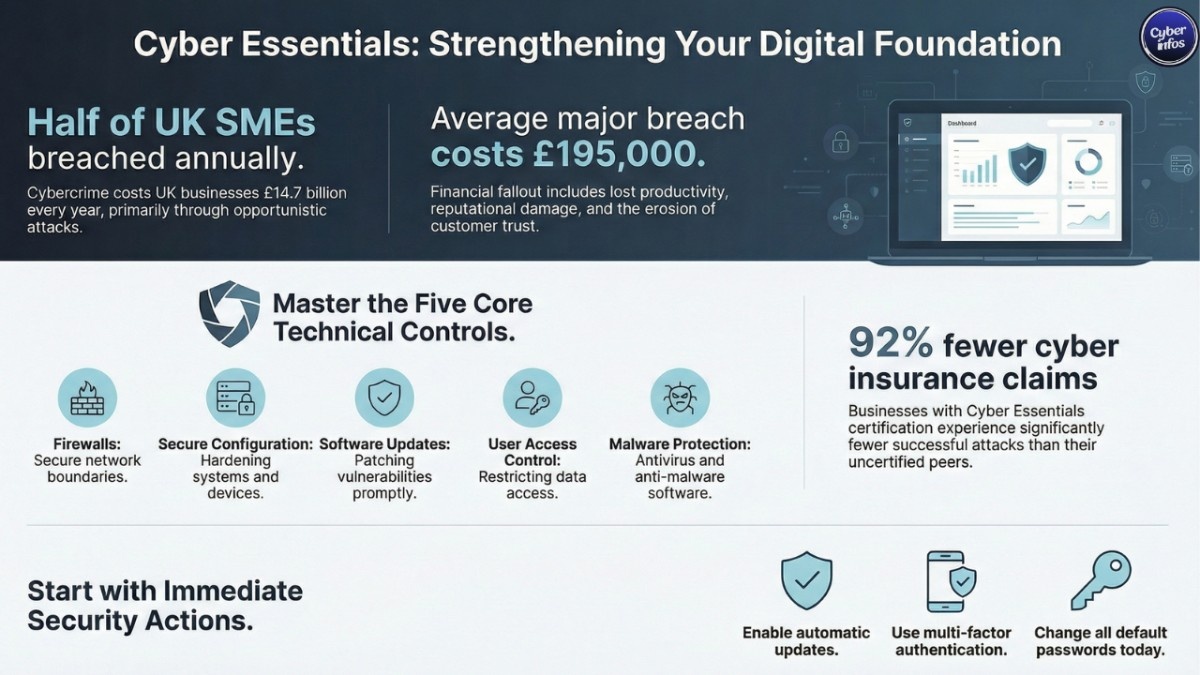
The timing matters. Cyber crime is costing UK businesses an estimated £14.7 billion annually. Half of small businesses experienced a breach or attack in the past 12 months. Among medium and large companies, 82% reported at least one cyber incident. When significant breaches occur, the average cost is around £195,000 not just financially, but in lost productivity, reputational damage, and customer trust.
The takeaway is clear: cyber criminals are not just targeting global brands. They’re scanning for easy openings and many smaller firms unintentionally provide them.
Why the UK Cyber Essentials Campaign Matters Right Now
For many business owners, cybersecurity feels abstract something handled by enterprise IT teams. But today’s threats are often automated and opportunistic. Attackers use tools that scan for weak passwords, outdated systems, and poorly configured services.
If they find a vulnerability, they exploit it.
The UK Cyber Essentials campaign shifts the focus from reacting to breaches to preventing them. Closing simple security gaps costs far less than responding to ransomware, legal consequences, or public fallout after a data leak.
Small businesses are particularly vulnerable because they often operate lean. Limited time and resources can mean delayed updates, shared passwords, or overlooked security settings. Attackers know this and frequently target SMEs as stepping stones into larger supply chains.
This campaign reframes cybersecurity as part of everyday business responsibility, not an optional technical add-on.
What Is Cyber Essentials?
At the center of the campaign is the Cyber Essentials certification scheme. Developed by the National Cyber Security Centre (NCSC) and the Department for Science, Innovation and Technology (DSIT), it provides a clear and manageable cybersecurity baseline.
Rather than overwhelming businesses with complex frameworks, Cyber Essentials focuses on five core technical controls:
- Firewalls – Preventing unauthorized access to your network.
- Secure Configuration – Setting up systems safely from the start.
- Software Updates – Fixing known vulnerabilities promptly.
- User Access Control – Restricting permissions to what employees truly need.
- Malware Protection – Detecting and blocking malicious software.
These measures stop the majority of common cyber attacks. In fact, organizations with Cyber Essentials certification experienced 92% fewer cyber insurance claims last year strong evidence that foundational protections work.
Certification can also improve business credibility, support bids for government contracts, and provide access to cyber insurance and a 24/7 emergency helpline.
The Biggest Risk: “It Won’t Happen to Us”
One of the most dangerous assumptions in cybersecurity is believing your company is too small to be targeted.
If your business stores customer information, processes payments, uses cloud platforms, or relies heavily on email, you are part of the digital landscape that attackers scan daily.
The UK Cyber Essentials campaign challenges this mindset. Cybersecurity is no longer a specialist concern it’s a business continuity issue. Whether you run a retail shop, consultancy, healthcare practice, or logistics firm, digital resilience is essential.
How to Protect Your Business Now
The strength of the UK Cyber Essentials campaign lies in turning awareness into action. Here are practical steps you can implement immediately:
Immediate Actions (Start Today)
- Enable automatic updates on all systems and applications.
- Change default passwords on routers, cloud services, and hardware.
- Turn on multi-factor authentication (MFA) wherever available.
- Back up critical data to secure cloud or offline storage.
Short-Term Actions (This Week)
- Review employee access permissions and remove unnecessary admin rights.
- Install or verify anti-malware protection on all endpoints.
- Check firewall settings to limit exposed services.
- Complete the Cyber Essentials Readiness Tool to assess gaps.
Long-Term Best Practices
- Apply for Cyber Essentials certification.
- Provide staff awareness training to reduce phishing risk.
- Create an incident response plan outlining roles and procedures.
- Conduct annual security reviews as your business grows.
Cybersecurity doesn’t have to be complicated. Consistency and accountability make the difference.
Free Resources Available to SMEs
To make adoption easier, the campaign includes practical support:
- A Cyber Essentials Readiness Tool for self-assessment.
- Free 30-minute consultations with NCSC-assured advisors.
- Access to official Question Set and IT Requirements documentation.
These tools remove uncertainty and help smaller firms move from intention to implementation.
National Resilience and Policy Context
The campaign complements broader legislative efforts, including the proposed Cyber Security and Resilience Bill, which aims to strengthen protections across essential and digital services such as healthcare, energy, and data infrastructure.
Adoption of Cyber Essentials among larger companies has already increased from 23% to 30%, showing growing awareness. The goal is to accelerate this momentum across businesses of all sizes.
The message from policymakers is consistent: attackers don’t discriminate by company size. They exploit weaknesses.
Additional Cyber Hygiene Tips
- Segment your network to contain potential breaches.
- Monitor login activity for unusual behavior.
- Test backups regularly to ensure fast recovery.
You may also consider publishing internal phishing simulations or reviewing ransomware preparedness as part of ongoing risk management.
FAQ: UK Cyber Essentials Campaign
What is the UK Cyber Essentials campaign?
It is a government initiative encouraging businesses to adopt baseline cybersecurity protections through the Cyber Essentials certification scheme.
Is Cyber Essentials mandatory?
It is not mandatory for all businesses, but it is required for certain government contracts and strongly recommended as a foundational defense.
Does certification prevent all cyber attacks?
No security measure offers 100% protection. However, Cyber Essentials significantly reduces exposure to common, opportunistic threats.
How long does certification take?
For many SMEs, once the five core controls are in place, certification can be completed relatively quickly.
Why is this campaign important now?
Cyber incidents are increasing in frequency and financial impact, making proactive prevention more urgent than ever.
Final Thoughts
The UK Cyber Essentials campaign reinforces a powerful truth: strong cybersecurity starts with simple actions.
Attackers are constantly scanning for vulnerabilities. Businesses that implement basic protections dramatically reduce their chances of becoming the next target. You don’t need to overhaul your entire IT infrastructure overnight. Start with the fundamentals. Build consistent habits. Treat cybersecurity as a core business function.
Stay ahead of emerging threats: Join our WhatsApp Channel for real-time security alerts.
Follow us on LinkedIn for daily cybersecurity insights and breaking news.
