


When critical infrastructure software is exposed to the internet, attackers rarely wait. That pattern has repeated itself with the recent SmarterMail vulnerabilities, which were weaponized within days of disclosure and are now tied to real-world ransomware activity.
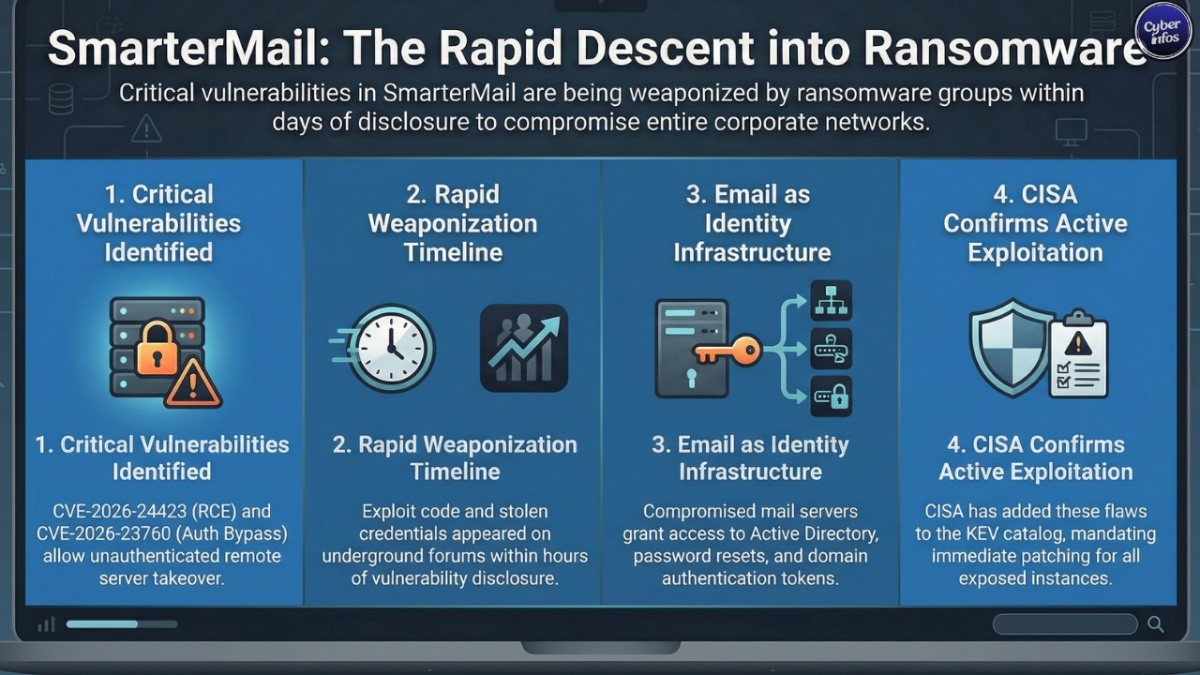
Security researchers monitoring underground Telegram channels and cybercrime forums observed threat actors rapidly sharing proof-of-concept (PoC) exploit code, offensive tooling, and even stolen administrator credentials linked to CVE-2026-24423 and CVE-2026-23760. What stands out isn’t just the severity of the flaws it’s the speed at which they were operationalized.
Email servers have quietly become one of the most strategic entry points into corporate networks. Unlike endpoint devices protected by EDR, messaging infrastructure often sits in a high-trust position, deeply integrated with identity systems and Active Directory. Once compromised, it can provide attackers with far more than mailbox access it can hand them the keys to the kingdom.
SmarterMail Vulnerabilities Enable Full Server Takeover
Two flaws are at the center of the current exploitation wave:
- CVE-2026-24423 – Critical unauthenticated remote code execution (CVSS 9.3)
- CVE-2026-23760 – Authentication bypass and password reset logic flaws (CVSS 9.3)
CVE-2026-24423 affects SmarterMail versions prior to Build 9511 and allows attackers to execute arbitrary code without authentication. No user interaction is required, making it highly suitable for automated mass scanning and exploitation campaigns.
In parallel, CVE-2026-23760 enables attackers to reset administrator credentials or bypass authentication controls entirely. When chained together, these vulnerabilities allow adversaries to escalate from application-level access to operating system control and potentially into domain-level compromise.
Security researchers have also observed patch reverse engineering, a common tactic where attackers analyze security updates to rapidly identify exploitable code paths. That shortens the timeline between disclosure and exploitation dramatically.
Real-World Breaches Confirm the Risk
In January 2026, SmarterTools confirmed it was breached after attackers exploited an unpatched internal SmarterMail server. The compromised VM was exposed within the company’s internal network and connected to segments integrated with Active Directory.
Attackers moved laterally, impacting approximately a dozen Windows servers. While customer services and data were reportedly unaffected, the incident followed a familiar ransomware playbook: foothold establishment, credential harvesting, lateral movement, and staging for encryption.
Separately, reporting from Bleeping Computer highlighted cases where ransomware operators gained access through SmarterMail vulnerabilities and delayed payload deployment a tactic commonly seen among affiliate-based ransomware groups seeking maximum leverage.
The pattern typically looks like this:
- Initial access via email server vulnerability
- Credential harvesting or token extraction
- Active Directory lateral movement
- Persistence via scheduled tasks or tool abuse
- Delayed ransomware deployment
Some activity clusters have been linked to the Warlock ransomware group, with overlaps suggesting possible nation-state-aligned tooling in certain cases. Attribution remains ongoing.
Email Servers: A High-Value Identity Target
Email infrastructure occupies a unique trust position inside organizations. It frequently provides:
- Domain authentication tokens
- Password reset workflows
- External communication gateways
- Internal contact intelligence
- Integration with directory and identity services
Compromise an email server, and you often compromise identity workflows.
This is why attackers increasingly treat email systems as stepping stones into broader enterprise environments. They are quieter targets compared to domain controllers but often just as powerful.
1,200+ Potentially Vulnerable Servers Exposed
Shodan analysis identified roughly 34,000 servers indicating SmarterMail exposure, with approximately 17,754 unique instances. Of those, around 1,185 appeared vulnerable to authentication bypass or RCE flaws at the time of inspection.
Geolocation data shows a strong concentration in the United States, though vulnerable systems span hosting providers, VPS environments, shared infrastructure, and self-managed deployments worldwide.
The distribution suggests a mix of small businesses, hosting resellers, and independently managed environments segments that often lack dedicated security monitoring.
Underground Forums Weaponize SmarterMail Vulnerabilities
Researchers observed exploit references appearing on Telegram channels within hours of disclosure. Arabic- and Spanish-speaking cybercrime communities shared PoC demonstrations and offensive tools tied to the vulnerabilities.
More concerning were posts advertising stolen administrator credentials allegedly harvested from compromised SmarterMail servers. In some cases, credential dumps included domain associations and login details.
This behavior is consistent with modern cybercrime supply chains:
- Vulnerability disclosure
- PoC development
- Credential harvesting
- Exploit kit packaging
- Ransomware affiliate adoption
The time between steps continues to shrink.
CISA Confirms Active Exploitation
In early February 2026, the Cybersecurity and Infrastructure Security Agency (CISA) added CVE-2026-24423 to its Known Exploited Vulnerabilities (KEV) catalog after confirming ransomware-linked exploitation.
CISA’s KEV listing is significant. Inclusion signals verified, real-world abuse and typically triggers federal patching mandates under Binding Operational Directive 22-01.
Organizations can review the KEV catalog directly via CISA’s official site
Guidance from the National Institute of Standards and Technology (NIST) further emphasizes prioritizing internet-exposed services when managing critical vulnerabilities.
How to Protect Email Infrastructure From Ransomware Access
Email servers must be treated as identity infrastructure not just application systems.
Security teams should:
Patch immediately
Upgrade to fixed SmarterMail builds. Treat these vulnerabilities with domain-controller-level urgency.
Audit administrator accounts
Rotate credentials, especially for admin and service accounts. Investigate unexpected password resets.
Enable comprehensive logging
Monitor:
- Admin password reset activity
- Suspicious API calls
- Unexpected outbound HTTP traffic
- Creation of scheduled tasks
Segment the network
Restrict lateral movement by isolating mail servers from unrestricted internal access.
Hunt for post-exploitation indicators
Search for:
- New administrative users
- Persistence mechanisms
- Unauthorized remote management tools
- Suspicious PowerShell activity
If compromise is suspected, engage incident response immediately.
Additional Safety Considerations
Smaller organizations and managed hosting providers face elevated risk. Self-hosted email infrastructure often lacks 24/7 monitoring, making detection slower.
Security teams should also:
- Review firewall exposure of mail services
- Implement MFA for administrative access
- Deploy EDR on underlying mail server hosts
- Monitor dark web exposure for leaked credentials
Attackers now view email servers as high-leverage assets. Defenders must adjust accordingly.
FAQ: SmarterMail Vulnerabilities and Ransomware Risk
What are the SmarterMail vulnerabilities CVE-2026-24423 and CVE-2026-23760?
CVE-2026-24423 is a critical unauthenticated remote code execution flaw, while CVE-2026-23760 enables authentication bypass and password reset abuse. Together, they allow full server compromise.
Are SmarterMail vulnerabilities being actively exploited?
Yes. CISA confirmed active exploitation in ransomware campaigns and added CVE-2026-24423 to its KEV catalog.
How quickly were the SmarterMail vulnerabilities weaponized?
Exploit references appeared on underground forums within days of disclosure. Proof-of-concept code circulated almost immediately.
How can organizations detect compromise of SmarterMail servers?
Look for unusual admin resets, new accounts, outbound connections, scheduled task creation, and abnormal Active Directory activity.
Final Thoughts
The rapid exploitation of SmarterMail vulnerabilities underscores a broader reality: attackers no longer wait months to operationalize new flaws. Disclosure-to-ransomware timelines now compress into days.
Email infrastructure is identity infrastructure. Treating it as anything less invites risk.
Organizations that move quickly patching, segmenting, monitoring, and hunting can stay ahead. Those that delay may find attackers already inside.
Calls to Action
- Audit your SmarterMail version today
- Patch immediately if vulnerable
- Monitor for suspicious admin activity
- Review network segmentation policies
Proactive defense now is far less costly than incident response later.
