


Most penetration tests don’t fail because defenders lack tools they fail because humans can’t run them fast enough. In under 15 minutes, a publicly exposed server can face dozens of automated probes from opportunistic attackers.
That gap between machine-speed attacks and human-speed testing is exactly why the AI-powered penetration testing tool model is gaining attention. Platforms like PentAGI aim to automate reconnaissance, vulnerability discovery, and exploitation workflows by coordinating specialized agents that control multiple security tools simultaneously. Instead of juggling dozens of scripts and terminals, security teams can experiment with autonomous penetration testing that runs structured assessments with minimal human intervention.
The stakes are real: a single overlooked service or misconfigured endpoint can expose internal assets long before a manual audit cycle even begins, especially when attackers already rely on automated red team tools.
This article breaks down how PentAGI’s multi-agent architecture works, what makes the platform different from traditional pentesting frameworks, and where it fits in modern offensive security pipelines built around an AI pentesting platform.
Core Capabilities of the PentAGI AI Pentesting Platform
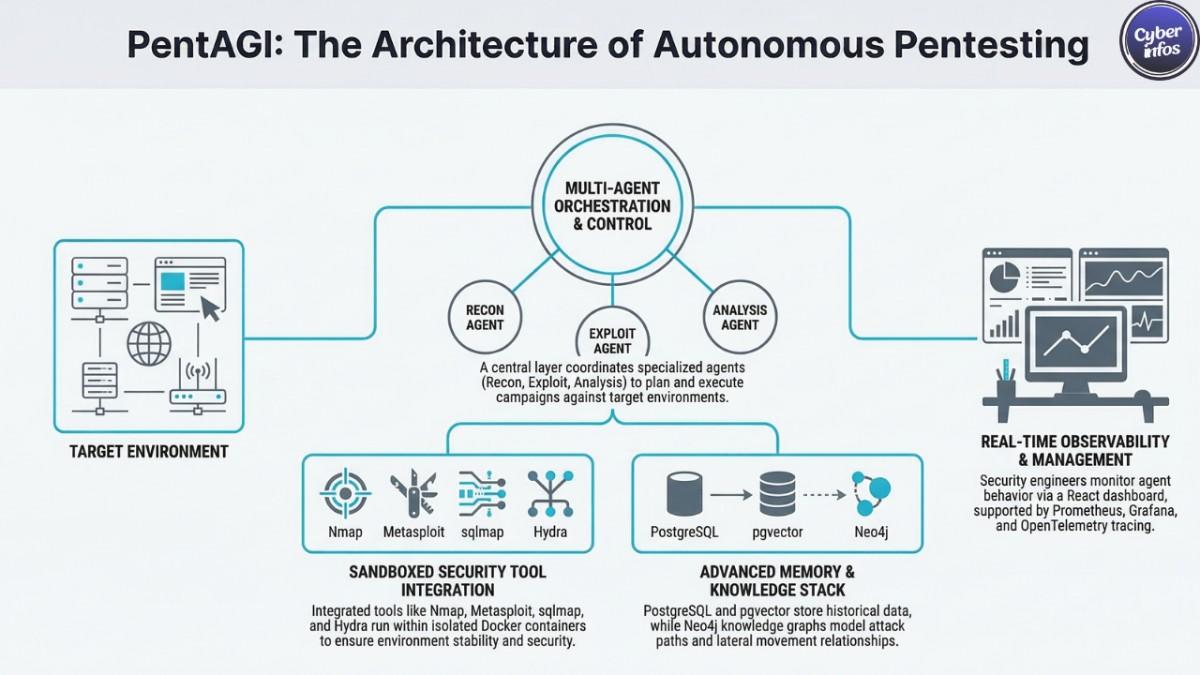
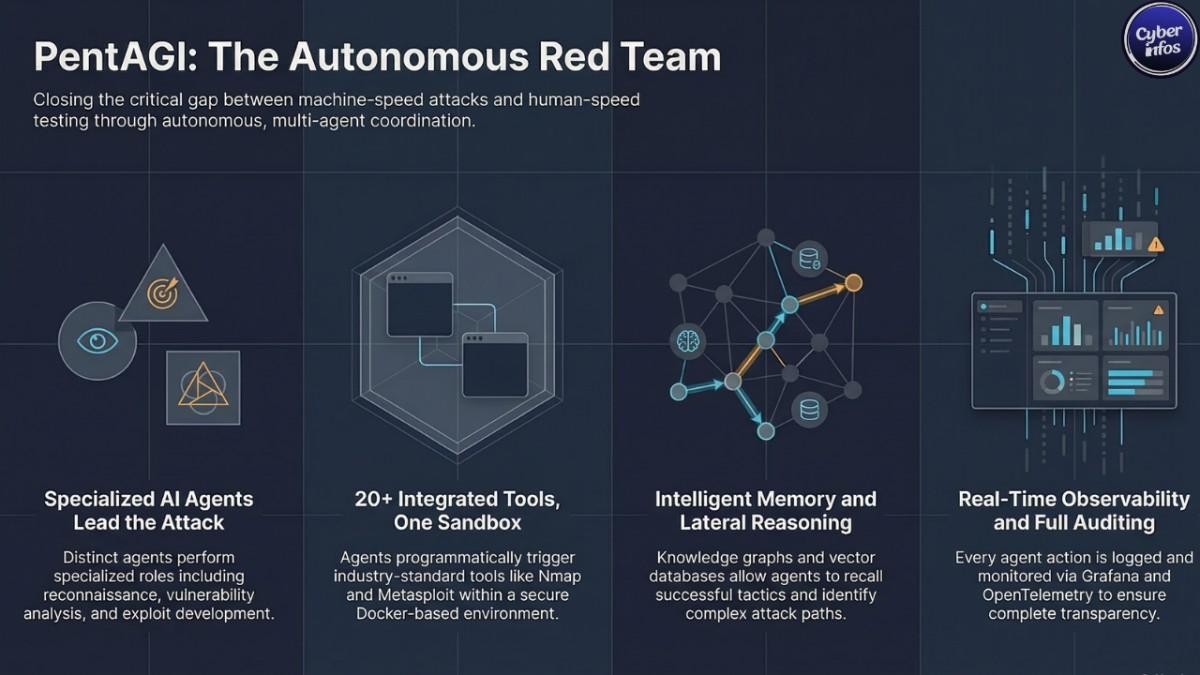
PentAGI runs on a multi-agent penetration testing architecture, forming an autonomous AI pentesting platform. Individual AI agents take on distinct roles: reconnaissance, exploit development, vulnerability analysis, and infrastructure management. A user defines a target environment. The agents plan and execute a full penetration testing campaign discovery through exploitation, finishing with structured reporting.
Every command is recorded. Every tool output is captured. Internal reasoning steps are logged so the test can be replayed later or audited by teams running formal red-team exercises. That audit trail matters.
Plenty of automated security tools fire off scans and dump results into a report. PentAGI attempts something more ambitious. The agents choose which tools to execute, interpret the results, then shift tactics depending on what they uncover during the test.
They also retain memory from previous engagements.
If an exploitation chain worked once perhaps a specific Nmap discovery followed by a Metasploit module and credential reuse the system can recall that pattern and attempt similar strategies later. What stands out isn’t raw novelty.
It’s persistence. The agents keep exploring attack paths until something sticks, much like a junior tester who refuses to move on until every lead is exhausted.
Integrated Security Tooling for Autonomous Penetration Testing
PentAGI bundles more than 20 widely used penetration testing utilities into one environment. Public documentation consistently lists tools such as:
- Nmap for network discovery
- Metasploit Framework for exploitation
- sqlmap for database vulnerability testing
- Hydra for credential attacks
All of it runs inside a Docker-based sandbox. The tools never execute directly on the analyst’s workstation.
That design choice solves a practical problem.
Anyone who has built a penetration-testing lab from scratch knows the routine: install scanners, patch dependency conflicts, chase missing Python modules, then glue everything together with scripts. Hours disappear before the first packet is even sent.
PentAGI collapses that setup into a single controlled environment where AI agents can trigger tools programmatically as part of an AI-powered penetration testing tool workflow .
But running commands is only half the story.
Outputs from those tools are parsed and stored in structured backends. Later stages of the attack reference those results instead of starting from scratch. A scan from Nmap identifies exposed services. Those services populate a knowledge graph. That graph then informs which Metasploit modules or sqlmap probes the agents attempt next.
Piece by piece, the platform builds a map of the target environment. Which starts to resemble a machine-driven attacker’s notebook.
AI and Memory Stack in the PentAGI Penetration Testing Framework
PentAGI is deliberately LLM-agnostic, meaning it can operate with several large language model providers. Supported integrations include:
- OpenAI
- Anthropic (Claude models)
- Google (Gemini models)
- Amazon Web Services via Bedrock
- Ollama for self-hosted inference
That flexibility isn’t cosmetic.
Security teams are understandably reluctant to ship reconnaissance results, vulnerability data, or internal network information to external AI providers. PentAGI lets organizations decide whether to rely on cloud models or keep everything inside their own infrastructure.
Which, for many security teams, is the difference between experimentation and deployment.
Long-term memory plays a central role in the system. PentAGI combines PostgreSQL with pgvector to store embeddings and historical penetration test data. Agents can run semantic searches across earlier campaigns and retrieve techniques that worked previously. There’s another layer.
Knowledge graphs stored in Neo4j model relationships between hosts, services, credentials, and vulnerabilities. Those graphs allow agents to reason about potential attack paths for example pivoting laterally when two machines share credentials or trust relationships.
At that point the platform stops looking like automation. It begins to resemble a structured attack simulation engine for multi-agent penetration testing.
Architecture and Observability in an AI-Powered Penetration Testing Tool
PentAGI uses a microservices architecture built around a React and TypeScript frontend with a Go-based backend. The backend exposes REST and GraphQL APIs, allowing external systems to trigger scans, retrieve results, or embed PentAGI workflows into existing security platforms.
That integration layer is not optional.
Security tools rarely live alone for long. Enterprises expect new platforms to connect with CI/CD pipelines, vulnerability management systems, and internal dashboards from day one.
Deployment revolves around Docker and Docker Compose. Entire stacks can spin up quickly in testing environments while still supporting more complex production deployments.
Typical supporting services include:
- Redis for caching
- ClickHouse for high-volume telemetry
- MinIO for artifact storage
- worker queues handling asynchronous tasks during long test runs
Then there’s observability.
PentAGI integrates monitoring and tracing platforms such as:
- Grafana
- Prometheus
- Jaeger
- OpenTelemetry
These tools track AI agent behavior, system performance, and penetration testing progress across extended automated campaigns.
Because if an AI-powered penetration testing tool is probing your network for hours, you probably want to see exactly what it’s doing.
Workflow and Reporting in an AI-Powered Penetration Testing Tool
For most users the process starts by cloning the PentAGI repository from GitHub, configuring environment variables usually API keys for selected AI providers and launching the platform using Docker Compose.
Once deployed, the web interface lets analysts define targets, select testing scenarios, and monitor ongoing campaigns in real time.
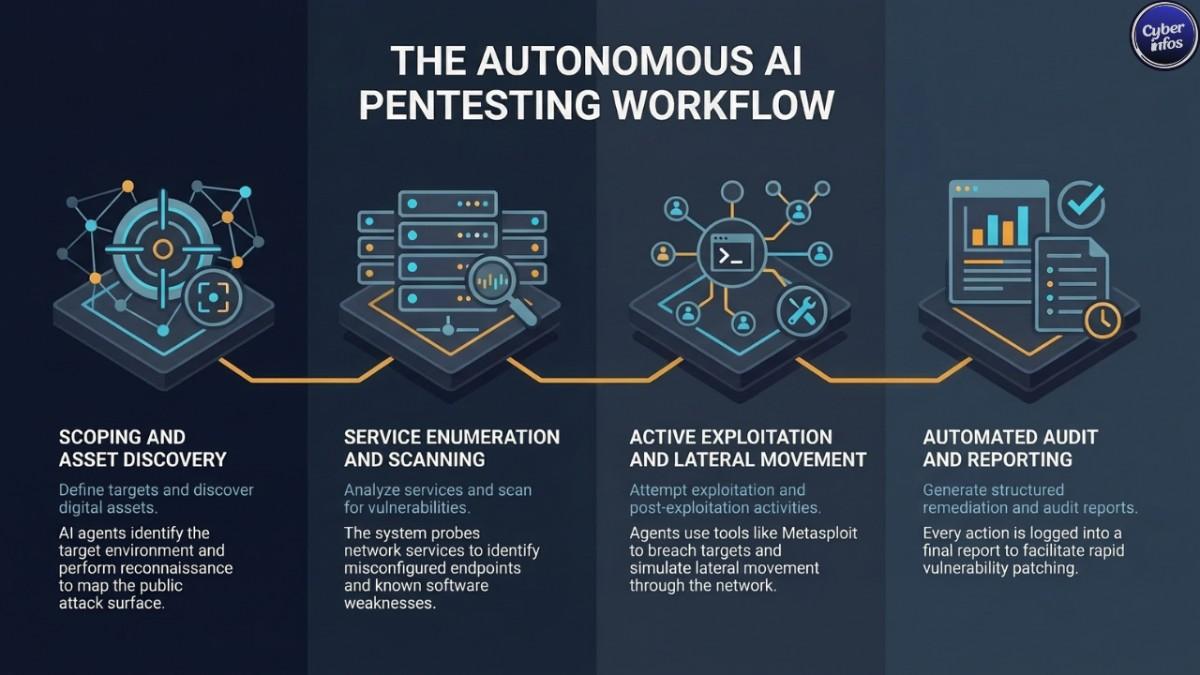
During a campaign, AI agents perform tasks such as:
- Reconnaissance and asset discovery
- Service enumeration
- Vulnerability analysis
- Exploitation attempts
- Post-exploitation activities
Every command and outcome is logged. Analysts can reconstruct the full attack chain later, step by step.
The agents can also query external intelligence sources and search providers for publicly available information about the target. Sometimes that means identifying leaked credentials. Other times it means spotting misconfigured services already visible on the public internet.
Small details often open big doors.
At the end of a campaign, PentAGI generates structured reports describing discovered vulnerabilities, exploitation evidence, and potential attack paths. Those reports can be exported or integrated into ticketing systems used by security teams to track remediation work.
Deployment Options and Security Controls
PentAGI is built primarily as a self-hosted AI pentest platform, giving organizations full control over how testing data is processed and stored.
- cloud-based AI providers
- fully local inference deployments
That flexibility makes the platform viable in regulated environments where sensitive information cannot leave internal networks.
Isolation is another key design decision.
All offensive activity runs inside sandboxed Docker containers rather than directly on the host machine. This separation reduces the risk that automated tests interfere with unrelated infrastructure or compromise the analyst’s workstation.
Enterprise deployments typically add additional guardrails, including:
- TLS encryption
- network isolation
- proxy support for outbound AI queries
- OAuth authentication integration
Those controls allow PentAGI to operate inside corporate environments where governance and auditability matter as much as technical capability.
PentAGI vs Other Automated Red Team Tools
PentAGI sits inside a fast-growing ecosystem of AI-driven security testing frameworks.
- PentestGPT
- PentestAgent
Each takes a slightly different approach to AI-assisted security work.
PentestGPT acts more like an intelligent assistant. Human testers still drive the terminal, but the system helps plan commands and interpret results. PentestAgent moves closer to automation, coordinating multiple AI agents to execute structured testing workflows.
PentAGI pushes even further.
By integrating numerous security tools, storing long-term operational memory, and modeling attack paths with knowledge graphs, the platform edges toward a fully automated AI red-team platform.
Whether that autonomy is comfortable for security teams is another question.
Benefits and Use Cases
The central advantage of PentAGI is efficiency.
Routine reconnaissance and initial vulnerability discovery can be delegated to automated agents. Human penetration testers then focus on creative attack chains, validation, and deeper analysis the parts machines still struggle with.
Continuous Security Testing
Organizations can schedule automated pentests regularly instead of relying solely on occasional manual engagements.
DevSecOps Integration
PentAGI workflows can plug into CI/CD pipelines to test new deployments automatically and surface vulnerabilities early in the development lifecycle.
Attack Surface Monitoring
Security teams can track exposed services and potential weaknesses across large infrastructures on a continuous basis.
Red-Team Simulation
Internal security groups can simulate real attack scenarios and evaluate how defensive systems respond under pressure.
For smaller organizations, automation changes the economics. Comprehensive testing becomes feasible without the cost of frequent external engagements.
Limitations and Considerations
PentAGI does not replace human penetration testers.
- defining engagement scope
- interpreting ambiguous results
- prioritizing remediation work
- ensuring testing remains legally authorized
There are also operational realities around AI usage.
Large campaigns can generate significant API costs when relying on cloud-based models. Rate limits and model latency may also slow automated testing workflows.
And then there’s reliability.
Large language models occasionally misinterpret tool output or invent reasoning steps that look plausible but are simply wrong. PentAGI’s logging and observability layers help surface those errors, though human oversight remains necessary.
Offensive security tooling always carries responsibility.
Automated penetration testing should only run against systems where explicit authorization has been granted.
The Future of AI-Powered Penetration Testing Tools
PentAGI stands as one of the more advanced open-source experiments in autonomous AI-driven red teaming.
Its blend of multi-agent orchestration, integrated security tooling, long-term memory systems, and observability infrastructure hints at how penetration testing workflows may evolve over the next few years.
Future versions of platforms like PentAGI will likely expand in several directions:
- deeper integrations with enterprise security platforms
- broader vulnerability scanning capabilities
- stronger guardrails for automated decision-making
- improved reasoning across complex attack paths
But the broader implication is harder to ignore.
If defenders begin running autonomous red-team platforms continuously inside their networks, it’s reasonable to assume attackers will eventually deploy similar systems outside them.
Which leaves a final, uncomfortable question.
When both sides have autonomous reconnaissance engines probing the same infrastructure around the clock, who adapts faster?
