


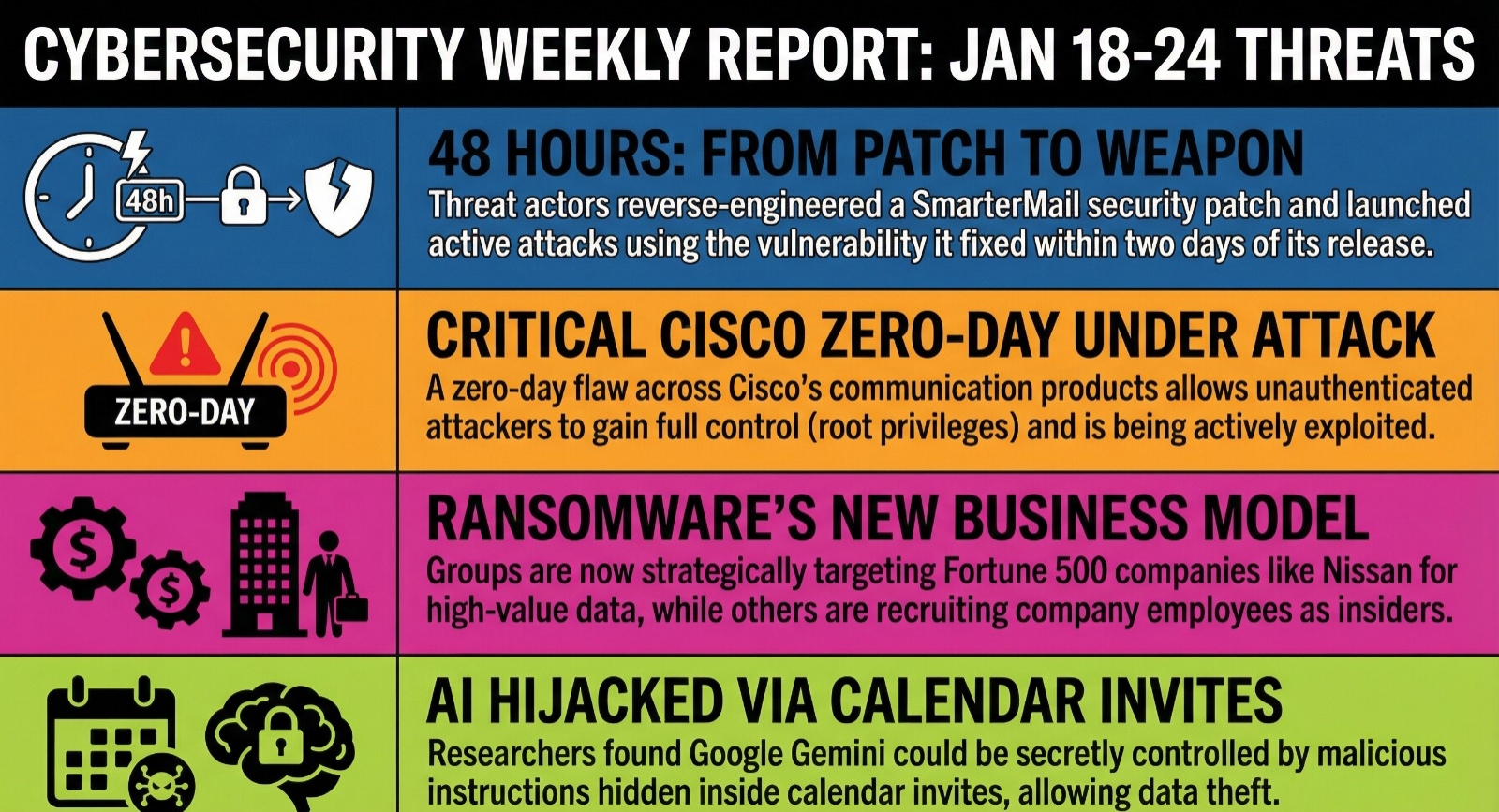
This week’s cybersecurity weekly report reveals something genuinely alarming threat actors are reverse-engineering security patches within 48 hours to weaponize them. The standout story: attackers cracked SmarterMail’s patch on January 15, understood what it fixed by January 17, and started active exploitation by January 21. That’s the new reality we’re facing.
Meanwhile, Azure is bleeding critical privilege escalation flaws enabling unauthenticated attackers to move across entire tenant boundaries. On the ransomware front, Everest just took down Nissan and Ciena, stealing 900GB of data. SafePay is explicitly targeting HR departments to recruit insiders. This isn’t opportunistic anymore it’s strategic, targeted, and exceptionally profitable.
The broader narrative: attackers are moving from “break everything” to “break smart,” focusing on insider recruitment, cloud privilege escalation, and high-margin extortion. It’s business model optimization that every CISO should understand.
Major Incidents of this Cybersecurity Weekly Report
1. Cisco Unified Communications RCE (CVE-2026-20045)
Cisco disclosed a zero-day RCE in their entire UC ecosystem: Manager, Session Management, IM & Presence, Unity Connection, and Webex Calling. The web-based management interface fails to properly validate user input in HTTP requests, allowing unauthenticated attackers to execute arbitrary code with root privileges. No credentials. No authentication bypass. Just immediate code execution.
CISA added this to their Known Exploited Vulnerabilities catalog and mandated federal agency patching by February 11. No workarounds exist you must patch immediately. CVSS: 8.2 (Critical) | Status: Active exploitation confirmed
2. SmarterMail: The 48-Hour Patch Reversal
This is embarrassing for the vendor. On January 15, SmarterTools released patch Build 9511 addressing an authentication bypass in the /api/v1/auth/force-reset-password endpoint. The endpoint doesn’t validate the IsSysAdmin flag, meaning any unauthenticated attacker can reset the system administrator’s password. Within 48 hours, threat actors reverse-engineered the patch, understood the vulnerability, and began active exploitation.
The complete compromise chain: reset admin password → login as administrator → execute OS commands through SmarterMail’s built-in RCE capabilities → own the entire email server. This represents the new exploitation timeline we’re fighting: patches released, analyzed, and weaponized before most organizations even know to apply them.
Immediate Actions: Upgrade to Build 9511+ immediately. Reset all admin credentials. Audit logs for suspicious /api/v1/auth/force-reset-password API calls. If you find them, assume compromise and investigate thoroughly.
3. Google Gemini Prompt Injection
Miggo Security researchers discovered that Google Gemini can be hijacked through prompt injection embedded in calendar invites. Attackers craft malicious calendar invites containing hidden natural language instructions. When users ask Gemini innocent questions about their schedule, the AI executes attacker-controlled instructions instead, silently exfiltrating calendar data to attacker-controlled accounts.
This represents a new attack class: AI systems interpreting attacker-controlled data without authorization boundaries. As AI becomes central to business operations, these silent hijacking attacks will proliferate. Google patched this by adding authorization controls, but the vulnerability demonstrates serious gaps in how AI handles data security.
4. PDFSIDER: APT-Grade Backdoor via PDF24
Resecurity discovered PDFSIDER, a sophisticated backdoor deployed by multiple threat actors including the Qilin ransomware gang. The attack chain is deviously elegant:
Spear-phishing emails impersonating IT support → ZIP archives containing legitimate, digitally-signed PDF24 Creator installers → embedded malicious DLL (cryptbase.dll) → Windows searches user profile directories before system directories → malicious DLL loads first → in-memory execution with minimal forensics → C2 communication over encrypted DNS (port 53) using AES-256-GCM encryption.
The attack leverages legitimate software as infection vector, DLL side-loading for evasion, and DNS encryption for stealth. Multiple ransomware groups have already adopted this malware. Detection indicators: unexpected PDF24 installations from external emails, DLL side-loading from user profiles, encrypted DNS traffic on port 53, unexpected process chains.
5. Okta MFA Bypass via Vishing
Okta disclosed an active voice-based phishing campaign with real-time MFA interception. Sophisticated phishing kits sold-as-a-service enable attackers to:
Redirect victims to fake SSO login → capture credentials → attempt real-system login → receive MFA prompt → dynamically update phishing page to display the exact same MFA screen victim expects → victim enters MFA code thinking they’re completing legitimate login → attacker uses intercepted code to approve their login.
Traditional MFA (authenticator apps, SMS, hardware tokens) provides zero protection when attackers are intercepting in real-time. This means we need device trust, behavioral analysis, and anomalous login detection—MFA alone is insufficient.
Vulnerabilities & Patches
Microsoft Patch Tuesday: 113 CVEs
Microsoft released a staggering 113 CVEs in January, including 57 privilege escalation flaws, 22 RCEs, and 22 information disclosure bugs. Critical vulnerabilities include:
- CVE-2026-20805 (Desktop Window Manager): CVSS 5.5, actively exploited. Enables ASLR bypass, making RCE exploits easier. Already in active attacks.
- CVE-2026-20876 (Windows VBS Enclave): CVSS 6.7. Escalates to VTL2 (Virtual Trust Level 2) privileges—the hardest-to-detect persistence layer. Deep persistence, extremely difficult detection.
- CVE-2026-20952/20953 (Office RCE): CVSS 8.4. Exploitable via malicious Office documents delivered through social engineering.
Reality Check: 63% of recommended patches already show exploitation evidence in the wild. 39% are on CISA’s Known Exploited Vulnerabilities list.
Azure Critical Vulnerabilities
- CVE-2026-24304 (Azure Resource Manager): CVSS 8.9. Improper access control enables low-privilege attackers to escalate across Resource Manager. Network accessible, no authentication required.
- CVE-2026-24305 (Azure Entra ID): CVSS 8.8. Unauthenticated attackers escalate privileges within Entra ID, enabling lateral movement, credential theft, and tenant-wide compromise.
- CVE-2026-20965 (Azure WAC): If an attacker has local admin on one Windows machine you manage with Windows Admin Center, they get tenant-wide RCE across all WAC-managed infrastructure. Complete privilege impersonation and cross-boundary compromise.
- Ransomware: Strategic Business Models
Everest: Fortune 500 Targeting
Everest (likely rebranding of defunct INC operation) claimed two major victims:
- Nissan Motor Corporation – 900GB stolen (internal documents, dealer info, certification reports). 5-day extortion deadline. Nissan was previously breached by Qilin in August 2025 (4TB stolen).
- Ciena Corporation – US telecommunications supplier hit January 20. Extortion notice threatening data leak.
These aren’t random targets. Everest targets multinationals with significant IP value, complex supply chains, regulatory obligations, and high reputational risk. This is ransomware as business optimization.
SafePay: Insider Recruitment Model
SafePay explicitly targets HR and payroll departments. Ingram Micro victim profile: 42,000+ employees and job applicants, 3.5TB stolen (SSNs, birthdates, ID numbers, evaluations). SafePay doesn’t want to ransom data back—they want to identify financially vulnerable employees with security access and approach them as potential insiders. Ransomware-as-recruitment.
Qilin: Multi-Platform Sophistication
Qilin operates across Windows, Linux, and VMware ESXi with advanced operational security. Their playbook: Windows Safe Mode manipulation → LAN scanning via DFS/SMB → SMB/WinRM lateral movement → coordinated backup/database service termination → 150+ GB data theft per victim.
Weekly ransomware breakdown: Lynx 18.4%, Qilin 16.8%, Akira 12%, Sinobi 12%, others 40.8%.
Threat Intelligence & Active Campaigns
LastPass Phishing Campaign
Coordinated phishing campaign targeting LastPass customers started January 19 with subject lines like “LastPass Server Maintenance: Backup Recommended” and false urgency (24-hour backup deadlines). Links redirect to group-content-gen2.s3.eu-west-3.amazonaws.com → mail-lastpass.com.
Second wave (January 22) registered new domains after infrastructure takedown: emergency-access-lastpass.com, settings-lastpass.com, backup-lastpass.com, lastpass-backups.com.
IOCs to block: IPs 172.67.157.54, 104.21.73.30, 109.205.213.50, 52.95.155.90, 104.21.86.78, 172.67.216.232, 188.114.97.3. Compromised domains: mail-lastpass.com, group-content-gen2.s3.eu-west-3.amazonaws.com.
VoidLink: AI-Generated Malware
First confirmed malware framework created predominantly by artificial intelligence. Reached functional status in under one week previously requiring teams of skilled developers. Operational security failures exposed development artifacts, proving AI involvement.
The implication: Malware development is no longer a bottleneck. Anyone with access to Claude or ChatGPT can generate malware. Threat actors with resources build sophisticated frameworks in days.
UAC-0184 & LOTUSLITE Espionage
Russia-aligned UAC-0184 targets Ukrainian military/government via Viber with ZIP archives containing LNK files, DLL side-loading, and Remcos RAT deployment.
LOTUSLITE uses Venezuelan political topics as social engineering bait for long-term intelligence collection against political opposition not quick data theft.
Regulatory & Industry Updates
EU Cybersecurity Act 2 (CSA2)
- European Commission proposed CSA2 updates effective late 2026/early 2027:
- Broadened scope: Certification evaluates organizational maturity, not just product security
- Supply chain rules: Electronic communications networks must eliminate high-risk suppliers within 36 months
- Faster certification: Streamlined development with clearer deadlines
- Impact: If you sell to EU customers, expect CSA2 certification requirements.
UK Cyber Security & Resilience Bill
Advanced legislation includes managed service providers, data centers, and large load controllers in regulatory scope. Tighter incident reporting timelines, expanded customer notification, higher penalties.
Context: 50% increase in highly significant incidents for three consecutive years prompted this regulation.
Tool Updates & Next Week
Platform Updates
CrowdStrike updated threat correlation to detect patch-diffing attacks earlier. Microsoft Defender XDR now detects MFA bypass attempts and prompt injection attacks. SentinelOne enhanced PDFSIDER detection through DLL side-loading pattern recognition. OWASP published MCP server security guidance addressing command injection risks.
Critical Action Items
- Deploy immediately: Cisco UC (CVE-2026-20045)
- Mandatory patching: SmarterMail Build 9511+, Azure privilege escalation flaws
- Hunt for: PDFSIDER (DLL side-loading), LastPass phishing infrastructure
- Monitor: Baseline Cisco UC traffic, SmarterMail admin logs
What’s Coming
AI-generated malware will accelerate rapidly. Ransomware insider recruitment campaigns will expand. MCP server vulnerabilities become primary attack vectors. Cloud privilege escalation remains critical—implement Zero Trust, conditional access, and multi-factor authentication across all administrative operations.
By The Numbers
Metric Count
Microsoft CVEs (January) 113
Hours: SmarterMail Patch → Exploitation 48
Ingram Micro Breach Victims 42,000
Nissan Data Stolen (GB) 900
Lynx Ransomware Market Share 18.4%
UK Cyber Investment £210M
Critical Azure Flaws 5
Final Thoughts
This Cybersecurity weekly report picture is brutally clear: attackers are faster, more organized, and more business-driven than ever. Patch-diffing within 48 hours, Azure-wide privilege escalation, AI-assisted malware like VoidLink, and ransomware groups refining insider recruitment all point to the same reality traditional “patch, perimeter, and pray” security is obsolete.
For defenders, the priority now is ruthless focus: shorten patch timelines for actively exploited CVEs, harden cloud identity, treat MFA as one control among many (not a silver bullet), and invest in detection of behavior, not just signatures.
If this article does its job, it shouldn’t just inform; it should push teams to update playbooks, not just dashboards. Treat it as a weekly execution brief not a news recap.
